Eurosatory 2026 Highlights Emerging Defense Technologies Shaping Global Military Transformation
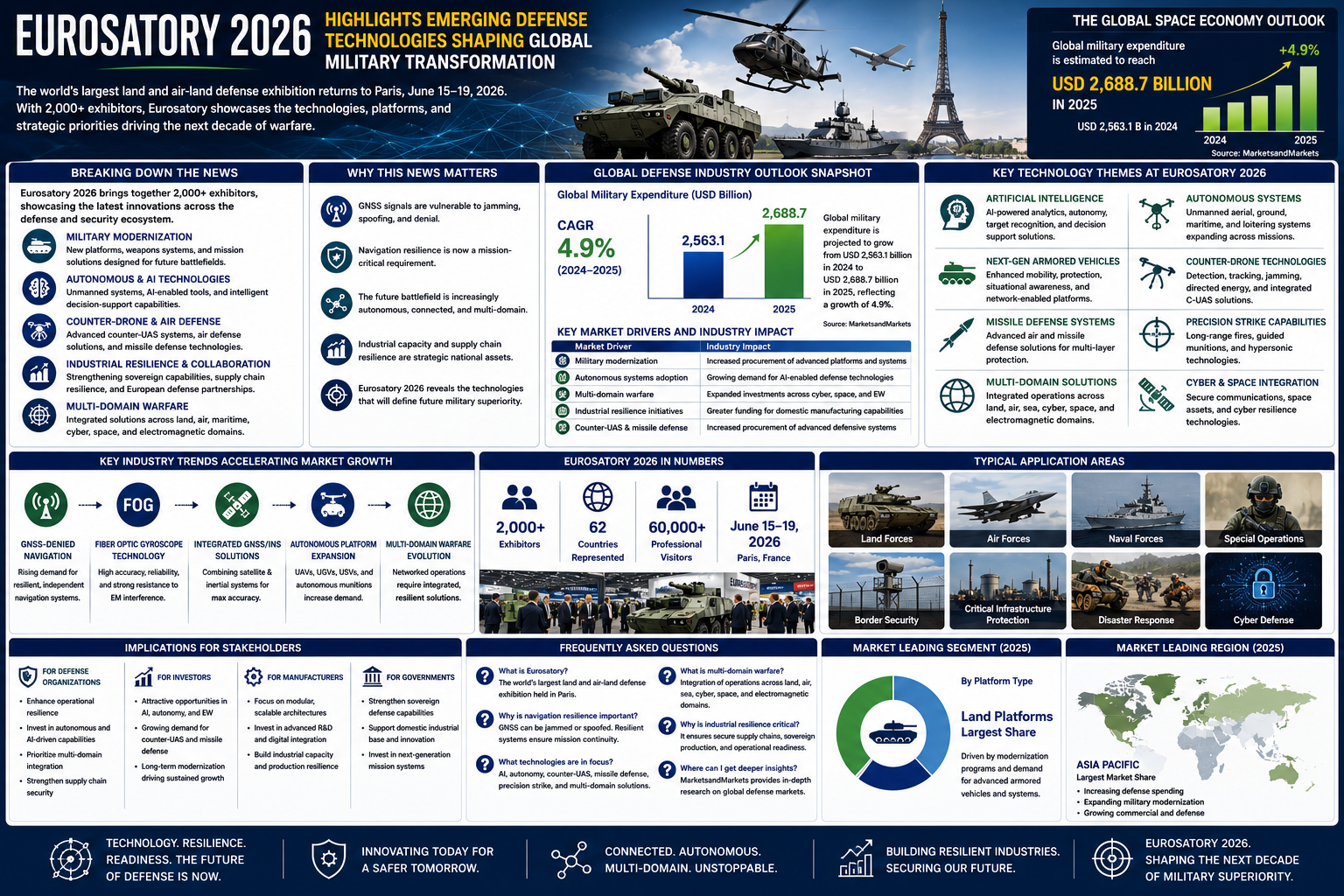
The world’s largest land and air-land defense exhibition has once again become a barometer for the future of military capability development. Eurosatory 2026, held in Paris from June 15-19, brings together more than 2,000 defense and security exhibitors, showcasing the technologies, platforms, and operational concepts expected to shape the next decade of warfare.
This year's exhibition arrives at a pivotal moment for the global defense sector. Governments worldwide are increasing military spending, accelerating modernization programs, and investing in emerging technologies designed to address evolving security challenges. Against a backdrop of geopolitical uncertainty, growing regional tensions, and rapidly changing battlefield requirements, Eurosatory has become more than a trade exhibition it has evolved into a strategic indicator of defense priorities.
The event highlights a broad spectrum of innovations, including autonomous systems, artificial intelligence-enabled military technologies, next-generation armored vehicles, missile defense systems, counter-drone capabilities, and multi-domain warfare solutions. Several collaborative European defense initiatives and new platform announcements underscore an increasingly important theme: industrial resilience and sovereign defense capability development.
For military leaders, defense contractors, investors, and policymakers, Eurosatory 2026 offers a real-time view of the forces shaping the Global Defense Industry Outlook Market. The technologies and strategic priorities showcased in Paris reflect broader trends that are influencing defense spending, procurement decisions, and future military capabilities across the world.
Breaking Down the News
Eurosatory 2026 has attracted more than 2,000 exhibitors from across the defense and security ecosystem, making it one of the most significant global gatherings for military technology and defense innovation.
Several themes have emerged as dominant priorities throughout the event:
-
Military modernization
-
Industrial resilience
-
Autonomous systems
-
Artificial intelligence in defense
-
Counter-drone technologies
-
Missile defense systems
-
Long-range precision strike capabilities
-
Multi-domain warfare
-
Cyber and space integration
-
Sovereign defense manufacturing
Numerous companies have unveiled new armored vehicle concepts, missile systems, battlefield networking solutions, and autonomous platforms designed to address evolving operational requirements.
European defense collaboration has also been a major focus, reflecting growing efforts to strengthen regional security capabilities and reduce reliance on external supply chains.
More broadly, the exhibition demonstrates how defense organizations are preparing for future conflicts characterized by technological complexity, contested environments, and multi-domain operations.
Why This News Matters Beyond the Headlines
While major defense exhibitions often generate attention through new platform announcements and technology demonstrations, the broader significance of Eurosatory 2026 lies in what it reveals about future military priorities.
The event highlights three major shifts occurring across the global defense landscape.
Defense Spending Is Becoming More Strategic
Governments are no longer investing solely in platform acquisition. Increasingly, defense budgets are being directed toward capability enhancement, resilience, and technological superiority.
Areas receiving heightened attention include:
-
Artificial intelligence
-
Autonomous systems
-
Electronic warfare
-
Cyber defense
-
Space capabilities
-
Precision strike technologies
These investments are reshaping defense procurement strategies worldwide.
Industrial Capacity Has Become a Strategic Asset
Recent geopolitical events have exposed vulnerabilities in defense supply chains and manufacturing ecosystems.
As a result, many countries are investing in:
-
Domestic production capabilities
-
Supply chain resilience
-
Strategic stockpiles
-
Defense industrial partnerships
-
Sovereign technology development
Industrial readiness is increasingly viewed as a critical component of national security.
Future Warfare Will Be Multi-Domain
The integration of land, air, maritime, cyber, and space capabilities is becoming central to military planning.
Future military success will depend on:
-
Networked operations
-
Real-time data sharing
-
Cross-domain coordination
-
Autonomous decision support
-
Integrated command architectures
Eurosatory 2026 reflects this transition toward increasingly interconnected military operations.
What This Means for the Global Defense Industry Outlook Market
The themes emerging from Eurosatory align closely with long-term trends shaping the Global Defense Industry Outlook Market.
According to MarketsandMarkets, global military expenditure is estimated at USD 2,563.1 billion in 2024 and is expected to reach USD 2,688.7 billion in 2025, representing growth of 4.9%.
This continued increase reflects sustained investment across multiple capability areas.
| Defense Trend | Market Impact |
|---|---|
| Military modernization | Increased procurement of advanced platforms and systems |
| Autonomous systems adoption | Growing demand for AI-enabled defense technologies |
| Multi-domain warfare | Expanded investments across cyber, space, and electronic warfare |
| Industrial resilience initiatives | Greater funding for domestic manufacturing capabilities |
| Counter-UAS and missile defense expansion | Increased procurement of advanced defensive systems |
The technologies showcased at Eurosatory directly support many of these market drivers.
As military organizations seek to enhance readiness and operational effectiveness, demand for advanced defense platforms and mission systems is expected to remain strong throughout the decade.
Organizations seeking deeper insights into evolving procurement priorities can explore broader developments within the Global Defense Industry Outlook Market and evaluate how emerging technologies are influencing future defense spending patterns.
Related Resource: Read about the Global Defense Industry Outlook Market: https://www.marketsandmarkets.com/Market-Reports/global-defense-industry-outlook-153569545.html
Key Industry Trends Accelerating Market Growth
Artificial Intelligence Is Becoming Central to Defense Operations
Artificial intelligence has evolved from an emerging capability to a core component of modern military planning.
Applications include:
-
Intelligence analysis
-
Battlefield decision support
-
Autonomous navigation
-
Target recognition
-
Predictive maintenance
-
Mission planning
The prominence of AI-enabled solutions at Eurosatory demonstrates the technology's growing strategic importance.
Autonomous Systems Are Expanding Across Domains
Autonomous technologies continue to gain momentum across land, air, maritime, and space environments.
Key applications include:
-
Unmanned aerial vehicles
-
Autonomous ground vehicles
-
Uncrewed maritime systems
-
Loitering munitions
-
Autonomous logistics platforms
The increasing use of these systems is driving demand for advanced sensors, communications, and mission management technologies.
Counter-UAS Technologies Are Emerging as a Major Investment Area
The proliferation of drones across military and civilian environments has elevated counter-drone capabilities to a strategic priority.
Modern counter-UAS solutions increasingly incorporate:
-
Radar systems
-
RF detection technologies
-
Artificial intelligence
-
Directed energy systems
-
Electronic warfare capabilities
Eurosatory highlights how counter-drone systems are becoming essential components of layered defense architectures.
Precision Strike Capabilities Continue to Evolve
Long-range precision fires remain a critical focus area for military modernization programs.
Investments are increasing in:
-
Precision-guided munitions
-
Hypersonic systems
-
Missile defense technologies
-
Networked targeting architectures
-
Long-range artillery systems
These capabilities enhance operational reach while improving mission effectiveness.
Defense Industrial Resilience Is Reshaping Procurement Strategies
Governments increasingly recognize that manufacturing capacity and supply chain security are strategic assets.
As a result, defense industrial base expansion has become a major policy objective.
Key initiatives include:
-
Domestic production programs
-
Strategic partnerships
-
Workforce development
-
Supply chain diversification
-
Advanced manufacturing investments
These efforts are expected to influence defense spending for years to come.
Market Implications for Stakeholders
For Defense Organizations
Military forces are increasingly prioritizing integrated capabilities that support multi-domain operations.
Future procurement strategies are likely to emphasize:
-
Autonomous systems
-
AI-enabled decision support
-
Resilient communications
-
Counter-drone technologies
-
Precision strike capabilities
Organizations capable of integrating these capabilities effectively may achieve significant operational advantages.
For Investors
Eurosatory 2026 reinforces several major investment themes across the defense sector.
Areas attracting significant attention include:
-
Artificial intelligence
-
Autonomous platforms
-
Missile defense systems
-
Cybersecurity solutions
-
Space-based military capabilities
Long-term modernization programs continue to create opportunities across these segments.
For Defense Manufacturers
The exhibition highlights increasing demand for flexible, interoperable, and scalable solutions.
Manufacturers must focus on:
-
Open architectures
-
Modular designs
-
Digital integration
-
Production scalability
-
Cross-domain interoperability
Technology leadership and industrial capacity are becoming equally important competitive differentiators.
For Governments
Governments continue to balance capability development with industrial resilience objectives.
Policy priorities increasingly include:
-
Strengthening domestic defense industries
-
Supporting innovation ecosystems
-
Expanding sovereign manufacturing capabilities
-
Enhancing military readiness
-
Building long-term technological advantages
These initiatives are expected to drive sustained investment throughout the defense sector.
Frequently Asked Questions
What is Eurosatory?
Eurosatory is one of the world’s largest international defense and security exhibitions, bringing together military organizations, defense manufacturers, technology providers, and government representatives to showcase emerging capabilities and technologies.
Why is Eurosatory 2026 significant?
The event highlights major trends shaping future military operations, including artificial intelligence, autonomous systems, multi-domain warfare, industrial resilience, missile defense, and counter-drone technologies.
What is driving growth in global defense spending?
Growth is being fueled by geopolitical tensions, military modernization programs, technological competition, national security concerns, and increasing investment in advanced defense capabilities.
What is multi-domain warfare?
Multi-domain warfare refers to the integration of military operations across land, air, maritime, cyber, and space domains to achieve coordinated operational effects.
Why are autonomous systems becoming important?
Autonomous systems enhance operational efficiency, reduce risks to personnel, support persistent surveillance, and enable new mission concepts across multiple operational environments.
What role does artificial intelligence play in defense?
AI supports intelligence analysis, autonomous operations, battlefield decision-making, logistics optimization, target recognition, and predictive maintenance applications.
Why is industrial resilience becoming a defense priority?
Recent geopolitical disruptions have highlighted the importance of secure supply chains, domestic production capabilities, and manufacturing readiness for sustaining military operations.
Where can organizations find deeper insights into global defense trends?
Industry stakeholders often rely on specialized market intelligence to evaluate procurement priorities, technology developments, competitive dynamics, spending forecasts, and emerging growth opportunities.
Looking Beyond Today's Headlines
Eurosatory 2026 offers a glimpse into the future of military capability development.
The technologies displayed in Paris reveal a defense sector increasingly focused on resilience, integration, autonomy, and technological superiority. Future military operations are expected to be faster, more connected, and more data-driven than ever before.
Several themes are likely to define the next decade:
-
AI-enabled battlefield operations
-
Autonomous combat systems
-
Multi-domain integration
-
Advanced missile defense architectures
-
Cyber and space warfare capabilities
-
Industrial resilience and sovereign production
As these trends continue to evolve, defense organizations will need to balance technological innovation with operational readiness and industrial sustainability.
The exhibition demonstrates that future military competitiveness will depend not only on advanced platforms but also on the ability to integrate emerging technologies across the entire defense ecosystem.
Future Outlook
Eurosatory 2026 reflects the rapidly evolving priorities of the global defense sector. The event highlights how military organizations are responding to changing security environments through investments in autonomous systems, artificial intelligence, counter-drone technologies, missile defense, and multi-domain warfare capabilities.
These developments align closely with broader trends shaping the Global Defense Industry Outlook Market, where rising defense spending, modernization initiatives, and industrial resilience programs continue to drive long-term growth.
For defense leaders, investors, manufacturers, and policymakers, understanding these trends will be critical to navigating future opportunities and challenges. As military technologies become increasingly interconnected and sophisticated, the defense industry is entering a new phase defined by innovation, readiness, and strategic resilience.
For readers seeking deeper insights into defense spending trends, procurement priorities, technology developments, and market opportunities, MarketsandMarkets provides comprehensive research on the Global Defense Industry Outlook Market and the forces shaping the future of global defense.
Download Sample Report: https://www.marketsandmarkets.com/pdfdownloadNew.asp?id=153569545
Explore the Global Defense Industry Outlook Market: https://www.marketsandmarkets.com/Market-Reports/global-defense-industry-outlook-153569545.html

This FREE sample includes market data points, ranging from trend analyses to market estimates & forecasts. See for yourself.
SEND ME A FREE SAMPLE






