The Rise of Attritable Drones: Why Low Cost Autonomous UAVs Are Reshaping Defense Strategies
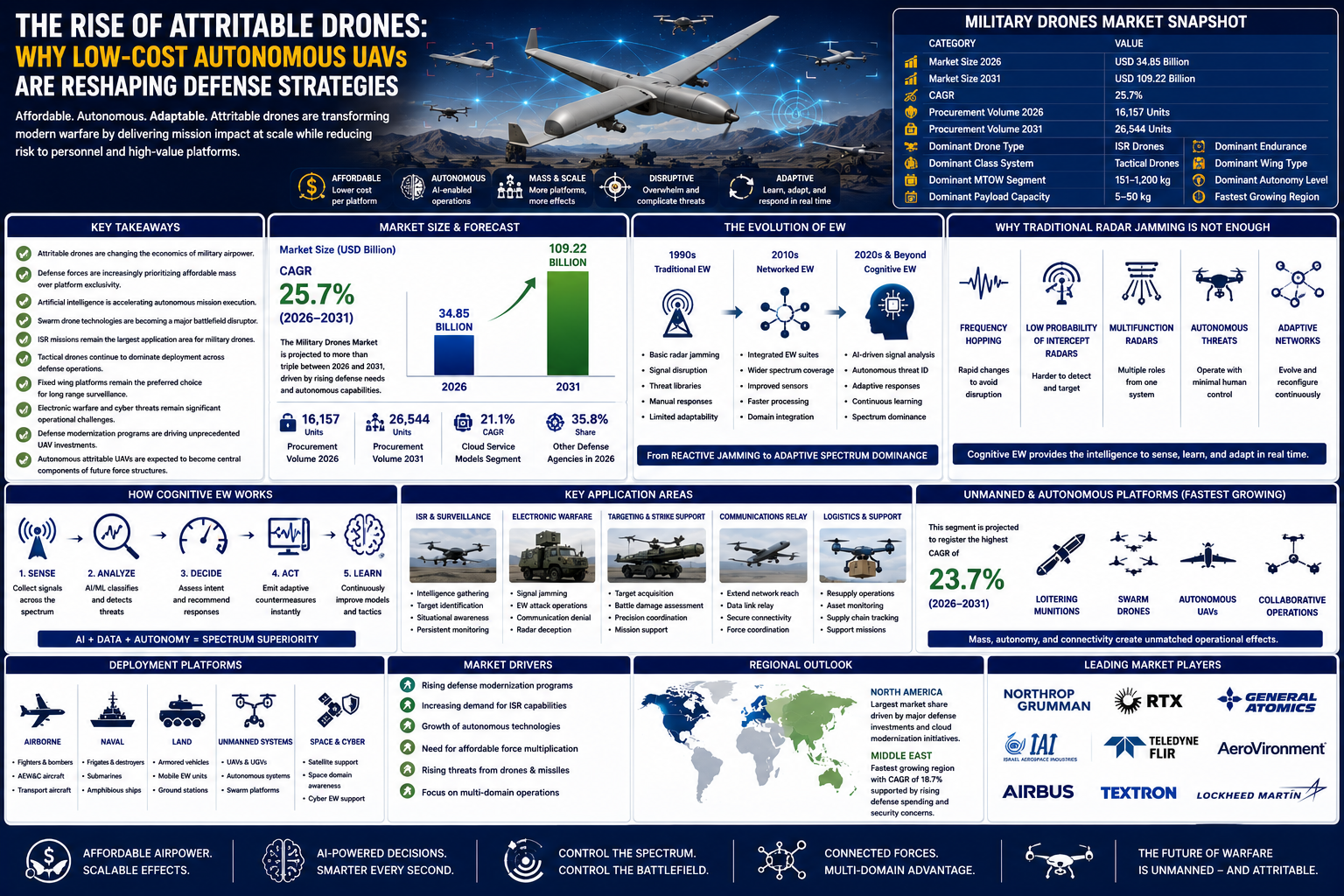
Military Drones Market Snapshot
| METRIC | DETAILS |
|---|---|
| Market Size 2026 | USD 34.85 Billion |
| Market Size 2031 | USD 109.22 Billion |
| CAGR | 25.7% |
| Procurement Volume 2026 | 16,157 Units |
| Procurement Volume 2031 | 26,544 Units |
| Dominant Drone Type | ISR Drones |
| Dominant Class System | Tactical Drones |
| Dominant MTOW Segment | 151–1,200 kg |
| Dominant Payload Capacity | 5–50 kg |
| Dominant Endurance | 5–20 Hours |
| Dominant Wing Type | Fixed Wing |
| Dominant Autonomy Level | Remotely Piloted |
| Fastest Growing Region | Middle East |
Market Size and Forecast
- Military Drones Market Size in 2026: USD 34.85 Billion
- Military Drones Market Size in 2031: USD 109.22 Billion
- CAGR from 2026 to 2031: 25.7%
- Military Drone Procurement Volume in 2026: 16,157 Units
- Military Drone Procurement Volume in 2031: 26,544 Units
- Tactical Drones Lead the Market by Class System
- ISR Drones Dominate by Drone Type
- Fixed Wing Platforms Lead by Wing Type
- Remotely Piloted Systems Dominate by Autonomy Level
- Middle East Expected to Register Fastest Regional Growth
Key Takeaways
- Attritable drones are changing the economics of military airpower.
- Defense forces are increasingly prioritizing affordable mass over platform exclusivity.
- Artificial intelligence is accelerating autonomous mission execution.
- Swarm drone technologies are becoming a major battlefield disruptor.
- ISR missions remain the largest application area for military drones.
- Tactical drones continue to dominate deployment across defense operations.
- Fixed wing platforms remain the preferred choice for long range surveillance.
- Electronic warfare and cyber threats remain significant operational challenges.
- Defense modernization programs are driving unprecedented UAV investments.
- Autonomous attritable UAVs are expected to become central components of future force structures.
Military aviation is entering a transformational era. For decades, military airpower revolved around highly sophisticated and expensive crewed aircraft designed to achieve air superiority, surveillance dominance, and precision strike capabilities. While these platforms remain essential, changing battlefield realities are forcing defense planners to reconsider how airpower should be deployed in future conflicts.
Modern conflicts increasingly demonstrate that quantity can be as important as quality. The emergence of affordable autonomous systems, advanced artificial intelligence, and swarm technologies is reshaping how military organizations think about force structures, operational risks, and battlefield effectiveness.
At the center of this shift is the rise of attritable drones. Unlike traditional high value platforms that must be protected at all costs, attritable drones are designed to be affordable enough to accept operational losses while still delivering meaningful mission outcomes. They bridge the gap between expendable systems and highly expensive strategic assets.
The Military Drones Market reflects this transformation. The market is projected to grow from USD 34.85 billion in 2026 to USD 109.22 billion by 2031, representing a CAGR of 25.7%. Procurement volume is expected to increase from 16,157 units in 2026 to 26,544 units by 2031. This growth highlights the increasing role of unmanned systems in defense modernization programs, surveillance operations, combat support missions, border security, and autonomous warfare.
Understanding Attritable Drones and Their Growing Importance
What Are Attritable Drones?
Attritable drones occupy a unique position within military aviation. They are neither disposable one time use systems nor highly expensive strategic platforms.
Instead, they are designed to be affordable enough to absorb losses during combat while remaining capable of executing sophisticated missions.
This concept allows military forces to deploy larger numbers of drones without exposing expensive crewed aircraft to unnecessary risk.
Why Militaries Are Embracing Attritable Platforms
Defense organizations increasingly recognize that future conflicts may involve highly contested environments where platform survivability cannot be guaranteed.
Attritable drones provide several advantages:
Operational Flexibility
They can be deployed aggressively in high threat areas.
Risk Reduction
They reduce the exposure of human pilots and expensive aircraft.
Force Multiplication
Large numbers of drones can support a smaller number of crewed assets.
Mission Diversity
They can perform surveillance, targeting, electronic warfare, and combat support missions.
The Shift Toward Autonomous Warfare
The growing adoption of artificial intelligence and autonomous systems is accelerating the development of attritable drone concepts. These technologies allow unmanned platforms to perform increasingly complex missions while requiring less direct human control.
Download PDF Brochure: https://www.marketsandmarkets.com/requestsampleNew.asp?id=221577711
Why Traditional Military Aviation Is Facing New Challenges
Rising Costs of Advanced Aircraft
Modern fighter aircraft, surveillance platforms, and support aircraft require enormous investments in development, procurement, maintenance, and upgrades.
As military budgets face competing priorities, defense organizations are searching for cost effective alternatives.
Increasing Battlefield Threats
Modern air defense systems are becoming more capable and widespread.
Challenges include:
Advanced Radar Networks
Providing broader detection coverage.
Integrated Air Defense Systems
Combining sensors and interceptors.
Electronic Warfare Threats
Disrupting communication and navigation systems.
Long Range Missile Systems
Increasing risk to crewed platforms.
The Need for Affordable Mass
Future conflicts may require large numbers of airborne assets operating simultaneously across vast operational areas.
Attritable drones provide a practical solution by enabling force expansion without proportional increases in cost.
The Economics of Attritable Airpower
Redefining Cost Efficiency
Traditional military aviation emphasizes technological superiority through highly capable platforms.
Attritable drones introduce a different approach by emphasizing scalable capability at lower cost.
Supporting Procurement Growth
The projected increase from 16,157 military drones in 2026 to 26,544 units by 2031 demonstrates growing demand for larger unmanned fleets.
This expansion reflects changing procurement strategies focused on increasing operational capacity.
Benefits of Affordable Airpower
Faster Production Cycles
Smaller systems can often be manufactured more rapidly.
Lower Lifecycle Costs
Maintenance and operational expenses are reduced.
Larger Inventories
Defense forces can field more assets.
Greater Operational Persistence
Higher quantities support sustained operations.
Balancing Quantity and Quality
Future force structures are increasingly expected to combine advanced crewed platforms with large numbers of attritable drones, creating a more resilient and adaptable airpower model.
Autonomous Technologies Powering Attritable Drones
Artificial Intelligence as a Force Multiplier
The military drones market is experiencing major technological shifts due to increasing adoption of AI based autonomous systems.
Artificial intelligence improves operational efficiency by supporting:
Autonomous Navigation
Allowing drones to operate with reduced human intervention.
Mission Planning
Optimizing routes and objectives.
Threat Recognition
Identifying potential hazards and targets.
Decision Support
Improving mission responsiveness.
Swarm Technologies
One of the most significant disruptions in the market is the emergence of swarm drone technologies.
Swarms allow multiple drones to coordinate activities and achieve objectives collectively.
Benefits include:
Wider Surveillance Coverage
Improved Mission Coordination
Greater Operational Resilience
Enhanced Target Saturation
Modular Payload Systems
Manufacturers are increasingly focusing on modular payload architectures that allow drones to adapt quickly to changing mission requirements.
Mission Roles Expanding Beyond Reconnaissance
ISR Remains the Dominant Segment
ISR drones dominate the military drones market because intelligence gathering and surveillance remain among the most important military requirements.
These systems support:
Battlefield Awareness
Border Monitoring
Target Identification
Mission Planning
Expanding Operational Roles
Attritable drones are increasingly being used for:
Electronic Warfare
Supporting signal monitoring and disruption.
Communications Relay
Extending network connectivity.
Target Acquisition
Supporting precision operations.
Battle Damage Assessment
Providing post mission intelligence.
Combat Support Operations
Enhancing force effectiveness.
Multi Mission Flexibility
The ability to perform diverse missions makes attritable drones valuable across multiple operational scenarios.
Drone Swarms and Collaborative Combat Operations
The Rise of Swarm Warfare
Swarm technologies represent one of the most transformative developments in modern defense operations.
Rather than relying on individual platforms, military forces can deploy coordinated groups of autonomous drones.
Advantages of Swarm Operations
Distributed Sensing
Multiple drones gather information simultaneously.
Cooperative Engagement
Assets work together toward common objectives.
Increased Survivability
The loss of individual drones does not compromise the mission.
Operational Scalability
Forces can rapidly increase drone numbers when required.
Human Machine Teaming
Future operations are expected to combine human decision making with autonomous drone execution, improving operational effectiveness while maintaining oversight.
Attritable Drones in Multi Domain Warfare
Supporting Integrated Operations
Modern warfare increasingly involves simultaneous activities across land, air, sea, cyber, and space domains.
Attritable drones support this approach through enhanced connectivity and information sharing.
Contributions Across Operational Domains
Land Operations
Supporting reconnaissance and targeting.
Naval Missions
Enhancing maritime surveillance.
Air Operations
Extending situational awareness.
Cyber Operations
Supporting network enabled warfare.
Space Enabled Missions
Leveraging satellite communications and navigation.
Strengthening Joint Operations
Autonomous drones contribute to improved coordination among military services by delivering real time intelligence and operational awareness.
Electronic Warfare and Survivability Enhancements
The Electronic Warfare Challenge
One of the major restraints facing military drone deployment involves vulnerability to electronic warfare systems and cyberattacks.
Communication disruptions can affect:
Navigation Systems
Mission Control Functions
Data Transmission
Operational Coordination
Countering Threats Through Numbers
Attritable drones offer a unique survivability advantage.
Rather than relying solely on technological protection, military forces can achieve resilience through operational mass.
Even if some drones are lost, the overall mission can continue.
Expanding Electronic Warfare Roles
Attritable drones increasingly support:
Radar Jamming
Signal Intelligence Collection
Electronic Attack Operations
Decoy Missions
Spectrum Monitoring
These capabilities strengthen operational effectiveness in contested environments.
Challenges Facing Attritable Drone Adoption
Cybersecurity Risks
As drones become more autonomous and connected, cybersecurity becomes increasingly important.
Potential threats include:
Data Interception
Signal Spoofing
Command Link Disruption
System Intrusion
Supply Chain Dependencies
Military drone production depends heavily on semiconductors, imaging sensors, and electronic components.
Supply chain disruptions can delay production schedules and impact delivery timelines.
Integration Complexity
Military organizations must integrate drones into existing command systems, communication networks, and operational doctrines.
Regulatory and Ethical Questions
Increasing autonomy raises questions regarding decision making, accountability, and operational control.
The Future of Defense Strategies in the Age of Attritable UAVs
A New Procurement Philosophy
Traditional defense procurement focused on acquiring smaller numbers of highly sophisticated platforms.
Future procurement strategies increasingly emphasize scalable fleets of autonomous systems.
Autonomous Systems Will Continue Expanding
Defense agencies are investing heavily in:
AI Enabled Mission Systems
Autonomous Navigation Technologies
Swarm Coordination Platforms
Advanced Intelligence Capabilities
The Role of Attritable Drones by 2031
As military forces continue modernization efforts, attritable drones are expected to become critical assets for surveillance, combat support, electronic warfare, targeting, and battlefield awareness.
Their ability to deliver operational effectiveness at lower cost makes them attractive solutions for future defense strategies.
The Middle East as a Growth Center
The Middle East is expected to be the fastest growing regional market due to increasing defense spending, strong demand for surveillance drones, expanding border security missions, growing investments in autonomous technologies, and rising geopolitical tensions.
Key Military Drone Industry Participants
The military drones ecosystem includes manufacturers, technology providers, system integrators, and defense organizations.
Major participants include:
- Northrop Grumman
- RTX
- General Atomics
- Israel Aerospace Industries
- Teledyne FLIR
- AeroVironment
- AIRBUS
- Textron
- Lockheed Martin
These organizations contribute to surveillance platforms, combat support systems, radar technologies, targeting solutions, communication systems, electronic warfare capabilities, and autonomous mission technologies.
Future Outlook
The rise of attritable drones represents one of the most significant shifts in military aviation since the introduction of unmanned systems. Defense organizations are increasingly recognizing that future conflicts will require a balance between advanced capabilities and operational mass.
The Military Drones Market is projected to grow from USD 34.85 billion in 2026 to USD 109.22 billion by 2031, supported by rising defense modernization programs, increasing surveillance requirements, expanding autonomous technologies, and growing demand for battlefield intelligence.
Attritable drones offer a compelling solution to many of the challenges facing modern military operations. They reduce risks to personnel, provide scalable operational capacity, support autonomous missions, and enable new concepts such as swarm warfare and collaborative combat operations.
As artificial intelligence, autonomous systems, and advanced mission technologies continue to evolve, attritable drones will play an increasingly important role in shaping future force structures. Their ability to combine affordability, flexibility, and operational effectiveness positions them as a cornerstone of next generation defense strategies.
Important FAQs
What are attritable drones?
Attritable drones are low cost unmanned aerial vehicles designed to perform valuable military missions while being affordable enough to accept potential combat losses.
Why are attritable drones becoming important?
They provide cost effective force multiplication, reduce risks to personnel, support autonomous operations, and enable large scale deployment in contested environments.
How large is the military drones market?
The military drones market is projected to grow from USD 34.85 billion in 2026 to USD 109.22 billion by 2031.
What is driving growth in military drone adoption?
Growth is driven by defense modernization programs, increasing surveillance requirements, border security operations, combat support missions, and autonomous technology investments.
Which drone type dominates the market?
ISR drones dominate the market because of their critical role in intelligence gathering and surveillance operations.
What role does artificial intelligence play in military drones?
Artificial intelligence supports autonomous navigation, mission planning, threat recognition, swarm coordination, and faster battlefield response.
What are swarm drone technologies?
Swarm technologies enable multiple drones to operate collaboratively, improving surveillance coverage, mission coordination, and operational resilience.
What challenges do military drones face?
Key challenges include electronic warfare threats, cyberattacks, communication disruptions, semiconductor shortages, and supply chain dependencies.
Which region is expected to grow the fastest?
The Middle East is expected to be the fastest growing regional market due to rising defense spending and increasing investments in autonomous defense systems.
How will attritable drones shape future warfare?
Attritable drones will support surveillance, targeting, electronic warfare, autonomous missions, swarm operations, and multi domain warfare while enabling affordable military force expansion.

This FREE sample includes market data points, ranging from trend analyses to market estimates & forecasts. See for yourself.
SEND ME A FREE SAMPLE






