How AutoFlight’s Historic Overseas eVTOL Certification Signals a Turning Point for the eVTOL Aircraft Market
The global race to commercialize electric vertical takeoff and landing (eVTOL) aircraft reached a significant milestone with AutoFlight’s announcement that its cargo-carrying eVTOL aircraft has become the first in the world to receive airworthiness validation outside its home country. The achievement represents more than a regulatory success for a single manufacturer it could mark an important step toward the international commercialization of advanced air mobility technologies.
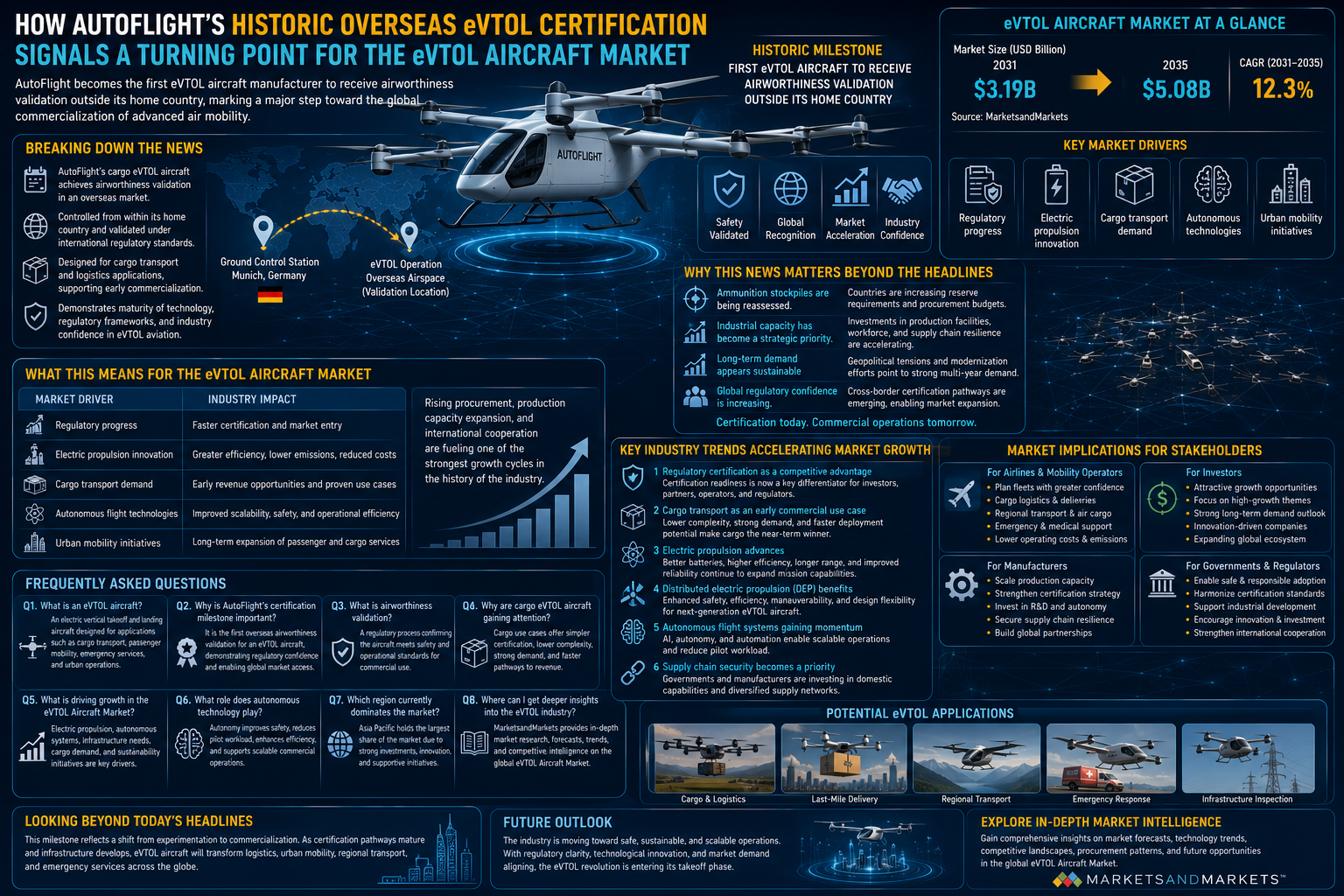
For years, the eVTOL industry has been defined by technological breakthroughs, prototype demonstrations, investment rounds, and ambitious visions of urban air mobility. Yet one of the biggest barriers to large-scale deployment has remained regulatory approval. Aircraft certification determines whether innovative designs can move beyond testing and enter commercial service.
AutoFlight’s overseas validation milestone demonstrates growing regulatory confidence in eVTOL technology and highlights the increasing maturity of the broader industry. More importantly, it provides a framework that other manufacturers may follow as they seek access to international markets.
For investors, aviation stakeholders, policymakers, and technology providers, the development offers insight into the next phase of growth within the eVTOL Aircraft Market. As certification pathways become clearer and commercial deployment accelerates, the industry may be approaching a critical inflection point that transforms advanced air mobility from a future concept into an operational reality.
Breaking Down the News
Chinese electric aircraft manufacturer AutoFlight announced that its cargo-focused eVTOL aircraft has successfully achieved airworthiness validation outside its home country, making it the first eVTOL platform globally to secure such recognition in an overseas market.
The certification milestone is significant because airworthiness validation serves as regulatory confirmation that an aircraft meets established safety and operational requirements.
The accomplishment highlights several key developments:
-
Growing maturity of eVTOL aircraft technology
-
Increased regulatory acceptance of electric aviation
-
Progress toward international market expansion
-
Validation of cargo-focused eVTOL business models
-
Advancement of commercial deployment timelines
Unlike many eVTOL projects focused primarily on passenger air taxi services, AutoFlight’s aircraft is designed for cargo transportation and logistics applications. This strategy aligns with a broader industry trend in which cargo operations are increasingly viewed as a practical pathway toward early commercialization.
The achievement also demonstrates how certification progress is becoming as important as technological innovation in determining which companies will emerge as leaders in the next generation of aviation.
Why This News Matters Beyond the Headlines
At first glance, the announcement may appear to be a regulatory accomplishment affecting only one aircraft manufacturer. In reality, the implications are much broader.
The eVTOL industry has long faced a fundamental challenge: technological readiness has often advanced faster than certification frameworks. While manufacturers have successfully demonstrated flight capabilities, obtaining regulatory approvals has remained a complex and time-consuming process.
AutoFlight’s overseas validation helps address a critical industry question:
Can eVTOL aircraft achieve international regulatory acceptance?
The answer now appears increasingly positive.
The milestone validates several important market assumptions:
-
Regulators are becoming more comfortable evaluating eVTOL platforms.
-
Cross-border certification pathways are beginning to emerge.
-
Commercial deployment timelines may accelerate.
-
Cargo operations may serve as a gateway to broader eVTOL adoption.
-
Investors may gain greater confidence in commercialization prospects.
For the broader Advanced Air Mobility (AAM) industry, certification progress is arguably more important than prototype demonstrations. Commercial success ultimately depends on regulatory approval, operational safety, and public trust.
As more aircraft receive validation and certification, industry momentum is likely to increase significantly.
What This Means for the eVTOL Aircraft Market
AutoFlight’s achievement aligns closely with major growth drivers shaping the global eVTOL Aircraft Market.
According to MarketsandMarkets, the eVTOL Aircraft Market is expected to grow from USD 3.19 billion in 2031 to USD 5.08 billion by 2035, registering a CAGR of 12.3%.
The industry is being driven by advancements in electric propulsion systems, autonomous flight technologies, lightweight materials, and increasing interest in sustainable transportation solutions.
| Market Driver | Industry Impact |
|---|---|
| Regulatory progress | Accelerates commercial deployment |
| Electric propulsion innovation | Improves efficiency and sustainability |
| Cargo transport demand | Creates early revenue opportunities |
| Autonomous flight technologies | Enhances operational scalability |
| Urban mobility initiatives | Expands future passenger applications |
AutoFlight’s certification milestone directly supports several of these trends.
Perhaps most importantly, it demonstrates that regulatory pathways are evolving alongside technological innovation. Certification progress reduces uncertainty for investors and provides greater confidence to operators considering future fleet deployments.
Industry participants monitoring emerging opportunities can gain additional insight into market developments by exploring broader trends within the eVTOL Aircraft Market.
Related Resource: Read about the eVTOL Aircraft Market: https://www.marketsandmarkets.com/Market-Reports/evtol-aircraft-market-28054110.html
Key Industry Trends Accelerating Market Growth
Regulatory Certification Is Becoming a Competitive Advantage
In the early stages of the industry, technological innovation was the primary differentiator among manufacturers.
Today, certification readiness is emerging as an equally important factor.
Companies capable of navigating complex regulatory requirements may achieve earlier market entry and secure stronger competitive positions.
Certification progress influences:
-
Investor confidence
-
Commercial partnerships
-
Fleet deployment timelines
-
Market expansion opportunities
-
Public acceptance
AutoFlight’s accomplishment demonstrates how regulatory milestones can become significant market catalysts.
Cargo Transport Is Emerging as an Early Commercial Use Case
While passenger air taxis often receive the most media attention, cargo transportation is rapidly becoming one of the most promising near-term applications for eVTOL aircraft.
Cargo-focused operations offer several advantages:
-
Simplified certification pathways
-
Lower operational complexity
-
Faster deployment potential
-
Strong logistics demand
-
Reduced public acceptance barriers
The cargo transport and last-mile delivery segment is expected to experience particularly strong growth during the forecast period.
Electric Propulsion Technologies Continue to Advance
Electric propulsion remains the foundation of the eVTOL ecosystem.
Recent innovations are improving:
-
Energy efficiency
-
Battery performance
-
Flight endurance
-
Maintenance requirements
-
Environmental sustainability
Advancements in electric propulsion systems are helping manufacturers overcome historical limitations related to range and payload capacity.
Distributed Electric Propulsion Is Enhancing Aircraft Performance
Distributed Electric Propulsion (DEP) is becoming a defining feature of many next-generation eVTOL designs.
DEP offers several benefits:
-
Improved aerodynamic efficiency
-
Enhanced safety redundancy
-
Reduced operating costs
-
Better maneuverability
-
Greater design flexibility
The technology continues to play an important role in shaping future aircraft architectures.
Autonomous Flight Systems Are Gaining Momentum
The fully autonomous segment is projected to grow rapidly as manufacturers integrate advanced automation capabilities into their aircraft.
Emerging technologies include:
-
Autonomous navigation
-
AI-assisted flight management
-
Collision avoidance systems
-
Predictive maintenance
-
Real-time mission optimization
These innovations are expected to improve operational efficiency while supporting scalable deployment models.
Market Implications for Stakeholders
For Airlines and Mobility Operators
Commercial operators are closely watching certification milestones because regulatory approval directly affects fleet planning and deployment strategies.
Successful validation programs increase confidence that commercial eVTOL operations could become viable sooner than previously expected.
Potential applications include:
-
Cargo logistics
-
Urban deliveries
-
Regional transportation
-
Emergency response
-
Medical supply transport
For Investors
Certification progress often serves as a key indicator of commercialization readiness.
AutoFlight’s achievement may strengthen investor confidence across the Advanced Air Mobility industry by demonstrating tangible progress toward revenue-generating operations.
Key investment themes include:
-
Electric aviation
-
Battery technologies
-
Autonomous systems
-
Air mobility infrastructure
-
Regulatory compliance solutions
For eVTOL Manufacturers
The milestone raises the competitive stakes across the industry.
Manufacturers must now focus not only on aircraft performance but also on:
-
Certification strategies
-
Regulatory engagement
-
International market access
-
Operational scalability
-
Supply chain readiness
Companies that achieve certification first may gain valuable first-mover advantages.
For Governments and Regulators
Regulatory agencies play a critical role in enabling the future of advanced air mobility.
AutoFlight’s overseas validation may encourage greater international cooperation among aviation authorities and help establish more standardized certification frameworks.
Such collaboration could accelerate market development while maintaining rigorous safety standards.
Frequently Asked Questions
What is an eVTOL aircraft?
An eVTOL aircraft is an electric vertical takeoff and landing vehicle designed to operate without conventional runways. These aircraft use electric propulsion systems and are being developed for applications such as passenger transportation, cargo delivery, emergency response, and urban air mobility.
Why is AutoFlight’s certification milestone important?
The achievement represents the first overseas airworthiness validation granted to an eVTOL aircraft. It demonstrates growing regulatory acceptance of eVTOL technology and could accelerate commercial deployment in international markets.
What is airworthiness validation?
Airworthiness validation is a regulatory process that confirms an aircraft meets applicable safety and operational standards. It is a critical step toward commercial operation and international market access.
Why are cargo eVTOL aircraft gaining attention?
Cargo operations often face fewer regulatory and operational challenges than passenger services. As a result, many manufacturers view cargo transportation as an effective pathway toward early commercialization and revenue generation.
What is driving growth in the eVTOL Aircraft Market?
Growth is being driven by advancements in electric propulsion, battery technology, autonomous flight systems, lightweight materials, sustainability initiatives, and increasing investment in urban and advanced air mobility solutions.
What role does autonomous technology play in eVTOL development?
Autonomous systems improve operational efficiency, reduce pilot workload, enhance safety, and support scalable deployment models. Many manufacturers view autonomy as a key component of future commercial operations.
Which region currently dominates the eVTOL market?
Asia Pacific currently represents the largest share of the market, supported by strong investments, government initiatives, technological innovation, and growing commercial deployment activity.
Where can organizations find deeper insights into the eVTOL industry?
Industry participants often rely on specialized market intelligence to evaluate certification trends, technology developments, competitive positioning, regulatory frameworks, and future growth opportunities within the rapidly evolving eVTOL ecosystem.
Looking Beyond Today's Headlines
AutoFlight’s certification milestone may ultimately represent one of the clearest indicators yet that the eVTOL industry is transitioning from experimentation to commercialization.
The next phase of market development will likely be defined by regulatory approvals, operational deployments, infrastructure expansion, and customer adoption rather than prototype demonstrations alone.
As certification pathways mature and more aircraft enter service, advanced air mobility concepts could begin transforming logistics networks, urban transportation systems, and regional mobility solutions.
The industry still faces challenges related to infrastructure, battery performance, public acceptance, and regulatory harmonization. However, milestones such as this demonstrate that meaningful progress is being made across multiple fronts simultaneously.
The path toward commercial eVTOL operations remains complex, but it is becoming increasingly visible.
Future Outlook
AutoFlight’s achievement of the world’s first overseas airworthiness validation for an eVTOL aircraft represents a significant milestone for the emerging advanced air mobility ecosystem. The development demonstrates growing regulatory confidence in electric aviation technologies and highlights the increasing maturity of certification frameworks that will be essential for large-scale commercialization.
Beyond the immediate achievement, the announcement validates broader trends driving growth across the eVTOL Aircraft Market, including electric propulsion innovation, autonomous flight capabilities, cargo transport expansion, and increasing international regulatory collaboration.
For investors, operators, manufacturers, and policymakers, the milestone offers a valuable indication of how quickly the industry is progressing toward commercial deployment. As certification barriers continue to be addressed, the market may enter a new phase characterized by accelerating adoption and expanding operational opportunities.
For readers seeking deeper analysis of technology trends, market forecasts, competitive developments, and growth opportunities, MarketsandMarkets provides comprehensive research covering the global eVTOL Aircraft Market and the forces shaping the future of advanced air mobility.
Download Sample Report: https://www.marketsandmarkets.com/pdfdownloadNew.asp?id=28054110
Explore the eVTOL Aircraft Market: https://www.marketsandmarkets.com/Market-Reports/evtol-aircraft-market-28054110.html

This FREE sample includes market data points, ranging from trend analyses to market estimates & forecasts. See for yourself.
SEND ME A FREE SAMPLE






