Germany Access Control Market
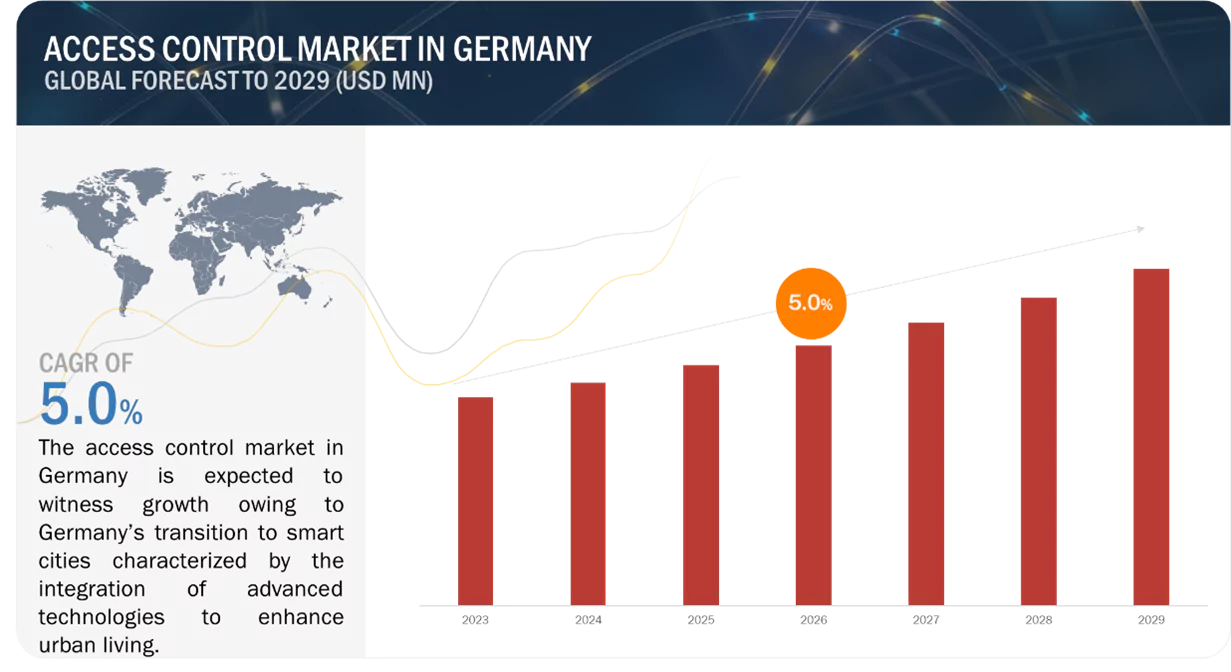
Germany is among the leading countries in the access control market in the Europe. The healthcare, financial, and retail verticals in Germany have witnessed incremental investments to develop high-quality facilities and ensure the progress of the country. The Retail, BFSI, and healthcare sectors require increased levels of security, which spikes the demand for access control systems. The installation of efficient security systems and enforcement of privacy laws across the country have augmented the demand for home security systems in Germany. Several German companies have already started deploying more biometric surveillance systems and other advanced security systems to ensure improved safety and security.
Germany’s Industry 4.0: Innovation and Technology
Germany is continuously working towards revolutionizing a better, faster, and smarter Germany. According to an article on October 2024, Industrie 4.0 is the central focus of the Federal Government’s Digital Agenda, the Ministry for Economic Affairs and Energy has funded nearly USD 105.7 million to two programmes – ‘Autonomics for Industrie 4.0’ and ‘Smart Service World’ – to foster research and innovation in relevant fields. With the rise of the Internet of Things (IoT) has led to the development of smart access control systems that offer enhanced connectivity and management capabilities. Such systems offer remote monitoring and control and thus are more efficient and user-friendly in a smart manufacturing environment. Moreover, the shift towards cloud-based access control systems also provides scalability and flexibility, allowing organizations to manage access permissions and monitor security events from anywhere. This is very beneficial for companies adopting Industry 4.0 practices that require real-time data access and management.
German Cities are at the Forefront of the Smart City Revolution
Germany's transition to Smart Cities is significantly driving the market for access control systems. This transformation is characterized by the integration of advanced technologies that enhance urban living, security, and operational efficiency. According to the digital association Bitkom, 2024, recently unveiled the Smart City Index for the sixth time, showcasing the ranking of the most intelligent German cities. Where the top three cities Munich, Hamburg and Cologne ranked as the most digital large cities in Germany. Smart cities leverage Internet of Things (IoT) technologies to create interconnected systems that improve city management and public safety. Access control systems integrated with IoT allow for real-time monitoring and management of entry points in public buildings, transportation hubs, and residential areas. Moreover, the use of data analytics in smart cities enables more informed decisions regarding security measures. Access control systems can analyze patterns and usage data to optimize security protocols.
Impact of AI on Access Control Market in Germany
Artificial intelligence is reshaping the Germany access control market by enhancing efficiency and improving user experience. AI-powered access control systems offer enhanced security and have higher efficiency. For instance, AI enhances biometric authentication methods such as facial recognition and fingerprint scanning. These technologies improve the accuracy of identity verification, making it more difficult for unauthorized individuals to gain access. AI algorithms can quickly process biometric data, ensuring a seamless user experience while maintaining high security standards. Integrating AI with access control can personalize access control by tailoring access permissions to individual users based on their roles, responsibilities, and real-time needs.
Challenges for Access Control Market in Germany
Despite its potential, the Germany access control market faces significant challenges. High installation, maintenance, and ownership cost remain a barrier, the implementation of access control systems often requires significant upfront costs, including hardware, software, installation, and ongoing maintenance expenses. This can be a barrier for many organizations, particularly small and medium-sized enterprises (SMEs). Moreover, system incompatibility is another significant challenge faced during integration as different access control systems use different protocols and technologies, making integration a challenge. Integrating access control systems with other security systems or building management platforms is complex and requires specialized expertise. This increases the costs and implementation time.
Related Report
Access Control Market by Offering (Hardware-Card-based, Biometric, & Multi-technology Readers, Electronics Locks, Controllers; Software; Services), ACaaS (Hosted, Managed, Hybrid), Vertical and Region - Global Forecast to 2029
Contact:
Mr. Rohan Salgarkar
MarketsandMarkets™ INC.
1615 South Congress Ave.
Suite 103
Delray Beach, FL 33445
USA : 1-888-600-6441
[email protected]

This FREE sample includes market data points, ranging from trend analyses to market estimates & forecasts. See for yourself.
SEND ME A FREE SAMPLE






