How Rapid Advances in Counter-Drone Technologies Are Accelerating Growth in the Counter-Unmanned Aircraft System (C-UAS) Market
The nature of aerial warfare is undergoing a profound transformation. Once considered niche battlefield assets, unmanned aerial systems (UAS) have become central components of modern military operations. From reconnaissance and intelligence gathering to precision strikes and swarm attacks, drones are increasingly shaping the outcome of conflicts around the world. As their use expands, so does the urgency of developing effective defenses against them.
A recent report highlighting the growing traction of counter-drone technologies illustrates how rapidly military priorities are evolving. The emergence of Ukraine’s Sting interceptor drone and Russia’s Yolka system demonstrates two competing approaches to kinetic drone interception, both designed to address a common challenge: how to stop increasingly sophisticated and inexpensive unmanned threats at scale.
The growing prevalence of drone swarms, loitering munitions, and mass aerial attacks is forcing military organizations to rethink traditional air defense architectures. Instead of relying solely on conventional missile defense systems, armed forces are increasingly investing in layered counter-drone capabilities that combine detection, tracking, electronic warfare, and hard-kill interception technologies.
This shift is creating significant momentum across the Counter-Unmanned Aircraft System (C-UAS) Market. As governments, critical infrastructure operators, and homeland security agencies seek effective protection against evolving aerial threats, demand for advanced counter-drone solutions is accelerating worldwide.
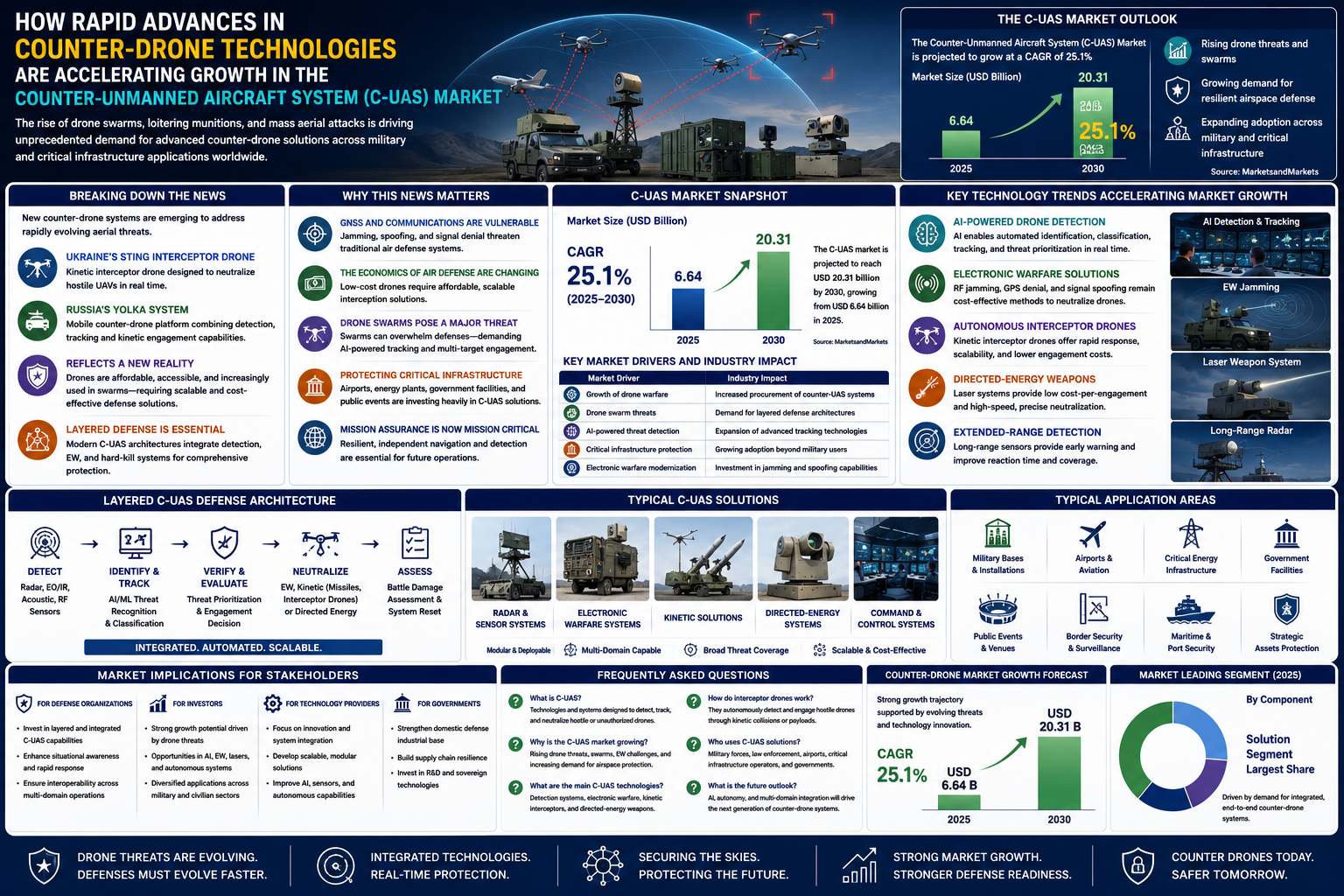
Breaking Down the News
The latest developments in counter-drone technology highlight how military organizations are adapting to a rapidly changing threat environment.
The article focuses on two notable systems:
-
Ukraine’s Sting interceptor drone
-
Russia’s Yolka counter-drone platform
Both systems represent kinetic approaches to drone defense, where unmanned systems themselves are used to intercept and neutralize hostile drones.
The emergence of these solutions reflects several broader realities:
-
Drones are becoming increasingly affordable and accessible.
-
Drone swarms can overwhelm traditional air defense systems.
-
Electronic warfare alone may not be sufficient against all threats.
-
Militaries require scalable and cost-effective interception methods.
-
Layered counter-drone architectures are becoming essential.
The rapid pace of innovation demonstrates that counter-UAS capabilities are no longer viewed as supplementary defense assets. They are increasingly becoming core components of national security and military modernization strategies.
Why This News Matters Beyond the Headlines
The significance of these developments extends well beyond the introduction of new counter-drone systems.
Modern conflicts have demonstrated that drones can create disproportionate battlefield effects relative to their cost. Relatively inexpensive unmanned systems are now capable of:
-
Conducting surveillance missions
-
Delivering precision strikes
-
Coordinating artillery fire
-
Disrupting logistics operations
-
Saturating air defense networks
This asymmetry is reshaping defense spending priorities.
The Economics of Air Defense Are Changing
Traditional missile defense systems often use expensive interceptors to engage low-cost drones.
This creates a challenging cost imbalance.
Counter-drone technologies seek to address this problem by providing:
-
Lower-cost interception options
-
Scalable deployment models
-
Rapid response capabilities
-
Greater operational flexibility
As drone threats continue to evolve, affordability is becoming as important as effectiveness.
Drone Swarms Are Driving New Defense Requirements
The rise of coordinated drone swarm attacks presents a unique challenge.
Unlike traditional aerial threats, swarms can involve dozens or even hundreds of unmanned systems operating simultaneously.
This requires:
-
Advanced threat detection
-
AI-powered tracking
-
Automated threat prioritization
-
Multi-target engagement capabilities
The need to counter swarms is becoming one of the strongest drivers of innovation in the Counter Drone Market.
Protection of Critical Infrastructure Is Expanding Demand
Counter-drone technologies are no longer limited to military applications.
Increasingly, organizations responsible for:
-
Airports
-
Energy facilities
-
Government buildings
-
Transportation hubs
-
Public events
are investing in anti-drone security systems to mitigate growing risks.
This expansion is broadening the addressable market significantly.
What This Means for the Counter-Unmanned Aircraft System (C-UAS) Market
The rapid advancement of counter-drone technologies aligns closely with major growth drivers shaping the global Counter-Unmanned Aircraft System (C-UAS) Market.
According to MarketsandMarkets, the Counter-Unmanned Aircraft System (C-UAS) Market is projected to grow from USD 6.64 billion in 2025 to USD 20.31 billion by 2030, registering a CAGR of 25.1%.
This remarkable growth reflects the increasing urgency of addressing evolving unmanned aerial threats.
| Market Driver | Industry Impact |
|---|---|
| Growth of drone warfare | Increased procurement of counter-UAS systems |
| Drone swarm threats | Demand for layered defense architectures |
| AI-powered threat detection | Expansion of advanced tracking technologies |
| Critical infrastructure protection | Growing adoption beyond military users |
| Electronic warfare modernization | Increased investment in jamming and spoofing capabilities |
The developments highlighted by Ukraine’s Sting and Russia’s Yolka systems reinforce many of these trends.
Organizations seeking deeper insights into industry developments can explore broader trends within the Counter-Unmanned Aircraft System (C-UAS) Market and evaluate how emerging technologies are reshaping modern air defense strategies.
Related Resource: Read about the Counter-Unmanned Aircraft System (C-UAS) Market: https://www.marketsandmarkets.com/Market-Reports/counter-cuas-systems-market-4197284.html
Key Industry Trends Accelerating Market Growth
AI-Powered Drone Detection Is Becoming Essential
Artificial intelligence is rapidly becoming a cornerstone of next-generation counter-drone systems.
AI enables:
-
Automated threat identification
-
Real-time classification
-
Behavioral analysis
-
Threat prioritization
-
Faster response times
As drone activity increases, AI-powered systems are becoming critical for managing large volumes of aerial threats.
Electronic Warfare Solutions Continue to Expand
Electronic warfare remains one of the most widely deployed approaches to drone defense.
Common capabilities include:
-
RF jamming
-
GPS denial
-
Signal spoofing
-
Communications disruption
These technologies offer cost-effective methods for neutralizing many drone threats without physical engagement.
Autonomous Interceptor Drones Are Emerging
The rise of systems such as Sting highlights growing interest in autonomous interceptor drones.
These platforms provide several advantages:
-
Lower engagement costs
-
Rapid deployment
-
Scalability
-
Improved mobility
-
Flexible mission profiles
Autonomous interceptors are expected to become increasingly important within layered defense architectures.
Directed-Energy Weapons Are Moving Toward Operational Deployment
Laser systems and other directed-energy technologies are gaining momentum as future counter-drone solutions.
Potential benefits include:
-
Low cost per engagement
-
High engagement speed
-
Minimal logistical burden
-
Precision targeting
Although still evolving, directed-energy systems are expected to play a larger role in future anti-drone defense strategies.
Extended-Range Detection Is Becoming a Priority
The extended-range segment is projected to dominate the market due to growing demand for earlier threat detection and engagement.
Long-range systems provide:
-
Improved situational awareness
-
Greater reaction time
-
Expanded coverage areas
-
Enhanced operational flexibility
As drone ranges increase, extended-range counter-UAS capabilities are becoming increasingly important.
Market Implications for Stakeholders
For Defense Organizations
Military forces are prioritizing layered counter-drone architectures capable of addressing diverse threat types.
Future procurement strategies are likely to emphasize:
-
AI-enabled detection systems
-
Autonomous interceptors
-
Electronic warfare capabilities
-
Integrated command-and-control platforms
-
Multi-layered defense networks
For Investors
The rapid evolution of drone warfare is creating attractive opportunities across the Counter-UAS Market.
Key investment areas include:
-
Drone detection technologies
-
AI-powered defense systems
-
Electronic warfare platforms
-
Directed-energy weapons
-
Autonomous interceptor drones
The market’s projected growth reflects strong long-term demand fundamentals.
For Technology Providers
Manufacturers are increasingly focused on delivering interoperable and scalable solutions.
Competitive differentiation is likely to depend on:
-
Detection accuracy
-
System integration
-
Response speed
-
Scalability
-
Cost efficiency
Innovation remains a critical driver of market success.
For Governments and Homeland Security Agencies
Governments are expanding investments in counter-drone capabilities to protect both military and civilian assets.
Key priorities include:
-
Airspace security
-
Infrastructure protection
-
Border surveillance
-
Event security
-
National resilience
Counter-drone systems are becoming an increasingly important component of homeland security strategies.
Frequently Asked Questions
What is a Counter-Unmanned Aircraft System (C-UAS)?
A Counter-Unmanned Aircraft System is a technology or integrated solution designed to detect, track, identify, and neutralize hostile or unauthorized drones.
Why is the C-UAS Market growing so rapidly?
Growth is being driven by the increasing use of drones in military conflicts, the emergence of drone swarms, rising security concerns, and expanding investments in airspace protection technologies.
What are drone swarm threats?
Drone swarms involve multiple unmanned systems operating together in a coordinated manner. These attacks can overwhelm traditional defenses and require advanced counter-drone capabilities.
How do electronic warfare solutions counter drones?
Electronic warfare systems disrupt drone communications, navigation signals, or control links through jamming and spoofing technologies, preventing effective operation.
What role does AI play in counter-drone systems?
AI helps identify, classify, track, and prioritize aerial threats in real time, improving detection accuracy and response effectiveness.
Why are autonomous interceptor drones gaining attention?
Autonomous interceptor drones provide cost-effective and scalable methods for physically engaging hostile drones, particularly in swarm scenarios.
Which sectors are adopting counter-drone technologies?
Defense organizations, airports, energy facilities, critical infrastructure operators, government agencies, and public event organizers are increasingly deploying counter-drone systems.
Where can organizations find deeper insights into C-UAS market trends?
Industry stakeholders often rely on specialized market intelligence to evaluate technology developments, procurement strategies, competitive dynamics, and future growth opportunities.
Looking Beyond Today's Headlines
The growing prominence of systems such as Sting and Yolka reflects a broader transformation underway in military air defense.
Future battlefields are expected to feature increasing numbers of autonomous aerial systems operating across multiple domains. As drones become more capable and more affordable, the challenge of defending against them will only intensify.
Several trends are likely to shape the next decade:
-
AI-enabled threat management
-
Autonomous interception systems
-
Directed-energy weapons
-
Integrated electronic warfare solutions
-
Multi-layered air defense architectures
The organizations that successfully combine these capabilities into cohesive defense ecosystems will be best positioned to address future unmanned threats.
Counter-drone technology is rapidly evolving from a niche capability into a foundational element of modern security strategy.
Future Outlook
The rapid advancement of counter-drone technologies highlighted by developments such as Ukraine’s Sting interceptor drone and Russia’s Yolka system underscores the growing importance of defending against unmanned aerial threats. As drone warfare evolves, military organizations are increasingly investing in layered defense architectures that combine detection, tracking, electronic warfare, and kinetic interception capabilities.
These developments align closely with broader trends shaping the Counter-Unmanned Aircraft System (C-UAS) Market, where rising drone threats, AI-powered detection technologies, electronic warfare modernization, and autonomous interception systems are driving significant growth.
For defense organizations, investors, technology providers, and policymakers, understanding these trends will be essential for navigating future security challenges. The continued evolution of drone warfare ensures that counter-UAS capabilities will remain among the highest-priority investment areas across the global defense sector.
For readers seeking deeper insights into market forecasts, technology developments, competitive dynamics, and growth opportunities, MarketsandMarkets provides comprehensive research on the global Counter-Unmanned Aircraft System (C-UAS) Market and the forces shaping its future.
Download Sample Report: https://www.marketsandmarkets.com/pdfdownloadNew.asp?id=4197284
Explore the Counter-Unmanned Aircraft System (C-UAS) Market: https://www.marketsandmarkets.com/Market-Reports/counter-cuas-systems-market-4197284.html

This FREE sample includes market data points, ranging from trend analyses to market estimates & forecasts. See for yourself.
SEND ME A FREE SAMPLE






