From Ukraine to Indo-Pacific: How Real-World Conflicts Are Accelerating Military Drone Adoption
Key Takeaways
-
The Military Drones Market is projected to grow from USD 34.85 billion in 2026 to USD 109.22 billion by 2031 at a CAGR of 25.7%.
-
Military drone procurement is expected to increase from 16,157 units in 2026 to 26,544 units by 2031.
-
The Middle East accounted for the largest market share at 41.9% in 2025 and is expected to remain a major growth region.
-
Fully autonomous drones are projected to register the fastest growth rate among autonomy segments.
-
Fuel cell powered drones are expected to record the highest growth among propulsion technologies.
-
AI enabled autonomous systems and swarm technologies are transforming military operations.
-
ISR drones remain the dominant drone type across defense applications.
-
Border security, surveillance missions, and combat support operations continue to drive adoption.
-
Military modernization programs are accelerating investments in unmanned systems worldwide.
-
Defense organizations are increasingly integrating drones into intelligence, reconnaissance, targeting, and battlefield monitoring operations.
Frequently Asked Questions
Why is the Military Drones Market growing so rapidly?
Rising defense spending, increasing surveillance requirements, military modernization programs, and growing adoption of autonomous systems are driving market growth.
How are real world conflicts influencing military drone adoption?
Recent conflicts have demonstrated the effectiveness of drones for intelligence gathering, surveillance, targeting, electronic warfare support, and combat operations.
What role does AI play in military drone systems?
AI enables autonomous navigation, target recognition, swarm coordination, mission execution, and real time decision support.
Which drone segment dominates the market?
ISR drones dominate the market because of their critical role in intelligence gathering and battlefield awareness.
Which region represents the largest opportunity?
The Middle East currently leads the market and continues to experience strong growth due to rising defense investments and regional security requirements.
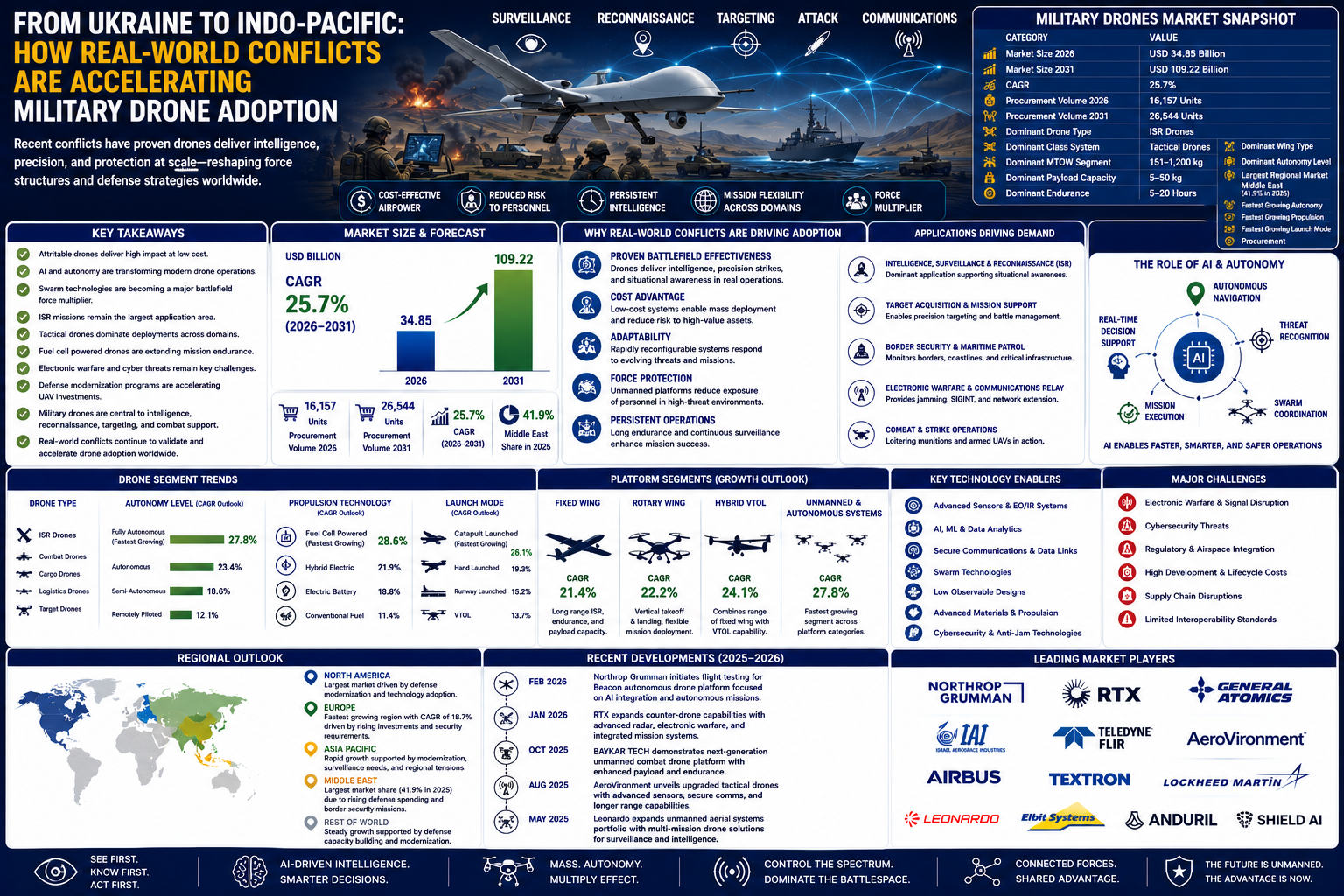
Executive Brief: The Battlefield Lessons Driving a Global Drone Revolution
Military history often reveals which technologies will define the next era of warfare. Over the last decade, few technologies have demonstrated their battlefield impact as clearly as military drones.
From surveillance missions over contested territories to autonomous strike operations and battlefield intelligence gathering, drones have transformed how military forces operate. Recent conflicts have accelerated this transition. Military planners across the world are closely analyzing how unmanned systems are changing battlefield dynamics, force structures, and operational decision making.
The lessons emerging from modern conflicts extend far beyond individual engagements. They are influencing procurement priorities, modernization strategies, defense budgets, and technology investments across major military powers.
As a result, the Military Drones Market is projected to grow from USD 34.85 billion in 2026 to USD 109.22 billion by 2031, representing a CAGR of 25.7%.
This remarkable growth reflects a broader shift toward autonomous systems, artificial intelligence driven operations, advanced intelligence gathering, and persistent battlefield awareness. Military drones are no longer viewed as supplementary assets. They are becoming central components of modern military operations.
Explore Comprehensive Military Drones Market Intelligence
Organizations seeking detailed forecasts, competitive analysis, technology trends, and regional opportunities can access the complete Military Drones Market report.
Read Full Report: https://www.marketsandmarkets.com/Market-Reports/military-drone-market-221577711.html
Download Sample Report: https://www.marketsandmarkets.com/requestsampleNew.asp?id=221577711
Military Drones Market at a Glance
| Metric | Value |
|---|---|
| Market Size 2026 | USD 34.85 Billion |
| Market Size 2031 | USD 109.22 Billion |
| CAGR | 25.7% |
| Procurement Volume 2026 | 16,157 Units |
| Procurement Volume 2031 | 26,544 Units |
| Largest Regional Market | Middle East |
| Fastest Growing Autonomy Segment | Fully Autonomous |
| Fastest Growing Propulsion Technology | Fuel Cell Powered |
| Fastest Growing Launch Mode | Catapult Launched |
The rapid expansion of procurement volumes highlights the growing importance of drones across intelligence, surveillance, combat support, and border security operations.
Why Modern Conflicts Are Accelerating Military Drone Investments
The evolution of military drones is closely linked to changes in the nature of warfare itself.
Modern military operations increasingly require persistent surveillance, rapid intelligence collection, precision targeting, and operational flexibility. Drones provide these capabilities while reducing risk to personnel.
Real Time Intelligence Has Become a Strategic Asset
Military commanders increasingly depend on real time battlefield information.
Drones support:
-
Persistent surveillance
-
Intelligence gathering
-
Target identification
-
Threat monitoring
-
Mission planning
-
Battle damage assessment
This capability is becoming essential in modern operational environments.
Operational Agility Is Driving Adoption
Unlike traditional manned platforms, drones can often be deployed rapidly and adapted for different mission requirements.
Their flexibility supports a wide range of military activities, including border security, reconnaissance, electronic warfare support, and combat operations.
Artificial Intelligence Is Reshaping Military Drone Operations
One of the most significant developments in the Military Drones Market is the integration of artificial intelligence.
Military organizations increasingly view AI as a force multiplier that enhances operational effectiveness while reducing response times.
Autonomous Mission Execution
AI enables drones to perform increasingly complex tasks.
Capabilities include:
-
Autonomous navigation
-
Route optimization
-
Object recognition
-
Threat detection
-
Mission adaptation
-
Swarm coordination
These technologies reduce operator workload while improving mission performance.
Swarm Technologies Gain Momentum
Swarm drone technologies are emerging as one of the most disruptive developments in defense.
Multiple autonomous platforms can coordinate activities, share information, and execute missions collectively.
Benefits include:
-
Wider surveillance coverage
-
Improved mission resilience
-
Faster intelligence collection
-
Enhanced operational flexibility
The growing adoption of swarm technologies is creating significant opportunities for drone manufacturers and defense organizations.
ISR Drones Continue to Dominate Military Operations
ISR drones remain the largest drone type segment because they provide critical intelligence capabilities across military operations.
Intelligence Gathering Drives Demand
ISR drones support:
-
Border monitoring
-
Surveillance operations
-
Reconnaissance missions
-
Target identification
-
Threat assessment
Military organizations continue expanding ISR capabilities to improve situational awareness and operational planning.
Persistent Surveillance Changes Decision Making
Unlike traditional surveillance assets, drones can provide continuous monitoring over extended periods.
This capability improves battlefield awareness and supports faster operational decisions.
Download Detailed ISR and Military Drone Forecasts
Download PDF Brochure: https://www.marketsandmarkets.com/pdfdownloadNew.asp?id=221577711
Autonomous Systems Represent the Next Growth Frontier
While remotely piloted systems currently dominate the market, fully autonomous drones are expected to record the fastest growth rate through 2031.
Why Autonomy Matters
Autonomous systems offer several advantages:
-
Reduced operator workload
-
Faster response times
-
Enhanced operational efficiency
-
Greater mission scalability
-
Improved survivability
As AI technologies mature, military organizations are expected to expand autonomous drone deployments significantly.
The Future Battlefield Will Be Increasingly Autonomous
Future military operations are likely to involve greater collaboration between manned and unmanned systems.
This trend is driving investments in autonomous technologies, mission management systems, and AI enabled decision support capabilities.
Fuel Cell Technologies Are Extending Drone Endurance
Fuel powered systems currently dominate the market due to their ability to support longer missions.
However, fuel cell powered drones are projected to register the highest growth rate during the forecast period.
Longer Endurance Creates Operational Advantages
Fuel cell technologies can support:
-
Extended surveillance missions
-
Greater operational range
-
Reduced logistics requirements
-
Improved mission persistence
These benefits are attracting growing interest from defense agencies.
Military Drone Ecosystems Continue to Expand
The military drones ecosystem includes platform manufacturers, system integrators, technology providers, defense contractors, and military end users.
Key Ecosystem Participants
Platform developers focus on:
-
Airframe development
-
Autonomous systems
-
Mission platforms
Technology providers contribute:
-
Radar systems
-
Sensors
-
Communications
-
Electronic warfare solutions
-
Mission software
Defense agencies remain the primary drivers of market demand through procurement and modernization programs.
Commercial Use Cases Highlight Operational Value
| Capability Area | Operational Benefit |
|---|---|
| High Altitude Surveillance Drones | Long range intelligence gathering |
| Counter Drone Technologies | Enhanced air defense capabilities |
| Combat Support UAVs | Reduced personnel risk |
| Tactical Surveillance Systems | Improved battlefield awareness |
| Advanced Imaging Sensors | Better target identification |
These applications demonstrate how military drones are supporting increasingly sophisticated defense missions.
Regional Outlook: Why the Middle East Is Leading Military Drone Growth
The Middle East accounted for 41.9% of the Military Drones Market in 2025.
Rising Defense Investments
Governments across the region continue investing in:
-
Autonomous defense systems
-
Border security programs
-
Surveillance technologies
-
Intelligence gathering platforms
Geopolitical Dynamics Support Demand
Regional security requirements continue driving investments in unmanned systems capable of supporting persistent surveillance and operational readiness.
Access Regional Forecasts and Competitive Analysis
Read Full Report: https://www.marketsandmarkets.com/Market-Reports/military-drone-market-221577711.html
Download Sample Report: https://www.marketsandmarkets.com/requestsampleNew.asp?id=221577711
Competitive Landscape: The Companies Shaping the Future of Military Drones
Key Market Leaders
-
Northrop Grumman
-
RTX
-
General Atomics
-
Israel Aerospace Industries Ltd.
-
Teledyne FLIR LLC
These companies maintain strong market positions through extensive product portfolios, operational experience, and continued innovation.
Emerging Innovators
ANDURIL INDUSTRIES and SHIELD AI have established strong reputations through advancements in autonomous systems and next generation defense technologies.
Company Evaluation Insights
Northrop Grumman is recognized as a leading market participant because of its expertise in long endurance surveillance platforms and autonomous defense systems.
BAYKAR TECH is emerging as a notable innovator with expanding capabilities in combat drones and tactical unmanned systems.
Recent Developments Reflect Industry Momentum
Recent announcements highlight the pace of innovation across the Military Drones Market.
February 2026
Northrop Grumman initiated flight testing for its Beacon autonomous drone platform focused on AI integration and autonomous mission execution.
January 2026
RTX expanded counter drone capabilities through advanced radar and electronic warfare integration.
October 2025
BAYKAR TECH completed demonstrations of its next generation unmanned combat drone platform.
August 2025
AeroVironment introduced upgraded tactical drone systems with enhanced surveillance payloads and secure communications.
May 2025
Leonardo expanded its unmanned aerial system portfolio with advanced sensor technologies for intelligence missions.
MarketsandMarkets Perspective: What the Data Suggests
Several long term themes are emerging within the Military Drones Market.
First, AI and autonomy are becoming foundational technologies across military drone programs.
Second, ISR missions remain the largest source of demand due to growing intelligence requirements.
Third, fuel cell technologies and advanced propulsion systems are expanding mission endurance capabilities.
Finally, increasing defense modernization initiatives are accelerating procurement activity across global markets.
The Road Ahead for Military Drones
The Military Drones Market is entering a period of unprecedented expansion driven by battlefield lessons, technological innovation, and evolving defense priorities.
As military organizations pursue greater operational awareness, faster decision cycles, and increased force protection, drones will continue moving from supporting assets to core operational capabilities.
Artificial intelligence, autonomous mission execution, swarm technologies, advanced sensors, and next generation propulsion systems are expected to define the future of military drone operations.
Organizations seeking deeper insights into market forecasts, technology developments, regional opportunities, and competitive intelligence can access the complete MarketsandMarkets Military Drones Market research.

This FREE sample includes market data points, ranging from trend analyses to market estimates & forecasts. See for yourself.
SEND ME A FREE SAMPLE






