Military Drone Market 2031: AI, Electronic Warfare, and Multi-Domain Operations Drive the Next Growth Cycle
Executive Brief: Military Drones Are Becoming the Backbone of Modern Defense Operations
Few military technologies have transformed warfare as rapidly as unmanned aerial systems.
What began as a niche surveillance capability has evolved into one of the most important components of modern military operations. Today, drones support intelligence gathering, surveillance, reconnaissance, targeting, communications, electronic warfare support, border security, and combat missions across every operational domain.
The next phase of this evolution is being driven by artificial intelligence, autonomous mission execution, advanced sensor technologies, and growing integration into multi domain military operations.
According to MarketsandMarkets, the Military Drones Market is projected to grow from USD 34.85 billion in 2026 to USD 109.22 billion by 2031, reflecting a CAGR of 25.7%.
This growth reflects more than increasing procurement activity. It signals a fundamental shift in how military organizations approach battlefield awareness, operational agility, force protection, and decision superiority.
Future military drones will increasingly function as intelligent networked systems capable of collecting information, supporting commanders, collaborating with other platforms, and operating in highly contested environments.
Key Takeaways
-
The Military Drones Market is projected to grow from USD 34.85 billion in 2026 to USD 109.22 billion by 2031 at a CAGR of 25.7%.
-
Military drone procurement is expected to increase from 16,157 units in 2026 to 26,544 units by 2031.
-
The Middle East accounted for 41.9% of the global market and remains a major growth center.
-
Fully autonomous drones are projected to grow at the highest CAGR of 31.7%.
-
Fuel cell powered drones are expected to record the highest growth among propulsion technologies.
-
AI driven autonomy and swarm technologies are becoming major market disruptors.
-
ISR drones remain the largest drone type segment due to increasing intelligence and surveillance requirements.
-
Electronic warfare resilience is becoming a critical capability requirement for future drone systems.
-
Multi domain operations are increasing demand for integrated unmanned platforms.
-
Defense modernization programs continue accelerating military drone procurement worldwide.
Frequently Asked Questions
Why is the Military Drones Market growing so rapidly?
Growing defense budgets, military modernization initiatives, increasing surveillance requirements, and the adoption of AI enabled autonomous systems are driving significant market expansion.
How is artificial intelligence transforming military drones?
AI enables autonomous navigation, mission planning, swarm coordination, target recognition, and real time battlefield decision support.
Why is electronic warfare becoming important for military drones?
Modern drones operate in contested environments where jamming, cyberattacks, and communication disruptions can impact mission effectiveness.
Which drone segment dominates the market?
ISR drones currently dominate the market because of their critical role in intelligence gathering and battlefield awareness.
What is the future of military drone operations?
Future military operations will increasingly rely on autonomous drones, swarm technologies, advanced sensors, and integrated multi domain command networks.
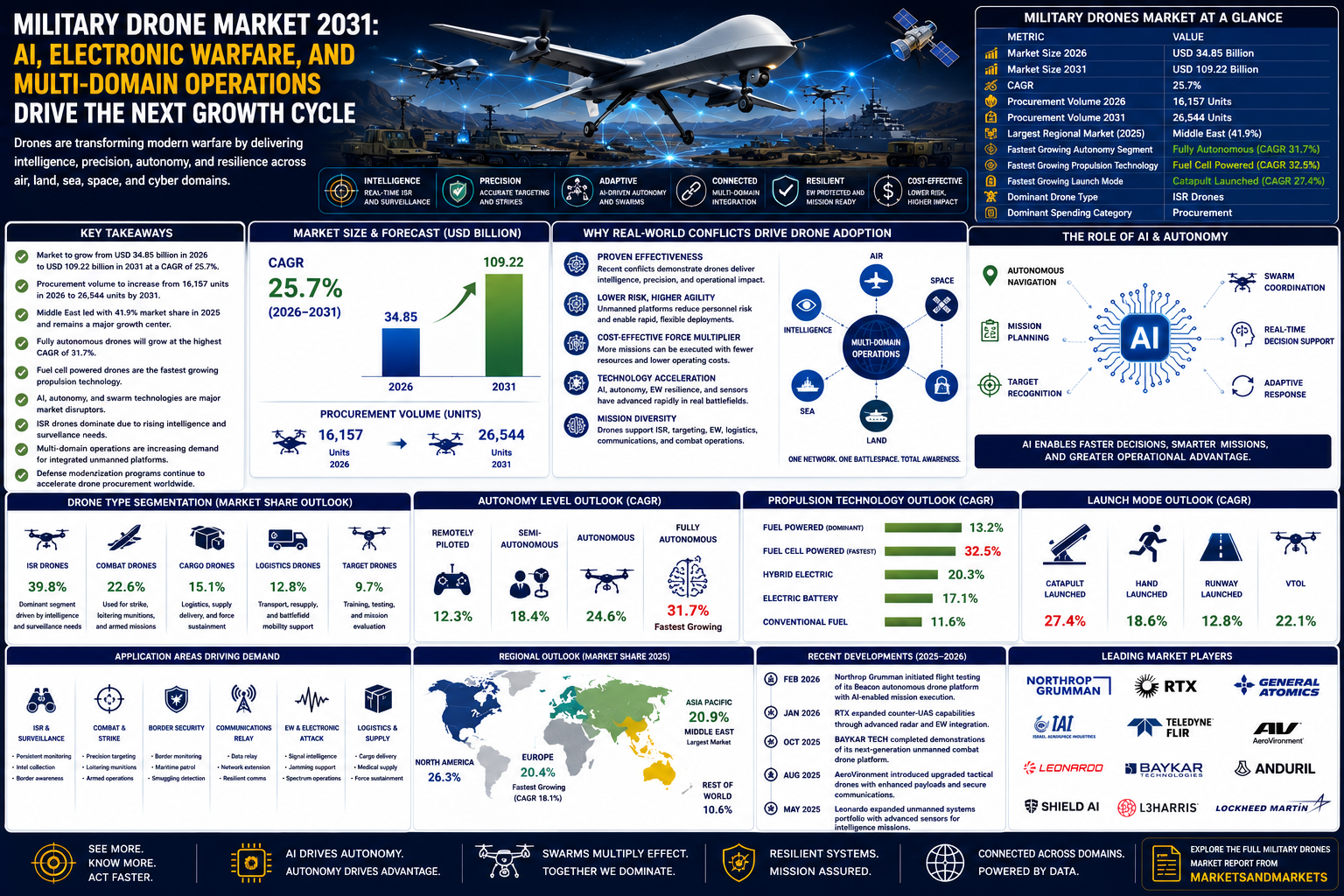
Executive Brief: Military Drones Are Becoming the Backbone of Modern Defense Operations
Few military technologies have transformed warfare as rapidly as unmanned aerial systems.
What began as a niche surveillance capability has evolved into one of the most important components of modern military operations. Today, drones support intelligence gathering, surveillance, reconnaissance, targeting, communications, electronic warfare support, border security, and combat missions across every operational domain.
The next phase of this evolution is being driven by artificial intelligence, autonomous mission execution, advanced sensor technologies, and growing integration into multi domain military operations.
According to MarketsandMarkets, the Military Drones Market is projected to grow from USD 34.85 billion in 2026 to USD 109.22 billion by 2031, reflecting a CAGR of 25.7%.
This growth reflects more than increasing procurement activity. It signals a fundamental shift in how military organizations approach battlefield awareness, operational agility, force protection, and decision superiority.
Future military drones will increasingly function as intelligent networked systems capable of collecting information, supporting commanders, collaborating with other platforms, and operating in highly contested environments.
Explore Comprehensive Military Drone Market Intelligence
Organizations seeking detailed forecasts, competitive analysis, technology trends, and growth opportunities can access the complete Military Drone Market report.
Read Full Report: https://www.marketsandmarkets.com/Market-Reports/military-drone-market-221577711.html
Download Sample Report: https://www.marketsandmarkets.com/requestsampleNew.asp?id=221577711
Military Drone Market at a Glance
| Metric | Value |
|---|---|
| Market Size 2026 | USD 34.85 Billion |
| Market Size 2031 | USD 109.22 Billion |
| CAGR | 25.7% |
| Procurement Volume 2026 | 16,157 Units |
| Procurement Volume 2031 | 26,544 Units |
| Largest Regional Market | Middle East |
| Fastest Growing Propulsion Technology | Fuel Cell Powered |
| Fastest Growing Launch Mode | Catapult Launched |
| Fastest Growing Autonomy Segment | Fully Autonomous |
The expected increase in procurement volumes demonstrates how unmanned systems are becoming central to military modernization strategies worldwide.
Artificial Intelligence Is Reshaping the Future of Military Drone Operations
Artificial intelligence is rapidly becoming one of the most important technologies influencing military drone development.
Defense agencies are investing heavily in autonomous systems capable of processing information, adapting to changing conditions, and executing missions with limited operator intervention.
From Remote Control to Autonomous Operations
Traditional drones relied heavily on human operators for navigation and mission execution.
AI is changing this paradigm by enabling:
-
Autonomous navigation
-
Dynamic route planning
-
Object recognition
-
Threat detection
-
Mission adaptation
-
Decision support
These capabilities improve operational effectiveness while reducing workload on military personnel.
Swarm Technologies Create New Operational Possibilities
One of the most disruptive developments in the Military Drones Market is the rise of swarm technologies.
Multiple drones can operate collaboratively to:
-
Expand surveillance coverage
-
Share battlefield information
-
Improve mission resilience
-
Enhance targeting effectiveness
Swarm technologies are expected to play an increasingly important role in future military operations.
Electronic Warfare Is Becoming a Defining Requirement for Next Generation Drones
As drones become more capable, they also become more exposed to electronic threats.
Electronic warfare systems can disrupt communications, interfere with navigation, and degrade mission performance.
Why Electronic Warfare Resilience Matters
Military drone operators face challenges including:
-
Signal jamming
-
Communication disruption
-
GPS interference
-
Data link attacks
-
Cyber intrusions
These threats can affect mission success and operational reliability.
Future Drones Must Operate in Contested Environments
Defense organizations increasingly require platforms capable of maintaining functionality despite electronic attacks.
This requirement is driving investments in:
-
Secure communications
-
Electronic protection systems
-
Adaptive navigation technologies
-
Anti jamming capabilities
Electronic warfare resilience is becoming a competitive differentiator within the Military Drones Market.
Multi Domain Operations Are Expanding Drone Roles Across the Battlefield
Modern military operations increasingly integrate activities across land, air, sea, space, and cyber domains.
Drones are becoming essential connectors within these operational ecosystems.
Supporting Network Centric Warfare
Military drones provide:
-
Intelligence gathering
-
Communications relay
-
Target acquisition
-
Battle damage assessment
-
Situational awareness
These capabilities support coordinated operations across multiple military domains.
Drones as Force Multipliers
By connecting sensors, commanders, and operational units, drones help military organizations make faster and more informed decisions.
This role is expected to expand significantly over the coming decade.
Access Detailed Military Drone Market Forecasts
Download PDF Brochure: https://www.marketsandmarkets.com/pdfdownloadNew.asp?id=221577711
ISR Drones Continue to Dominate Market Demand
ISR drones remain the largest drone type segment due to their importance in intelligence gathering and surveillance operations.
Real Time Intelligence Drives Operational Success
ISR drones support:
-
Border monitoring
-
Threat assessment
-
Reconnaissance missions
-
Battlefield awareness
-
Operational planning
Military organizations increasingly depend on these capabilities to improve decision making.
Persistent Surveillance Creates Strategic Advantages
Unlike many traditional surveillance assets, drones can remain operational for extended periods while continuously collecting information.
This capability enhances operational awareness and mission effectiveness.
Autonomous Systems Represent the Fastest Growing Opportunity
Although remotely piloted systems currently dominate deployments, fully autonomous drones are projected to register the highest CAGR of 31.7%.
Why Autonomy Matters
Autonomous systems offer:
-
Faster responses
-
Reduced operator burden
-
Improved mission scalability
-
Greater operational efficiency
-
Enhanced survivability
As AI technologies continue advancing, autonomous systems are expected to play increasingly important roles.
Future Operations Will Be More Autonomous
Future military missions will likely involve greater collaboration between autonomous drones, manned platforms, and command systems.
This trend is expected to reshape procurement priorities through 2031.
Fuel Cell Technologies Are Extending Mission Endurance
Fuel powered drones currently dominate the market because of their ability to support longer range missions.
However, fuel cell powered drones are projected to record the highest growth rate at 32.5%.
Endurance Creates Operational Value
Longer flight durations support:
-
Extended surveillance
-
Persistent intelligence gathering
-
Wider operational coverage
-
Reduced mission interruptions
These advantages are driving increased interest in advanced propulsion systems.
Commercial Use Cases Demonstrate Operational Impact
| Capability Area | Operational Benefit |
|---|---|
| High Altitude Surveillance Drones | Long range intelligence collection |
| Counter Drone Technologies | Improved air defense effectiveness |
| Tactical Surveillance Platforms | Better battlefield awareness |
| Combat Support UAVs | Reduced personnel exposure |
| Advanced Sensor Integration | Improved target identification |
These applications demonstrate how drones are increasingly supporting diverse military missions.
Regional Outlook: Why the Middle East Remains a Strategic Growth Hub
The Middle East accounted for 41.9% of the Military Drones Market in 2025 and continues to represent a significant growth opportunity.
Rising Defense Investments
Governments across the region are increasing spending on:
-
Surveillance systems
-
Autonomous technologies
-
Border security solutions
-
Intelligence capabilities
Security Requirements Drive Demand
Regional security concerns continue encouraging investments in advanced drone platforms capable of supporting persistent monitoring and rapid response operations.
Explore Regional Market Opportunities
Read Full Report: https://www.marketsandmarkets.com/Market-Reports/military-drone-market-221577711.html
Download Sample Report: https://www.marketsandmarkets.com/pdfdownloadNew.asp?id=221577711
Competitive Landscape: The Companies Defining Military Drone Innovation
Key Market Leaders
MarketsandMarkets identifies the following organizations as leading participants:
-
Northrop Grumman
-
RTX
-
General Atomics
-
Israel Aerospace Industries Ltd.
-
Teledyne FLIR LLC
These companies maintain strong market positions through extensive product portfolios and continued investment in technology development.
Progressive Innovators
ANDURIL INDUSTRIES and SHIELD AI have emerged as influential innovators through advancements in autonomy, AI integration, and next generation drone technologies.
Company Evaluation Highlights
Northrop Grumman maintains a strong position through expertise in long endurance surveillance platforms and autonomous defense systems.
BAYKAR TECH continues expanding its presence through combat drone innovation and tactical unmanned systems development.
Recent Developments Reflect Accelerating Innovation
February 2026
Northrop Grumman initiated flight testing of its Beacon autonomous drone platform focused on AI enabled mission execution and battlefield decision support.
January 2026
RTX expanded counter unmanned aerial system capabilities through advanced radar and electronic warfare integration.
October 2025
BAYKAR TECH completed demonstrations of next generation unmanned combat drone platforms.
August 2025
AeroVironment introduced upgraded tactical drone systems featuring enhanced surveillance payloads and secure communications.
May 2025
Leonardo expanded its unmanned systems portfolio through advanced sensor integration for intelligence and reconnaissance missions.
MarketsandMarkets Perspective: What the Data Suggests
Several themes are shaping the future direction of the Military Drones Market.
First, AI is becoming central to autonomous mission execution and operational decision support.
Second, ISR missions continue driving procurement activity across defense organizations.
Third, electronic warfare resilience is becoming increasingly important as operational environments become more contested.
Fourth, fuel cell technologies and advanced propulsion systems are extending mission endurance and operational flexibility.
Finally, multi domain operations are increasing demand for networked unmanned systems capable of supporting integrated defense strategies.
The Road Ahead for Military Drones
The Military Drones Market is entering a transformative period characterized by AI driven autonomy, electronic warfare resilience, advanced propulsion technologies, and integrated multi domain operations.
Future military drones will increasingly function as intelligent networked assets capable of collecting information, supporting commanders, collaborating with other systems, and adapting to changing battlefield conditions.
As defense organizations pursue greater situational awareness, operational agility, and decision superiority, drones will continue moving from supporting assets to mission critical capabilities.
Organizations seeking comprehensive forecasts, technology assessments, competitive intelligence, and strategic opportunities can access the complete MarketsandMarkets Military Drone Market research.

This FREE sample includes market data points, ranging from trend analyses to market estimates & forecasts. See for yourself.
SEND ME A FREE SAMPLE






