How General Dynamics’ Vulcano-Based 155mm Artillery Contract Signals a New Era for the 155 MM Ammunition Market
Modern warfare is increasingly defined by precision, range, and speed. The ability to strike high-value targets accurately at extended distances has become a central requirement for military forces seeking to maintain battlefield superiority. Against this backdrop, General Dynamics Ordnance and Tactical Systems’ recent U.S. Army contract to develop and qualify a Vulcano-based 155mm precision-guided extended-range artillery projectile represents far more than a routine procurement announcement. It highlights a broader transformation occurring across global artillery modernization programs.
The contract supports the U.S. Army’s ongoing effort to expand long-range precision fires capabilities while simultaneously increasing domestic artillery ammunition production capacity. By leveraging the Vulcano family of ammunition originally developed by Leonardo and Diehl Defence the Army aims to combine greater range with enhanced precision, enabling more effective engagement of high-value targets while reducing ammunition expenditure and collateral damage.
For defense planners, military procurement agencies, investors, and ammunition manufacturers, the announcement serves as a clear indicator of where artillery systems are heading. Precision-guided artillery projectiles are rapidly evolving from specialized capabilities into core components of modern battlefield doctrine.
As geopolitical tensions persist and defense modernization programs accelerate worldwide, developments such as this are expected to influence procurement priorities, industrial investments, and technology innovation across the global 155 MM Ammunition Market.
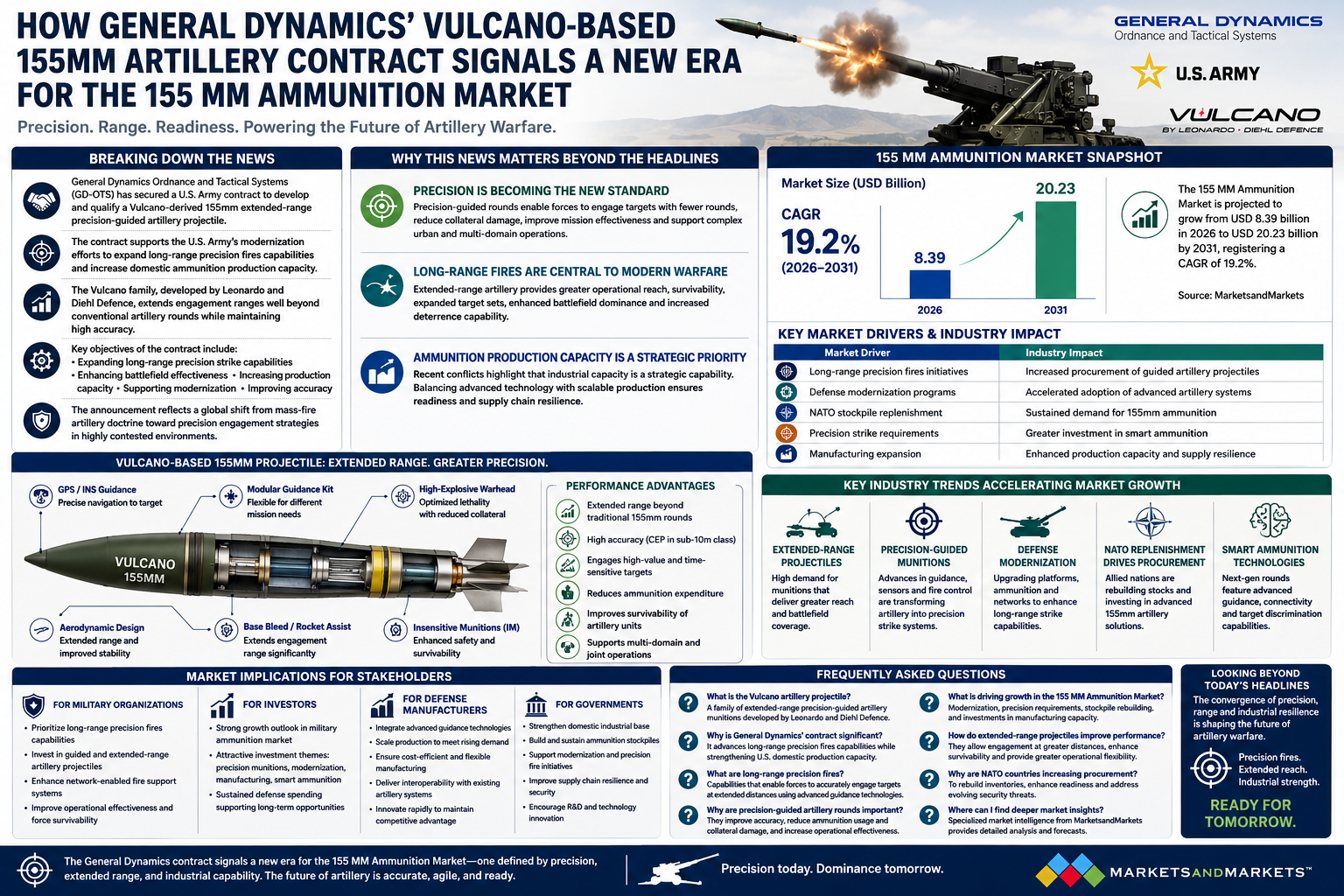
Breaking Down the News
General Dynamics Ordnance and Tactical Systems (GD-OTS) has secured a U.S. Army contract to develop and qualify a Vulcano-derived 155mm extended-range precision-guided artillery projectile.
The contract aligns with broader U.S. Army modernization initiatives focused on strengthening long-range precision fires capabilities, one of the military's highest-priority operational requirements.
The Vulcano ammunition family, developed through collaboration between Leonardo and Diehl Defence, has gained recognition for its ability to significantly extend engagement ranges beyond conventional artillery rounds while maintaining high levels of accuracy.
Key objectives of the contract include:
-
Expanding long-range precision strike capabilities
-
Enhancing battlefield effectiveness
-
Increasing artillery ammunition production capacity
-
Supporting modernization of artillery systems
-
Improving engagement accuracy against high-value targets
The announcement reflects a growing shift away from traditional mass-fire artillery doctrines toward precision engagement strategies that maximize operational effectiveness while minimizing resource consumption.
More importantly, it demonstrates increasing demand for advanced artillery solutions capable of supporting multi-domain operations in highly contested environments.
Why This News Matters Beyond the Headlines
At first glance, the contract appears to be a procurement and development initiative focused on a specific artillery projectile. However, the broader implications reveal several strategic trends shaping the future of military operations.
Precision Is Becoming the New Standard
Historically, artillery effectiveness relied heavily on volume of fire. Modern conflicts increasingly prioritize precision-guided engagement to achieve operational objectives more efficiently.
Precision-guided artillery rounds allow military forces to:
-
Engage targets with fewer rounds
-
Reduce collateral damage
-
Improve mission effectiveness
-
Enhance operational flexibility
-
Support complex urban operations
The Vulcano program reflects this transition from quantity-based firepower to precision-based lethality.
Long-Range Fires Are Central to Modern Warfare
Military planners worldwide are investing heavily in long-range precision fires capabilities.
The ability to strike targets beyond conventional artillery ranges provides significant advantages, including:
-
Greater operational reach
-
Improved survivability
-
Expanded target sets
-
Enhanced battlefield dominance
-
Increased deterrence capability
Extended-range artillery projectiles are therefore becoming critical elements of future force structures.
Ammunition Production Capacity Is a Strategic Priority
Recent conflicts have highlighted the importance of robust ammunition manufacturing ecosystems.
Governments are increasingly recognizing that production capacity itself represents a strategic capability.
The U.S. Army’s focus on both precision fires and production expansion illustrates how procurement strategies are now balancing technological advancement with industrial resilience.
What This Means for the 155 MM Ammunition Market
The General Dynamics contract aligns closely with key growth drivers shaping the global 155 MM Ammunition Market.
According to MarketsandMarkets, the market is projected to grow from USD 8.39 billion in 2026 to USD 20.23 billion by 2031, registering a CAGR of 19.2%.
This robust growth is being driven by a combination of modernization programs, stockpile replenishment initiatives, and increasing demand for precision-guided artillery systems.
| Market Driver | Industry Impact |
|---|---|
| Long-range precision fires initiatives | Increased procurement of guided artillery projectiles |
| Defense modernization programs | Accelerated adoption of advanced artillery systems |
| NATO stockpile replenishment | Sustained demand for 155mm ammunition |
| Precision strike requirements | Greater investment in smart ammunition |
| Manufacturing expansion | Enhanced production capacity and supply resilience |
The Vulcano-based projectile program directly supports several of these trends.
The contract demonstrates how military organizations are increasingly prioritizing ammunition capable of delivering precision strike capabilities at extended ranges. Such requirements are expected to shape procurement strategies across NATO members and allied nations over the coming decade.
Stakeholders seeking a broader understanding of industry developments can explore emerging opportunities within the 155 MM Ammunition Market and assess how precision-guided artillery technologies are influencing future defense investments.
Related Resource: Read about the 155 MM Ammunition Market: https://www.marketsandmarkets.com/Market-Reports/155-mm-ammunition-market-261760271.html
Key Industry Trends Accelerating Market Growth
Growing Demand for Extended-Range Artillery Projectiles
One of the most significant trends driving market expansion is the increasing demand for extended-range artillery munitions.
Traditional artillery systems face limitations in operational reach, particularly against dispersed or highly mobile targets.
Extended-range guided munitions such as the Vulcano projectile provide:
-
Increased engagement distances
-
Greater battlefield coverage
-
Improved survivability for artillery units
-
Enhanced strategic flexibility
-
Better operational effectiveness
These capabilities are becoming increasingly important in modern combat environments.
Precision-Guided Munitions Are Reshaping Fire Support Operations
Precision-guided munitions are transforming artillery from an area-effect weapon into a highly accurate precision strike system.
Advances in:
-
GPS guidance
-
Inertial navigation systems
-
Target acquisition technologies
-
Digital fire-control integration
-
Sensor-based targeting
are enabling unprecedented levels of accuracy.
As a result, precision-guided artillery rounds are becoming central components of modern fire support doctrines.
Defense Modernization Programs Continue to Expand
Military organizations worldwide are investing heavily in artillery modernization initiatives.
These programs typically focus on:
-
Upgrading artillery platforms
-
Expanding ammunition inventories
-
Integrating precision-guided capabilities
-
Improving battlefield networking
-
Enhancing long-range strike capacity
The U.S. Army contract reflects this broader global trend.
NATO Ammunition Replenishment Is Driving Procurement
NATO countries are significantly increasing ammunition procurement efforts following heightened geopolitical tensions and operational demands.
Governments are rebuilding inventories while simultaneously upgrading capabilities.
This dual focus is creating strong demand for both conventional and advanced 155mm artillery ammunition.
Smart Ammunition Technologies Are Gaining Momentum
The emergence of smart artillery ammunition is one of the most important developments in the industry.
Next-generation projectiles increasingly incorporate:
-
Advanced guidance systems
-
Precision navigation technologies
-
Digital connectivity
-
Improved target discrimination
-
Enhanced lethality optimization
These innovations improve mission effectiveness while reducing overall ammunition consumption.
Market Implications for Stakeholders
For Military Organizations
Defense forces are increasingly prioritizing ammunition capable of delivering precision effects at long range.
Future procurement strategies are expected to focus on:
-
Guided artillery projectiles
-
Extended-range munitions
-
Smart ammunition technologies
-
Network-enabled fire support systems
-
Long-range precision engagement capabilities
The Vulcano program exemplifies these evolving requirements.
For Investors
The contract reinforces confidence in long-term growth opportunities within the Military Ammunition Market.
Several investment themes continue to attract attention:
-
Precision-guided munitions
-
Artillery modernization
-
Defense manufacturing expansion
-
Smart ammunition technologies
-
Long-range strike systems
Companies supporting these areas may benefit from sustained defense spending growth.
For Defense Manufacturers
Manufacturers face increasing demand for advanced artillery solutions.
Success will likely depend on capabilities such as:
-
Precision guidance integration
-
Production scalability
-
Cost-efficient manufacturing
-
Interoperability with existing systems
-
Rapid technology innovation
Organizations capable of delivering both performance and production capacity are likely to secure competitive advantages.
For Governments
Governments continue to prioritize defense readiness and industrial resilience.
Key policy priorities include:
-
Strengthening domestic production capacity
-
Enhancing ammunition stockpiles
-
Supporting modernization programs
-
Encouraging technology innovation
-
Improving supply chain security
These initiatives are expected to drive sustained market growth throughout the forecast period.
Frequently Asked Questions
What is the Vulcano artillery projectile?
The Vulcano projectile is a family of extended-range precision-guided artillery munitions developed by Leonardo and Diehl Defence. It offers greater range and accuracy compared with conventional 155mm artillery shells.
Why is General Dynamics’ U.S. Army contract significant?
The contract supports the development of advanced precision-guided artillery projectiles designed to enhance long-range precision fires capabilities while strengthening domestic ammunition production capacity.
What are long-range precision fires?
Long-range precision fires refer to military capabilities that allow forces to accurately engage targets at extended distances using advanced guidance, navigation, and targeting technologies.
Why are precision-guided artillery rounds becoming important?
Precision-guided rounds improve accuracy, reduce ammunition expenditure, minimize collateral damage, and increase operational effectiveness, making them increasingly valuable in modern warfare.
What is driving growth in the 155 MM Ammunition Market?
Growth is being driven by defense modernization initiatives, increasing demand for precision-guided artillery systems, ammunition stockpile replenishment efforts, and rising investments in domestic manufacturing capacity.
How do extended-range artillery projectiles improve battlefield performance?
Extended-range projectiles allow military forces to engage targets at greater distances, improve survivability, expand operational flexibility, and support more effective battlefield maneuvering.
Why are NATO countries increasing ammunition procurement?
NATO members are rebuilding inventories, enhancing readiness, and responding to evolving security challenges by expanding ammunition stockpiles and investing in advanced artillery capabilities.
Where can organizations find deeper insights into artillery ammunition trends?
Industry participants often rely on specialized market intelligence to evaluate procurement patterns, technology developments, manufacturing capacity expansions, competitive dynamics, and future growth opportunities.
Looking Beyond Today's Headlines
The General Dynamics contract represents more than a single modernization effort. It highlights the evolution of artillery systems toward greater precision, extended range, and enhanced operational effectiveness.
The future battlefield will increasingly favor forces capable of delivering accurate fires rapidly and at long distances. Precision-guided artillery projectiles are emerging as a critical enabler of this capability.
As governments continue investing in defense modernization, extended-range guided munitions are likely to play a central role in shaping next-generation artillery doctrines. Simultaneously, investments in manufacturing capacity will help ensure that advanced capabilities can be produced at scale.
The convergence of precision, range, and industrial resilience is creating a new era for artillery systems worldwide.
Future Outlook
General Dynamics’ U.S. Army contract to develop a Vulcano-based 155mm extended-range precision-guided artillery projectile underscores the growing importance of long-range precision fires in modern military operations. The initiative highlights how defense organizations are simultaneously pursuing advanced capabilities and expanded manufacturing capacity to address evolving operational requirements.
The announcement validates several major trends driving the 155 MM Ammunition Market, including artillery modernization programs, precision-guided munitions adoption, NATO stockpile replenishment efforts, and increased investment in domestic production ecosystems.
For military planners, defense manufacturers, investors, and policymakers, the development offers valuable insight into the future direction of artillery warfare and ammunition procurement strategies. As precision engagement becomes increasingly central to military effectiveness, advanced 155mm artillery systems are expected to remain a critical area of investment.
For readers seeking deeper analysis of market forecasts, technology developments, procurement trends, and competitive dynamics, MarketsandMarkets provides comprehensive research on the global 155 MM Ammunition Market and the factors shaping its future growth trajectory.
Download Sample Report: https://www.marketsandmarkets.com/requestsampleNew.asp?id=261760271
Explore the 155 MM Ammunition Market: https://www.marketsandmarkets.com/Market-Reports/155-mm-ammunition-market-261760271.html

This FREE sample includes market data points, ranging from trend analyses to market estimates & forecasts. See for yourself.
SEND ME A FREE SAMPLE






