How Exail’s Rapidly Deployable GNSS-Denied Navigation Solution Signals the Next Growth Phase of the Inertial Navigation System Market
Modern military operations increasingly depend on reliable positioning, navigation, and timing (PNT) capabilities. Yet one of the most significant challenges facing defense forces today is the growing vulnerability of Global Navigation Satellite Systems (GNSS), including GPS, to electronic warfare threats such as jamming, spoofing, and signal denial. As adversaries invest heavily in electronic attack capabilities, military organizations are seeking resilient navigation technologies capable of maintaining operational effectiveness when satellite-based navigation becomes unavailable.
Against this backdrop, Exail’s introduction of a rapidly deployable navigation solution for GNSS-denied environments represents more than a new product launch. It reflects a broader transformation occurring across the defense navigation ecosystem. Designed to provide assured positioning, navigation, and timing capabilities without requiring vehicle modifications or dedicated infrastructure, the system enables military units to maintain operational continuity even in highly contested electromagnetic environments.
Built around Exail’s proven fiber optic gyroscope (FOG) technology, the solution can be deployed within minutes and scaled according to mission requirements, ranging from tactical-grade applications to high-performance navigation operations. The launch highlights a growing recognition among defense organizations that resilient navigation systems are becoming essential components of modern warfare.
For military planners, investors, technology developers, and defense contractors, this development offers valuable insight into the future direction of the Inertial Navigation System Market, where demand for assured navigation and autonomous positioning technologies continues to accelerate.
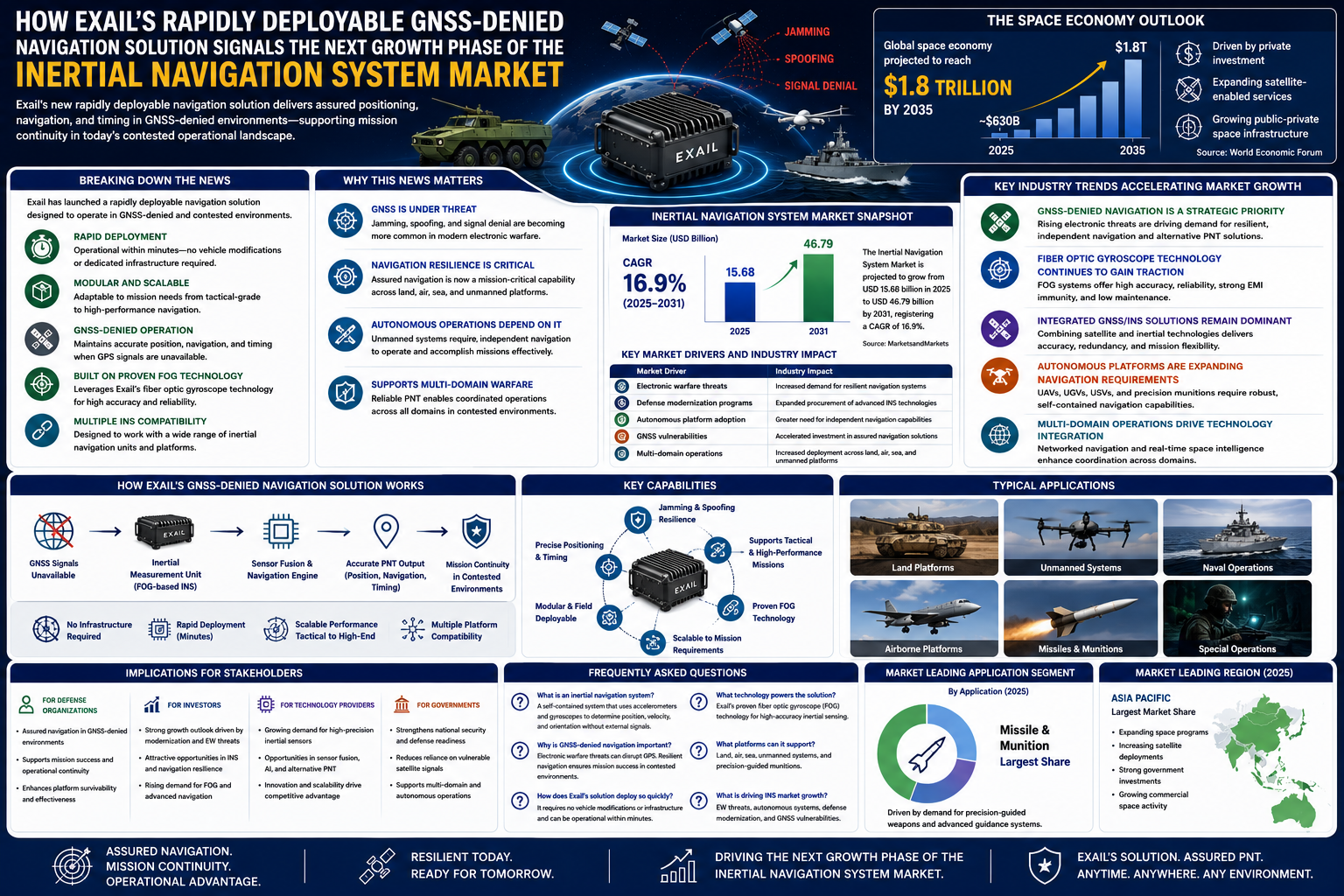
Breaking Down the News
Exail recently announced the launch of a rapidly deployable navigation solution specifically designed for operations in GNSS-denied and contested environments.
Unlike conventional navigation architectures that often require extensive platform integration, Exail’s solution is intended to be fielded quickly and efficiently without vehicle modifications or dedicated infrastructure.
Key features include:
- Rapid deployment within minutes
- Modular and scalable architecture
- Operation in GPS-denied environments
- Compatibility with multiple inertial navigation units
- Support for tactical and high-performance missions
- Reliance on proven fiber optic gyroscope technology
The solution addresses one of the most pressing operational challenges facing modern military forces: maintaining accurate positioning and navigation capabilities when GNSS signals are degraded or unavailable.
As electronic warfare becomes increasingly sophisticated, the ability to navigate independently of satellite signals is emerging as a strategic requirement across land, air, maritime, and unmanned platforms.
Why This News Matters Beyond the Headlines
At first glance, Exail’s announcement may appear to be a niche defense technology launch. However, the strategic implications extend far beyond a single navigation solution.
Military organizations worldwide are increasingly operating in contested electromagnetic environments where traditional GPS-dependent systems may be vulnerable to disruption.
Recent conflicts and military exercises have demonstrated that:
- GNSS signals can be jammed.
- Navigation systems can be spoofed.
- Satellite-based positioning may become unavailable during critical operations.
- Autonomous platforms require resilient backup navigation capabilities.
These realities are reshaping defense procurement priorities.
Navigation resilience is no longer viewed as a supplementary capability it is becoming a mission-critical requirement.
Exail’s solution directly addresses this challenge by providing assured navigation capabilities independent of external satellite signals.
More broadly, the launch validates several major trends influencing the future of military navigation:
- Growth in GNSS-denied navigation technologies
- Increased adoption of inertial navigation systems
- Rising demand for autonomous operations
- Expansion of multi-domain warfare capabilities
- Greater emphasis on navigation resilience
As defense organizations prepare for increasingly complex operational environments, these trends are expected to drive sustained investment across the navigation technology ecosystem.
What This Means for the Inertial Navigation System Market
The Exail announcement aligns closely with long-term growth drivers shaping the global Inertial Navigation System Market.
According to MarketsandMarkets, the Inertial Navigation System Market is estimated at USD 9.42 billion in 2026 and projected to reach USD 11.92 billion by 2030, registering a CAGR of 6.1%.
The market is benefiting from increasing defense modernization efforts, rising geopolitical tensions, and growing demand for navigation systems capable of operating independently of external positioning signals.
| Market Driver | Industry Impact |
|---|---|
| Electronic warfare threats | Increased demand for resilient navigation systems |
| Defense modernization programs | Expanded procurement of advanced INS technologies |
| Autonomous platform adoption | Greater need for independent navigation capabilities |
| GNSS vulnerabilities | Accelerated investment in assured navigation solutions |
| Multi-domain operations | Increased deployment across land, air, sea, and unmanned platforms |
The Exail system directly supports these trends by providing a scalable navigation solution capable of functioning effectively in contested operational environments.
Organizations evaluating future navigation technologies can gain additional insights by exploring broader developments within the Inertial Navigation System Market and understanding how resilient navigation capabilities are reshaping defense strategies.
Related Resource: Read about the Inertial Navigation System Market: https://www.marketsandmarkets.com/Market-Reports/inertial-navigation-system-market-154810661.html
Key Industry Trends Accelerating Market Growth
GNSS-Denied Navigation Is Becoming a Strategic Priority
One of the most significant trends influencing the market is the increasing demand for navigation systems capable of operating without satellite signals.
Military forces can no longer assume continuous access to GNSS infrastructure.
As a result, organizations are investing heavily in:
- Inertial navigation systems
- Sensor fusion technologies
- Autonomous navigation solutions
- Alternative PNT architectures
- Anti-jamming technologies
These investments are expected to drive sustained market growth throughout the forecast period.
Fiber Optic Gyroscope Technology Continues to Gain Traction
Fiber optic gyroscope technology has emerged as one of the most important navigation technologies for high-performance applications.
FOG systems offer:
- High accuracy
- Excellent reliability
- Resistance to electromagnetic interference
- Long operational life
- Low maintenance requirements
Exail’s latest solution demonstrates the continued relevance of FOG technology within advanced defense navigation architectures.
Integrated GNSS/INS Solutions Remain Dominant
While independent navigation capabilities are increasingly important, integrated GNSS/INS systems continue to dominate the market.
By combining satellite positioning with inertial navigation, these systems provide:
- Improved accuracy
- Enhanced reliability
- Greater operational flexibility
- Redundant navigation capabilities
Integrated solutions are expected to remain a cornerstone of navigation modernization programs worldwide.
Autonomous Platforms Are Expanding Navigation Requirements
The growing deployment of unmanned systems is creating new opportunities within the INS Market.
Applications include:
- Unmanned aerial vehicles (UAVs)
- Autonomous ground vehicles
- Unmanned maritime systems
- Precision-guided munitions
- Autonomous logistics platforms
These systems require robust navigation capabilities capable of operating with minimal external support.
Multi-Domain Operations Are Driving Technology Integration
Modern military strategies increasingly emphasize coordinated operations across land, air, maritime, cyber, and space domains.
This operational evolution is driving demand for:
- Networked navigation systems
- Real-time situational awareness
- Precision positioning capabilities
- Integrated command-and-control architectures
Advanced inertial navigation technologies are becoming essential enablers of these capabilities.
Market Implications for Stakeholders
For Defense Organizations
Military forces are increasingly prioritizing navigation resilience as part of broader modernization initiatives.
Future procurement strategies are likely to focus on:
- Assured navigation systems
- GNSS-independent capabilities
- Sensor fusion architectures
- Multi-domain interoperability
- Electronic warfare resilience
The Exail solution aligns closely with these emerging requirements.
For Investors
The launch reinforces several attractive investment themes within the defense technology sector.
Areas attracting growing attention include:
- Inertial navigation systems
- Fiber optic gyroscopes
- Autonomous navigation technologies
- Electronic warfare resilience
- Precision positioning solutions
Companies operating in these segments may benefit from sustained defense spending and modernization programs.
For Technology Providers
Navigation technology providers face increasing demand for solutions that combine accuracy, resilience, and scalability.
Competitive differentiation is likely to depend on:
- Performance in contested environments
- Modular system architectures
- Ease of deployment
- Integration capabilities
- Advanced sensor technologies
Innovation remains a key driver of market success.
For Governments
Governments continue to strengthen domestic defense technology capabilities to ensure operational readiness and supply chain security.
Navigation systems represent a critical area of investment because they support a wide range of defense platforms and mission profiles.
Public-sector funding is therefore expected to remain an important contributor to market growth.
Frequently Asked Questions
What is an inertial navigation system?
An inertial navigation system is a self-contained navigation technology that determines position, velocity, and orientation using accelerometers and gyroscopes without relying on external signals such as GPS.
Why are GNSS-denied environments becoming important?
Modern electronic warfare capabilities allow adversaries to jam, spoof, or disrupt satellite navigation signals. As a result, military organizations require alternative navigation methods that can operate independently of GNSS infrastructure.
What is Exail’s new navigation solution designed to do?
The solution provides resilient positioning, navigation, and timing capabilities in contested environments and can be deployed rapidly without requiring vehicle modifications or dedicated infrastructure.
Why is fiber optic gyroscope technology important?
Fiber optic gyroscopes provide highly accurate motion sensing, excellent reliability, and strong resistance to electromagnetic interference, making them ideal for advanced navigation applications.
What is driving growth in the Inertial Navigation System Market?
Growth is being driven by defense modernization programs, increasing geopolitical tensions, autonomous platform adoption, navigation resilience requirements, and rising investments in advanced military technologies.
How do integrated GNSS/INS systems improve performance?
By combining satellite navigation with inertial sensing technologies, integrated systems provide greater accuracy, redundancy, and operational reliability across a wide range of mission scenarios.
Which application segment is expected to dominate the market?
The missile and munition segment is expected to account for the largest market share due to increasing demand for precision-guided weapons and advanced guidance systems.
Where can organizations find deeper insights into navigation technology trends?
Industry stakeholders often rely on specialized market intelligence to evaluate technology developments, procurement strategies, competitive dynamics, and future growth opportunities within the navigation ecosystem.
Looking Beyond Today's Headlines
Exail’s launch reflects a broader shift occurring across military navigation and positioning technologies.
The future battlefield is expected to be increasingly contested, connected, and autonomous. In such environments, dependence on vulnerable satellite signals creates operational risks that defense organizations can no longer ignore.
Navigation resilience is becoming as important as communications security and cyber defense.
Future developments are likely to include:
- AI-enabled navigation systems
- Advanced sensor fusion architectures
- Alternative PNT technologies
- Autonomous mission navigation
- Enhanced anti-jamming capabilities
As military operations become more technologically sophisticated, assured navigation solutions will play an increasingly central role in enabling mission success.
The ability to maintain accurate positioning in the absence of GNSS signals may ultimately become one of the defining characteristics of next-generation defense platforms.
Future Outlook
Exail’s rapidly deployable navigation solution highlights the growing importance of resilient positioning, navigation, and timing capabilities in modern military operations. By addressing the challenges associated with GNSS-denied environments, the company has introduced a technology that aligns closely with emerging defense priorities centered on navigation resilience, autonomous operations, and electronic warfare readiness.
The announcement reinforces several major trends driving growth across the Inertial Navigation System Market, including increasing defense modernization efforts, adoption of autonomous platforms, and demand for assured navigation technologies capable of operating independently of satellite signals.
For military organizations, investors, technology providers, and policymakers, understanding these trends will be critical as navigation systems become increasingly important components of future defense architectures.
For readers seeking deeper insights into technology developments, market forecasts, competitive dynamics, and growth opportunities, MarketsandMarkets provides comprehensive research on the global Inertial Navigation System Market and the factors shaping its continued evolution.
Download Sample Report: https://www.marketsandmarkets.com/pdfdownloadNew.asp?id=154810661
Explore the Inertial Navigation System Market: https://www.marketsandmarkets.com/Market-Reports/inertial-navigation-system-market-154810661.html

This FREE sample includes market data points, ranging from trend analyses to market estimates & forecasts. See for yourself.
SEND ME A FREE SAMPLE






