How Three Commercial Trends Driving a $1.8 Trillion Space Economy Are Fueling Growth in the Space Sensors and Actuators Market
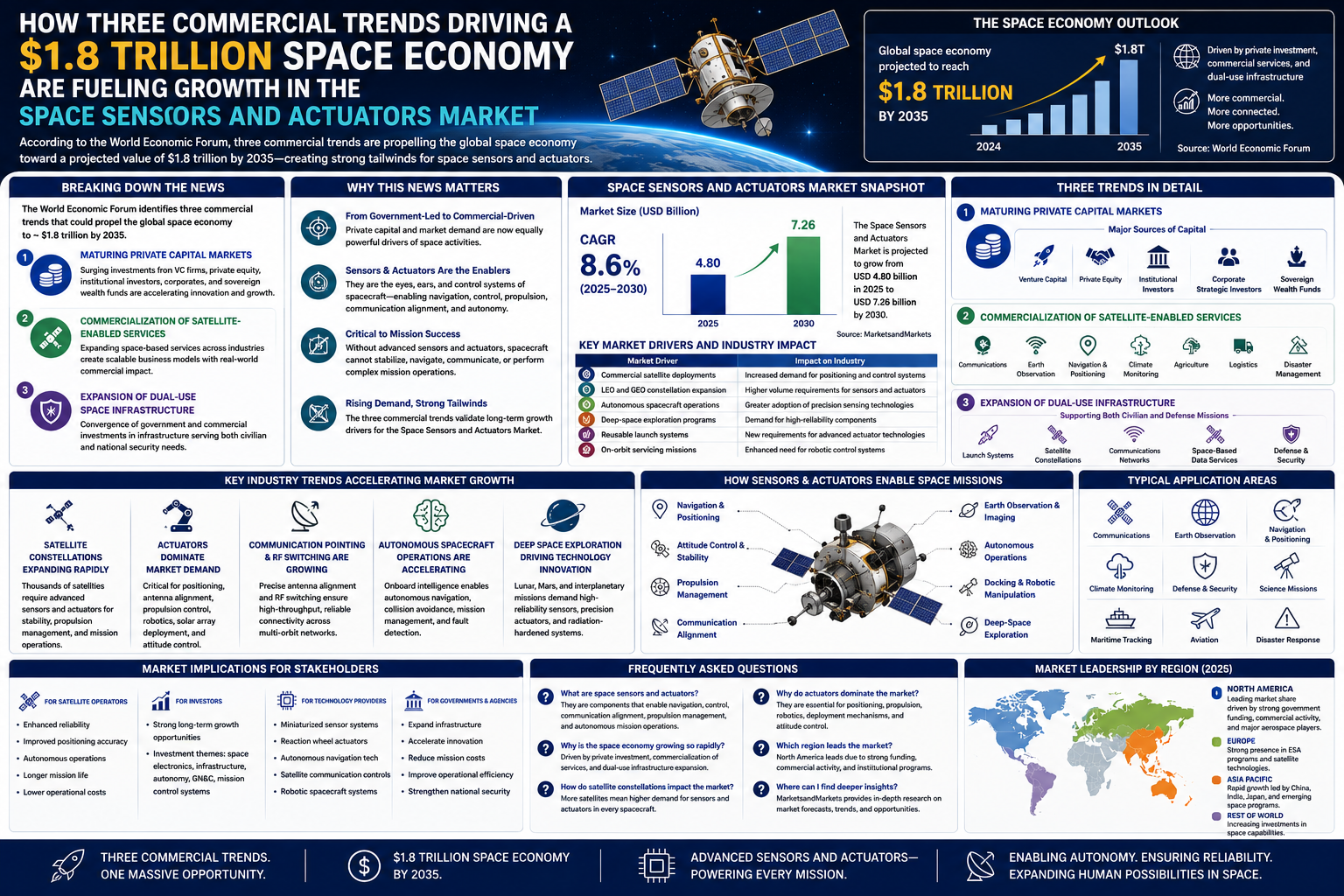
The global space industry is undergoing one of the most significant transformations in its history. What was once dominated by government agencies and national space programs is increasingly becoming a commercially driven ecosystem powered by private capital, scalable business models, and expanding demand for space-enabled services. According to a recent World Economic Forum (WEF) analysis, three major commercial trends are accelerating the growth of the global space economy toward a projected value of $1.8 trillion by 2035: the maturation of private capital markets, the commercialization of satellite-enabled services, and the expansion of dual-use space infrastructure.
These developments are reshaping every layer of the space value chain. Venture capital firms, institutional investors, satellite operators, launch providers, telecommunications companies, and government agencies are collectively building a more dynamic and interconnected space economy. As satellite constellations expand and commercial missions become increasingly sophisticated, demand is rising for the underlying technologies that make modern spacecraft possible.
Among the most critical enabling technologies are space sensors and actuators. These components serve as the eyes, ears, and control systems of spacecraft, enabling navigation, positioning, propulsion management, attitude control, communication alignment, and autonomous mission operations.
As commercial space activity scales globally, the Space Sensors and Actuators Market is emerging as one of the most important beneficiaries of this transformation. The same trends driving growth in the broader space economy are creating powerful tailwinds for the technologies that enable spacecraft to operate reliably in increasingly complex missions.
Breaking Down the News
The World Economic Forum recently identified three commercial trends that could propel the global space economy to approximately $1.8 trillion by 2035.
Trend 1: Maturing Private Capital Markets
Private investment has become one of the most powerful growth engines in the space sector.
Over the past decade, the industry has attracted significant funding from:
- Venture capital firms
- Private equity investors
- Institutional asset managers
- Corporate strategic investors
- Sovereign wealth funds
This influx of capital is supporting innovation across launch services, satellite manufacturing, Earth observation platforms, communications networks, and next-generation spacecraft technologies.
Trend 2: Commercialization of Satellite-Enabled Services
The second trend involves the rapid expansion of space-enabled services that support industries across the global economy.
These services include:
- Satellite communications
- Earth observation
- Navigation and positioning
- Climate monitoring
- Precision agriculture
- Logistics optimization
- Disaster management
The growing commercial relevance of these applications is creating sustainable business models that extend far beyond traditional aerospace markets.
Trend 3: Expansion of Dual-Use Space Infrastructure
The third trend is the convergence of government and commercial investment in space infrastructure.
Launch systems, satellite constellations, communications networks, and space-based data services increasingly serve both civilian and national security purposes.
This dual-use approach is accelerating innovation while improving economic viability across the broader space ecosystem.
Why This News Matters Beyond the Headlines
The World Economic Forum's analysis highlights a fundamental shift in how space activities are funded, developed, and commercialized.
While launch vehicles and satellite constellations often receive the most public attention, their success depends heavily on the technologies embedded within every spacecraft.
Space sensors and actuators are among the most critical of these technologies.
Without advanced sensors and actuators, spacecraft cannot:
- Maintain orbital stability
- Execute propulsion maneuvers
- Align communications systems
- Conduct Earth observation missions
- Navigate autonomously
- Perform docking operations
- Support deep-space exploration
As commercial space ventures expand and governments increase investments in strategic space infrastructure, demand for these foundational technologies is growing rapidly.
The three trends identified by the World Economic Forum effectively validate several of the long-term growth drivers underpinning the Space Sensors and Actuators Market.
The expansion of satellite constellations, increased commercialization, and growing mission complexity all require more sophisticated sensing and control systems.
What This Means for the Space Sensors and Actuators Market
The continued expansion of the commercial space economy is creating significant opportunities for suppliers of spacecraft sensing and control technologies.
According to MarketsandMarkets, the Space Sensors and Actuators Market is estimated at USD 4.80 billion in 2025 and is projected to reach USD 7.26 billion by 2030, registering a CAGR of 8.6%.
Several factors are contributing to this growth trajectory.
| Market Driver | Industry Impact |
|---|---|
| Commercial satellite deployments | Increased demand for positioning and control systems |
| LEO and GEO constellation expansion | Higher volume requirements for sensors and actuators |
| Autonomous spacecraft operations | Greater adoption of precision sensing technologies |
| Deep-space exploration programs | Demand for high-reliability components |
| Reusable launch systems | New requirements for advanced actuator technologies |
| On-orbit servicing missions | Enhanced need for robotic control systems |
The trends highlighted by the World Economic Forum reinforce the long-term sustainability of these demand drivers.
As commercial satellite operators expand their fleets and governments pursue increasingly ambitious exploration programs, the market for space sensors and actuators is expected to remain on a strong growth trajectory.
Organizations seeking a deeper understanding of industry developments can explore broader trends within the Space Sensors and Actuators Market and evaluate how spacecraft technologies are evolving to support the next generation of space missions.
Related Resource: Read about the Space Sensors and Actuators Market: https://www.marketsandmarkets.com/Market-Reports/space-sensors-and-actuators-market-73650517.html
Key Industry Trends Accelerating Market Growth
Satellite Constellations Are Driving Component Demand
One of the strongest growth drivers for the market is the rapid deployment of commercial satellite constellations.
Companies and governments are launching thousands of satellites to support:
- Broadband internet services
- Earth observation networks
- Navigation systems
- Defense communications
- Climate monitoring initiatives
Every satellite requires advanced sensors and actuators to maintain orientation, manage propulsion systems, and support mission operations.
As constellation deployments increase, demand for spacecraft components is rising accordingly.
Actuators Continue to Dominate Market Demand
Actuators currently account for a leading share of the market due to their critical role in spacecraft functionality.
Applications include:
- Satellite positioning
- Antenna alignment
- Propulsion control
- Robotic operations
- Solar array deployment
- Attitude control
Continuous innovation in compact, lightweight, and radiation-hardened actuators is expanding their use across both commercial and exploration missions.
Communication Pointing and RF Switching Are Becoming Increasingly Important
Satellite communication networks depend heavily on precise antenna alignment and signal management.
The communication pointing and RF switching segment remains a major application area because modern satellite systems require:
- Enhanced signal accuracy
- Reliable connectivity
- Dynamic network optimization
- Multi-orbit interoperability
As high-throughput satellite networks expand globally, demand for precision control technologies continues to increase.
Autonomous Spacecraft Operations Are Accelerating
Autonomous spacecraft are becoming increasingly common across commercial and government missions.
Advanced onboard systems now support:
- Autonomous navigation
- Collision avoidance
- Attitude control
- Fault detection
- Mission management
These capabilities rely heavily on sophisticated sensor technologies and high-performance control systems.
As autonomy becomes more widespread, demand for precision sensing and actuation is expected to grow substantially.
Deep Space Exploration Is Driving Technology Innovation
Interest in lunar exploration, Mars missions, and interplanetary science programs is creating new opportunities for advanced spacecraft technologies.
Deep-space missions require:
- High-reliability sensors
- Precision guidance systems
- Advanced actuators
- Radiation-resistant electronics
- Autonomous control architectures
NASA, ESA, ISRO, and emerging commercial exploration companies are all contributing to increased demand in this segment.
Market Implications for Stakeholders
For Satellite Operators
Commercial satellite operators increasingly rely on advanced sensors and actuators to maximize mission performance.
Key priorities include:
- Enhanced reliability
- Improved positioning accuracy
- Autonomous operation capabilities
- Longer mission life cycles
- Reduced maintenance requirements
Advanced spacecraft control technologies play a critical role in achieving these objectives.
For Investors
The World Economic Forum's projection of a $1.8 trillion space economy highlights significant long-term investment opportunities.
Areas attracting growing attention include:
- Space electronics
- Satellite infrastructure
- Autonomous spacecraft systems
- Guidance and navigation technologies
- Space mission control systems
Companies developing enabling technologies may benefit substantially from industry expansion.
For Technology Providers
Manufacturers of space sensors and actuators are positioned to capitalize on increasing demand across multiple mission categories.
Future opportunities are expected to emerge in:
- Miniaturized sensor systems
- Reaction wheel actuators
- Autonomous navigation technologies
- Satellite communication controls
- Robotic spacecraft systems
Innovation and reliability will remain key differentiators.
For Governments and Space Agencies
Governments continue to view space as a strategic domain for economic growth, national security, and scientific advancement.
Public-sector organizations are increasingly collaborating with commercial operators to:
- Expand infrastructure
- Accelerate innovation
- Reduce mission costs
- Improve operational efficiency
These partnerships are likely to drive sustained market growth over the coming decade.
Frequently Asked Questions
What are space sensors and actuators?
Space sensors and actuators are spacecraft components responsible for navigation, positioning, attitude control, propulsion management, communication alignment, and autonomous operations. They enable spacecraft to function effectively in orbit and deep-space environments.
Why is the global space economy expected to reach $1.8 trillion?
According to the World Economic Forum, growth is being driven by expanding private investment, increasing commercialization of satellite-enabled services, and growing collaboration between government and commercial space initiatives.
Why are actuators important in spacecraft?
Actuators control physical movement and positioning functions within spacecraft. They are used for propulsion systems, antenna alignment, robotic operations, attitude control, and deployment mechanisms.
How do satellite constellations impact the Space Sensors and Actuators Market?
Large satellite constellations require thousands of individual spacecraft, each equipped with sensors and actuators. As deployments increase, demand for these technologies rises proportionally.
What role do sensors play in autonomous spacecraft operations?
Sensors provide critical information related to navigation, orientation, positioning, environmental monitoring, and spacecraft health, enabling autonomous decision-making and mission execution.
Which segment dominates the Space Sensors and Actuators Market?
Actuators currently lead the market due to their extensive use in satellite positioning, propulsion control, robotic systems, and spacecraft maneuvering applications.
Why is North America leading the market?
North America benefits from strong government funding, a mature aerospace ecosystem, extensive commercial space activity, and major institutional programs led by organizations such as NASA and the U.S. Space Force.
Where can organizations find deeper insights into space technology trends?
Industry stakeholders often rely on specialized market intelligence to evaluate satellite deployment trends, technology innovations, investment opportunities, competitive dynamics, and emerging growth areas within the global space ecosystem.
Looking Beyond Today's Headlines
The World Economic Forum’s projection of a $1.8 trillion space economy reflects a broader transformation taking place across the global aerospace sector.
Private investment is accelerating innovation. Commercial satellite services are creating scalable business models. Governments and commercial operators are increasingly collaborating on infrastructure and mission development.
Behind these visible developments lies an essential technological foundation. Space sensors and actuators enable virtually every spacecraft operation, from maintaining orbital stability to supporting autonomous exploration missions.
As the New Space economy continues to evolve, these technologies will become even more important. Satellite constellations, reusable launch systems, on-orbit servicing missions, deep-space exploration programs, and autonomous spacecraft operations all depend on increasingly sophisticated sensing and control systems.
The future growth of the space economy will not simply be measured by the number of satellites launched or missions completed. It will also be determined by the performance, reliability, and intelligence of the technologies that keep spacecraft operating successfully.
Future Outlook
The World Economic Forum’s identification of three commercial trends driving the global space economy toward $1.8 trillion by 2035 underscores the growing momentum behind commercial space activities. The maturation of private capital markets, expansion of satellite-enabled services, and growth of dual-use infrastructure are reshaping the future of the industry.
These developments are creating powerful opportunities across the Space Sensors and Actuators Market. As satellite deployments expand, autonomous operations become more prevalent, and deep-space missions increase, demand for advanced sensing and control technologies is expected to accelerate significantly.
For investors, satellite operators, technology providers, and policymakers, understanding the role of these enabling technologies will be critical to navigating future opportunities in the rapidly evolving space ecosystem.
For readers seeking deeper insights into market forecasts, technology developments, competitive dynamics, and growth opportunities, MarketsandMarkets provides comprehensive research on the global Space Sensors and Actuators Market and the factors shaping its future trajectory.
Download Sample Report: https://www.marketsandmarkets.com/requestsampleNew.asp?id=73650517
Explore the Space Sensors and Actuators Market: https://www.marketsandmarkets.com/Market-Reports/space-sensors-and-actuators-market-73650517.html

This FREE sample includes market data points, ranging from trend analyses to market estimates & forecasts. See for yourself.
SEND ME A FREE SAMPLE






