100 Counter-UAS Companies: Key Players, Technologies and Competitive Landscape
Counter Unmanned Aircraft Systems (C UAS) are becoming an essential component of modern defense, homeland security, airport protection, and critical infrastructure security. The growing use of unmanned aerial vehicles for surveillance, reconnaissance, smuggling, and other unauthorized activities has increased demand for systems that can detect, track, identify, and mitigate drone threats. As drones become more accessible and operationally sophisticated, governments and security organizations are investing in counter drone technologies that can protect sensitive locations and maintain control over restricted airspace.
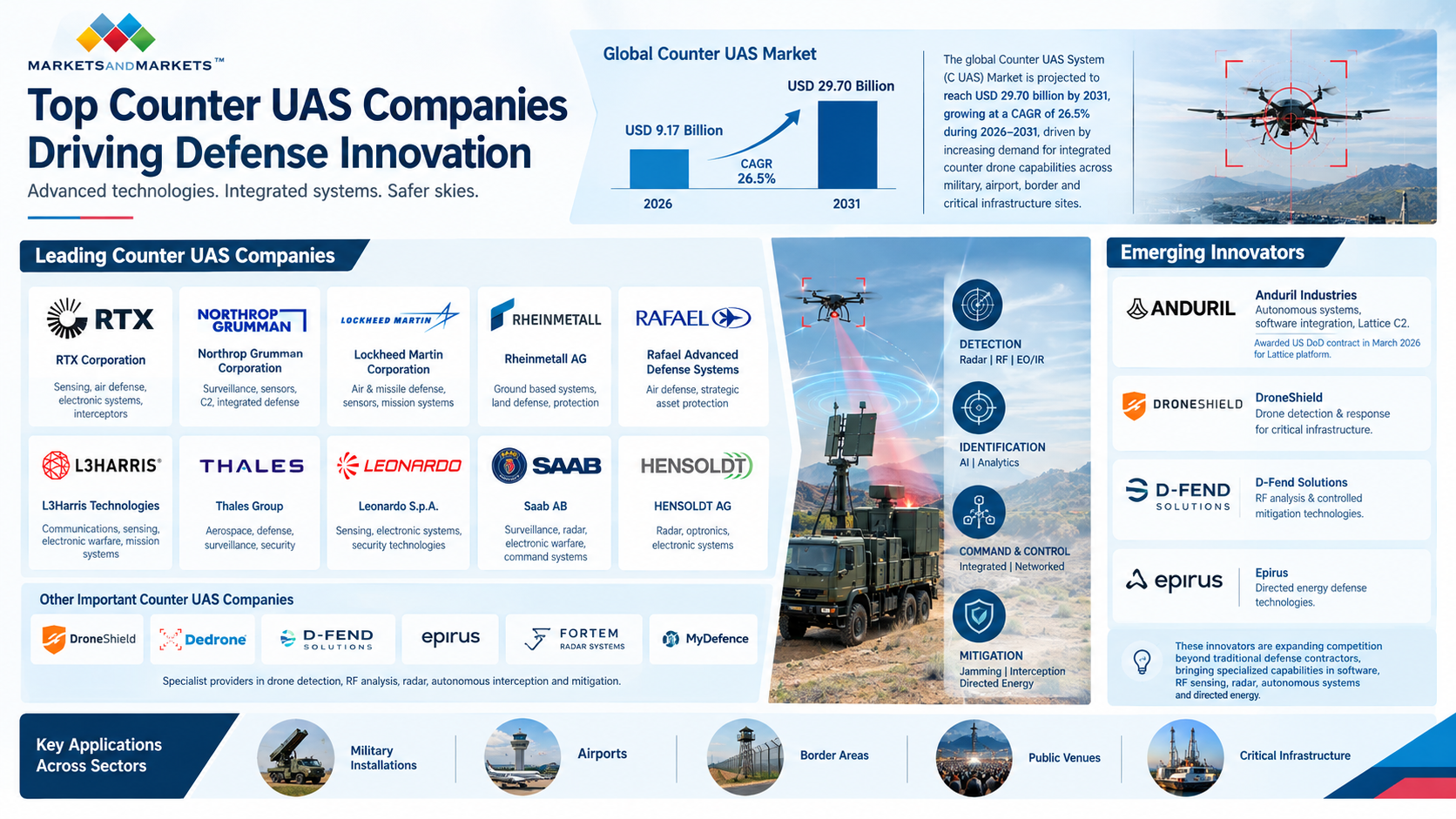
According to MarketsandMarkets, the Global Counter UAS System (C UAS) Market was valued at USD 9.17 billion in 2026 and is projected to reach USD 29.70 billion by 2031, growing at a compound annual growth rate (CAGR) of 26.5% during the forecast period. This expansion reflects the growing importance of integrated counter drone capabilities across military installations, airports, border areas, public venues, and strategically important infrastructure.
The competitive landscape includes defense contractors, radar manufacturers, electronic warfare specialists, sensor developers, and companies focused on artificial intelligence and autonomous threat detection. These organizations are developing systems that combine radar, radio frequency detection, electro optical and infrared sensors, command and control software, electronic countermeasures, and other mitigation technologies. The ability to integrate multiple sensors and response options into a coordinated platform is becoming an important differentiator for C UAS providers.
AI enabled detection and tracking are also influencing the market. Modern counter drone platforms increasingly need to distinguish unauthorized drones from birds, authorized unmanned aircraft, and other objects in crowded or complex environments. Advanced data processing can help security teams assess threats, reduce false alarms, and make faster decisions. At the same time, different operating environments require different mitigation approaches, making flexibility and interoperability important competitive considerations.
The leading Counter UAS companies compete through technology development, system integration, defense procurement relationships, product reliability, and the ability to address evolving security requirements. As investment increases, competitive success will depend on providing adaptable systems that can operate across a wide range of environments while meeting applicable safety, spectrum, and regulatory requirements.
Market Size and Forecast
The global Counter UAS market is entering a period of rapid expansion as defense agencies, government organizations, and infrastructure operators strengthen protection against unauthorized unmanned aircraft. The market forecast indicates a substantial increase in demand for integrated detection, command and control, and mitigation solutions over the next several years.
|
Market Metric |
Value |
|---|---|
|
Market size in 2026 |
USD 9.17 billion |
|
Projected market size in 2031 |
USD 29.70 billion |
|
CAGR from 2026 to 2031 |
26.5% |
|
Forecast period |
2026 to 2031 |
|
Key demand areas |
Defense, homeland security, airports, critical infrastructure, public safety |
The projected increase from USD 9.17 billion in 2026 to USD 29.70 billion in 2031 highlights the growing strategic importance of counter drone systems. Demand is supported by the need to protect military installations, airports, government facilities, and critical infrastructure against unauthorized surveillance and potential attacks.
The market is also evolving from standalone detection products toward integrated architectures that combine multiple sensors, software, command and control, and mitigation capabilities. This creates opportunities for both large defense contractors and specialized counter drone technology providers.
Top 10 Key Takeaways
- The global Counter UAS market is projected to grow from USD 9.17 billion in 2026 to USD 29.70 billion by 2031.
- The market is expected to register a CAGR of 26.5% from 2026 to 2031.
- RTX and Northrop Grumman are identified by MarketsandMarkets as leading players in the market.
- Lockheed Martin, Rheinmetall, and Rafael Advanced Defense Systems are among the other major competitors.
- AI is increasingly used for drone classification, threat assessment, and reduction of false alarms.
- Radar, radio frequency detection, and electro optical and infrared sensors are important components of integrated counter drone solutions.
- Command and control platforms help combine information from multiple sensors and coordinate threat responses.
- UAS mitigation and neutralization is projected to be the largest solution segment during the forecast period.
- North America is projected to be the fastest growing region, with a forecast CAGR of 27.4% from 2026 to 2031.
- Layered counter drone architectures and applications outside traditional military settings are important growth opportunities.
Key Growth Drivers in the Counter UAS Market
Rising Hostile and Unauthorized Drone Activities
The increasing use of drones for unauthorized surveillance, border infiltration, smuggling, and attacks is a central driver of the Counter UAS market. Small unmanned aircraft can be difficult to detect consistently, particularly when operating at low altitudes or near buildings, terrain, and other sources of interference. Security organizations need technologies that can identify suspicious activity early and provide operators with enough information to assess the threat.
Military bases, border facilities, airports, energy installations, and government sites are among the environments where counter drone capabilities can help improve airspace awareness. The required response differs by location, since a military installation may have different mitigation authority and operating requirements from a civilian airport or commercial facility. This encourages suppliers to develop systems that can be configured for distinct security needs.
Defense Modernization and Layered Air Defense
Defense organizations are increasingly treating small unmanned aircraft as part of a broader air defense challenge. Counter drone systems can complement existing surveillance networks and air defense capabilities by providing detection and response options for smaller, lower altitude threats.
Modernization programs create opportunities for established defense contractors with experience in radar, electronic warfare, command and control, and integrated defense systems. Companies that can connect counter drone equipment with existing military networks may be well positioned to compete for larger procurement programs.
Growing Demand for AI Enabled Detection
Artificial intelligence is becoming an important component of counter drone systems because operators must identify threats within large volumes of sensor data. Radar, radio frequency sensors, and electro optical and infrared cameras can generate different types of information, and AI based analytics can help correlate these inputs to improve classification and tracking.
AI can also help differentiate drones from birds and other objects, prioritize potential threats, and reduce unnecessary alerts. Its effectiveness depends on sensor quality, data availability, environmental conditions, and system validation. Companies that combine reliable sensing with effective analytics can offer more useful operational information to security teams.
Protection of Airports and Critical Infrastructure
Unauthorized drone activity can disrupt airport operations and create security risks around energy facilities, industrial sites, public venues, and government infrastructure. As a result, counter drone requirements are extending beyond military applications.
Civilian and commercial deployments need to account for nearby people, aircraft, communication networks, and other legitimate activity. This increases the importance of accurate detection, controlled response options, regulatory compliance, and integration with existing security operations. The opportunity extends to fixed installations as well as mobile systems that can be deployed temporarily around events or emerging threats.
Advances in Sensor Integration and Command and Control
Counter drone effectiveness depends on more than a single detection sensor or mitigation device. Radar can support tracking, radio frequency sensors can identify relevant emissions, and electro optical and infrared systems can provide visual confirmation. Command and control software combines information from these sources and helps operators coordinate an appropriate response.
This creates a competitive advantage for companies that can deliver interoperable systems rather than isolated products. Integrated architectures can also support future upgrades, allowing customers to add sensors or mitigation capabilities as operational requirements change.
Top Counter UAS Companies and Their Competitive Positioning
The Counter UAS competitive landscape includes established defense contractors and specialized companies developing technologies for detection, tracking, command and control, and mitigation. MarketsandMarkets identifies RTX, Northrop Grumman, Lockheed Martin, Rheinmetall, and Rafael Advanced Defense Systems among the leading market participants. Its wider company coverage also includes L3Harris Technologies, Thales, Leonardo, Saab, and other defense and technology providers.
The companies below are selected from the market participants identified in the supplied report URL. The descriptions summarize their broad areas of relevance to counter drone competition and do not imply a precise ranking beyond the published market information.
RTX Corporation
RTX is identified by MarketsandMarkets as one of the leading players in the Counter UAS market. Its broader defense capabilities span sensing, air defense, electronic systems, and interceptor technologies. These capabilities are relevant to counter drone architectures that combine detection, threat assessment, command and control, and mitigation.
RTX's competitive position is supported by its experience in defense systems and its ability to participate in integrated air defense programs. The company is among the established suppliers serving customers that need counter drone capabilities connected with wider defense infrastructure.
Northrop Grumman Corporation
Northrop Grumman is another leading company identified in the MarketsandMarkets Counter UAS coverage. Its broader portfolio includes surveillance, sensors, command and control, and integrated defense technologies. These capabilities are relevant to detecting aerial threats and integrating information into wider military operating environments.
The company's established role in defense programs gives it a competitive foundation in applications where counter drone systems must work alongside other surveillance and defense assets. Its market position reflects the importance of system integration and interoperability in advanced counter drone deployments.
Lockheed Martin Corporation
Lockheed Martin participates in the Counter UAS market through its broader defense systems capabilities. Its expertise across air and missile defense, sensors, mission systems, and command and control is relevant to integrated counter drone requirements.
The company is positioned to address defense customers seeking counter drone capabilities that complement existing military infrastructure. Its broad defense portfolio also provides a basis for integration with other surveillance and protection systems.
Rheinmetall AG
Rheinmetall is among the leading Counter UAS market participants identified by MarketsandMarkets. Its defense portfolio includes ground based systems and technologies relevant to protection against aerial threats. Counter drone requirements align with the wider need to protect military forces, installations, and other strategic assets.
As demand grows for mobile and layered protection, companies with experience in land defense systems can contribute to integrated architectures that combine detection and threat response. Rheinmetall's participation highlights the role of European defense suppliers in this competitive market.
Rafael Advanced Defense Systems
Rafael Advanced Defense Systems is identified among the leading Counter UAS companies in the MarketsandMarkets research. The company develops defense technologies relevant to air defense and the protection of military and strategic assets.
Its presence in the market reflects growing demand for specialized defense solutions that can address unmanned aerial threats as part of a wider security architecture. Integration, operational suitability, and the ability to respond to evolving drone capabilities remain important competitive considerations for suppliers in this category.
L3Harris Technologies
L3Harris Technologies is included among the companies active in the Counter UAS market. Its broader capabilities in communications, sensing, electronic warfare, and mission systems are relevant to detecting and responding to unmanned aircraft threats.
Counter drone operations frequently depend on understanding the signals associated with a target and combining this information with other sensor data. Suppliers with experience in electronic systems and mission integration can support customers seeking coordinated airspace protection.
Thales Group
Thales participates in the Counter UAS market through its broader aerospace, defense, surveillance, and security technology activities. Its capabilities are relevant to sensor integration and the management of complex security environments.
Counter drone deployments at airports, military facilities, and critical infrastructure sites require detection and tracking systems that can fit into existing operational processes. Companies with established experience in surveillance and command systems can support this integration requirement.
Leonardo S.p.A.
Leonardo is identified among the active companies in the Counter UAS market. Its broader defense and aerospace activities include sensing, electronic systems, and security technologies relevant to aerial threat detection and response.
The company's position illustrates the role of established European defense suppliers in addressing the need for integrated airspace protection. Demand from military and government customers creates opportunities for solutions that can coordinate information from multiple sensors and support a range of deployment environments.
Saab AB
Saab is among the established defense companies covered in the Counter UAS market landscape. Its broader portfolio includes surveillance, radar, electronic warfare, and command systems, which are relevant to counter drone operations.
As security organizations seek improved detection and tracking, suppliers with expertise in surveillance and integrated defense can address the need for reliable situational awareness. Saab's participation reflects the importance of sensor capabilities and integration in the evolving market.
HENSOLDT AG
HENSOLDT is included in MarketsandMarkets' list of Counter UAS market companies. Its specialization in radar, optronics, and electronic systems is relevant to the detection, identification, and tracking components of counter drone architectures.
As customers increasingly seek layered systems, sensor suppliers play a central role in providing the data needed for threat assessment and response coordination. HENSOLDT's market relevance illustrates the importance of sensing technologies alongside mitigation equipment.
Other Important Counter UAS Companies
The competitive landscape also includes specialist providers such as DroneShield, Dedrone, D-Fend Solutions, Epirus, Fortem Technologies, Robin Radar Systems, and MyDefence. These businesses focus on areas including drone detection, RF based threat identification, radar, autonomous interception, and mitigation technologies.
Their role is important because the market does not depend exclusively on large defense contractors. Specialized providers can develop focused products and partner with system integrators to deliver complete counter drone solutions. Their ability to address specific operating requirements can help broaden the range of systems available to military, government, and commercial customers.
Speak Our Industry Analyst to Know More: https://www.marketsandmarkets.com/speaktoanalystNew.asp?id=4197284
Emerging Innovators in the Counter UAS Market
Specialized technology developers are contributing to the market by addressing specific technical challenges in drone detection, identification, and mitigation. Their products can complement larger defense systems or provide targeted capabilities for customers that require flexible and rapidly deployable protection.
Anduril Industries
Anduril is an important participant in the counter drone ecosystem, with a focus on autonomous defense technologies and software driven system integration. Its Lattice command and control platform is designed to integrate information from sensors and coordinate connected defense systems. MarketsandMarkets reported an award to Anduril in March 2026 for a US Department of Defense Domestic Shield Program contract supporting its Lattice platform.
DroneShield
DroneShield focuses on counter drone technologies for detecting and responding to unauthorized unmanned aircraft. Its portfolio is relevant to organizations that need to monitor airspace around critical infrastructure, defense facilities, and temporary security locations. Specialist providers such as DroneShield contribute to a market in which customers require solutions suited to specific threats and deployment conditions.
D-Fend Solutions
D-Fend Solutions specializes in counter drone technologies that use radio frequency analysis and controlled mitigation approaches. Its focus is relevant to environments where security teams need to understand drone communications and respond while considering the potential impact on nearby communication systems and authorized aircraft.
Epirus
Epirus is associated with directed energy defense technologies, an area receiving attention as military organizations seek alternatives and complements to conventional interception methods. Directed energy approaches may offer advantages in particular operational scenarios, although effectiveness depends on factors such as target characteristics, range, environmental conditions, and system configuration.
These innovators illustrate how competition is expanding beyond traditional defense contractors. The market increasingly includes companies specializing in software, RF sensing, radar, autonomous systems, and directed energy technologies.
Key Market Trends and Insights
AI Based Drone Detection and Threat Classification
Artificial intelligence is influencing the development of counter drone systems by helping operators process sensor data, classify potential threats, and prioritize responses. AI enabled tools can combine information from radar, radio frequency detection, and optical sensors to improve situational awareness.
The growing emphasis on automated classification reflects the difficulty of monitoring crowded airspace. Systems must distinguish potentially hostile drones from birds, authorized aircraft, and other objects while limiting false alarms. Continued improvements in analytics and sensor fusion are likely to remain important areas of competition.
Growth of Integrated Counter Drone Platforms
The market is shifting toward integrated platforms that combine detection, tracking, identification, command and control, and mitigation. Instead of relying on separate devices, customers increasingly require a coordinated operating picture that enables security teams to understand threats and manage responses.
Integrated systems can also improve upgrade flexibility. Operators may be able to add new sensors or mitigation options as requirements evolve, depending on system architecture and compatibility. This creates opportunities for suppliers that can demonstrate interoperability with existing security and defense infrastructure.
Increased Demand for Mobile and Vehicle Mounted Systems
Counter drone systems are being developed for different deployment scenarios, including permanent installations, portable configurations, vehicles, maritime platforms, and airborne applications. Fixed installations can provide continuous monitoring at protected sites, while mobile platforms support operations that require flexibility.
MarketsandMarkets projects that vehicle mounted deployments will register a CAGR of 29.9% between 2026 and 2031. This outlook highlights the potential for mobile systems as military and security organizations seek protection that can move with personnel and equipment.
Expansion of Mitigation and Neutralization Technologies
Counter drone mitigation includes multiple technology categories, ranging from electronic countermeasures to directed energy and kinetic interception. The appropriate method depends on the operating environment, the type of threat, the consequences of a failed response, and the authority available to the operator.
MarketsandMarkets identifies UAS mitigation and neutralization as the solution segment expected to be largest during the forecast period. This indicates the importance of moving beyond detection alone toward systems that support an effective response to confirmed threats.
Greater Focus on Interoperability
Counter drone platforms increasingly need to operate alongside existing radar networks, air defense systems, security operations centers, and communications infrastructure. Interoperability helps organizations combine information from different sources and coordinate responses across multiple systems.
For suppliers, this makes software integration and compatibility important competitive factors. Companies that can connect their products with existing customer infrastructure may have an advantage when competing for larger defense and government programs.
Counter UAS Market Segmentation
The global Counter UAS market can be analyzed by solution, deployment, range, technology, end use, and region. Each category reflects different operational requirements and purchasing priorities.
|
Market Segment |
Categories |
Key Market Consideration |
|---|---|---|
|
By solution |
Drone detection, tracking and identification; command and control; mitigation and neutralization; services |
Customers require a coordinated process from threat detection to response. |
|
By deployment |
Fixed site, portable or man portable, vehicle mounted, shipborne or maritime, airborne or drone mounted |
Deployment depends on mobility, coverage, and operating conditions. |
|
By range |
Short range, tactical range, medium range, long range, extended long range |
Range requirements depend on the protected area and available response time. |
|
By technology |
Conventional and AI |
AI can support threat classification, data fusion, and automated analysis. |
|
By end use |
Commercial and civil, critical infrastructure and government security, military and defense, homeland security and law enforcement |
Each end user has different security, safety, and regulatory requirements. |
|
By region |
North America, Europe, Asia Pacific, Middle East, and Rest of the World |
Growth depends on threat exposure, defense spending, and procurement activity. |
Solution Insights
Drone detection, tracking, and identification provide the initial information required to recognize and assess potential threats. Command and control platforms combine data from available sensors and help operators coordinate activity. Mitigation and neutralization technologies provide response options when a drone is assessed as unauthorized or hostile.
Services are also important because counter drone systems require installation, integration, training, maintenance, and operational support. Customers evaluating suppliers must consider the full lifecycle of a system rather than only its initial purchase price.
Deployment Insights
Fixed site systems are relevant to locations requiring continuous airspace monitoring, including military bases, airports, and critical infrastructure. Portable and man portable solutions are suitable for security teams that need to relocate equipment or protect temporary sites.
Vehicle mounted systems support mobile operations, while shipborne and airborne configurations address more specialized environments. These deployment types create different engineering requirements related to power, size, weight, environmental durability, sensor coverage, and integration.
Technology Insights
Conventional counter drone technologies include established sensing, tracking, command and control, and mitigation capabilities. AI based systems add advanced analytics to help process sensor information and classify threats.
The distinction does not mean that AI systems operate independently of conventional technologies. In many applications, AI is integrated with radar, radio frequency sensors, cameras, and command software to enhance an existing architecture. Performance depends on the quality of the integrated system and its suitability for the operating environment.
End Use Insights
Military and defense organizations require protection for bases, deployed forces, airfields, and strategic installations. Homeland security and law enforcement agencies may need capabilities for border monitoring, public safety, and government facilities.
Commercial and civil users, including airports and infrastructure operators, have distinct operational and legal considerations. Their systems must account for legitimate aircraft and communication activity, as well as the consequences of disrupting surrounding operations.
Regional Insights
North America
North America is projected to be the fastest growing regional market, with a CAGR of 27.4% during 2026 to 2031, according to MarketsandMarkets. Demand is supported by defense modernization, homeland security requirements, and efforts to protect military installations and critical infrastructure.
The region is also home to major defense contractors and specialized technology developers. Competition involves established suppliers with broad defense portfolios as well as newer companies focused on autonomous systems, software integration, and directed energy. Procurement opportunities will depend on system performance, program requirements, integration, and regulatory authorization.
Europe
European demand is influenced by military modernization, the protection of strategic infrastructure, and the need to strengthen surveillance and airspace security. Established defense suppliers such as Rheinmetall, Thales, Leonardo, Saab, and HENSOLDT contribute capabilities across sensing, electronic systems, and defense integration.
The regional market also presents opportunities for interoperable systems that can operate across different facilities and security networks. Procurement requirements, national regulations, and customer preferences may vary across countries, making local partnerships and system compatibility important.
Asia Pacific
Asia Pacific offers opportunities as governments address military security, border protection, and the protection of strategically important facilities. Markets in the region have different procurement priorities and levels of technology development, creating demand for a range of fixed, portable, and mobile counter drone solutions.
Regional companies, including Bharat Electronics Limited and Hanwha Group, are part of the broader defense ecosystem identified in the MarketsandMarkets report. The competitive environment includes both domestic suppliers and international companies seeking to provide sensors, command systems, and mitigation capabilities.
Middle East
The Middle East is an important market for airspace protection because of the need to secure defense facilities, energy infrastructure, airports, and other strategic sites. Customers may require layered systems that combine early detection with multiple response options.
Suppliers must account for local operating conditions, integration requirements, and the legal authority governing counter drone operations. Partnerships, local support, and the ability to maintain systems over their service life can influence procurement decisions.
Rest of the World
Markets outside the major regional centers can offer opportunities where governments and infrastructure operators are strengthening protection against unauthorized drones. Adoption is likely to vary with available budgets, threat exposure, technical expertise, and the maturity of procurement programs.
Portable systems and modular solutions may be attractive when customers require targeted protection without deploying a large fixed infrastructure. Long term market development will depend on affordability, training, maintenance, and the availability of authorized mitigation capabilities.
Growth Opportunities in the Counter UAS Market
Layered Counter Drone Architectures
A layered architecture combines several detection and response capabilities to reduce dependence on a single sensor or mitigation method. This can improve coverage and provide operators with alternative response options when a particular technology is ineffective or unsuitable.
The opportunity is particularly relevant for defense facilities and critical infrastructure operators that need protection across multiple areas. Suppliers that can integrate sensors, command software, and compatible mitigation technologies may be positioned to address broader system requirements.
Commercial and Civil Security Applications
Counter drone demand is expanding beyond traditional defense users. Airports, energy facilities, industrial sites, public venues, and government buildings have reasons to monitor nearby airspace and respond to unauthorized drone activity.
Commercial applications create opportunities for scalable systems that can be tailored to site size, risk level, and regulatory authority. Solutions designed for these users need to balance reliable threat detection with minimal disruption to legitimate operations.
AI Enabled Sensor Fusion
Sensor fusion is a major opportunity for technology providers. Combining radar, RF sensing, optical and infrared imagery, and other available inputs can give operators a more complete view of a potential threat.
AI can support data correlation, object classification, and threat prioritization. Companies that demonstrate reliable performance in challenging environments may differentiate their systems, although claims of improved accuracy need to be validated against realistic operating conditions.
Mobile and Modular Systems
Portable and vehicle mounted counter drone platforms offer flexibility for military deployments, temporary security arrangements, and mobile protection. Modular architectures can also make it easier to configure systems for different sites or expand capability over time.
The projected 29.9% CAGR for vehicle mounted deployments between 2026 and 2031 underscores the importance of this segment within the forecast.
Partnerships and System Integration
The complexity of counter drone operations creates opportunities for partnerships between defense contractors, sensor manufacturers, software providers, and specialist mitigation companies. A supplier may provide a specific sensor or countermeasure, while an integrator combines multiple technologies into an operational platform.
Collaborative development can help companies address technical gaps, reach new customers, and support larger procurement programs. Compatibility, cybersecurity, data handling, and long term product support remain important considerations when selecting partners.
Challenges Facing the Counter UAS Industry
Regulatory and Legal Restrictions
The authority to interfere with or neutralize an unmanned aircraft varies by country and operating context. Radio frequency interference, interception, and physical mitigation may be subject to restrictions intended to protect aviation, communications, public safety, and property.
These limitations can affect where and how systems are deployed. Suppliers must ensure that products can be operated within applicable legal frameworks, and customers need clear procedures defining who is authorized to assess and respond to threats.
Rapid Evolution of Drone Technology
Drone designs and operating methods continue to evolve. Changes in communications, autonomy, flight characteristics, and operating tactics can reduce the effectiveness of systems designed around earlier threat profiles.
Counter drone providers must continually evaluate detection and response performance. Software updates, sensor improvements, testing, and operational training can help maintain effectiveness, but they also add lifecycle costs and technical complexity.
False Alarms and Complex Environments
Crowded airspace, birds, weather, terrain, buildings, and radio frequency congestion can complicate drone detection. A system that generates too many false alarms may place an unnecessary burden on operators, while missed detections can create serious security gaps.
Reliable performance therefore depends on sensor quality, effective data fusion, suitable deployment, and testing under realistic conditions. AI can support classification, but it does not eliminate the need for validation and human oversight where operational decisions require it.
High Deployment and Integration Costs
Comprehensive counter drone installations may require multiple sensors, command and control software, communication links, mitigation equipment, installation work, and ongoing support. Integrating these components with existing security infrastructure can add cost and complexity.
Smaller organizations may face budget constraints, particularly when systems require continuous monitoring and specialized personnel. Modular architectures and deployment options suited to specific risks may help address these constraints, although the appropriate solution depends on the customer's operational requirements.
Interoperability and Cybersecurity
Counter drone systems often rely on connected sensors, software, communications, and command platforms. Poor interoperability can limit the value of individual components, while insecure connections can expose sensitive operational information or create vulnerabilities.
Suppliers need to consider secure data exchange, access control, software maintenance, and compatibility throughout the system lifecycle. Customers should assess not only detection and mitigation capabilities but also how the platform will operate within their existing cybersecurity and information management policies.
Future Outlook
The global Counter UAS market is expected to experience strong expansion through 2031, supported by rising drone related security concerns and increased investment in defense, homeland security, airports, and critical infrastructure. MarketsandMarkets projects the market to increase from USD 9.17 billion in 2026 to USD 29.70 billion in 2031, representing a CAGR of 26.5%.
Competition is likely to focus on the ability to provide integrated detection, tracking, identification, command and control, and mitigation capabilities. Established defense contractors bring experience in large system integration and government procurement, while specialist technology companies contribute focused capabilities in AI analytics, RF sensing, autonomous systems, and directed energy.
AI enabled detection and sensor fusion are expected to remain important areas of development. Customers will continue to seek systems that can distinguish relevant threats, reduce false alarms, support timely decisions, and operate reliably in complex environments. Mobile and vehicle mounted platforms are also expected to provide opportunities as organizations seek flexible protection for deployed forces and temporary security sites.
Regional growth will reflect differences in procurement priorities and security requirements. North America is projected to record the fastest regional growth during the forecast period, while Europe, Asia Pacific, and the Middle East offer opportunities across military and civilian applications.
Ultimately, the competitive advantage of Counter UAS companies will depend on more than the performance of individual sensors or countermeasures. Integration, interoperability, regulatory compliance, lifecycle support, and the ability to adapt to changing drone threats will be important factors shaping market leadership through 2031.
Frequently Asked Questions
1. What is the projected size of the global Counter UAS market by 2031?
The global Counter UAS System market is projected to reach USD 29.70 billion by 2031, increasing from USD 9.17 billion in 2026. The market is expected to grow at a CAGR of 26.5% during 2026 to 2031.
2. Which companies are leading the Counter UAS market?
MarketsandMarkets identifies RTX and Northrop Grumman as leading players. Other major companies include Lockheed Martin, Rheinmetall, Rafael Advanced Defense Systems, L3Harris Technologies, Thales, Leonardo, Saab, and HENSOLDT.
3. Which technologies are used in Counter UAS systems?
Counter UAS systems can combine radar, radio frequency detection, electro optical and infrared sensors, command and control software, AI based analytics, electronic countermeasures, directed energy, and kinetic interception technologies. The combination depends on the threat, operating environment, and authorized response options.
4. Which region is expected to grow fastest in the Counter UAS market?
North America is projected to be the fastest growing region, with a CAGR of 27.4% during 2026 to 2031. Defense modernization, homeland security requirements, and investment in counter drone technologies support this outlook.
5. What are the main growth opportunities in the Counter UAS market?
Major opportunities include layered counter drone architectures, AI enabled sensor fusion, mobile and vehicle mounted systems, and expanded applications across airports, critical infrastructure, and public safety. Partnerships between defense contractors and specialist technology providers can also support integrated solutions.

This FREE sample includes market data points, ranging from trend analyses to market estimates & forecasts. See for yourself.
SEND ME A FREE SAMPLE