100 Military Drone Companies: Industry Leaders and Emerging Innovators
Military drones have become an important part of modern defense capabilities, supporting surveillance, reconnaissance, border security, combat support, and other military operations. Their ability to collect information and operate without an onboard pilot is encouraging armed forces to expand unmanned aircraft capabilities and integrate them into broader defense architectures.
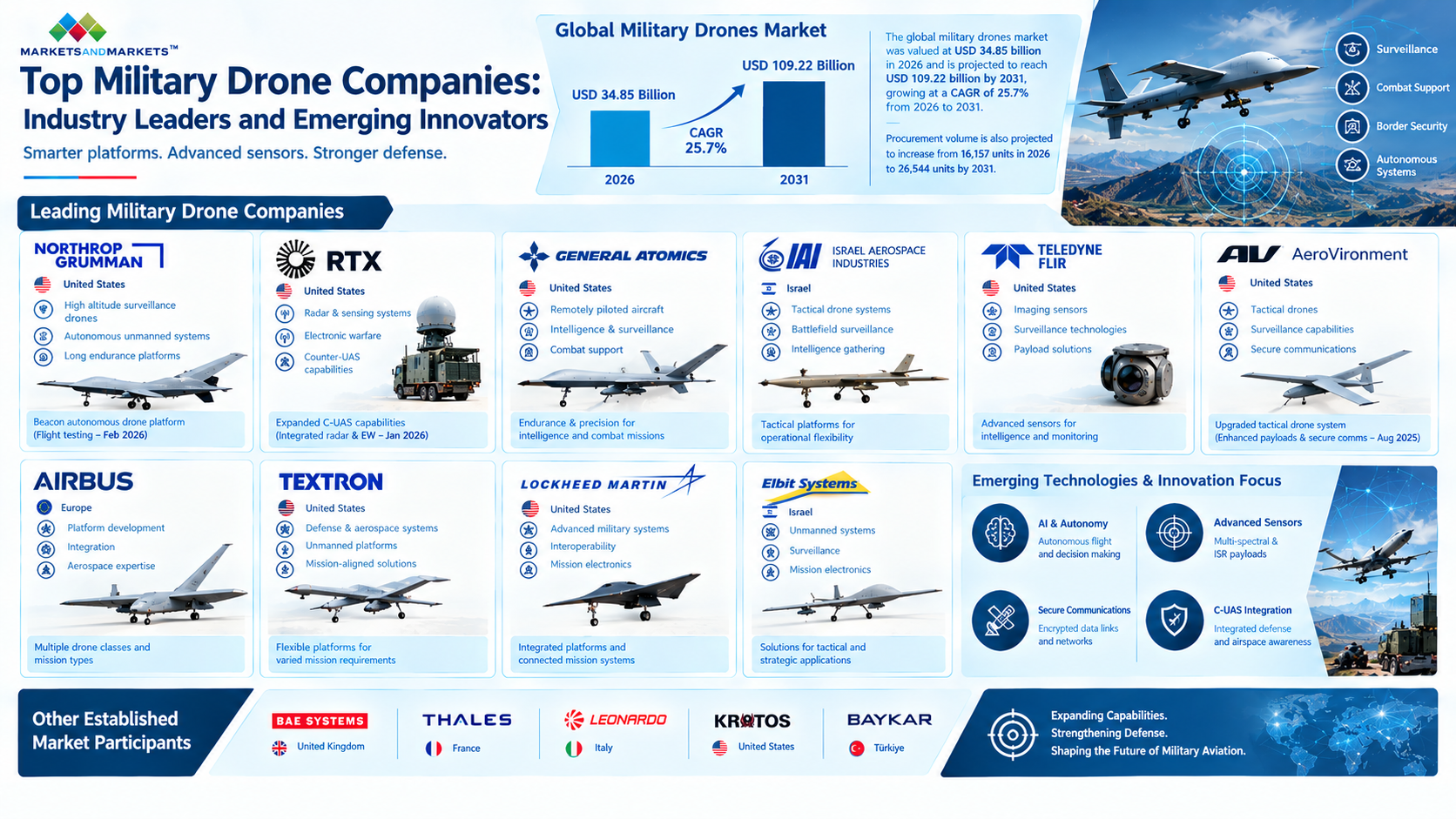
According to MarketsandMarkets, the Global Military Drones Market was valued at USD 34.85 billion in 2026 and is projected to reach USD 109.22 billion by 2031, growing at a compound annual growth rate (CAGR) of 25.7% from 2026 to 2031. Procurement volume is also projected to increase from 16,157 units in 2026 to 26,544 units by 2031. These forecasts reflect rising defense expenditure, growing demand for surveillance missions, combat support operations, border security, and investment in autonomous drone technologies.
The competitive landscape includes established aerospace and defense manufacturers, specialized unmanned aerial vehicle developers, and emerging technology companies. Their offerings span different drone sizes, endurance capabilities, mission profiles, and levels of autonomy. Companies are competing through platform performance, sensor integration, communications, autonomy, mission flexibility, and the ability to meet military procurement requirements.
As defense organizations expand unmanned capabilities, military drone manufacturers are increasingly important to the modernization of defense forces. Their challenge is to deliver reliable platforms that can operate in demanding environments and integrate with existing command, communications, and intelligence systems.
Military Drones Market Size and Forecast
|
Market Metric |
Value |
|---|---|
|
Market size in 2026 |
USD 34.85 billion |
|
Projected market size in 2031 |
USD 109.22 billion |
|
CAGR from 2026 to 2031 |
25.7% |
|
Procurement volume in 2026 |
16,157 units |
|
Projected procurement volume in 2031 |
26,544 units |
|
Leading regional market by 2025 share |
Middle East |
|
Middle East market share in 2025 |
41.9% |
|
Fastest growing autonomy segment |
Fully autonomous drones |
|
Fastest growing propulsion segment |
Fuel cell powered drones |
Source: MarketsandMarkets, Military Drones Market.
The forecast represents an increase of USD 74.37 billion in market value between 2026 and 2031. The projected rise in procurement volume also indicates that market growth involves both higher spending on military unmanned systems and an increase in the number of drones procured.
Top 10 Key Takeaways
- The global military drones market is projected to grow from USD 34.85 billion in 2026 to USD 109.22 billion by 2031.
- The market is forecast to register a CAGR of 25.7% from 2026 to 2031.
- Military drone procurement volume is projected to increase from 16,157 units in 2026 to 26,544 units in 2031.
- Northrop Grumman, RTX, General Atomics, Israel Aerospace Industries, and Teledyne FLIR are identified as leading market players.
- Anduril Industries and Shield AI are identified as progressive companies because of their product innovation and technological development.
- Tactical drones and intelligence, surveillance, and reconnaissance drones are leading segments in the market overview.
- The Middle East accounted for 41.9% of the market in 2025.
- Fully autonomous military drones are projected to grow at the fastest rate among autonomy segments, with a CAGR of 31.7%.
- Fuel cell powered military drones are projected to record the fastest growth among propulsion segments, at a CAGR of 32.5%.
- AI enabled autonomy, swarm technologies, modular payloads, and manned unmanned teaming are important trends shaping the market.
Key Growth Drivers in the Military Drones Market
Rising Defense Spending and Military Modernization
Increasing defense expenditure is supporting procurement of unmanned platforms across major military markets. Defense organizations are expanding their use of drones to support surveillance, reconnaissance, border monitoring, and combat operations.
Modernization programs are also increasing demand for platforms with improved endurance, payload capabilities, sensors, and secure communications. These requirements are creating opportunities for established defense contractors and specialized drone manufacturers.
Growing Demand for Intelligence, Surveillance, and Reconnaissance
Intelligence, surveillance, and reconnaissance, commonly known as ISR, is a major application area for military drones. These systems help defense organizations collect information, monitor operational areas, and improve situational awareness.
The MarketsandMarkets overview identifies ISR drones as the leading drone type. Their role in battlefield monitoring, border surveillance, and intelligence gathering supports demand for platforms that can carry suitable sensing equipment and remain operational for extended periods.
Increasing Border Security Requirements
Border monitoring and counterterrorism operations are contributing to the adoption of military drones. Unmanned systems can support persistent observation over large areas and provide information to defense and security personnel.
As defense agencies expand surveillance capabilities, they require platforms that can support mission appropriate endurance, payloads, and communication links. These requirements contribute to demand across tactical and strategic drone categories.
Growth in Combat Support and Unmanned Operations
Military drones are being incorporated into a wider range of defense missions, including combat support and specialized unmanned operations. This is increasing demand for different platform classes, from small systems to larger strategic drones.
Manufacturers are responding with a variety of designs based on mission requirements, payload capacity, endurance, propulsion, and launch method. The market therefore includes both surveillance focused platforms and systems intended for other military roles.
Investment in Artificial Intelligence and Autonomy
AI enabled autonomy is an important driver of military drone innovation. Defense agencies are investing in technologies that can support autonomous mission functions, data processing, and coordinated operations.
The market is also seeing growing interest in swarm technologies, in which multiple unmanned systems can coordinate activities. These developments are influencing platform design and the integration of software, sensors, communications, and mission systems.
Demand for Cost Effective Force Multiplication
Military drones can extend surveillance and operational capacity without requiring a pilot onboard every aircraft. This is encouraging interest in unmanned platforms as part of broader defense force modernization.
The economic case varies by drone class, mission, support infrastructure, and lifecycle cost. However, demand for scalable unmanned capabilities is contributing to procurement across different defense applications.
Key Military Drone Companies and Competitive Positioning
The military drones market includes established defense contractors with broad unmanned aircraft portfolios, companies specializing in remotely piloted platforms, sensor suppliers, and newer developers focused on autonomous technologies.
MarketsandMarkets identifies Northrop Grumman, RTX, General Atomics, Israel Aerospace Industries, and Teledyne FLIR as leading players. AeroVironment, Airbus, Textron, Lockheed Martin, Elbit Systems, BAE Systems, Thales, Leonardo, Kratos, and Baykar are also included among the key companies.
Northrop Grumman
Headquarters: United States
Northrop Grumman is identified by MarketsandMarkets as a leading player in the military drones market. The company's position is associated with high altitude surveillance drones and autonomous unmanned systems for intelligence gathering and defense monitoring.
The report identifies the company's capabilities in long endurance unmanned platforms as a contributor to its market position. These systems serve requirements for sustained surveillance and intelligence collection.
In February 2026, Northrop Grumman began flight testing activities for its Beacon autonomous drone platform, according to the report. The development focuses on AI integration and autonomous mission execution in future military aircraft programs.
RTX
Headquarters: United States
RTX is listed as a leading participant in the military drones market. The company's role in the broader defense technology ecosystem includes radar, sensing, and electronic systems relevant to military operations involving unmanned platforms.
MarketsandMarkets reports that RTX expanded its counter unmanned aerial system capabilities in January 2026 through the integration of advanced radar and electronic warfare technologies. While counter drone systems are distinct from military drones themselves, these technologies are relevant to the wider unmanned systems environment.
General Atomics
Headquarters: United States
General Atomics is identified as a leading military drone manufacturer. The company is recognized for remotely piloted aircraft used in intelligence missions and combat related operations.
Its presence reflects the continuing role of established unmanned aircraft manufacturers in defense procurement. Demand for long duration missions, intelligence collection, and combat support contributes to the importance of platforms that combine endurance with mission specific payloads.
Israel Aerospace Industries
Headquarters: Israel
Israel Aerospace Industries (IAI) is identified among the leading players in the military drones market. MarketsandMarkets highlights its presence in tactical drone systems and battlefield surveillance platforms.
The company's inclusion reflects demand for unmanned systems designed for intelligence gathering and defense monitoring. Tactical platforms are particularly relevant to military organizations seeking drone capabilities for missions requiring situational awareness and operational flexibility.
Teledyne FLIR
Headquarters: United States
Teledyne FLIR is a leading company identified in the MarketsandMarkets report. Its position is associated with imaging sensors and surveillance technologies used on military drone platforms.
Sensors are an important part of the military drone ecosystem because they enable the collection of information for intelligence and monitoring missions. The company's inclusion highlights the importance of payload and sensing technologies alongside complete aircraft platforms.
AeroVironment
Headquarters: United States
AeroVironment is included among the key companies in the military drones market. The company participates in the unmanned systems sector, where demand spans tactical platforms, surveillance capabilities, and rapidly deployable systems.
In August 2025, MarketsandMarkets reported that AeroVironment introduced an upgraded tactical drone system with enhanced surveillance payloads and secure communication technologies for military intelligence operations. The reported development reflects the continued importance of payload and communications improvements.
Airbus
Headquarters: Europe
Airbus is listed among the key military drone market companies. Its presence reflects the participation of major aerospace manufacturers in the broader unmanned aircraft sector.
The military drone market includes multiple classes and mission types, requiring different aircraft designs and systems. Large aerospace companies can contribute through platform development, integration, and their wider experience in aviation and defense programs.
Textron
Headquarters: United States
Textron is included among the leading companies covered by the MarketsandMarkets report. The company participates in the defense and aerospace ecosystem, which includes unmanned systems and related military technologies.
Demand for military drones varies by platform size, endurance, payload, and launch method. Suppliers operating across defense programs must align their products with the mission requirements and procurement priorities of military customers.
Lockheed Martin
Headquarters: United States
Lockheed Martin is listed among the key military drone market participants. Its presence reflects the role of major defense contractors in the development and integration of advanced military systems.
As defense agencies invest in unmanned platforms and connected mission systems, interoperability with existing defense infrastructure is increasingly important. The wider market therefore includes aircraft manufacturers as well as companies supplying mission electronics, sensors, and communications technologies.
Elbit Systems
Headquarters: Israel
Elbit Systems is included among the key companies in the military drones market. The company is part of the international defense technology sector supporting unmanned systems and associated military electronics.
The market's development is influenced by demand for surveillance capabilities, autonomous technologies, and mission systems. Suppliers must address different platform and operational requirements across tactical and strategic applications.
Other Established Market Participants
MarketsandMarkets also lists BAE Systems, Thales, Leonardo, Kratos, and Baykar among the key military drone companies. These suppliers contribute to the wider defense ecosystem for unmanned aircraft, military electronics, and mission technologies.
The market is not limited to manufacturers of complete aircraft. Sensor providers, communication technology companies, autonomy developers, and other subsystem suppliers also influence performance and competition across the military drone industry.
Speak Our Industry Analyst to Know More: https://www.marketsandmarkets.com/speaktoanalystNew.asp?id=221577711
Emerging Innovators in the Military Drones Market
The military drones market is attracting companies that emphasize autonomy, software integration, and new approaches to unmanned systems. MarketsandMarkets identifies Anduril Industries and Shield AI as progressive companies distinguished by product innovation and technological development. Baykar is also highlighted in the report's company evaluation discussion as an emerging company with a growing portfolio of combat drones and tactical unmanned systems.
Anduril Industries
United States
Anduril Industries is identified as a progressive company in the military drones market. Its position reflects the wider industry shift toward software driven defense technologies and autonomous unmanned systems.
As military organizations explore connected and autonomous platforms, innovation increasingly involves more than airframe design. Software, sensing, communication, and the ability to integrate systems into wider defense networks are also important areas of development.
Shield AI
United States
Shield AI is another progressive company identified by MarketsandMarkets. Its inclusion highlights growing interest in autonomy related innovation within the military drone ecosystem.
The market's focus on autonomous mission functions and AI enabled technologies is creating opportunities for companies developing software and systems for unmanned platforms. Adoption depends on operational requirements, testing, and the ability to integrate new technologies into military environments.
Baykar
Türkiye
Baykar is identified in the MarketsandMarkets company evaluation matrix as an emerging company with a growing portfolio of combat drones and tactical unmanned systems.
In October 2025, the report noted new flight demonstrations for a next generation unmanned combat drone platform, with a focus on autonomous flight capabilities and operational endurance. This illustrates how established regional drone manufacturers are continuing to develop platforms for military surveillance and combat related missions.
Technology Innovations Transforming Military Drones
Artificial Intelligence and Autonomous Mission Functions
AI is an important innovation area in military drones. Defense agencies are increasingly interested in systems that can support autonomous mission functions, process information, and assist operators in complex environments.
Autonomy spans different levels, from remotely piloted aircraft with automated functions to semi autonomous and fully autonomous platforms. The market distinguishes these categories, and the degree of autonomy varies by system and intended mission.
MarketsandMarkets projects the fully autonomous segment to grow at a CAGR of 31.7% from 2026 to 2031, making it the fastest growing autonomy category in the report.
Swarm Drone Technologies
Swarm technologies are an emerging trend in the military drone market. The concept involves coordinating multiple unmanned systems rather than relying solely on a single aircraft operating independently.
Interest in swarm technologies reflects broader investment in autonomy and coordinated unmanned operations. Such systems introduce demanding requirements for communications, coordination, reliability, and integration with military command structures.
Long Endurance Platforms
Long endurance drones are important for missions requiring extended observation and intelligence gathering. Their capabilities depend on factors including aircraft design, propulsion, payload, and energy management.
MarketsandMarkets identifies endurance as a key market segmentation category, covering drones operating for less than five hours, five to twenty hours, twenty to forty hours, and more than forty hours. These categories reflect different operational requirements across military drone classes.
Modular Payload Systems
Modular payloads allow platforms to accommodate different mission equipment, depending on the design of the aircraft and its payload interfaces. This trend can support greater flexibility across surveillance, communications, and other military applications.
For manufacturers, modularity involves balancing payload capacity, aircraft performance, power requirements, and integration complexity. The market's emphasis on modular payload systems reflects demand for platforms adaptable to varied defense needs.
Fuel Cell Propulsion
Fuel cell powered military drones are projected to record the highest growth rate among propulsion categories, with a CAGR of 32.5% from 2026 to 2031.
The propulsion segment includes fuel powered, battery powered, and fuel cell systems. Different propulsion options serve different requirements related to endurance, power, platform size, and operating conditions. The projected growth of fuel cell powered drones highlights increasing interest in alternative propulsion technologies for military unmanned aircraft.
Secure Communications and Connected Mission Systems
Military drones rely on communication systems to exchange information with operators and other defense assets. As the market moves toward connected mission systems, secure communications and data integration are important areas of development.
This trend also creates challenges. MarketsandMarkets identifies vulnerability to electronic warfare, cyberattacks, and communication disruptions as a market restraint. Manufacturers must therefore consider system resilience and reliable communications alongside platform performance.
Military Drones Market Segmentation
MarketsandMarkets segments the military drones market across class, drone type, maximum takeoff weight, payload capacity, endurance, wing type, autonomy level, launch mode, propulsion, and region.
|
Segmentation Category |
Key Segments |
Market Insight |
|---|---|---|
|
Class |
Small, tactical, strategic |
Tactical drones are identified as the leading class. |
|
Drone type |
Combat or strike, ISR, delivery, target |
ISR drones lead the drone type category. |
|
Maximum takeoff weight |
Up to 150 kg, 151 to 2,000 kg, above 2,000 kg |
The 151 to 2,000 kg category is identified as the leading segment in the report overview. |
|
Payload capacity |
Below 5 kg, 5 to 50 kg, 50 to 250 kg, above 250 kg |
The 5 to 50 kg category leads the payload capacity segmentation. |
|
Endurance |
Below 5 hours, 5 to 20 hours, 20 to 40 hours, above 40 hours |
The 5 to 20 hour category leads the endurance segmentation. |
|
Wing type |
Fixed wing, rotary wing, hybrid |
Fixed wing drones are identified as the leading segment. |
|
Autonomy level |
Remotely piloted, semi autonomous, fully autonomous |
Fully autonomous drones are projected to grow fastest. |
|
Launch mode |
VTOL, runway dependent, catapult launched, hand launched |
Catapult launched drones are projected to grow fastest. |
|
Propulsion |
Fuel powered, battery powered, fuel cell |
Fuel cell powered drones are projected to grow fastest. |
Source: MarketsandMarkets, Military Drones Market.
Class Insights
Tactical drones are identified as the leading class. Their use in surveillance, battlefield monitoring, and other military missions supports demand for platforms that can operate across tactical environments.
The market also covers small and strategic drones. These categories serve different requirements in terms of size, payload, endurance, deployment, and operational range.
Drone Type Insights
ISR drones lead the drone type category in the report overview. Their role in intelligence collection, surveillance, and reconnaissance makes them important to military organizations seeking improved situational awareness.
The market also includes combat or strike drones, delivery drones, and target drones. These types support different military requirements and contribute to demand for varied unmanned aircraft designs.
Payload and Endurance Insights
The 5 to 50 kg payload category and the 5 to 20 hour endurance category are identified as leading segments in the MarketsandMarkets overview.
Payload capacity influences the equipment a drone can carry, while endurance affects how long it can remain in operation. Manufacturers must balance these factors with aircraft weight, propulsion, and mission requirements.
Wing Type and Launch Mode Insights
Fixed wing drones are identified as the leading wing type, reflecting their use in missions requiring coverage over large areas and sustained flight. Rotary wing and hybrid platforms also form part of the market.
Runway dependent drones are identified as the leading launch mode, while catapult launched systems are projected to record the highest CAGR of 26.7% from 2026 to 2031. This demonstrates that the market includes both established deployment methods and launch approaches expected to expand faster.
Regional Insights: Middle East Leads Market Share
Middle East
The Middle East accounted for 41.9% of the global military drones market in 2025, making it the leading regional market by share in the MarketsandMarkets overview. Defense spending, geopolitical tensions, border security requirements, and investment in autonomous defense technologies are identified as factors supporting regional demand.
Military drones are relevant to regional requirements for surveillance, intelligence gathering, and combat support. The market outlook is also influenced by national procurement strategies and the adoption of unmanned systems across defense organizations.
North America
North America is home to several major military drone companies, including Northrop Grumman, RTX, General Atomics, Teledyne FLIR, AeroVironment, Textron, and Lockheed Martin.
The region's market is influenced by defense modernization, investment in autonomous technologies, and demand for advanced unmanned systems. Its established defense industrial base supports the development of aircraft, sensors, communications, and other technologies used in military drone platforms.
Europe
Europe's military drone market includes established aerospace and defense companies such as Airbus, BAE Systems, Thales, and Leonardo. These companies operate within a broader regional ecosystem supporting military aircraft and defense technologies.
Demand is influenced by national defense priorities, unmanned system procurement, and the integration of new technologies into existing defense architectures. Regional opportunities vary according to procurement budgets and individual military requirements.
Asia Pacific
Asia Pacific is included among the regions covered by the MarketsandMarkets report. Demand across the region is associated with defense modernization, border monitoring, surveillance, and investment in unmanned technologies.
The region's market development depends on procurement priorities, local industrial capabilities, and the adoption of different drone classes and mission types. The supplied market overview does not provide a separate numerical regional forecast for Asia Pacific.
Latin America and Africa
Latin America and Africa are also covered in the market assessment. Adoption in these regions depends on defense and security priorities, available procurement budgets, and requirements for surveillance and border monitoring.
The supplied report overview does not provide separate market size figures for these regions, so their individual market values should not be inferred.
Opportunities in the Military Drones Market
International Drone Exports and Defense Partnerships
MarketsandMarkets identifies expansion of military drone exports and international defense collaborations as an important market opportunity. Partnerships can support procurement, technology development, and the expansion of manufacturer relationships across countries.
Export opportunities depend on national regulations, procurement decisions, defense partnerships, and the technical requirements of the purchasing country.
Manned Unmanned Teaming
Manned unmanned teaming involves coordinating crewed aircraft or other platforms with unmanned systems. The report identifies growing integration of military drones with manned unmanned teaming operations as an opportunity.
This trend is connected to the wider move toward networked defense systems in which different platforms share information and contribute to broader missions. Interoperability and reliable communications are important requirements for such integration.
Autonomous Systems and Software Innovation
Investment in autonomy creates opportunities for companies developing software, sensors, communications, and integrated mission systems. The projected growth of the fully autonomous segment indicates increasing interest in this area.
Companies can differentiate themselves through technological innovation, integration capabilities, and the ability to meet the reliability and validation requirements of military customers.
Alternative Propulsion Technologies
Fuel cell powered drones are projected to record the fastest growth among propulsion segments. This creates an opportunity for manufacturers and technology suppliers working on propulsion options for military unmanned aircraft.
The development and adoption of these systems depend on their suitability for particular platforms, endurance requirements, operating environments, and procurement needs.
Modular Payloads and Mission Flexibility
Modular payload systems are an important trend in the market. They allow suitable platforms to accommodate different mission equipment within the limits of their design.
Manufacturers that can support compatible payload interfaces and effective system integration may be able to address a broader set of military requirements. However, the practical flexibility of each platform depends on its payload capacity and technical architecture.
Challenges Facing Military Drone Manufacturers
Vulnerability to Electronic Warfare and Cyberattacks
Military drones may be affected by electronic warfare, cyberattacks, and communication disruptions. These risks can influence navigation, data exchange, and mission control.
MarketsandMarkets identifies these vulnerabilities as a restraint in the military drones market. Resilience, secure communications, and dependable system performance are therefore important concerns for manufacturers and defense customers.
High Procurement and Lifecycle Costs
Advanced military drones can require substantial investment in acquisition, operation, and maintenance. Costs vary according to aircraft class, payload, endurance, propulsion, support infrastructure, and mission requirements.
High procurement and lifecycle costs can constrain adoption, especially when defense organizations must balance unmanned system spending against other modernization priorities.
Supply Chain Disruptions
Military drone production depends on electronic components, semiconductors, imaging sensors, propulsion systems, and other specialized technologies. Disruptions or shortages can delay manufacturing and affect delivery schedules.
MarketsandMarkets identifies dependence on critical semiconductor and electronic components as a challenge for the industry. Manufacturers must account for supply continuity and component availability as they plan production.
Integration and Interoperability
Military drones need to work with communications infrastructure, ground control systems, sensors, and other defense platforms. Integrating new systems with existing infrastructure can introduce technical and operational complexity.
Interoperability is especially important as defense agencies move toward connected mission systems and manned unmanned teaming. System integration, validation, and long term support can influence procurement decisions.
Regulatory and Ethical Concerns
The growing use of autonomous combat drones raises regulatory and ethical questions. MarketsandMarkets identifies these concerns as a challenge for the industry.
The level of autonomy, the role of human oversight, and the governance of military applications can influence development and adoption. Companies must consider applicable regulatory requirements and the specific expectations of defense customers.
Recent Developments in the Military Drones Market
MarketsandMarkets highlights several recent developments that illustrate activity across platforms, autonomy, sensors, and communications.
|
Date |
Company |
Reported Development |
|---|---|---|
|
February 2026 |
Northrop Grumman |
Began flight testing activities for the Beacon autonomous drone platform, focusing on AI integration and autonomous mission execution. |
|
January 2026 |
RTX |
Expanded counter unmanned aerial system capabilities through integration of advanced radar and electronic warfare technologies. |
|
October 2025 |
Baykar |
Completed flight demonstrations for a next generation unmanned combat drone platform, with a focus on autonomous flight and endurance. |
|
August 2025 |
AeroVironment |
Introduced an upgraded tactical drone system with enhanced surveillance payloads and secure communications technologies. |
|
May 2025 |
Leonardo |
Expanded its unmanned aerial system portfolio through integration of advanced sensors for intelligence and reconnaissance missions. |
Source: MarketsandMarkets, Military Drones Market.
These developments reflect several areas of competitive activity: autonomous aircraft development, counter drone technologies, surveillance payload improvements, and sensor integration. Together, they illustrate that market competition involves aircraft platforms as well as the supporting technologies that enable military missions.
Future Outlook for the Military Drones Market
The global military drones market is projected to increase from USD 34.85 billion in 2026 to USD 109.22 billion by 2031, registering a CAGR of 25.7%. Procurement volume is expected to rise from 16,157 units to 26,544 units over the same period. These projections reflect growing defense expenditure, increased use of unmanned systems, and investment in autonomous technologies.
Northrop Grumman, RTX, General Atomics, Israel Aerospace Industries, and Teledyne FLIR are identified as leading market participants. Anduril Industries and Shield AI are recognized as progressive companies, while Baykar is highlighted for its developing portfolio of combat and tactical unmanned systems.
Technology development will remain an important competitive factor. AI enabled autonomy, swarm technologies, modular payloads, secure communications, and alternative propulsion systems are influencing the direction of the market. Fully autonomous and fuel cell powered drones are projected to record particularly strong growth within their respective segments.
The Middle East accounted for 41.9% of the market in 2025, while demand across North America, Europe, Asia Pacific, Latin America, and Africa reflects differing defense priorities and procurement requirements.
At the same time, manufacturers face challenges related to electronic warfare, cybersecurity, component supply chains, lifecycle costs, and the integration of autonomous systems. Long term competitiveness will depend on the ability to meet defense customer requirements while maintaining reliability, supply continuity, and compatibility with evolving defense infrastructure.
Overall, the military drones market is entering a period of substantial projected growth. Established defense contractors and emerging innovators are likely to remain important as military organizations expand unmanned capabilities and incorporate increasingly connected technologies into their defense operations.
Frequently Asked Questions
1. What is the projected size of the military drones market by 2031?
The global military drones market is projected to reach USD 109.22 billion by 2031, increasing from USD 34.85 billion in 2026 at a CAGR of 25.7%.
2. Who are the leading military drone companies?
MarketsandMarkets identifies Northrop Grumman, RTX, General Atomics, Israel Aerospace Industries, and Teledyne FLIR as leading players. Other key companies include AeroVironment, Airbus, Textron, Lockheed Martin, Elbit Systems, BAE Systems, Thales, Leonardo, Kratos, and Baykar.
3. Which region held the largest share of the military drones market in 2025?
The Middle East accounted for 41.9% of the global military drones market in 2025, according to the MarketsandMarkets overview.
4. Which military drone segment is expected to grow fastest by autonomy level?
The fully autonomous military drone segment is projected to record the highest CAGR among autonomy categories, at 31.7% from 2026 to 2031.
5. What technologies are shaping the future of military drones?
Key trends include AI enabled autonomy, swarm technologies, modular payload systems, secure communications, manned unmanned teaming, and fuel cell propulsion. Fuel cell powered military drones are projected to grow at a CAGR of 32.5% from 2026 to 2031.

This FREE sample includes market data points, ranging from trend analyses to market estimates & forecasts. See for yourself.
SEND ME A FREE SAMPLE