100 Missile Defense Companies: Industry Leaders and Emerging Technologies
Missile defense systems are a critical part of modern national security infrastructure. Designed to detect, track, assess, and counter incoming missile threats, these systems support the protection of military installations, strategic assets, population centers, and other high value targets. Their role is becoming increasingly important as governments respond to evolving ballistic and cruise missile threats and modernize their defense capabilities.
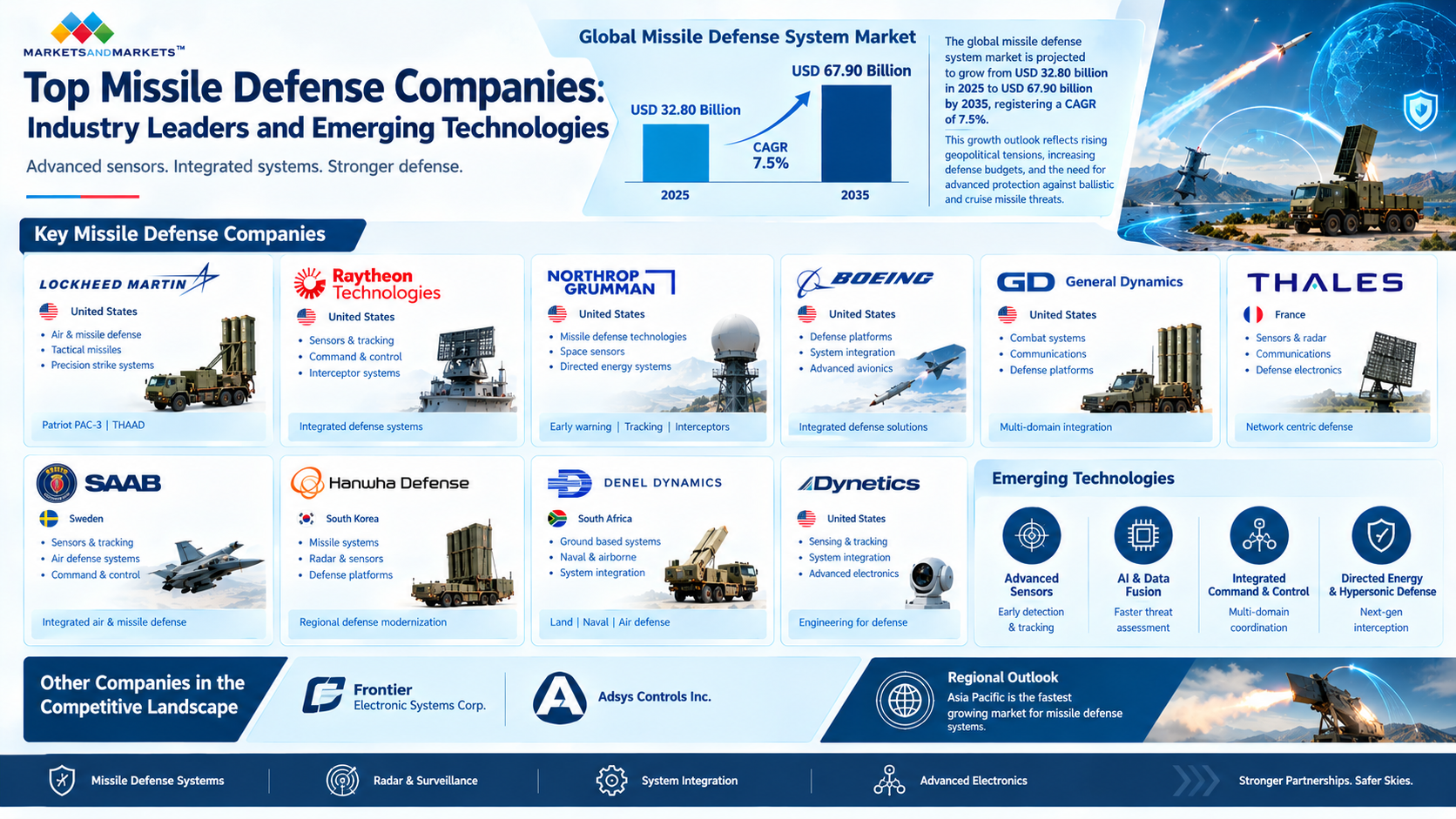
According to MarketsandMarkets, the Global Missile Defense System Market is estimated to reach approximately USD 32.80 billion in 2025 and is projected to grow to USD 67.90 billion by 2035, registering a compound annual growth rate (CAGR) of 7.5% during the forecast period. Rising geopolitical tensions, increasing defense budgets, and the need for advanced missile protection are supporting market expansion.
The competitive landscape includes major defense companies such as Lockheed Martin Corporation, Raytheon Technologies, Northrop Grumman Corporation, Boeing, General Dynamics, BAE Systems, Thales Group, and MBDA. These companies operate across different parts of the defense ecosystem, including missile defense systems, radar technologies, interceptors, fire control, and command and control infrastructure.
Technology development is also changing how missile defense architectures are designed and integrated. Artificial intelligence, connected sensor networks, automation, advanced radar, and sensor fusion are increasingly important in efforts to improve threat assessment and coordination between system components. Hypersonic missile defense and directed energy technologies are among the emerging areas attracting attention in defense modernization programs.
Missile Defense System Market Size and Forecast
|
Market Metric |
Value |
|---|---|
|
Estimated market size in 2025 |
USD 32.80 billion |
|
Projected market size in 2035 |
USD 67.90 billion |
|
CAGR from 2025 to 2035 |
7.5% |
|
Leading system category |
Ground based missile defense systems |
|
Leading regional market |
North America |
|
Fastest growing region |
Asia Pacific |
|
Major companies |
Lockheed Martin, Raytheon Technologies, Northrop Grumman, Boeing, General Dynamics |
Source: MarketsandMarkets, Missile Defense System Market.
The forecast indicates a substantial expansion in the value of the missile defense system market over the next decade. The market's development is connected to national security priorities, the modernization of defense infrastructure, and investment in systems designed to respond to a changing range of missile threats.
Top 10 Key Takeaways
-
The global missile defense system market is projected to grow from USD 32.80 billion in 2025 to USD 67.90 billion by 2035.
-
The market is forecast to register a CAGR of 7.5% during 2025 to 2035.
-
Lockheed Martin, Raytheon Technologies, Northrop Grumman, Boeing, and General Dynamics are among the major companies identified in the market assessment.
-
Ground based missile defense systems are the leading product category because of their role in national defense architectures.
-
North America leads the market, supported by advanced defense infrastructure and investment in missile defense programs.
-
Asia Pacific is projected to be the fastest growing regional market.
-
Artificial intelligence and automation are supporting advances in threat analysis and decision support.
-
Connected sensors and command and control networks are contributing to the development of network centric missile defense architectures.
-
Hypersonic missile defense, multi layered interception, and sensor fusion are important technology development areas.
-
Defense modernization, rising missile threats, and increasing defense expenditure are central factors supporting market growth.
Key Growth Drivers in the Missile Defense System Market
Rising Geopolitical Tensions and Evolving Missile Threats
Increasing geopolitical tensions and concerns about national security are encouraging governments to strengthen missile defense capabilities. The development and proliferation of ballistic and cruise missiles are increasing the importance of early warning, tracking, threat assessment, and interception systems.
Missile defense programs must account for changing threat characteristics and the need to protect strategic assets across different operating environments. This is supporting investment in integrated defense architectures that connect sensors, command centers, and interception systems.
Increasing Defense Budgets and Modernization Programs
Defense modernization is another major driver of market growth. Governments are investing in new capabilities and upgrading existing defense infrastructure to address evolving operational requirements.
These investments support demand for radar systems, interceptor technologies, fire control systems, and command and control infrastructure. For suppliers, modernization programs create opportunities across the wider missile defense ecosystem, from individual components to integrated system solutions.
Growing Need for Multi Layered Defense Architectures
Modern missile defense increasingly emphasizes multiple layers of detection, tracking, decision support, and interception. A layered architecture can combine different systems and operating domains to address threats under varying conditions.
Ground based systems remain central to national missile defense strategies, while naval and airborne systems provide additional deployment options. The integration of these systems with shared command and control networks is an important direction in market development.
Advancements in Radar and Sensor Technologies
Radar systems and advanced sensors provide information needed to identify and track potential threats. Improvements in detection, tracking, data processing, and sensor integration are helping shape the development of missile defense systems.
The market is also seeing increased interest in sensor fusion, which brings information from multiple sensors together for analysis. Integrating these capabilities with command and control systems is important for creating a coordinated operational picture.
Artificial Intelligence, Automation, and Connected Systems
Artificial intelligence and automation are becoming more important in missile defense system development. AI supported analytics can help process large volumes of sensor information, assess potential threats, and support decision making.
Connected sensor networks and Internet of Things technologies can improve information exchange between sensors, interceptors, and command centers. The wider objective is to develop more integrated and responsive defense architectures, although actual capabilities depend on the system design and its validation.
Growing Investment in Hypersonic Missile Defense
Hypersonic missile threats are creating new requirements for detection, tracking, assessment, and interception. The speed and flight characteristics associated with these threats present challenges for existing defense architectures.
As a result, hypersonic missile defense is emerging as an important area of research and investment. Companies with relevant sensing, tracking, command and control, and interception capabilities are participating in a wider industry focused on developing next generation defense technologies.
Key Missile Defense Companies and Competitive Positioning
The missile defense system market includes established defense contractors, missile system developers, and technology providers. Their competitive positions are influenced by system integration capabilities, experience with government defense programs, technological innovation, and the ability to support complex military requirements.
MarketsandMarkets identifies Lockheed Martin Corporation, Raytheon Technologies Corporation, Northrop Grumman Corporation, Boeing Company, and General Dynamics Corporation among the major market players. The broader market overview also identifies BAE Systems, Thales Group, and MBDA as companies shaping the competitive landscape.
Lockheed Martin Corporation
Headquarters: United States
Lockheed Martin is one of the major defense contractors identified in the missile defense system market. Its Missile and Fire Control business covers air and missile defense systems, tactical missiles, precision strike systems, fire control, and related integration and support activities.
MarketsandMarkets identifies the Patriot Advanced Capability 3 (PAC 3) and Terminal High Altitude Area Defense (THAAD) programs among the company's major missile defense programs. These programs illustrate the role of established defense contractors in supplying and integrating advanced missile defense capabilities.
Missile Defense System Industry Players
Lockheed Martin's position reflects the importance of integrated system expertise in a market where missile defense depends on the coordination of detection, tracking, command and control, and interception functions.
Raytheon Technologies Corporation
Headquarters: United States
Raytheon Technologies is identified by MarketsandMarkets as a major participant in the missile defense system market. The company is part of the established defense industry serving requirements for air and missile defense capabilities.
Competition in this market increasingly involves the integration of radar, interceptors, fire control, and command and control technologies. Companies must support demanding defense requirements while continuing to invest in technical improvements and system integration.
Raytheon Technologies is among the major suppliers shaping the competitive environment as governments pursue missile defense modernization.
Northrop Grumman Corporation
Headquarters: United States
Northrop Grumman is a major defense and aerospace company identified in the MarketsandMarkets competitive landscape. Its missile defense related capabilities span areas such as command systems, interceptors, space based sensors, and directed energy technologies.
The company's role reflects the broad technical requirements of missile defense, which extend beyond interceptor hardware to include detection, tracking, communications, and system testing. These capabilities are important in the development and integration of complex defense architectures.
Missile Defense System Industry Players
As demand grows for advanced detection and interception capabilities, companies with experience across multiple elements of missile defense infrastructure remain important participants in the market.
Boeing Company
Headquarters: United States
Boeing is included among the major missile defense system market players identified by MarketsandMarkets. Its inclusion reflects the participation of large aerospace and defense companies in programs addressing national security and advanced defense capabilities.
The missile defense market requires coordination across multiple technology areas, including sensing, command and control, system integration, and interception. The competitive environment is therefore shaped by companies that can contribute to complex defense programs and meet demanding customer requirements.
General Dynamics Corporation
Headquarters: United States
General Dynamics is identified as one of the major companies in the missile defense system market. MarketsandMarkets describes its broader portfolio as including combat vehicles, communications systems, ships, submarines, and other defense capabilities.
The company's participation illustrates the connections between missile defense and the wider defense platform ecosystem. Naval platforms, communications infrastructure, and integrated defense systems all contribute to the broader environment in which missile defense capabilities are deployed.
Missile Defense System Industry Players
BAE Systems
Headquarters: United Kingdom
BAE Systems is among the defense companies identified in the broader missile defense market overview. The company operates in the aerospace and defense sector, where advanced electronics, sensing, combat systems, and integration technologies are important areas of activity.
The wider market is placing increasing emphasis on interoperable defense architectures, advanced sensor networks, and integrated command and control. These requirements create opportunities for established defense suppliers participating in complex military programs.
Thales Group
Headquarters: France
Thales Group is included in the broader list of companies shaping the missile defense system market. Its presence reflects the importance of defense electronics and sensing technologies within the market's wider industrial ecosystem.
Radar, sensor networks, and command and control systems are key elements of missile defense architecture. Suppliers with experience in defense electronics and system integration operate in a market where reliable information exchange and coordination across components are increasingly important.
MBDA
Headquarters: Europe
MBDA is identified among the companies shaping the missile defense market. As a missile systems company, it is part of the broader ecosystem of suppliers and integrators serving advanced defense requirements.
The market's development is linked to the procurement of missile systems and the integration of interception capabilities into wider defense architectures. This makes missile system expertise and compatibility with related defense infrastructure important considerations in the competitive landscape.
Other Companies and Emerging Technology Participants
The MarketsandMarkets market page also lists Frontier Electronic Systems Corp., Adsys Controls Inc., Hanwha Defense, Denel Dynamics, and Dynetics, Inc. within its company coverage. These organizations form part of the wider landscape of suppliers and technology participants associated with missile defense systems.
The term emerging technology participants does not necessarily mean these companies are new entrants. Rather, it describes the broader set of companies involved in technology development, system components, and specialized defense solutions alongside established prime contractors.
For the market as a whole, innovation in sensing, radar, command and control, interception technologies, and system integration is an important competitive factor. The market page does not provide comparable market shares or a complete ranking for every company, so individual company positions should not be inferred beyond the information it supplies.
Speak Our Industry Analyst to Know More: https://www.marketsandmarkets.com/speaktoanalystNew.asp?id=16924979
Emerging Technologies Transforming Missile Defense Systems
Artificial Intelligence and Automated Threat Assessment
AI is influencing missile defense system development by supporting the analysis of information from sensors and other system components. Machine learning and advanced analytics can help process large data volumes and provide decision support to operators.
Automation can also support the coordination of system functions and reduce the time required for certain information processing tasks. The extent of automation depends on system design, operational requirements, and validation processes. Human oversight and reliable system performance remain important considerations in defense applications.
Advanced Radar and Sensor Networks
Radar systems play a central role in detecting and tracking potential missile threats. Continued advances in radar technology and sensor networks are intended to improve the information available to missile defense systems.
Networked sensors can provide information from different locations and platforms, while sensor fusion can combine data for a more comprehensive assessment. These capabilities support the broader move toward connected, multi domain defense architectures.
Multi Layered Interception Systems
Multi layered missile defense architectures use different systems and deployment options to address missile threats. The approach can combine ground based systems with naval or airborne capabilities, depending on national defense requirements.
Ground based systems remain the leading product category in the MarketsandMarkets overview. Naval systems are gaining attention for their mobility and deployment flexibility, while airborne systems are an emerging area for advanced interception missions.
Hypersonic Defense Technologies
Hypersonic missile defense is an emerging technology area as governments seek ways to address evolving missile threats. Developing appropriate defense capabilities involves challenges in detection, tracking, decision making, and interception.
The market overview identifies hypersonic missile defense among the important technology trends. Its development is part of the broader effort to adapt missile defense architectures to changing threat profiles.
Directed Energy Systems
Directed energy weapons are another technology area associated with the evolution of missile defense. They use concentrated energy rather than conventional interceptor projectiles to engage a target.
These technologies are part of a broader innovation landscape that includes advanced sensors, tracking, and interception concepts. Their deployment depends on system maturity, operating conditions, and the requirements of specific defense programs.
Connected Command and Control Networks
Command and control systems coordinate information from sensors, decision makers, and defense assets. Their integration with connected sensor networks can help improve information exchange and support coordinated responses.
As defense infrastructure becomes more network centric, interoperability, secure communications, and dependable data handling are important requirements. The ability to integrate new technologies with existing systems remains a central challenge for suppliers.
Missile Defense System Market Segmentation
The MarketsandMarkets report segments the missile defense system market by technology, range, threat type, domain, and region. The product overview also distinguishes ground based, naval based, and airborne missile defense systems.
|
Segmentation Category |
Key Segments |
Market Insight |
|---|---|---|
|
Technology |
Fire control system, weapon system, countermeasure system, command and control system |
Integration of sensing, decision support, and interception technologies is shaping system development. |
|
Range |
Short range, medium range, long range |
Different range categories address different defense requirements. |
|
Threat type |
Ballistic missiles, cruise missiles, hypersonic threats and other missile threats |
Evolving threat profiles are encouraging investment in advanced defense capabilities. |
|
Domain |
Ground, air, marine, space |
Ground based systems lead the market, while naval and airborne systems are also important. |
|
Region |
North America, Europe, Asia Pacific, rest of the world |
North America leads, while Asia Pacific is projected to grow fastest. |
Source: MarketsandMarkets, Missile Defense System Market.
Product Insights: Ground Based, Naval Based, and Airborne Systems
Ground based missile defense systems represent the leading product category in the market overview. These systems form a major part of national defense infrastructure and can include radar installations, interceptors, and command and control units. Their strategic role supports continued investment in ground based defense capabilities.
Naval based missile defense systems are gaining prominence because ships can provide mobile defense capabilities and operate across maritime regions. These systems integrate detection, tracking, and interception functions into naval platforms.
Airborne missile defense systems are an emerging segment associated with mobility and advanced interception requirements. Their development involves integrating defense technologies with aircraft platforms and associated sensing and control systems.
Technology and Component Insights
Technology is central to the development of missile defense systems. Fire control systems, weapon systems, countermeasure systems, and command and control systems represent key categories in the market segmentation.
Radar systems, infrared sensors, tracking technologies, and advanced data processing contribute to the ability to detect and assess threats. AI, connected sensor networks, and automation are influencing the way these components exchange information and support system operations.
Future technology development includes sensor fusion, hypersonic defense, directed energy systems, and more integrated command and control networks. The challenge for manufacturers is to incorporate these technologies while meeting reliability, interoperability, and validation requirements.
Application Insights
Military and defense applications dominate the missile defense system market. Governments use these systems to support national defense, protect strategic assets, and strengthen the security of critical infrastructure.
Air defense is a significant application area because it involves protecting airspace from incoming missile threats. Naval applications support the protection of maritime platforms and operating areas, while ground based systems remain a central part of national defense architectures.
The market's future development is also connected to multi domain operations, where land, air, maritime, and space based assets share information through integrated networks.
Regional Insights: North America Leads While Asia Pacific Grows Fastest
North America
North America leads the missile defense system market, supported by advanced defense infrastructure, high military expenditure, and investment in missile defense programs. The region has an established defense industry with major companies participating in system development, integration, and production.
The United States is identified as the largest national market within North America in the supplied report overview. MarketsandMarkets estimates US market growth at approximately 7.2% CAGR, supported by continued investment in advanced defense systems.
Asia Pacific
Asia Pacific is projected to be the fastest growing regional market. Increasing defense budgets, regional security concerns, and investment in indigenous missile defense capabilities are supporting its outlook.
The report highlights China, India, and Japan as countries focusing on enhancing their missile defense capabilities. It estimates China's market CAGR at approximately 8.5%, while Japan is described as experiencing steady growth supported by technological innovation and increased defense spending.
Europe
Europe is experiencing steady market development, supported by collaborative defense initiatives, modernization programs, and increased attention to regional security. Germany and France are identified as important markets.
MarketsandMarkets estimates a CAGR of approximately 7.0% for Germany and 6.8% for France. These estimates reflect the report's outlook for investment in advanced missile defense technologies and modernization.
Rest of the World
The report also covers the rest of the world. Market development in this category is influenced by national defense requirements, modernization priorities, and investment in missile protection capabilities. The supplied market overview does not provide a separate overall market size or CAGR for this category.
Growth Opportunities for Missile Defense Companies
Investment in Advanced Radar and Sensor Technologies
Radar and sensor technologies are essential to missile detection and tracking. Advances in sensing, data processing, and sensor fusion create opportunities for companies developing components and integrated solutions for missile defense programs.
Suppliers that can support system integration and reliable information exchange may be well positioned to address evolving requirements across defense platforms.
Development of Hypersonic Defense Capabilities
Hypersonic threats are creating demand for research into new detection, tracking, and interception technologies. This is an important development area for defense contractors, research organizations, and specialized technology suppliers.
The commercial opportunity will depend on the maturity of the technologies, the needs of defense customers, and the procurement of validated systems.
AI Enabled Command and Control
AI and automation create opportunities in data analysis, threat assessment, and decision support. These technologies are increasingly relevant to command and control systems that need to coordinate information across multiple sensors and defense assets.
The integration of these technologies also creates requirements for secure data handling, interoperability, testing, and system reliability.
Multi Domain Defense Integration
The integration of ground, naval, airborne, and space based assets is an important opportunity for companies supplying command and control networks and related system infrastructure.
Multi domain operations depend on reliable information exchange between different platforms and components. Companies capable of supporting complex integration requirements can participate in this evolving market.
Regional Modernization Programs
Asia Pacific's projected growth creates opportunities for companies participating in regional missile defense modernization and indigenous defense development programs. North America remains a major market, while Europe continues to invest in advanced defense systems and regional security capabilities.
Challenges Facing the Missile Defense System Market
High Development and Procurement Costs
Missile defense systems involve multiple interconnected components, including sensors, radar, command and control infrastructure, and interception systems. Developing, testing, integrating, and maintaining these capabilities can require substantial investment.
Budget constraints and procurement priorities can influence program timelines and the scale of investment in new capabilities.
Complex System Integration
Missile defense systems depend on coordination between sensors, command centers, and interception assets. Integrating components across different platforms and technology generations can be challenging.
Interoperability, dependable communications, and system validation are important to ensure that integrated architectures meet their intended requirements.
Evolving Missile Threats
Missile technologies continue to evolve, creating challenges for existing detection and interception capabilities. The development of hypersonic missile threats is one area that has increased attention on next generation defense technologies.
Defense companies must adapt to changing requirements while ensuring that new systems are tested and validated for their intended operational roles.
Cybersecurity and Network Reliability
As missile defense architectures become more connected, protecting their communications and data systems becomes increasingly important. Connected sensors and command and control networks require secure information exchange and dependable operation.
Digital transformation can improve coordination, but it also increases the importance of cybersecurity, system resilience, and careful integration.
Long Procurement and Modernization Cycles
Defense procurement programs often involve extended development, testing, and acquisition timelines. Changes in budgets, requirements, and national priorities can affect the pace of implementation.
For suppliers, the ability to sustain technical support, manufacturing capacity, and system compatibility over long program lifecycles remains important.
Future Outlook for the Missile Defense System Market
The global missile defense system market is projected to grow from USD 32.80 billion in 2025 to USD 67.90 billion by 2035, registering a CAGR of 7.5%. The outlook reflects increasing defense investment, the need to counter evolving missile threats, and ongoing modernization of national defense infrastructure.
Lockheed Martin, Raytheon Technologies, Northrop Grumman, Boeing, and General Dynamics are among the major companies identified in the market assessment. BAE Systems, Thales Group, and MBDA also form part of the broader competitive landscape. Their market opportunities are connected to the development and integration of advanced missile defense capabilities.
Ground based systems are expected to remain central to the market, while naval and airborne systems contribute additional deployment options. North America currently leads the market, whereas Asia Pacific is projected to grow fastest as countries invest in modernization and indigenous defense technologies.
AI, automation, advanced radar, connected sensor networks, and integrated command and control systems are shaping the next phase of technological development. Hypersonic defense and directed energy technologies also represent areas of ongoing innovation.
Overall, the market's future will depend on defense budgets, evolving threat environments, the successful integration of advanced technologies, and the ability of manufacturers to deliver reliable and interoperable systems. Companies that can align their capabilities with changing defense requirements will remain important participants in the global missile defense industry.
Frequently Asked Questions
1. What is the projected size of the missile defense system market by 2035?
The global missile defense system market is projected to reach USD 67.90 billion by 2035, growing from an estimated USD 32.80 billion in 2025 at a CAGR of 7.5%.
2. Who are the leading missile defense companies?
Major companies identified by MarketsandMarkets include Lockheed Martin Corporation, Raytheon Technologies Corporation, Northrop Grumman Corporation, Boeing Company, and General Dynamics Corporation. The broader market overview also identifies BAE Systems, Thales Group, and MBDA.
3. Which product segment leads the missile defense system market?
Ground based missile defense systems are the leading product category in the MarketsandMarkets overview. Their role in national defense infrastructure and protection strategies supports their market position.
4. Which region is expected to grow fastest in the missile defense system market?
Asia Pacific is projected to be the fastest growing region. Increasing defense budgets, regional security concerns, and investment in indigenous missile defense capabilities are supporting its growth outlook.
5. What technologies are shaping the future of missile defense systems?
Key technology trends include AI supported threat analysis, connected sensor networks, advanced radar, sensor fusion, automation, hypersonic missile defense, directed energy systems, and integrated command and control networks.

This FREE sample includes market data points, ranging from trend analyses to market estimates & forecasts. See for yourself.
SEND ME A FREE SAMPLE