100 Missile Seeker Companies: Key Players and Technology Innovations
Missile seekers are critical components of modern guided missile systems, enabling target detection, tracking, and guidance. Their capabilities influence the accuracy and effectiveness of missiles used across air defense, air to air, air to surface, surface to air, and other military applications. As armed forces invest in advanced precision guided munitions, the demand for sophisticated seeker technologies is increasing.
The Global Missile Seekers Market is estimated to reach approximately USD 6.10 billion in 2025 and is projected to grow to USD 11.90 billion by 2031, registering a compound annual growth rate (CAGR) of 7.3% during the forecast period. This growth is supported by defense modernization programs, rising procurement of advanced missile systems, and the increasing importance of precision guidance in modern warfare.
Technology innovation is reshaping the competitive environment. Improvements in sensing technologies, signal processing, multi mode seekers, and sensor fusion are expanding the capabilities of missile seeker systems. Artificial intelligence and automation are also influencing the development of more sophisticated target recognition and guidance functions.
For companies operating in this market, competition involves more than supplying individual sensors. It also involves integrating seeker hardware, signal processing, guidance interfaces, and system level capabilities to meet the demanding requirements of modern defense programs.
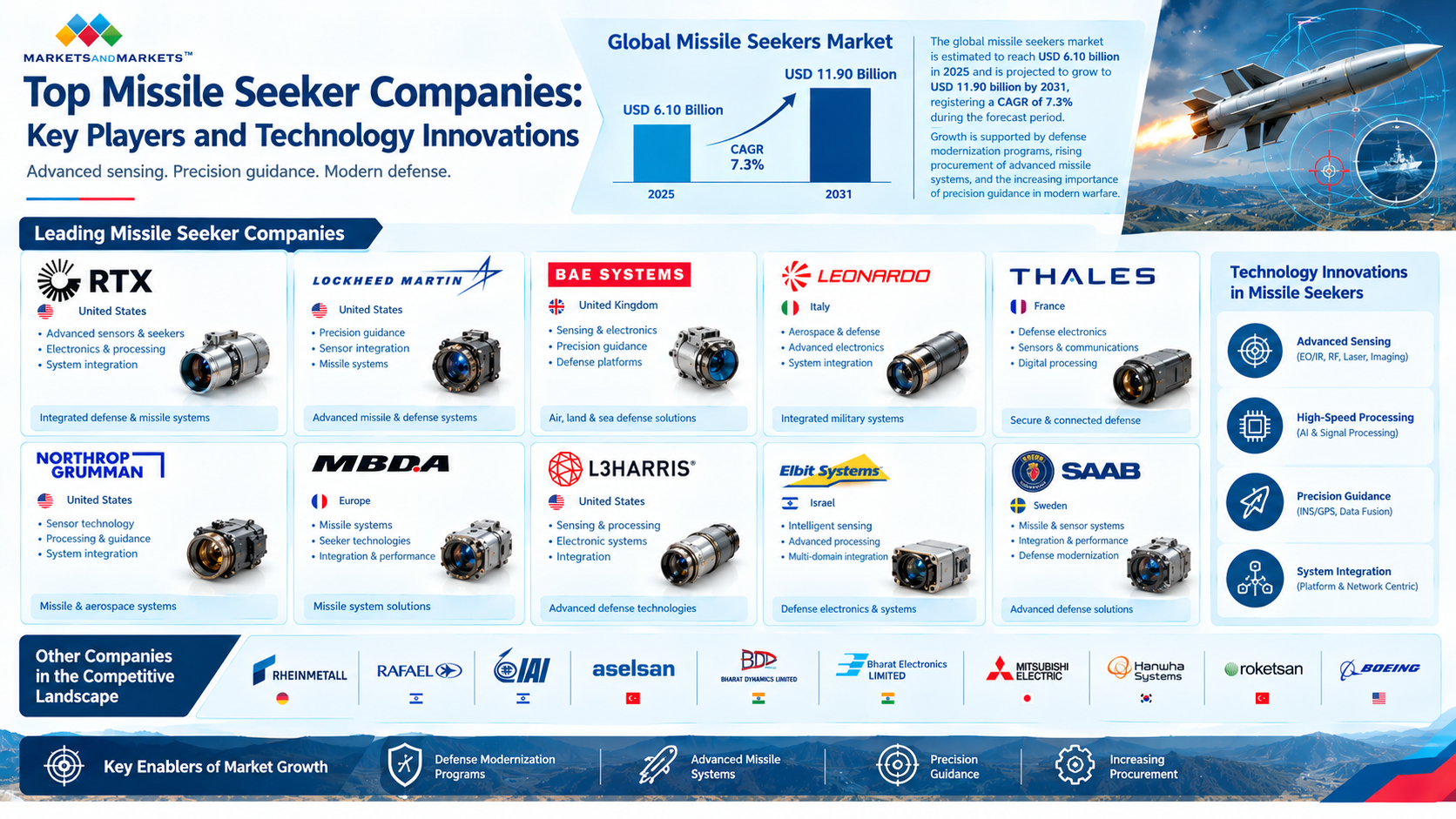
Missile Seekers Market Size and Forecast
|
Market Metric |
Value |
|---|---|
|
Market size in 2025 |
USD 6.10 billion |
|
Projected market size in 2031 |
USD 11.90 billion |
|
CAGR from 2025 to 2031 |
7.3% |
|
Leading technology |
Infrared seekers |
|
Leading application |
Air to air missiles |
|
Leading regional market |
North America |
|
Fastest growing region |
Asia Pacific |
Source: MarketsandMarkets, Missile Seekers Market.
The market is expected to expand as defense organizations prioritize precision guidance and invest in increasingly sophisticated missile systems. The combination of sensor technology, signal processing, and integrated electronic systems is shaping the next phase of market development.
Top 10 Key Takeaways
- The global missile seekers market is projected to grow from USD 6.10 billion in 2025 to USD 11.90 billion by 2031, at a CAGR of 7.3%.
- Defense modernization and procurement of advanced missile systems are major growth drivers.
- Infrared seekers represent the leading technology segment in the market overview.
- Radar and laser seekers remain important technologies for different missile applications.
- Multi mode seekers are gaining attention because they combine multiple sensing approaches.
- Artificial intelligence is increasingly associated with target recognition, signal processing, and adaptive system functions.
- North America leads the market, supported by its defense infrastructure and investment in advanced missile technologies.
- Asia Pacific is projected to be the fastest growing region, supported by increasing defense spending and missile development programs.
- Key companies identified by MarketsandMarkets include RTX, Lockheed Martin, BAE Systems, Leonardo, Thales, Northrop Grumman, MBDA, L3Harris, Elbit Systems, and Saab.
- Innovation in sensing, signal processing, sensor fusion, and miniaturization is shaping the competitive landscape.
Key Growth Drivers in the Missile Seekers Market
Defense Modernization and Advanced Missile Procurement
Defense modernization is a major factor influencing demand for missile seekers. Military organizations are upgrading existing capabilities and procuring advanced missile systems to address changing operational requirements. These programs create demand for seeker technologies that can support target detection, tracking, and guidance within complex electronic systems.
As countries invest in modern defense platforms, seeker technology remains an important component of missile system development. Demand is shaped by procurement priorities, the development of new missile programs, and the need to incorporate advanced sensing and processing capabilities.
Increasing Demand for Precision Guided Munitions
Precision guided munitions rely on guidance systems that help missiles detect and track intended targets. Missile seekers provide an important sensing function within these systems, making their performance relevant to the broader development of precision strike and air defense capabilities.
The growing emphasis on precision in modern military operations is encouraging continued investment in sensing technologies, guidance electronics, and signal processing. This demand supports the development of more sophisticated seeker systems across different missile categories.
Advancements in Sensing Technologies
Missile seekers use different sensing technologies, including infrared, radar, laser, electro optical, and multi mode approaches. Each technology offers different characteristics, and selection depends on the system requirements and intended application.
Improvements in sensing technology are contributing to the evolution of seeker systems. Imaging infrared technology, in particular, is receiving attention because it provides image based information for target detection and recognition. Radar and laser seekers also remain important within the broader technology landscape.
Artificial Intelligence and Signal Processing
Artificial intelligence and advanced signal processing are emerging as important areas of development in seeker technology. AI based processing can help interpret sensor information, support target classification, and improve the handling of complex data.
The wider adoption of intelligent processing capabilities is contributing to interest in systems that can analyze sensor inputs in real time. The degree of AI integration varies by platform and program, but the broader direction reflects the growing role of software and digital processing in advanced defense electronics.
Multi Mode Seekers and Sensor Fusion
Multi mode seekers combine more than one sensing technology within a seeker system. This approach can support complementary sensing functions and provide greater flexibility across changing operating conditions.
Sensor fusion is also an important technology trend because it brings information from different sensors or sensing channels together for processing. These approaches are attracting interest as defense programs seek more capable and adaptable seeker systems.
Key Missile Seeker Companies and Competitive Positioning
The missile seekers market includes major defense companies involved in missile systems, sensing technologies, guidance electronics, and related defense capabilities. MarketsandMarkets lists RTX, Lockheed Martin, BAE Systems, Leonardo, Thales, Northrop Grumman, MBDA, L3Harris, Elbit Systems, Saab, Rheinmetall, Rafael Advanced Defense Systems, Israel Aerospace Industries, ASELSAN, Bharat Dynamics Limited, Bharat Electronics Limited, Mitsubishi Electric, Hanwha Systems, Roketsan, and Boeing among the companies covered in its market assessment.
The companies below represent key participants identified in the supplied MarketsandMarkets report. Their competitive positions are discussed at a market level, without assuming that every company manufactures every seeker technology.
RTX
RTX is a major US defense and aerospace company identified in the missile seekers market. Its role in the broader missile systems sector places it among the companies involved in advanced defense technologies and precision guided systems.
Competition in this market increasingly reflects the ability to integrate sensing technologies with electronics and broader missile system architectures. The development of advanced seekers requires coordination between sensor performance, processing, and system integration.
Lockheed Martin
Lockheed Martin is a leading US defense company listed by MarketsandMarkets as a key participant in the missile seekers market. Its presence reflects the importance of major defense system integrators in the development and supply of advanced missile capabilities.
For companies operating in this market, the integration of seeker functions with missile system requirements is a central consideration. Demand for advanced sensing, processing, and guidance capabilities creates an ongoing need for innovation across defense programs.
BAE Systems
BAE Systems is a UK based defense and aerospace company included among the key missile seeker market participants. The company operates in a wider defense environment where precision guidance, sensing, and advanced electronics are important areas of technology development.
Its inclusion in the market reflects the importance of established defense suppliers in supporting advanced missile programs and related technologies. Continued development of sensing and electronic systems is shaping competition among major industry participants.
Leonardo
Leonardo, headquartered in Italy, is identified by MarketsandMarkets as a key company in the missile seekers market. The company operates across aerospace, defense, and security sectors, giving it a presence in the broader ecosystem of advanced military electronics and systems.
As the market develops, the ability to integrate sensing and electronic technologies into defense platforms remains an important competitive consideration. Leonardo is among the established European companies identified in the market assessment.
Thales
Thales is a French technology and defense company listed among the key missile seekers market participants. Its broader focus on defense electronics, sensors, communications, and related systems places it within the advanced technology ecosystem serving defense customers.
The evolution of missile seekers is increasingly connected with developments in sensing, digital processing, and electronic integration. These areas are relevant to the competitive landscape for established defense technology suppliers.
Northrop Grumman
Northrop Grumman is a US defense and aerospace company identified by MarketsandMarkets as a key participant. The company's inclusion reflects the role of major defense contractors in advanced missile and sensor related programs.
The market is influenced by the need to develop increasingly capable electronic systems while meeting program specific requirements for reliability, integration, and performance. Sensor technology and processing capabilities remain important areas across this wider industry.
MBDA
MBDA is a European missile systems company included in the MarketsandMarkets list of key market players. Its presence reflects the importance of missile system developers in the wider market for seeker technologies.
Missile seekers form part of the larger system architecture, and the requirements placed on them depend on the intended missile type, launch platform, and operational environment. The development of advanced missile systems therefore contributes to demand for evolving seeker technologies.
L3Harris Technologies
L3Harris Technologies is a US defense technology company included among the key players in the market assessment. Its position in the broader defense electronics environment aligns with the market's emphasis on sensing, processing, and electronic system integration.
As seeker systems become more digitally sophisticated, technology capabilities related to signal processing and system integration remain relevant to the competitive environment.
Elbit Systems
Elbit Systems is an Israel based defense technology company listed among the key missile seekers market participants. Its inclusion reflects the presence of international defense technology suppliers in a market driven by investment in advanced missile capabilities.
The wider market is placing increasing emphasis on intelligent sensing, advanced processing, and the integration of different technologies. These areas are contributing to the evolution of the competitive landscape.
Saab
Saab is a Swedish defense and aerospace company identified by MarketsandMarkets as a key market participant. The company operates within the broader European defense sector, where advanced missile technologies and modernization programs contribute to demand for specialized systems.
Competition in the missile seekers market is influenced by system performance, technological innovation, integration capabilities, and the requirements of defense procurement programs. Saab is among the established companies included in the report's company coverage.
Other Companies in the Competitive Landscape
The MarketsandMarkets report also identifies Rheinmetall, Rafael Advanced Defense Systems, Israel Aerospace Industries, ASELSAN, Bharat Dynamics Limited, Bharat Electronics Limited, Mitsubishi Electric, Hanwha Systems, Roketsan, and Boeing.
These companies contribute to the broader international defense ecosystem associated with missile systems, electronics, and advanced military technology. The market remains competitive as defense organizations pursue modernization programs and suppliers continue to develop sensing and processing capabilities.
Speak Our Industry Analyst to Know More: https://www.marketsandmarkets.com/speaktoanalystNew.asp?id=78626710
Technology Innovations Transforming the Missile Seekers Market
Infrared and Imaging Infrared Technology
Infrared seekers are identified as the leading technology segment in the MarketsandMarkets market overview. These systems detect infrared energy and are used in missile applications where thermal sensing is an important part of target detection.
Imaging infrared technology is an important development within this category. Unlike non imaging approaches, imaging infrared systems generate image based information that can support more detailed target recognition. These capabilities are contributing to continued innovation in seeker sensing technology.
Radar Seeker Technology
Radar seekers use radio frequency signals to support target detection and tracking. Active, semi active, and passive radar approaches represent distinct technology categories within the market.
Radar based systems remain relevant across different missile applications. Their continued development is connected to improvements in sensing hardware, signal processing, and integration with broader missile system architectures.
Laser and Electro Optical Technologies
Laser seekers are another technology category covered by the market assessment. Electro optical seekers, including TV and digital imaging approaches, also form part of the broader technology landscape.
These technologies support different sensing requirements depending on the missile system and intended application. Their presence in the market demonstrates that seeker development extends beyond a single sensing method.
Multi Mode Seekers
Multi mode seekers combine two or more sensing technologies. Dual mode and tri mode systems are included in the market's technology coverage.
Interest in multi mode approaches reflects the demand for seeker systems that can combine complementary sensor inputs. Integrating multiple technologies can increase system complexity, making sensor integration, processing, and validation important engineering considerations.
Artificial Intelligence and Automation
AI and automation are increasingly discussed in connection with missile seeker innovation. AI based processing can support interpretation of sensor information, while automation can contribute to manufacturing consistency and system testing.
The broader trend toward digital transformation in defense is encouraging greater attention to software, data processing, and integrated electronics. However, the actual capabilities of individual systems depend on their design, qualification, and intended use.
Sensor Fusion and Electronic Integration
Sensor fusion brings information from multiple sensing channels together for analysis. Within the wider defense electronics ecosystem, this trend is linked to the development of more integrated systems that can process complex inputs.
The integration of seeker electronics with wider missile and defense systems makes interoperability, reliability, and system validation important considerations for manufacturers.
Missile Seekers Market Segmentation
The MarketsandMarkets report organizes the market across technology, missile type, launch platform, end user, component, and region.
|
Segmentation Category |
Key Segments |
|---|---|
|
Technology |
Radio frequency seekers, infrared seekers, electro optical seekers, laser seekers, acoustic seekers, multi mode seekers |
|
Radio frequency technology |
Active RF, semi active RF, passive RF |
|
Infrared technology |
Imaging infrared, non imaging infrared |
|
Electro optical technology |
TV or CCD seekers, CMOS or digital imaging seekers |
|
Laser technology |
Semi active laser, laser beam riding |
|
Multi mode technology |
Dual mode, tri mode and advanced multi mode |
|
Missile type |
Air to air, surface to air, air to surface, surface to surface, anti ship, hypersonic missiles |
|
Launch platform |
Air launched, ground launched, ship launched, submarine launched |
|
End user |
Army, Navy, Air Force, joint and strategic forces |
|
Components |
Antenna, radome, receiver or transmitter, signal processor, detector or focal plane array, guidance and control electronics |
|
Region |
North America, Europe, Asia Pacific, rest of the world |
Source: MarketsandMarkets, Missile Seekers Market.
Product and Technology Insights
Infrared seekers are identified as the leading product category in the market overview. Radar and laser technologies also contribute to the market, while multi mode systems represent an area of continued innovation.
The broader technology landscape includes RF sensing, infrared imaging, electro optical systems, laser sensing, acoustic sensing, and multi mode integration. This variety reflects the different requirements that apply across missile types and launch platforms.
Missile Type Insights
The report covers air to air, surface to air, air to surface, surface to surface, anti ship, and hypersonic missile categories. Each category represents a different part of the wider missile system market and can involve different seeker requirements.
Air to air missiles are identified as the leading application segment in the supplied market overview. Demand for advanced aerial combat capabilities and beyond visual range missile systems contributes to the importance of this segment.
Component Insights
The component segmentation includes antennas, radomes, receivers and transmitters, signal processors, detectors and focal plane arrays, and guidance and control electronics.
These components form part of the wider seeker architecture. The development of advanced seeker systems depends on the performance and integration of sensing hardware, electronic processing, and related subsystems.
Regional Insights: North America Leads While Asia Pacific Expands
North America
North America leads the missile seekers market, according to the MarketsandMarkets overview. The region benefits from advanced defense infrastructure, substantial defense investment, and the presence of major defense companies.
Investment in advanced missile systems and sensing technologies supports the region's position. The presence of established defense contractors also contributes to the concentration of development and integration capabilities in the regional market.
Asia Pacific
Asia Pacific is projected to be the fastest growing regional market. The report associates this outlook with increasing defense budgets, geopolitical tensions, and expanding missile development programs.
The region's market development reflects continued investment in defense modernization and advanced military capabilities. However, growth varies across countries and depends on procurement priorities, domestic industrial capacity, and individual defense programs.
Europe
Europe is an important market for missile seekers, with established defense companies and collaborative defense initiatives contributing to the regional ecosystem. Modernization programs and demand for advanced defense systems support interest in sensing and guidance technologies.
Companies such as BAE Systems, Leonardo, Thales, MBDA, and Saab are among the European defense industry participants identified in the market overview.
Rest of the World
The report also includes a rest of the world category in its regional scope. Demand in these markets depends on defense procurement, missile system modernization, and investment in national security capabilities. The supplied market overview does not provide a separate numerical forecast for this category.
Growth Opportunities for Missile Seeker Companies
Development of Multi Mode Technologies
Multi mode seekers represent an area of technological development because they combine different sensing approaches within a single system. Companies that can develop and integrate complementary sensing technologies may be positioned to address evolving program requirements.
Advances in Imaging and Digital Sensing
Imaging infrared and digital electro optical technologies are important areas of innovation. Continued development in sensing and signal processing is supporting interest in systems capable of interpreting increasingly complex sensor information.
Integration of AI and Advanced Processing
AI and advanced signal processing are creating opportunities for companies working across defense electronics and sensing technologies. These developments are influencing the wider evolution of seeker systems, although individual capabilities remain dependent on program design and validation.
Growing Demand Across Missile Categories
The market includes several missile types and launch platforms, creating a range of potential application requirements. Suppliers may serve different parts of the market depending on their technologies, product portfolios, and participation in defense programs.
Regional Defense Modernization
Growing defense investment in Asia Pacific is expected to support the region's position as the fastest growing market. North America remains a major market, while Europe continues to be an important center for defense system development and modernization.
Challenges Facing the Missile Seekers Market
High Development and Qualification Requirements
Missile seeker systems must meet demanding performance and reliability requirements. Development and validation can be complex because systems combine sensing hardware, electronics, signal processing, and integration with the wider missile platform.
Technology Integration Complexity
Combining multiple sensing technologies increases system integration complexity. Multi mode architectures may require coordination between different sensors and processing functions, adding to design and validation requirements.
Rapid Technological Change
Advances in sensors, electronics, and processing can require ongoing research and development. Companies must adapt to changing requirements while maintaining compatibility with existing defense programs and platform architectures.
Procurement and Program Timelines
Missile seeker suppliers depend heavily on defense procurement programs. Procurement priorities, budget decisions, and program schedules can influence when products are developed, qualified, and purchased. These factors can affect the timing and predictability of market demand.
Competition Among Established Defense Suppliers
The market includes numerous established defense companies with technical capabilities and experience in complex programs. Competition requires suppliers to demonstrate relevant performance, system compatibility, and the ability to support program requirements over time.
Future Outlook for the Missile Seekers Market
The global missile seekers market is projected to increase from USD 6.10 billion in 2025 to USD 11.90 billion by 2031, representing a CAGR of 7.3%. The outlook reflects continued defense modernization, procurement of advanced missile systems, and demand for precision guided munitions.
Technology innovation is expected to remain central to market development. Infrared sensing, imaging infrared, radar, laser, electro optical systems, and multi mode architectures are all part of the evolving technology landscape. AI, advanced signal processing, and sensor fusion are also influencing how manufacturers approach the development of sophisticated seeker systems.
RTX, Lockheed Martin, BAE Systems, Leonardo, Thales, Northrop Grumman, MBDA, L3Harris, Elbit Systems, and Saab are among the companies identified in the MarketsandMarkets report. Their competitive environment is shaped by defense procurement priorities, technological development, and the requirements of missile programs across different regions.
North America is expected to maintain its leadership, while Asia Pacific is projected to record the fastest regional growth. Across the market, companies will need to respond to evolving technical requirements, demanding validation processes, and complex system integration challenges.
Overall, the market's development will be influenced by the combination of defense investment and advances in sensing and processing technology. Companies with relevant technical capabilities, established defense program relationships, and the ability to meet demanding system requirements will remain important participants in the competitive landscape.
Frequently Asked Questions
1. What is the projected size of the global missile seekers market by 2031?
The global missile seekers market is projected to reach USD 11.90 billion by 2031, growing from an estimated USD 6.10 billion in 2025 at a CAGR of 7.3%.
2. Who are the leading missile seeker companies?
Companies identified by MarketsandMarkets include RTX, Lockheed Martin, BAE Systems, Leonardo, Thales, Northrop Grumman, MBDA, L3Harris, Elbit Systems, and Saab. Other companies covered include Rafael Advanced Defense Systems, Israel Aerospace Industries, ASELSAN, Rheinmetall, and Boeing.
3. Which technology leads the missile seekers market?
Infrared seekers are identified as the leading technology category in the MarketsandMarkets market overview. Radar, laser, electro optical, and multi mode seekers are also part of the market.
4. How are AI and sensor fusion influencing missile seeker technology?
AI and advanced signal processing are influencing the analysis of sensor information, while sensor fusion combines information from different sensing channels. These developments are shaping innovation in seeker system design and electronic integration.
5. Which region is expected to grow fastest in the missile seekers market?
Asia Pacific is projected to be the fastest growing region, supported by rising defense budgets, geopolitical tensions, and expanding missile development programs. North America currently leads the market, according to the MarketsandMarkets overview.

This FREE sample includes market data points, ranging from trend analyses to market estimates & forecasts. See for yourself.
SEND ME A FREE SAMPLE