How Avilus’ 800km Remote Flight Milestone Signals the Next Evolution of the UAV (Drone) Market
The unmanned aviation industry has reached another important milestone. Avilus recently demonstrated the ability to remotely operate its Bussard unmanned aircraft from a ground control station near Munich while the aircraft flew approximately 800 kilometers away in North Sea airspace. Beyond the impressive technical achievement, the demonstration showcased the growing maturity of long-range drone operations and highlighted the expanding role of dual-use unmanned aircraft capable of serving both civilian and defense missions.
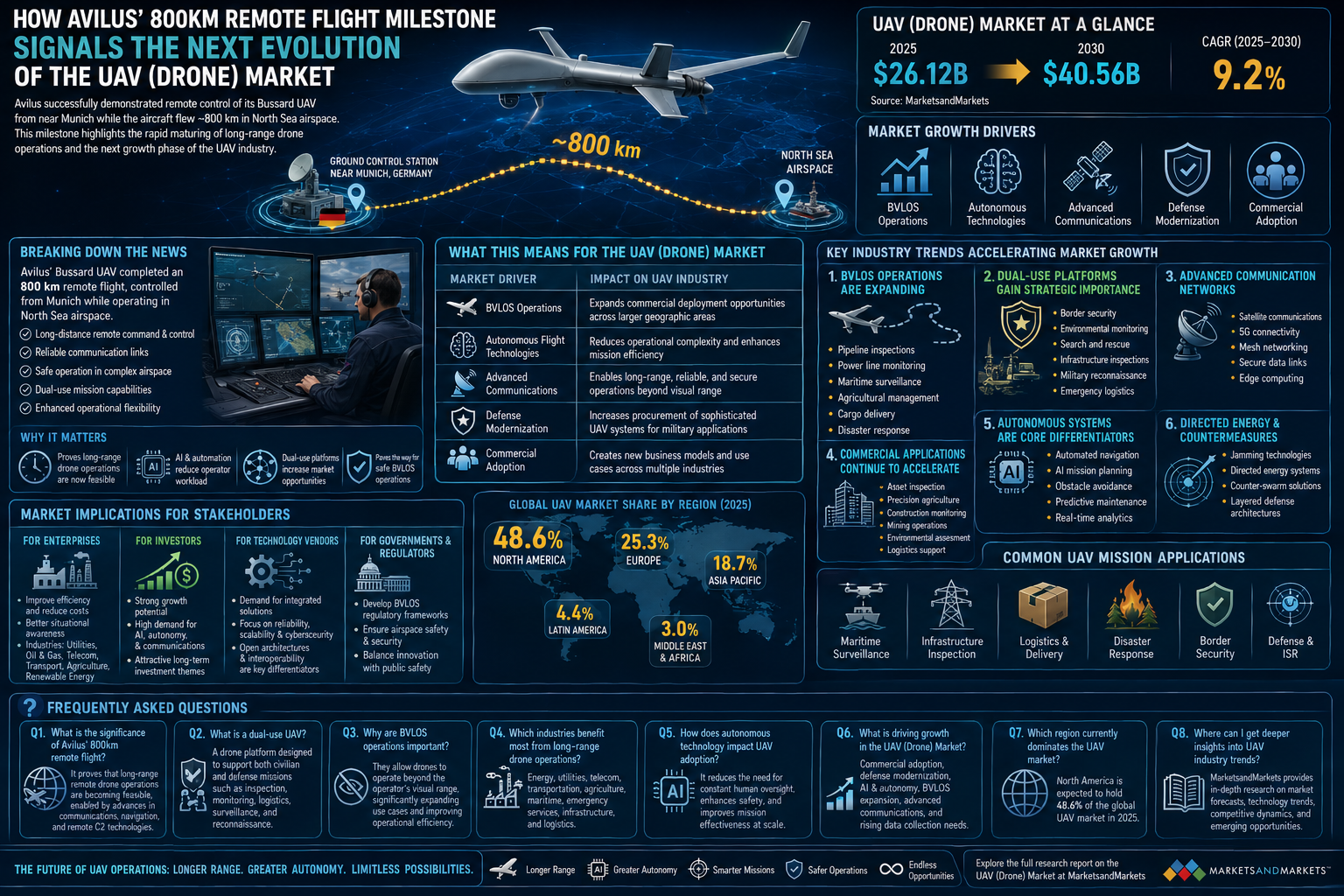
As governments, enterprises, and defense organizations increasingly invest in advanced unmanned aerial capabilities, milestones such as this offer a glimpse into the future of aviation. The ability to safely and effectively control drones over extended distances unlocks new opportunities in logistics, emergency response, maritime surveillance, infrastructure inspection, border security, and military operations.
For technology leaders, investors, policymakers, and drone manufacturers, Avilus’ achievement represents more than a successful test flight. It reflects broader trends shaping the global UAV (Drone) Market, including advances in autonomous systems, beyond-visual-line-of-sight (BVLOS) operations, satellite communications, and the integration of drones into national airspace systems.
As regulatory frameworks evolve and drone capabilities expand, long-range remote operations are expected to become a critical enabler of the next growth phase in the UAV industry.
Breaking Down the News
Avilus announced the successful completion of an 800-kilometer remote flight demonstration involving its Bussard unmanned aircraft. During the operation, pilots controlled the aircraft from a ground control station near Munich while the drone operated hundreds of kilometers away in North Sea airspace.
The demonstration highlighted several important technological capabilities:
-
Long-distance remote command and control
-
Reliable communication links across extended ranges
-
Safe operation in complex airspace environments
-
Integration of dual-use mission capabilities
-
Enhanced operational flexibility for commercial and defense users
The Bussard aircraft has been designed as a dual-use platform capable of supporting both civilian and government missions. Such versatility is becoming increasingly important as drone manufacturers seek to address multiple markets using adaptable airframe architectures.
The successful demonstration comes at a time when regulators worldwide are working to expand beyond-visual-line-of-sight operations and establish frameworks that allow drones to operate safely over greater distances.
For the UAV industry, the achievement serves as evidence that advanced drone platforms are moving beyond experimental testing toward real-world operational deployment.
Why This News Matters Beyond the Headlines
The significance of Avilus’ achievement extends well beyond the successful completion of a single flight.
Historically, one of the biggest limitations facing the drone industry has been operational range. Many commercial drone applications have been constrained by regulatory restrictions, communication limitations, and safety concerns associated with beyond-visual-line-of-sight missions.
By demonstrating reliable remote operation over 800 kilometers, Avilus highlights how advancements in communications, automation, navigation systems, and aircraft design are helping overcome these challenges.
The milestone validates several important industry assumptions:
-
Long-range drone operations are becoming technically feasible.
-
Remote piloting technologies are maturing rapidly.
-
Dual-use drone platforms offer broader commercial viability.
-
BVLOS operations will become increasingly common.
-
Autonomous and semi-autonomous systems are reducing operational complexity.
For enterprises, this opens the possibility of conducting missions across larger geographic areas without requiring local operators at every location. For defense organizations, it enhances operational reach while reducing risks to personnel.
The achievement also reinforces the growing convergence between commercial and defense drone technologies. Increasingly, innovations developed for one market are being adapted for use in the other, accelerating technology development across the broader ecosystem.
What This Means for the UAV (Drone) Market
The Avilus demonstration aligns closely with several growth drivers currently shaping the global UAV (Drone) Market.
According to MarketsandMarkets, the overall UAV (Drone) Market is projected to grow from USD 26.12 billion in 2025 to USD 40.56 billion by 2030, registering a CAGR of 9.2%.
This growth is being driven by increasing adoption across both commercial and government sectors.
| Market Driver | Impact on UAV Industry |
|---|---|
| BVLOS operations | Expands commercial deployment opportunities |
| Autonomous flight technologies | Reduces operational complexity |
| Advanced communications | Enables long-range missions |
| Defense modernization | Increases procurement of sophisticated UAVs |
| Commercial adoption | Creates new business applications |
Avilus’ achievement directly supports these trends.
The ability to remotely operate drones over long distances creates opportunities across numerous industries including logistics, energy, infrastructure management, environmental monitoring, maritime surveillance, emergency response, and public safety.
The demonstration also highlights the growing importance of reliable communications systems, navigation technologies, and integrated mission management platforms within the UAV ecosystem.
Stakeholders seeking a broader understanding of industry developments can explore emerging trends within the UAV (Drone) Market and evaluate how advancements in long-range operations are influencing future investment priorities.
Related Resource: Read about the UAV (Drone) Market: https://www.marketsandmarkets.com/Market-Reports/unmanned-aerial-vehicles-uav-market-662.html
Key Industry Trends Accelerating Market Growth
Beyond-Visual-Line-of-Sight Operations Are Expanding
BVLOS capabilities represent one of the most significant growth opportunities for the drone industry.
Traditional drone operations often require pilots to maintain direct visual contact with the aircraft. This limitation restricts operational range and reduces efficiency for many commercial applications.
Advancements demonstrated by Avilus show how long-range remote operations can unlock new use cases, including:
-
Pipeline inspections
-
Power line monitoring
-
Maritime surveillance
-
Agricultural management
-
Cargo delivery
-
Disaster response
As regulators continue developing BVLOS frameworks, adoption is expected to accelerate globally.
Dual-Use Platforms Are Gaining Strategic Importance
The Bussard aircraft exemplifies a growing industry trend toward dual-use platforms.
Dual-use UAVs are designed to support both civilian and defense missions, allowing manufacturers to maximize market opportunities while reducing development costs.
Potential applications include:
-
Border security
-
Environmental monitoring
-
Search and rescue
-
Infrastructure inspections
-
Military reconnaissance
-
Emergency logistics
This flexibility is becoming increasingly attractive to governments seeking cost-effective technology investments.
Advanced Communication Networks Are Transforming UAV Operations
Reliable communication remains essential for long-range drone missions.
Recent advances in:
-
Satellite communications
-
5G connectivity
-
Mesh networking
-
Secure data links
-
Edge computing
are enabling drones to operate farther from operators while maintaining mission effectiveness and safety.
The future of long-range UAV operations will depend heavily on continued innovation within communications infrastructure.
Commercial Applications Continue to Accelerate
The commercial segment is expected to experience some of the fastest growth within the UAV industry.
Organizations are increasingly deploying drones for:
-
Asset inspection
-
Precision agriculture
-
Construction monitoring
-
Mining operations
-
Environmental assessment
-
Logistics support
As technology becomes more reliable and regulations become more accommodating, commercial deployments are expected to expand significantly.
Autonomous Systems Are Becoming Core Differentiators
Autonomy is emerging as one of the most important competitive differentiators within the UAV industry.
Modern drone platforms increasingly incorporate:
-
Automated navigation
-
AI-powered mission planning
-
Obstacle avoidance
-
Predictive maintenance
-
Real-time analytics
The ability to operate with reduced human intervention will be critical for scaling drone operations across large geographic regions.
Market Implications for Stakeholders
For Enterprises
Businesses stand to benefit significantly from advancements in long-range drone operations.
Organizations managing geographically dispersed assets can leverage UAVs to improve efficiency, reduce inspection costs, and enhance situational awareness.
Industries likely to benefit include:
-
Utilities
-
Oil and gas
-
Telecommunications
-
Transportation
-
Agriculture
-
Renewable energy
Extended-range capabilities expand the economic viability of drone-based operations across these sectors.
For Investors
The Avilus milestone reinforces confidence in long-term UAV market growth.
Investors continue to monitor several attractive themes:
-
BVLOS expansion
-
Autonomous systems
-
Drone logistics
-
Defense modernization
-
AI-enabled aviation
-
Communications infrastructure
Companies developing technologies that support long-range and autonomous drone operations may be particularly well-positioned for future growth.
For Technology Vendors
Drone manufacturers and technology providers face increasing demand for integrated solutions.
Customers increasingly prioritize:
-
Reliability
-
Scalability
-
Regulatory compliance
-
Operational efficiency
-
Cybersecurity
-
Interoperability
Vendors capable of combining advanced aircraft platforms with sophisticated communications and autonomy technologies are likely to gain competitive advantages.
For Governments and Regulators
Regulatory agencies play a crucial role in shaping the future of the UAV industry.
Demonstrations such as Avilus’ provide valuable evidence supporting broader adoption of BVLOS operations.
Governments must balance innovation with safety by developing frameworks that encourage technological progress while maintaining airspace security.
Successful policy development could significantly accelerate market expansion over the coming decade.
Frequently Asked Questions
What is the significance of Avilus’ 800km remote flight?
The demonstration shows that long-range remote drone operations are becoming increasingly feasible. It highlights advancements in communications, navigation systems, and remote command-and-control technologies that could enable broader commercial and defense applications.
What is a dual-use UAV?
A dual-use UAV is a drone platform designed to serve both civilian and defense purposes. These systems can perform a wide range of missions, including infrastructure inspection, environmental monitoring, surveillance, logistics, and military reconnaissance.
Why are BVLOS operations important for the UAV industry?
Beyond-visual-line-of-sight operations allow drones to travel beyond the operator’s direct visual range. This capability significantly expands potential use cases and is considered essential for scaling commercial drone applications.
Which industries benefit most from long-range drone operations?
Industries such as energy, utilities, telecommunications, transportation, agriculture, maritime operations, and emergency services can benefit from extended-range drone capabilities by improving efficiency and reducing operational costs.
How does autonomous technology impact UAV adoption?
Autonomous technologies simplify drone operations by reducing the need for constant human oversight. Features such as automated navigation, obstacle avoidance, and AI-driven decision-making enhance safety and operational effectiveness.
What is driving growth in the UAV (Drone) Market?
Growth is being driven by increasing commercial adoption, defense modernization programs, advancements in autonomous technologies, expanding BVLOS operations, and rising demand for drone-based data collection and monitoring services.
Which region currently dominates the UAV market?
North America is expected to account for 48.6% of the UAV market in 2025, supported by strong defense spending, advanced technology ecosystems, and growing commercial drone adoption.
Where can organizations find deeper insights into UAV industry trends?
Organizations often rely on specialized market intelligence to evaluate technology developments, regulatory changes, competitive positioning, adoption trends, and emerging opportunities within the rapidly evolving drone ecosystem.
Looking Beyond Today's Headlines
Avilus’ successful 800-kilometer remote flight offers a glimpse into the future of unmanned aviation.
The industry is moving toward a world where drones can safely operate across vast distances, perform increasingly complex missions, and integrate seamlessly into existing airspace systems. Advances in communications, autonomy, artificial intelligence, and air traffic integration are collectively enabling this transformation.
Over the next decade, long-range drone operations could become routine across commercial, industrial, and government sectors. Organizations that once viewed drones as niche tools may begin treating them as essential operational assets.
The technologies demonstrated by Avilus today may eventually serve as foundational building blocks for next-generation logistics networks, emergency response systems, and autonomous aviation ecosystems.
Future Outlook
Avilus’ 800km remote flight milestone represents a significant achievement for the unmanned aviation industry and highlights the growing maturity of long-range drone operations. The successful demonstration validates key trends including BVLOS expansion, autonomous mission management, advanced communications infrastructure, and the increasing importance of dual-use aircraft platforms.
For enterprises, governments, investors, and technology providers, the announcement provides insight into how the UAV industry is evolving beyond traditional operational limitations. As drones become more capable, connected, and autonomous, their role across commercial and defense applications will continue to expand.
The broader UAV (Drone) Market remains on a strong growth trajectory as organizations seek innovative ways to improve efficiency, enhance situational awareness, and support mission-critical operations. Understanding the technologies, regulatory developments, and market dynamics shaping this transformation will be increasingly important for strategic decision-making.
For readers seeking a deeper understanding of market forecasts, technology trends, competitive positioning, and future opportunities, MarketsandMarkets provides comprehensive analysis of the global UAV (Drone) Market and the factors driving its continued evolution.
Download Sample Report: https://www.marketsandmarkets.com/pdfdownloadNew.asp?id=662
Explore the UAV (Drone) Market: https://www.marketsandmarkets.com/Market-Reports/unmanned-aerial-vehicles-uav-market-662.html

This FREE sample includes market data points, ranging from trend analyses to market estimates & forecasts. See for yourself.
SEND ME A FREE SAMPLE





