Military Displays Market Size, Share, Trends & Growth Analysis by End Market (Land, Airborne, Naval), Technology (LED, LCD, OLED, AMOLED), Type, Panel Size (Microdisplays, Small & Medium-Sized Panels, Large Panels), Product Type, and Region - Global Forecast to 2031


Military Displays Market Summary
This growth is driven by increasing defense modernization programs, the rising demand for advanced cockpit and command-and-control systems, and the integration of digital technologies across military platforms. Military displays are evolving from traditional rugged screens to intelligent, high-resolution, multi-functional systems powered by artificial intelligence, IoT connectivity, and automation. As defense forces globally prioritize real-time data visualization and network-centric warfare, military displays are becoming indispensable components for enhancing operational efficiency and mission success.
Key Market Trends & Insights
The Military Displays Market is undergoing significant transformation due to rapid technological advancements and evolving defense requirements. North America leads the market owing to its robust defense infrastructure and continuous investments in advanced avionics and battlefield systems. Asia Pacific is emerging as the fastest-growing region, driven by increasing defense budgets and modernization initiatives.
Airborne displays dominate the market, particularly cockpit displays used in fighter jets, transport aircraft, and helicopters. These systems require high performance, reliability, and real-time data integration, making them critical for mission success.
Emerging trends include the adoption of augmented reality (AR) and virtual reality (VR) in military displays, enabling enhanced situational awareness and pilot training. AI-powered display systems are enabling intelligent data processing and visualization, while IoT integration is facilitating seamless communication between different platforms.
Automation is playing a key role in reducing pilot workload and improving decision-making speed. Additionally, advancements in display technologies such as OLED, AMOLED, and high-brightness LCD are improving visibility and durability in extreme environments.
Military Displays Market Top 10 key takeaway
- The market is expected to nearly double by 2035 due to modernization programs.
- Airborne displays dominate due to their critical role in cockpit systems.
- North America leads with strong defense investments and innovation.
- Asia Pacific is the fastest-growing region driven by rising defense budgets.
- AI integration enhances real-time data processing and decision-making.
- IoT enables connectivity across platforms and systems.
- AR and VR technologies are transforming training and operations.
- Automation reduces operator workload and improves efficiency.
- Advanced display technologies improve performance and durability.
- Increasing focus on network-centric warfare is driving demand.
Product Insights
The Military Displays Market is segmented into cockpit displays, helmet-mounted displays (HMDs), handheld displays, and vehicle-mounted displays. Among these, cockpit displays hold the largest market share due to their critical role in providing pilots with real-time flight data, navigation information, and mission-critical insights. These displays are integral to modern avionics systems and are designed to operate under extreme conditions.
The dominance of cockpit displays is supported by the increasing adoption of glass cockpit systems in both fixed-wing and rotary aircraft. Helmet-mounted displays are also gaining significant traction, particularly in advanced fighter aircraft, where they provide pilots with enhanced situational awareness by projecting critical information directly onto the visor.
Emerging product categories include wearable displays and flexible display systems that can be integrated into uniforms and equipment. AI-enabled displays are capable of filtering and prioritizing information, reducing cognitive load on operators. Additionally, the integration of touch and gesture-based interfaces is enhancing user interaction and operational efficiency.
Technology / Component Insights (Display Technologies & Smart Systems)
The Military Displays Market is driven by advancements in display technologies, processing units, and connectivity systems. OLED and AMOLED displays are gaining popularity due to their superior contrast, energy efficiency, and flexibility. High-brightness LCDs remain widely used for their durability and reliability in harsh environments.
Artificial intelligence is transforming military displays by enabling intelligent data processing and visualization. AI algorithms can analyze large volumes of data from sensors and present actionable insights in real time, enhancing decision-making capabilities.
The integration of IoT is enabling seamless connectivity between display systems and other components of the military network. This connectivity allows for real-time data sharing and coordination across platforms, supporting network-centric operations.
Cloud computing is playing an increasing role in data storage and analytics, enabling remote access to critical information. Automation technologies are reducing manual intervention and improving system efficiency. Future innovations are expected to include holographic displays, advanced AR interfaces, and fully integrated digital command systems.
Application Insights
Airborne applications dominate the Military Displays Market, driven by the increasing adoption of advanced avionics and the need for real-time situational awareness in aircraft. Cockpit displays and helmet-mounted systems are essential for modern combat and transport aircraft.
Land-based applications are also significant, with displays used in armored vehicles, command centers, and portable systems for field operations. Naval applications are growing steadily, with displays integrated into ship control systems and combat information centers.
Future opportunities are emerging in unmanned systems and autonomous platforms, where advanced display technologies are required for remote operation and monitoring. The integration of AI and IoT is expected to further expand the application scope of military displays.
Regional Insights
North America dominates the Military Displays Market due to its advanced defense ecosystem, strong presence of key manufacturers, and continuous investment in R&D. The region’s focus on technological innovation and modernization has driven the adoption of advanced display systems.
Europe is another key market, characterized by strong defense collaborations and investments in next-generation technologies. The region is focusing on enhancing its defense capabilities through digital transformation.
Asia Pacific is the fastest-growing region, driven by increasing defense spending, modernization of military forces, and rapid technological adoption. Countries in the region are investing heavily in advanced display technologies to improve operational efficiency.
- North America leads due to strong defense infrastructure and innovation
- Europe benefits from collaborative defense initiatives
- Asia Pacific shows fastest growth due to rising defense budgets
- Increasing focus on digitalization is driving adoption
- Government investments are supporting market expansion
Country Specific Market Trends
In Asia Pacific, China is experiencing strong growth with a CAGR of around 8%–10%, driven by large-scale military modernization and investments in advanced technologies. Japan is also witnessing steady growth, focusing on integrating AI and automation into defense systems.
In North America, the United States leads the market with a CAGR of approximately 7%–8%, supported by extensive R&D and advanced defense programs. Canada and Mexico are also contributing to growth through increasing investments in military technology.
In Europe, Germany and France are key contributors, with a CAGR of 6%–8%. Germany is focusing on innovation and engineering excellence, while France is investing in advanced avionics and display technologies.
- China leads APAC growth with strong defense investments
- Japan emphasizes AI and automation integration
- United States dominates North America with advanced technologies
- Canada and Mexico show steady defense growth
- Germany and France drive European market development
Key Military Displays Company Insights
The Military Displays Market is highly competitive, with leading companies focusing on innovation, advanced technologies, and strategic partnerships. Major players include BAE Systems plc, Thales Group, Elbit Systems Ltd., L3Harris Technologies, Inc., Collins Aerospace (RTX Corporation), Saab AB, Leonardo S.p.A., General Dynamics Corporation, and Barco NV.
These companies are investing heavily in research and development to develop high-performance display systems and integrate advanced technologies such as AI and IoT. The focus on enhancing display resolution, durability, and energy efficiency is driving innovation in the market.
Strategic collaborations with defense agencies and system integrators are helping companies expand their market presence. The development of modular and scalable display systems is enabling customization for different applications, further strengthening competitive positioning.
- Companies are investing in AI-enabled display systems
- Focus on high-resolution and durable displays is increasing
- Strategic partnerships are driving market expansion
- Modular designs are enabling customization
- Continuous R&D ensures technological leadership
Recent Developments
Recent developments in the Military Displays Market highlight the growing focus on advanced technologies and digitalization. Several companies have introduced next-generation cockpit displays with enhanced resolution and AI-driven data processing capabilities.
There has also been an increase in partnerships between defense contractors and technology firms to develop integrated display systems for network-centric operations. Additionally, advancements in AR and VR technologies are improving training and operational capabilities.
Market Segmentation
The Military Displays Market is segmented based on product, technology/component, application, and region. By product, the market includes cockpit displays, helmet-mounted displays, handheld displays, and vehicle-mounted displays. By technology, it encompasses OLED, LCD, AI-enabled systems, IoT-integrated platforms, and AR/VR technologies.
In terms of application, the market serves airborne, land, and naval platforms. Regionally, the market is divided into North America, Europe, Asia Pacific, and the rest of the world, each contributing to overall growth with unique drivers and opportunities.
- Product segmentation includes cockpit, helmet-mounted, and vehicle displays
- Technology segmentation covers OLED, LCD, AI, IoT, and AR/VR
- Applications include airborne, land, and naval platforms
- Regional segmentation includes North America, Europe, and Asia Pacific
- Each segment offers strong growth potential
Conclusion
The Military Displays Market is poised for steady growth through 2035, driven by increasing defense modernization and the adoption of advanced technologies. The integration of AI, IoT, and automation is transforming military displays into intelligent systems capable of enhancing situational awareness and decision-making.
As global defense forces continue to invest in digital transformation and network-centric warfare, the demand for advanced display systems will increase significantly. Companies that focus on innovation and technological advancement will be well-positioned to capitalize on emerging opportunities and maintain a competitive edge in this evolving market.
FAQs
1. What is the market size of Military Displays?
The market was valued at approximately USD 1.3–1.6 billion in 2025.
2. What is the expected growth rate of the market?
The market is projected to grow at a CAGR of around 7%–9% during the forecast period.
3. What are the key drivers of market growth?
Key drivers include defense modernization, adoption of advanced avionics, and integration of AI, IoT, and automation technologies.
4. Which region leads the market?
North America leads the market due to strong defense infrastructure and technological advancements.
5. Who are the key companies in the Market?
Key companies include BAE Systems plc, Thales Group, Elbit Systems Ltd., L3Harris Technologies, Inc., Collins Aerospace, Saab AB, Leonardo S.p.A., General Dynamics Corporation, and Barco NV.
 Exclusive indicates content/data unique to MarketsandMarkets and not available with any competitors.
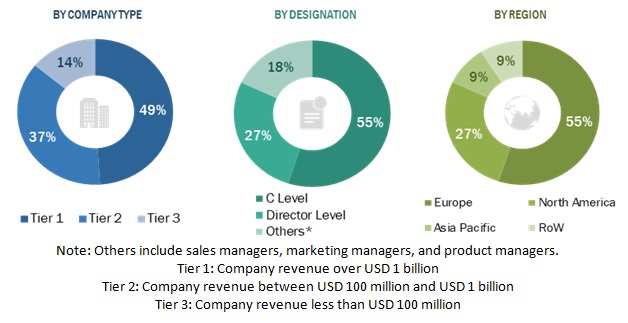
The research study conducted on the Military displays market involved extensive use of secondary sources, directories, and databases such as Hoovers, Bloomberg Businessweek, and Factiva to identify and collect information relevant to the Military displays market. The primary sources considered included industry experts from the Military displays market consisting of Military displays service providers, government agencies, technology vendors, system integrators, research organizations, and original equipment manufacturers related to all segments of the value chain of this industry. In-depth interviews with various primary respondents, including key industry participants, Subject Matter Experts (SMEs), industry consultants, and C-level executives, have been conducted to obtain and verify critical qualitative and quantitative information pertaining to the Military display as well as to assess the growth prospects of the market.
Secondary Research
Secondary sources referred for this research study included Boeing and Airbus Market Outlook 2019, General Aviation Manufacturers Association (GAMA); International Air Transport Association (IATA) publications; Flight Global World Airforce Fleet; Stockholm International Peace Research Institute, corporate filings (such as annual reports, investor presentations, and financial statements); Federal Aviation Administration (FAA) and trade, business, and professional associations. Secondary data was collected and analyzed to arrive at the overall market size, which was further validated by primary respondents.
To know about the assumptions considered for the study, download the pdf brochure
Market Size Estimation
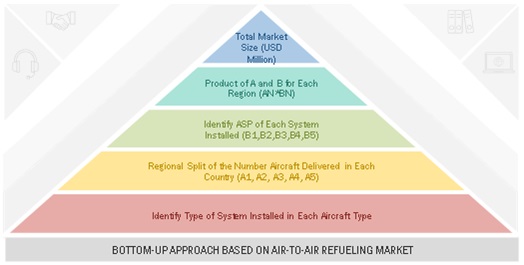
Both top-down and bottom-up approaches were used to estimate and validate the size of the Military display market. The research methodology used to estimate the market size also included the following details:
- Key players in the market were identified through secondary research, and their market ranking was determined through primary and secondary research. This included a study of annual and financial reports of top market players and extensive interviews with industry experts with knowledge on Military display
- All percentage shares, splits, and breakdowns were determined using secondary sources and verified through primary sources.
- All possible parameters that affect the markets covered in this research study were accounted for, viewed in extensive detail, verified through primary research, and analyzed to obtain the final quantitative and qualitative data. This data was consolidated, enhanced with detailed inputs, and analyzed by MarketsandMarkets and presented in this report.
Market size estimation methodology: Bottom-up approach
Data triangulation
After arriving at the overall market size from the market size estimation process, the total market was split into several segments and subsegments. Data triangulation and market breakdown procedures explained below were implemented, wherever applicable, to complete the overall market engineering process and arrive at the estimated market numbers for the segments and subsegments of Military display market. The data was triangulated by studying various factors and trends from both the demand and supply sides. Along with this, the market size was validated using both top-down and bottom-up approaches.
Report Objectives
- To define, describe, and forecast the size of the Military display market based on System, Propulsion Type, Passenger Capacity, End use, Range, Autonomy and Region.
- To identify and analyze key drivers, opportunities, and challenges influencing the growth of the market
- To identify industry trends, market trends, and technology trends currently prevailing in the market
- To forecast the size of different segments of the market with respect to North America, Europe, Asia Pacific, Middle East and Latin America.
- To profile leading market players based on their product portfolios, financial positions, and key growth strategies
- To analyze the degree of competition in the market by identifying key growth strategies, such as mergers & acquisitions, contracts, agreements, collaborations, new product launches, and funding, adopted by leading market players.
- To provide a detailed competitive landscape of the market, along with rank analysis, revenue share analysis, and market share analysis of key players
- To provide a comprehensive analysis of business and corporate strategies adopted by key market players.
Available Customizations
Along with the market data, MarketsandMarkets offers customizations as per the specific needs of companies. The following customization options are available for the report:
Product Analysis
- Product matrix, which gives a detailed comparison of the product portfolio of each company
Regional Analysis
- Further breakdown of the market segments at country-level
Company Information
- Detailed analysis and profiling of additional market players (up to 5)

 Generating Response ...










Growth opportunities and latent adjacency in Military Displays Market
Nice information regarding military displays Really I like this information.