How Consumer Geospatial AI Is Accelerating Growth in the Artificial Intelligence (AI) in Drones Market
Artificial intelligence is rapidly transforming the drone industry, enabling unmanned systems to navigate, perceive, and make decisions with unprecedented levels of autonomy. While many of these advances originate from defense research programs, an increasingly important trend is emerging in the opposite direction: commercial technologies developed for consumer applications are finding new roles in military operations.
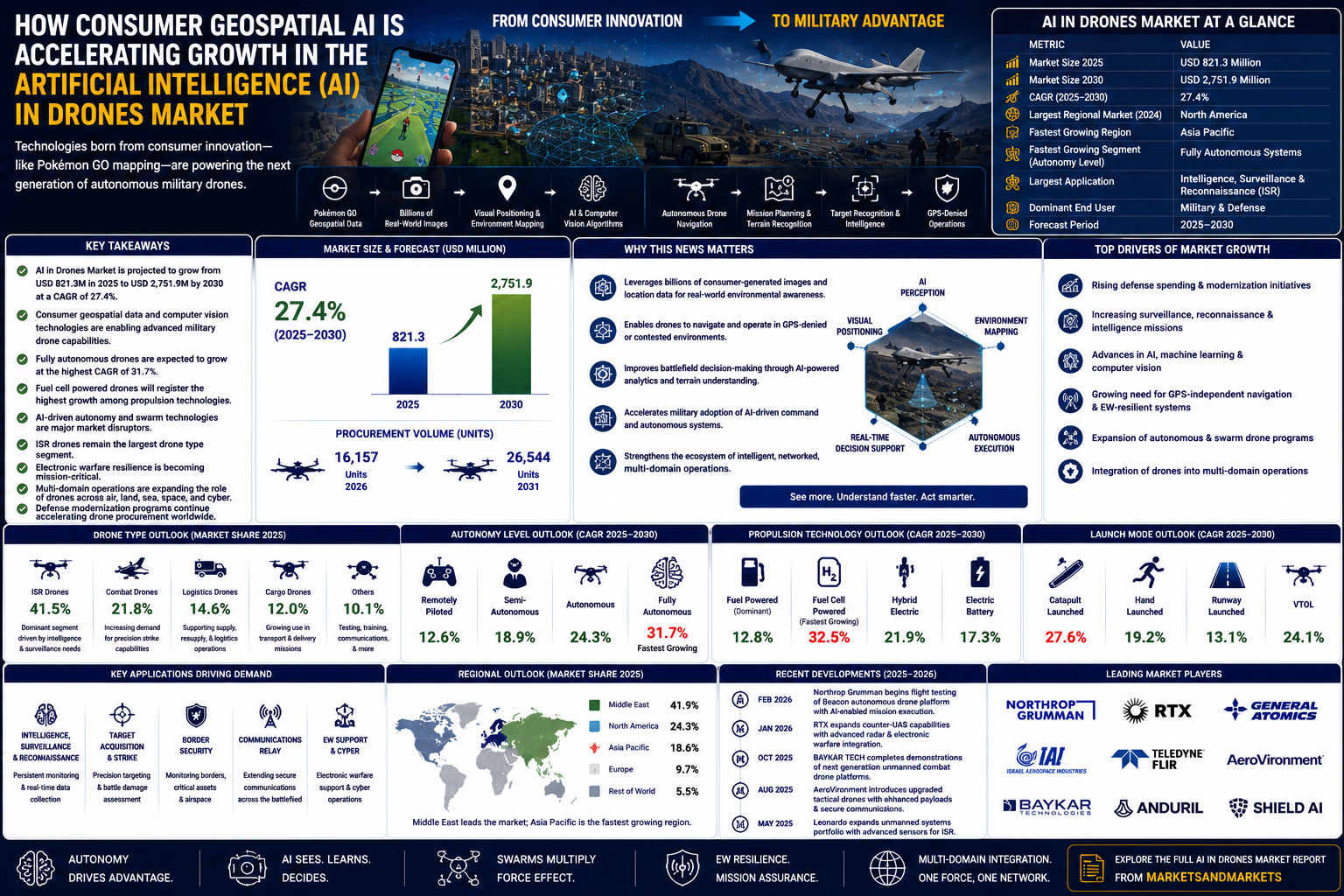
A recent report highlighting how geospatial data originally collected through Pokémon GO and other consumer applications is being leveraged for military artificial intelligence development underscores this shift. What began as a gaming platform built around location-based interactions has evolved into one of the world's largest geospatial mapping ecosystems. Through billions of user-generated images, environmental scans, and location interactions, advanced visual positioning and environmental understanding technologies have been created that now have potential applications far beyond entertainment.
According to the report, technologies developed through Niantic's geospatial mapping platform and its associated spin-off initiatives are being explored for defense use cases including autonomous drone navigation, mission planning, target recognition, intelligence gathering, and operations in GPS-denied environments.
The development highlights a broader transformation occurring across the drone ecosystem. Commercial AI innovation, machine learning, computer vision, and geospatial intelligence are increasingly becoming foundational technologies for next-generation military and civilian drone platforms. As a result, demand for AI-enabled drone systems is accelerating across defense, commercial, and government sectors worldwide.
Breaking Down the News
The article focuses on how consumer-generated geospatial data is contributing to advanced artificial intelligence applications within defense technologies.
The foundation of this development lies in geospatial mapping capabilities built through years of user interaction with location-based applications.
These systems leverage:
-
Billions of real-world images
-
Environmental mapping data
-
Visual positioning information
-
Location interaction datasets
-
Computer vision algorithms
Originally developed to improve augmented reality experiences, these technologies are now being adapted for applications including:
-
Autonomous drone navigation
-
Terrain recognition
-
Mission planning
-
GPS-denied operations
-
Target identification
-
Environmental awareness
The ability of AI systems to understand and interpret real-world environments has significant implications for both commercial and military drone operations.
More broadly, the story illustrates how innovations originating in consumer technology ecosystems are increasingly influencing defense modernization programs.
Why This News Matters Beyond the Headlines
The significance of this development extends well beyond gaming applications or individual drone programs.
It reflects several important trends shaping the future of autonomous systems.
Geospatial Intelligence Is Becoming a Strategic Asset
Modern military operations increasingly rely on accurate environmental understanding.
Geospatial intelligence supports:
-
Navigation
-
Mission planning
-
Threat assessment
-
Route optimization
-
Target acquisition
AI-powered geospatial systems can process vast amounts of visual and spatial data to generate actionable insights for operators and autonomous platforms alike.
GPS Dependence Is Becoming a Vulnerability
Many military and commercial drones rely heavily on satellite navigation systems.
However, modern conflicts have demonstrated that GPS signals can be:
-
Jammed
-
Spoofed
-
Disrupted
-
Denied entirely
Visual positioning technologies provide an alternative method of navigation by enabling drones to understand their surroundings through onboard sensors and AI processing.
This capability is becoming increasingly important in contested environments.
Commercial Innovation Is Driving Defense Transformation
Historically, defense technologies often migrated into commercial applications.
Today, the opposite trend is becoming more common.
Commercial sectors are leading advancements in:
-
Artificial intelligence
-
Computer vision
-
Cloud computing
-
Geospatial analytics
-
Edge processing
Defense organizations are increasingly adapting these innovations to accelerate modernization efforts while reducing development timelines.
What This Means for the Artificial Intelligence (AI) in Drones Market
The developments highlighted in the article align closely with long-term growth drivers shaping the Artificial Intelligence (AI) in Drones Market.
According to MarketsandMarkets, the Artificial Intelligence (AI) in Drones Market is estimated at USD 821.3 million in 2025 and projected to reach USD 2,751.9 million by 2030, registering a CAGR of 27.4%.
This growth is being driven by increasing adoption of AI-powered drone capabilities across military, commercial, and civil applications.
| Market Driver | Industry Impact |
|---|---|
| Autonomous navigation systems | Reduced dependence on remote operators |
| Computer vision technologies | Improved environmental understanding |
| Geospatial intelligence integration | Enhanced mission planning and navigation |
| Military modernization programs | Increased procurement of AI-enabled drones |
| GPS-denied operations | Greater demand for visual positioning systems |
The convergence of consumer AI innovation and defense applications reinforces many of these growth trends.
Organizations seeking deeper insights into emerging opportunities can explore broader developments within the Artificial Intelligence (AI) in Drones Market and evaluate how AI technologies are reshaping the future of unmanned systems.
Related Resource: Read about the Artificial Intelligence (AI) in Drones Market: https://www.marketsandmarkets.com/Market-Reports/artificial-intelligence-drones-market-43722301.html
Key Industry Trends Accelerating Market Growth
Computer Vision Is Becoming Core Drone Infrastructure
Computer vision technologies are increasingly serving as the foundation for autonomous drone operations.
These capabilities enable drones to:
-
Identify objects
-
Recognize terrain
-
Avoid obstacles
-
Navigate complex environments
-
Conduct autonomous inspections
As processing capabilities improve, computer vision is becoming a standard feature across advanced drone platforms.
Geospatial Intelligence Is Expanding Operational Capabilities
AI-powered geospatial intelligence enhances drone effectiveness by providing deeper environmental awareness.
Applications include:
-
Terrain mapping
-
Route optimization
-
Mission planning
-
Infrastructure analysis
-
Battlefield intelligence
These capabilities are becoming increasingly valuable across both military and commercial sectors.
Autonomous Navigation Is Reducing Reliance on GPS
One of the most important developments in the drone industry is the shift toward navigation systems capable of operating independently of satellite signals.
Technologies supporting this transition include:
-
Visual positioning systems
-
Sensor fusion architectures
-
AI-based localization
-
Terrain matching algorithms
-
Edge processing solutions
These capabilities improve operational resilience and mission effectiveness.
AI-Enabled ISR Missions Continue to Expand
Defense organizations are increasingly deploying AI-powered drones for intelligence, surveillance, and reconnaissance missions.
Benefits include:
-
Faster data processing
-
Improved target identification
-
Automated threat detection
-
Enhanced situational awareness
-
Reduced operator workload
ISR remains one of the most significant growth areas within the Military AI Drones segment.
Swarm Intelligence Is Emerging as a Strategic Priority
Drone swarms represent one of the most transformative applications of artificial intelligence.
AI enables swarm platforms to:
-
Coordinate autonomously
-
Share information
-
Adapt to changing conditions
-
Execute complex missions
Many military modernization programs are investing heavily in swarm technologies as future force multipliers.
Market Implications for Stakeholders
For Defense Organizations
Military forces are increasingly seeking AI-enabled drone capabilities that improve autonomy and operational flexibility.
Procurement priorities are likely to focus on:
-
GPS-independent navigation
-
AI-based target recognition
-
Autonomous mission execution
-
Geospatial intelligence integration
-
Swarm drone technologies
These capabilities support future multi-domain operations.
For Investors
The AI Drone Market continues to present attractive growth opportunities.
Key investment themes include:
-
Computer vision platforms
-
Autonomous navigation technologies
-
Edge AI systems
-
Geospatial analytics
-
Military autonomous systems
The market's projected growth reflects strong demand across multiple sectors.
For Technology Providers
Developers of AI-powered drone solutions are benefiting from increasing interest in autonomy and intelligent mission systems.
Competitive differentiation will depend on:
-
Navigation accuracy
-
AI performance
-
Sensor integration
-
Processing efficiency
-
Operational reliability
Innovation remains a critical factor for long-term success.
For Governments
Governments are supporting investments in autonomous systems as part of broader defense modernization initiatives.
Strategic priorities include:
-
National security enhancement
-
Technology sovereignty
-
Advanced manufacturing
-
AI leadership
-
Defense innovation
Public-sector funding is expected to remain a major catalyst for industry growth.
Frequently Asked Questions
What is the Artificial Intelligence (AI) in Drones Market?
The Artificial Intelligence (AI) in Drones Market includes drone systems that use AI technologies such as machine learning, computer vision, deep learning, and autonomous navigation to improve performance and decision-making.
Why is geospatial intelligence important for drones?
Geospatial intelligence helps drones understand their surroundings, navigate accurately, plan missions, and operate effectively in complex environments.
How can drones operate in GPS-denied environments?
Drones can use visual positioning systems, computer vision, terrain mapping, sensor fusion, and AI-powered navigation technologies to determine location without relying on GPS signals.
What role does computer vision play in autonomous drones?
Computer vision enables drones to identify objects, recognize terrain, avoid obstacles, track targets, and understand environmental conditions.
Why are military organizations investing in AI-enabled drones?
AI improves mission effectiveness through autonomous navigation, target recognition, intelligence analysis, surveillance capabilities, and faster decision-making.
What are drone swarm technologies?
Drone swarms involve multiple autonomous drones operating cooperatively through AI-enabled coordination and communication systems.
Which industries are adopting AI-powered drones?
Defense, logistics, agriculture, infrastructure inspection, mapping, emergency response, energy, and transportation sectors are increasingly deploying AI-enabled drone systems.
Where can organizations find deeper insights into AI drone trends?
Industry stakeholders often rely on specialized market intelligence to evaluate technology developments, competitive dynamics, investment opportunities, and future growth prospects.
Looking Beyond Today's Headlines
The use of consumer-generated geospatial data for advanced AI applications highlights a broader transformation occurring across the drone ecosystem.
Future drone platforms will increasingly rely on artificial intelligence not only for navigation but also for perception, planning, coordination, and mission execution.
Several trends are expected to define the next phase of industry growth:
-
Autonomous navigation systems
-
AI-powered visual positioning
-
Edge AI processing
-
Swarm intelligence
-
Advanced geospatial analytics
-
Multi-domain autonomous operations
As these technologies mature, drones will become increasingly capable of operating independently in complex and contested environments.
The convergence of commercial AI innovation and defense modernization efforts is likely to remain one of the most influential forces shaping the future of autonomous systems.
Future Outlook
The evolution of geospatial technologies originally developed through consumer applications into advanced military AI capabilities demonstrates how rapidly innovation is transforming the drone ecosystem. Technologies supporting visual positioning, environmental understanding, and autonomous navigation are becoming increasingly important for both commercial and defense applications.
These developments align closely with broader trends shaping the Artificial Intelligence (AI) in Drones Market, where increasing demand for autonomous systems, computer vision, geospatial intelligence, and AI-powered mission capabilities continues to drive significant growth.
For defense organizations, investors, technology providers, and policymakers, understanding these trends will be essential as artificial intelligence becomes a defining feature of next-generation drone platforms. The continued convergence of commercial innovation and military applications suggests that AI-enabled drones will remain among the most dynamic segments of the broader aerospace and defense market.
For readers seeking deeper insights into market forecasts, technology developments, competitive dynamics, and growth opportunities, MarketsandMarkets provides comprehensive research on the Artificial Intelligence (AI) in Drones Market and the factors driving its continued expansion.
Download Sample Report: https://www.marketsandmarkets.com/pdfdownloadNew.asp?id=43722301
Explore the Artificial Intelligence (AI) in Drones Market: https://www.marketsandmarkets.com/Market-Reports/artificial-intelligence-drones-market-43722301.html

This FREE sample includes market data points, ranging from trend analyses to market estimates & forecasts. See for yourself.
SEND ME A FREE SAMPLE






