AI Impact Analysis on Active Protection System Industry
Artificial Intelligence is redefining the way modern militaries defend armored vehicles from advanced threats. Active Protection Systems (APS), which serve as autonomous countermeasures against anti tank missiles, rocket propelled grenades, and other projectiles, are undergoing a fundamental transformation with the integration of AI. Traditionally, APS technologies relied heavily on pre programmed response protocols. With AI, these systems are now capable of learning, adapting, and evolving in real time. AI introduces new levels of speed, accuracy, and decision making agility. This evolution is crucial in a world where adversarial weaponry is becoming increasingly sophisticated, fast, and difficult to track using conventional means. Nations around the world are investing in AI driven APS to improve survivability on the battlefield, reduce human error, and ensure proactive response to ever changing threats. As AI technologies mature, they are expected to become the core operating engine behind next generation active defense systems.
AI-Enhanced Threat Detection and Classification in APS
At the heart of any Active Protection System lies its ability to detect, classify, and prioritize threats within milliseconds. The introduction of AI into this process significantly enhances the system's capabilities. AI driven threat detection utilizes deep learning and computer vision to recognize incoming munitions with unprecedented accuracy. These systems are trained on vast datasets of weapon signatures, enabling them to distinguish between real threats and non threats even in high noise environments. Traditional radar and infrared detection systems are limited by their sensor specific processing. AI bridges this limitation by analyzing cross sensor data inputs combining radar, optical, infrared, and acoustic data streams to provide a more holistic and reliable threat profile. In battlefield scenarios where multiple projectiles may be incoming from different angles and velocities, AI enables the APS to prioritize which threat to neutralize first, drastically improving the chances of vehicle survival. Furthermore, AI algorithms continue to learn from each encounter, refining detection protocols with every engagement.
Machine Learning in APS Decision-Making and Countermeasure Deployment
The true test of an APS is not just in its ability to detect threats but also in how it responds. AI, and specifically machine learning, plays a pivotal role in enhancing the decision making process for countermeasure deployment. Modern APS are capable of employing both hard kill (physical interception) and soft kill (electronic jamming or deception) tactics. The choice of response must be calculated instantly, depending on the nature of the threat, proximity, and available resources. AI decision engines analyze battlefield conditions in real time and simulate multiple response scenarios before selecting the optimal one. Through reinforcement learning, the AI component continually improves its decision tree based on past outcomes. This allows the APS to not only respond faster but also adapt to changing threat landscapes. For instance, an AI enabled APS may recognize that a top attack missile is best countered with a soft kill measure followed by evasive maneuvering, whereas a direct RPG strike requires a kinetic countermeasure. Such intelligent orchestration of responses significantly enhances the survivability of the protected vehicle.
Sensor Fusion Using AI in Active Protection Systems
Sensor fusion is a critical enabler of modern APS, and AI serves as the glue that binds diverse sensor data into a coherent operational picture. In the chaos of combat, reliance on a single sensor modality can be a liability. AI driven sensor fusion allows the APS to combine inputs from radar, infrared cameras, LiDAR, ultrasonic sensors, and acoustic detectors. The AI system interprets these inputs, filters out irrelevant or misleading signals, and generates an accurate, unified threat visualization. This real time synthesis ensures that no threat is missed due to signal overlap or sensor limitations. Moreover, AI is capable of weighting sensor data based on confidence levels and historical reliability, dynamically adjusting sensor priority in different conditions such as fog, dust, or electronic warfare interference. As threats become more stealthy and multidimensional, sensor fusion powered by AI becomes the bedrock of a responsive and robust APS architecture.
Autonomous Vehicle Protection Through AI-Enabled APS
Unmanned ground vehicles (UGVs) and optionally manned armored platforms are increasingly becoming the focus of modern militaries. These platforms demand APS that operate autonomously, without direct human oversight. AI makes this autonomy possible by embedding situational awareness, decision making, and action execution within the vehicle’s protection system. For autonomous vehicles operating in contested environments, an AI driven APS can evaluate terrain, enemy movement, and incoming fire, making split second decisions to avoid damage or neutralize threats. This kind of onboard intelligence enables the vehicle to perform complex protective maneuvers that were previously dependent on remote human control. Additionally, AI allows these vehicles to communicate and coordinate with nearby units, sharing threat data and synchronizing countermeasures. This collaborative approach improves not only the survivability of individual vehicles but also the effectiveness of entire fleets in coordinated missions.
AI in Real-Time Data Processing for Hypersonic and Swarm Threats
Modern battlefields are witnessing the rise of hypersonic missiles and swarm drone attacks, which pose unique challenges to traditional defense systems. These threats are characterized by high speed, erratic trajectories, and multi angle convergence, leaving minimal reaction time. AI’s strength lies in processing vast volumes of data in real time and making decisions faster than any human or legacy system can. When an APS equipped with AI encounters a hypersonic threat, it processes radar and sensor inputs at microsecond intervals, predicting trajectories and calculating interception vectors in real time. Similarly, in the face of a swarm attack where multiple small drones approach from varying directions the AI can identify and rank threats by lethality and proximity, assigning countermeasures accordingly. This requires deep neural networks trained on thousands of combat scenarios, which allow the system to recognize even novel threat behaviors. In effect, AI becomes the nervous system of the APS, sensing danger and reacting with unmatched speed and accuracy.
AI and Simulation in APS Design, Testing, and Optimization
Before a new APS can be deployed on the battlefield, it must undergo rigorous design, testing, and optimization cycles. AI plays a vital role in this development phase by enabling advanced simulations and the use of digital twins. Using AI powered modeling tools, defense engineers can simulate countless battlefield conditions varying terrain, threat types, engagement angles, and environmental challenges without the need for costly physical prototypes. AI algorithms analyze these simulations to identify weaknesses in sensor coverage, response time, or countermeasure effectiveness. Through generative design, AI can also suggest alternative configurations for sensor placement, armor geometry, and intercept angles. This iterative design process results in faster development timelines, reduced costs, and systems that are better suited to real world deployment. Once deployed, these digital twins continue to operate, collecting field data and feeding it back into the design cycle, enabling continuous improvement of APS performance over time.
Get AI Impact Analysis on Active Protection Market, Request Pdf Brochure: https://www.marketsandmarkets.com/pdfdownloadNew.asp?id=5804076
Integration of AI with C4ISR and Battlefield Management Systems
For an APS to be fully effective, it must not operate in isolation. Integration with command, control, communications, computers, intelligence, surveillance, and reconnaissance (C4ISR) systems is critical for coordinated battlefield defense. AI enables seamless integration by translating raw sensor data into actionable intelligence that can be shared across military networks. When multiple vehicles are equipped with AI driven APS, they can become active nodes in a larger information sharing network. These systems can broadcast detected threats, suggest evasive actions to nearby units, and even coordinate intercepts. For example, if a tank’s APS detects a missile that cannot be intercepted due to angle constraints, it can alert a nearby vehicle to deploy its own countermeasures. AI also supports strategic planning by analyzing patterns in threat data, predicting enemy tactics, and recommending defensive maneuvers to commanders. By embedding AI within both the APS and the broader C4ISR architecture, militaries can achieve a new level of battlefield intelligence and responsiveness.
AI Cybersecurity in Active Protection System Networks
As APS becomes more interconnected and reliant on digital networks, cybersecurity has become a major concern. AI plays a dual role in this context both as a target and a defender. On one hand, adversaries may attempt to spoof sensors or inject malicious code into the APS network. On the other hand, AI is an effective tool for identifying and neutralizing such threats. AI based intrusion detection systems monitor network traffic, device behavior, and communication protocols in real time, flagging anomalies that may indicate cyber intrusion. These systems can isolate affected modules, reroute data, or initiate self healing protocols without human intervention. Furthermore, AI helps in creating cyber resilient architectures that adapt to emerging threats and resist known exploit patterns. The dynamic nature of AI driven cybersecurity ensures that APS systems remain functional, even under electronic warfare conditions. As the digital threat landscape evolves, AI will remain at the forefront of securing the brain of modern active protection platforms.
Future Trends and Market Outlook for AI-Driven APS Technologies
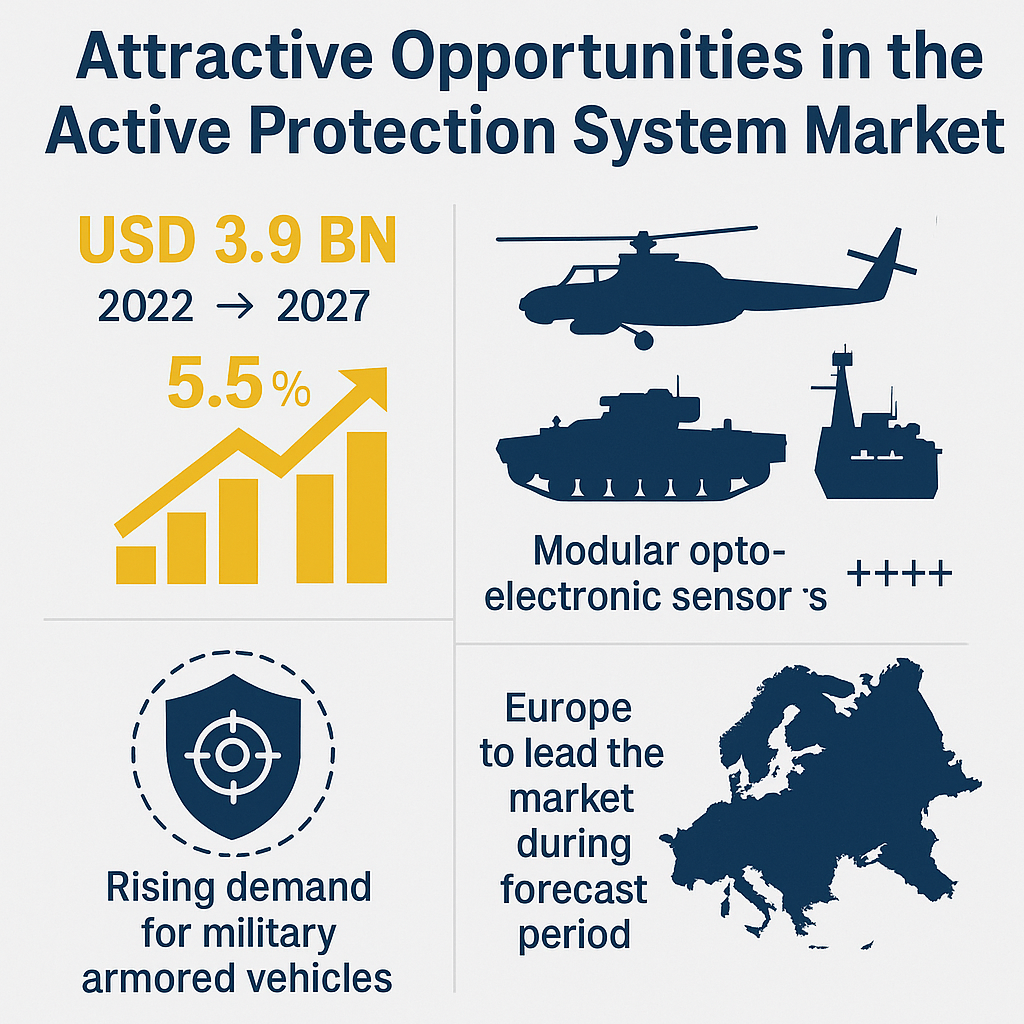
The future of the Active Protection Systems market is tightly interwoven with the evolution of artificial intelligence. As AI algorithms become more explainable, secure, and mission configurable, their integration into APS will deepen. Nations are increasingly adopting AI powered APS in next generation infantry fighting vehicles, main battle tanks, and autonomous defense platforms. Commercial defense firms are investing in AI partnerships and cross domain collaboration to stay ahead in this rapidly growing segment. Regionally, the United States, Israel, Russia, South Korea, and China are leading innovation in this space, with NATO members accelerating AI integration in their modernization programs. Emerging trends include the use of quantum AI to enhance real time processing, federated learning for fleet wide APS training, and swarm intelligence models that allow multiple APS units to operate as a single, intelligent network. Over the next decade, AI is expected to transition APS from reactive systems into proactive battlefield agents capable of not just defending assets but reshaping tactical outcomes.
Artificial Intelligence has ushered in a new era for Active Protection Systems, transforming them from reactive defense modules into intelligent, autonomous guardians of military assets. From rapid threat detection to real time countermeasure deployment, from autonomous vehicle integration to battlefield networking, AI enables APS to operate faster, smarter, and more collaboratively. The increasing complexity of modern warfare demands such innovation, where milliseconds can mean the difference between mission success and failure. As AI technologies continue to evolve, so too will their role in securing armored platforms against the full spectrum of current and emerging threats. The future of the active protection market is undeniably intelligent, adaptive, and AI driven, marking a strategic inflection point in defense system design and deployment.
Related Report:
Active Protection System Market by Kill System Type (Soft Kill System, Hard Kill System, Reactive Armor), End User (Defense, Homeland Security), Platform (Ground, Marine, Airborne), and Region - Global Forecast

This FREE sample includes market data points, ranging from trend analyses to market estimates & forecasts. See for yourself.
SEND ME A FREE SAMPLE

