AI Impact Analysis on Aircraft Fuel Cells Industry
The aviation world is entering a transformational era. Hydrogen fuel cells are at the forefront of future propulsion systems as airlines, OEMs, and regulators seek zero emission technologies. AI is emerging as the accelerant fueling this transformation, optimizing everything from design to compliance. By intelligently managing performance, safety, manufacturing, and market strategy, AI is positioning aircraft fuel cells to become a cornerstone of next generation flight.
AI Enhanced Design and Optimization of Aircraft Fuel Cells
Advanced AI algorithms are now reshaping how engineers conceive and refine fuel cell architectures. Generative design tools driven by deep learning automate the exploration of cell configurations, electrode layouts, and fluid flow dynamics. These systems drastically cut design cycles and optimize size to power ratios. AI supported multiphysics simulations merge thermal, electrochemical, and structural domains, delivering high fidelity insights during early prototyping. A recent MarketsandMarkets study highlights this accelerating AI innovation synergy.
Predictive Maintenance for Fuel Cell Systems Using AI
In flight and ground based predictive maintenance is a critical enabler for aircraft fuel cell adoption. AI driven platforms ingest sensor data related to voltage, current, temperature, and pressure to spot early signs of membrane degradation, catalyst deactivation, or hydrogen contamination. These insights schedule maintenance proactively, reducing unplanned downtime and lowering lifecycle costs. Volkswagen’s Hydrogen Aviation Lab is using digital twins to simulate such strategies ahead of deployment on future Airbus platforms .
Real Time Performance Monitoring and Control
Safety and efficiency in flight require instantaneous health monitoring. AI systems continuously assess stack voltage balancing, thermal management, and pressure margins. When anomalies appear like a localized temperature hotspot or output drop the controller autonomously redistributes load among stack modules. Adaptive balancing algorithms also help share power delivery across battery and fuel cell groups for smooth flight. Such systems are being piloted on ZeroAvia’s ZA2000 engine platform, supported by onboard AI processors.
AI in Hydrogen Fuel Cell Safety and Leak Detection
Hydrogen, though efficient, poses leak and fire risks that demand vigilant detection. AI unlocks real time multisensor leak detection by analyzing humidity, pressure, and thermal patterns. With advanced neural networks, AI systems reduce false alerts while reliably flagging emerging hazards. Additionally, risk models powered by predictive AI can forecast leak escalation scenarios, enabling preemptive emergency measures. Airbus and MTU, for instance, recently partnered to advance fuel cell safety through intelligent controls .
Intelligent Energy Management in Hybrid Aircraft
Hybrid electric aircraft featuring fuel cell and battery systems require dynamic power balancing. AI systems orchestrate load management in real time, adapting to flight modes like takeoff, climb, cruise, or descent. Neural controllers optimize power distribution by predicting future energy demands, smoothing transitions, and extending range. Leveraging AI in routing hybrid flows improves efficiency and supports mission flexibility on platforms such as regional hydrogen electric turboprops.
AI Driven Fuel Cell Integration with Electric Propulsion
Integrating fuel cells with electric motors requires precise synchronization of voltage, current, and frequency. AI driven control loops coordinate inverters, motor throttles, and stack stacks under varied aerodynamic environments. Machine learning calibrates response latency during power surges in climb, preventing step changes in acceleration or noise. Simulation led integration reduces bench testing requirements, thanks to AI platforms that simulate cascading behaviors of multi component systems.
Get AI Impact Analysis on Aircraft Fuel Cells Market, Request Pdf Brochure: https://www.marketsandmarkets.com/pdfdownloadNew.asp?id=245111926
Accelerating Certification and Compliance with AI Tools
Certification for new propulsion systems typically spans years. AI powered regulatory simulators accelerate this with virtual test beds. NLP engines assist by generating compliance documentation automatically. Recent industry trends show that simulation led certification research is being piloted within hydrogen labs to align prospective platforms with FAA/EASA requirements . By predicting test outcomes and identifying compliance gaps in simulation, AI tools can compress certification timelines and reduce cost.
Material Innovation for Fuel Cells Powered by AI Insights
Material science decisions are critical for fuel cell performance and cost. AI helps identify novel catalysts (like platinum group metal alternatives), durable membranes, and robust bipolar plates. Using generative models and high throughput analysis, these platforms surface material optimizations far faster than conventional methods. AI steered research identifies compounds that resist carbon corrosion, tolerate thermal cycling, and improve power density all essential for aviation use.
AI’s Role in Scaling Aircraft Fuel Cell Production
To serve airline markets, hydrogen fuel cells need scalable manufacturing. AI controlled robotic assembly lines now align stack elements, compressors, electrodes, and membrane components with precision. Computer vision ensures quality checks on solder joints, seal integrity, and material placement. Manufacturing data analysis helps reduce defects, predict supply bottlenecks, and guide real time process adjustments. These AI driven measures are reducing per unit costs and enabling high volume adoption.
Market Forecasting and Strategic Planning with AI
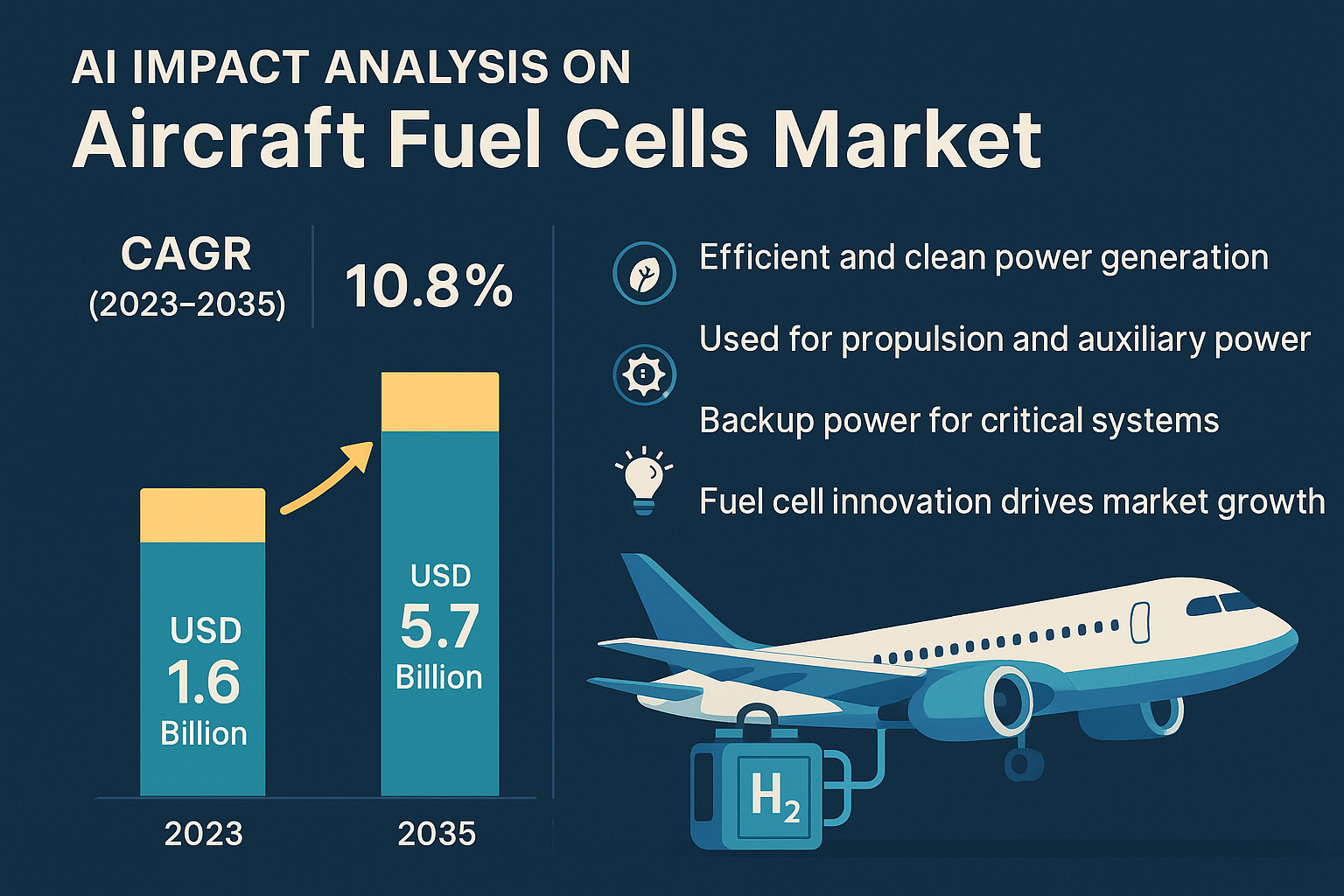
On a strategic level, AI predicts adoption curves, investment returns, and geopolitical influences. By analyzing policy frameworks, adoption readiness, and fleet growth scenarios, AI supports strategic planning for OEMs, regulators, and MRO providers. Market models from DefenseC5ISR partner platforms suggest aircraft fuel cell demand growing at an 18 percent CAGR to reach USD 4.3 billion by 2032. Scenario modeling supports business decisions and risk mitigation in a shifting sector.
Market Adoption: Leading Programs and Strategic Alignment
ZeroAvia stands at the forefront with its ZA2000 hydrogen fuel cell powertrain. In parallel, electric hydrogen efforts by Airbus ZEROe, DLR HY4, and Project Fresson are exploring hybrid electric architectures. Airlines are already signaling intent. American Airlines recently signed a conditional pact to purchase 100 hydrogen electric engines from ZeroAvia, targeting emission free regional flights by 2029.
European and North American efforts are synchronizing on regulation and infrastructure. Airbus and MTU are collaborating on fuel cell architecture maturity under Clean Aviation programs. Investments are flowing from government and venture sources such as Intelligent Energy’s UK led project receiving £17 million for commercial aircraft systems.
Challenges and Outlook: The AI Fuel Cell Flight Path
Significant hurdles remain. AI models must be trained under aviation grade safety standards, and hydrogen storage brings volumetric constraints. Research such as the DLR PEMFC eVTOL models show target specific power at 1.1 kW/kg. Maintaining thermal balance, hydrogen storage compatibility, and compliance under mixed flight profiles demand progressive innovation. AI remains central in validating architectures, managing safety, and supporting regulatory conformity.
As OEMs mature stacks, regulators align certification pathways, and airlines place orders, the broader aviation system must evolve. Global hydrogen infrastructure expansion will be crucial beyond aircraft systems. Successful deployment depends on synchronized AI tools driving system design, monitoring, certification, and scale.
AI is the Co-Pilot for Fuel Cell Flight
AI stands at the core of the aircraft fuel cell revolution, driving it from concept to runway. By optimizing design, accelerating certification, predicting maintenance, embedding safety, and guiding market strategies, AI accelerates a pathway to green flight. As leading aviation players pilot eVTOLs, regional hybrids, and hydrogen powertrains through test programs, AI ensures each iteration is safer, lighter, more efficient, and compliant. In this market, success will be defined not solely by hydrogen stacks, but by intelligent systems that knit them seamlessly into tomorrow’s aircraft.
Related Report:
Aircraft Fuel Cells Market by Fuel Type (Hydrogen, Hydrocarbon, Others), Power Output (0-100kW, 100 kW- 1MW, 1MW & Above), Aircraft Type (Fixed-Wing, Rotary Wing, UAVs, AAMs) and Region - Global Forecast to 2035

This FREE sample includes market data points, ranging from trend analyses to market estimates & forecasts. See for yourself.
SEND ME A FREE SAMPLE






