AI Impact Analysis on Artillery Systems Industry
Artificial Intelligence (AI) is fundamentally transforming the artillery system market, ushering in a new era of digitized, precision based, and highly autonomous warfare. Artillery, once dependent on manual calculations, rigid logistics, and delayed responses, is rapidly evolving into a smart warfare component. Nations across the globe are integrating AI into artillery systems to increase battlefield efficiency, reduce collateral damage, and enhance survivability in dynamic combat environments. As militaries seek faster, smarter, and more networked systems, AI is emerging as the technological backbone of modern artillery operations.
Smart Targeting and Fire Control Powered by AI
One of the most profound impacts of AI on artillery systems is in the realm of smart targeting and fire control. Traditional targeting often required complex ballistic calculations, real time weather adjustments, and manual inputs from operators. AI has changed this landscape by enabling real time data processing through advanced algorithms and machine learning models. These systems can now autonomously assess environmental conditions, track moving targets, and calculate optimal firing solutions without human intervention. The result is greater accuracy, faster response times, and the ability to engage high value targets with minimal error. The integration of AI also means that artillery units can react to battlefield changes dynamically, altering targeting strategies on the fly based on drone surveillance, satellite imagery, and acoustic sensors. As AI continues to evolve, fire control systems are becoming increasingly predictive, enhancing the first shot kill probability and improving mission success rates.
Predictive Maintenance in Artillery Systems Using AI
Maintenance has long been a pain point for artillery operations, often leading to unexpected downtime or mission delays. AI is revolutionizing this area through predictive maintenance capabilities. By analyzing sensor data from artillery components such as barrels, recoil systems, actuators, and power sources, AI systems can detect patterns indicating wear and tear or potential failures. Machine learning models use this data to predict when a component is likely to fail, allowing for preemptive repairs or replacements. This shift from reactive to predictive maintenance reduces operational costs, increases system availability, and ensures higher readiness levels during deployments. The use of digital twins and AI powered analytics platforms in defense maintenance strategies is also gaining momentum, providing real time monitoring and lifecycle management of artillery systems across fleets. The AI driven approach is essential for modern militaries aiming to extend the longevity and effectiveness of their high value assets.
AI Integration in Battlefield Surveillance for Artillery Precision
AI is becoming integral to surveillance and reconnaissance processes that support artillery targeting. Real time battlefield intelligence from drones, satellites, and ground based sensors is now being processed using AI for enhanced situational awareness. Computer vision algorithms can identify and classify enemy movements, artillery positions, armored vehicles, and even camouflaged threats. This data is then transmitted to artillery fire control units, significantly reducing the sensor to shooter time. AI can also analyze terrain maps, movement patterns, and threat probabilities, allowing commanders to determine the most strategic positions for artillery deployment. By coupling AI with ISR (Intelligence, Surveillance, Reconnaissance), modern artillery systems are not only more accurate but also more strategically placed. This synergy improves mission planning, ensures efficient ammunition use, and contributes to superior battlefield dominance.
Autonomous Artillery Platforms and AI Coordination
Autonomy in artillery systems is no longer a futuristic concept. AI is enabling artillery platforms to function with minimal human oversight, whether on land based self propelled guns or on robotic missile launchers. Autonomous navigation systems powered by AI allow artillery units to maneuver through rugged terrain, identify suitable firing locations, and adjust their positions dynamically to avoid counter battery fire. These systems are also capable of communicating with unmanned aerial vehicles (UAVs), command centers, and other artillery units for coordinated missions. AI driven autonomy ensures greater responsiveness and adaptability in high intensity conflicts, especially in GPS denied or electronic warfare environments. Several defense manufacturers are now developing AI coordinated swarm artillery systems where multiple robotic units work in sync to deliver a massive and precise firepower punch. These developments not only reduce the human burden in dangerous operational zones but also open new strategic dimensions for modern warfare.
AI-Enhanced Munitions and Precision-Guided Artillery
Munitions are being redefined by the integration of AI. Precision guided artillery shells equipped with onboard AI chips can analyze in flight data, adjust their trajectory, and hit targets with remarkable accuracy. These smart munitions use sensor fusion, GPS guidance, and onboard computing to adapt to changes in target movement or environmental conditions mid flight. AI also enables networked munitions to communicate with other systems, ensuring coordinated strikes and real time targeting updates. This evolution marks a shift from traditional saturation fire tactics to precision warfare, reducing ammunition wastage and collateral damage. Moreover, guided artillery is increasingly being integrated with AI enabled targeting systems, allowing for pinpoint strikes on moving or hidden targets. This capability is vital for urban warfare, asymmetric threats, and operations in civilian sensitive zones, where accuracy is paramount.
AI in Logistics and Ammunition Resupply for Artillery Units
Effective artillery operations depend heavily on timely logistics and ammunition resupply. AI is transforming this domain by optimizing the supply chain, automating resupply missions, and predicting consumption rates based on operational data. Autonomous vehicles, guided by AI, are now being used to transport artillery shells and spare parts to forward deployed units. AI logistics platforms analyze real time battlefield data to prioritize resupply missions, select the safest routes, and forecast future needs. By minimizing human intervention in dangerous zones and enhancing delivery efficiency, AI powered logistics ensure that artillery units remain combat effective throughout extended engagements. Defense forces are also experimenting with drone based ammunition drops for inaccessible areas, further expanding the logistical capabilities enabled by AI. The digitization and automation of the supply chain are reducing vulnerabilities and significantly increasing operational tempo.
Get AI Impact Analysis on Artillery System Market, Request Pdf Brochure: https://www.marketsandmarkets.com/pdfdownloadNew.asp?id=69844596
AI-Driven Command and Control Systems in Artillery Operations
Command and Control (C2) systems are the nerve centers of artillery operations, and AI is elevating their capabilities to unprecedented levels. AI enhanced C2 systems integrate data from diverse sources, including radar, satellite, drone feeds, and soldier inputs, to provide a unified operational picture. Advanced analytics help commanders assess battlefield conditions in real time, enabling faster and more informed decisions. These systems also recommend optimal fire missions, assign tasks to specific units, and adjust strategies dynamically based on evolving threats. AI can simulate various combat scenarios to suggest the best course of action, enhancing situational flexibility. Furthermore, AI integration ensures secure, encrypted communication among all nodes in the artillery network, minimizing latency and maximizing coordination. The future of C2 lies in semi autonomous systems that can direct entire artillery battalions with minimal human input, powered by continuous AI learning and real time threat adaptation.
Cybersecurity Challenges and AI Protection for Networked Artillery
As artillery systems become more digitized and connected, they also become more vulnerable to cyber threats. AI plays a dual role in this context: both as a target and as a defender. Cyberattacks on artillery fire control systems, communication links, or targeting data can lead to devastating consequences. AI based cybersecurity solutions are being deployed to detect, prevent, and respond to such threats in real time. Machine learning models can identify anomalies in network behavior, isolate compromised nodes, and deploy countermeasures before the attack spreads. AI also enhances encryption methods and secures communication protocols used in artillery systems. In contested environments where electronic warfare and spoofing are common, AI ensures data integrity and resilience. Moreover, AI systems can run red team simulations to test the vulnerability of artillery systems and recommend hardening strategies. As cyber warfare evolves, AI will remain a crucial tool for securing the digital backbone of artillery operations.
Future Trends and Market Forecast for AI in Artillery Systems
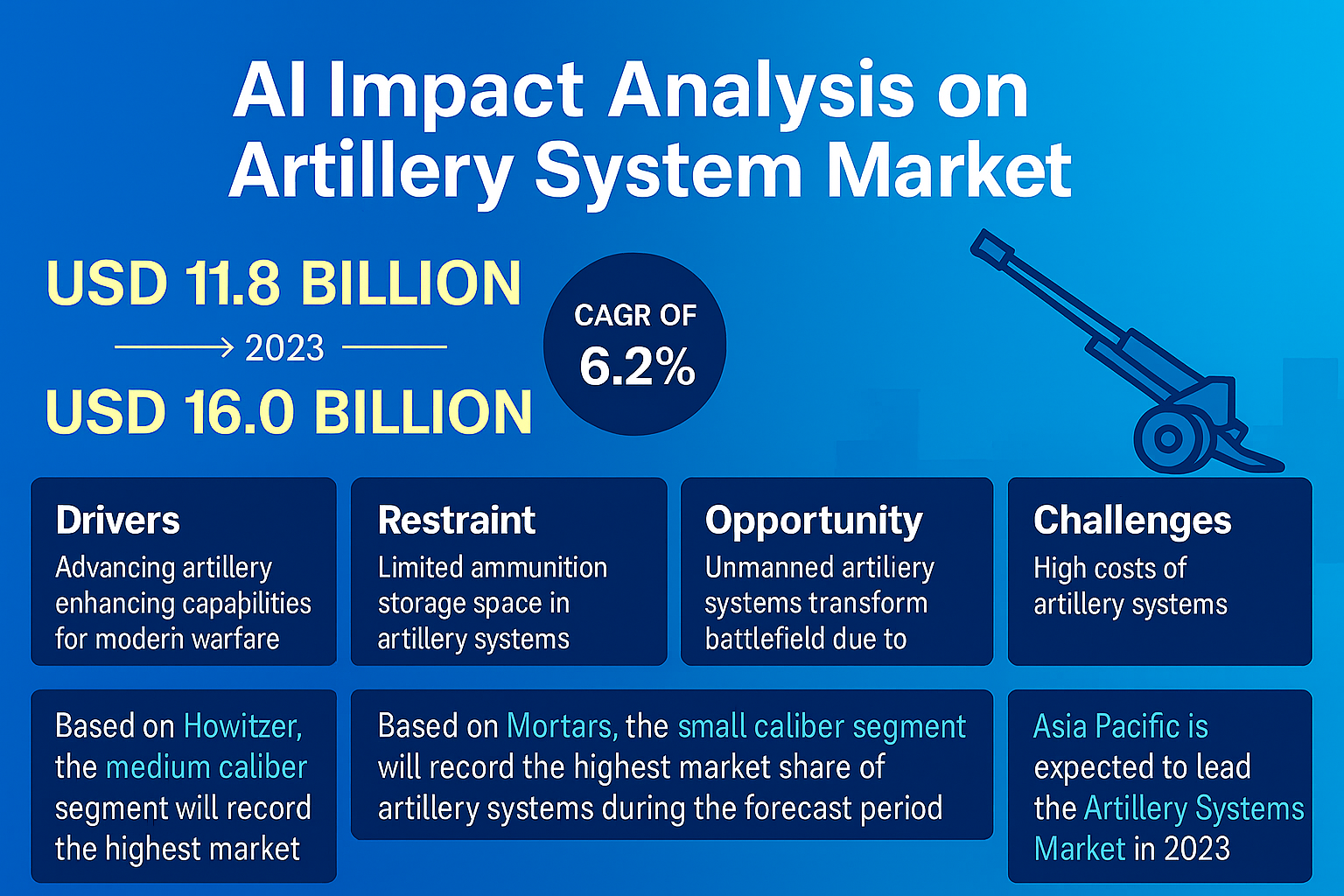
The integration of AI in artillery systems is more than a technological trend; it represents a paradigm shift in modern military doctrine. The global market for AI enabled artillery is expected to experience robust growth over the next decade, driven by defense modernization programs, geopolitical tensions, and breakthroughs in AI and robotics. Countries like the United States, China, Israel, and Russia are investing heavily in smart artillery technologies, while emerging economies are also beginning to explore AI based solutions for enhancing their artillery capabilities. Key future trends include the development of quantum AI for targeting, 6G battlefield networks, ethical AI in automated strikes, and full spectrum sensor fusion. Additionally, there is growing interest in integrating AI with nextgen artillery platforms such as electromagnetic railguns and directed energy weapons. Market analysts predict that the AI artillery systems market could grow at a double digit CAGR, with major opportunities in autonomous platforms, smart munitions, and integrated battlefield networks. As technology matures, the defense industry will witness a shift from AI assisted to AI driven artillery operations, fundamentally altering the structure of future conflicts.
Artificial Intelligence is redefining the artillery system market, turning conventional platforms into highly intelligent, autonomous, and integrated components of modern warfare. From targeting to logistics, and from surveillance to cybersecurity, AI is playing a transformative role at every stage of artillery operations. The convergence of AI with defense technologies is not only enhancing operational capabilities but also shaping strategic doctrines and defense investments across the globe. As this technology continues to evolve, the artillery systems of tomorrow will be faster, smarter, and far more lethal and those who lead in AI adoption will define the future of warfare.
Related Report:
Artillery Systems Market by Type (Howitzers, Rocket Launchers, Mortars, Anti-air weapons, Artillery), Range(Short-range, Medium-range, Long-range), Subsystem (Turrets, Engines, Fire Control Systems, AHS, Auxiliary Systems), and Region- Global Forecast to 2028

This FREE sample includes market data points, ranging from trend analyses to market estimates & forecasts. See for yourself.
SEND ME A FREE SAMPLE






