AI Impact Analysis on Aviation Industry
The aviation market has always been at the forefront of technological evolution, but the integration of artificial intelligence has elevated it to a new era of digital transformation. Artificial intelligence is no longer a futuristic concept; it is actively deployed across airlines, airports, and regulatory bodies to improve efficiency, enhance safety, and optimize passenger experience. From autonomous navigation systems to predictive analytics, AI is influencing almost every segment of aviation. The global aviation market is undergoing a shift where airlines are no longer just service providers but also technology driven enterprises. AI has enabled aviation stakeholders to build more resilient, agile, and customer focused ecosystems.
AI adoption in aviation is expanding because of increasing demand for air travel, the rising need for safety and security, and pressure to optimize operational costs. Airlines and airports worldwide are investing heavily in smart technologies, creating new growth opportunities for the aviation market.
AI in Flight Operations and Navigation
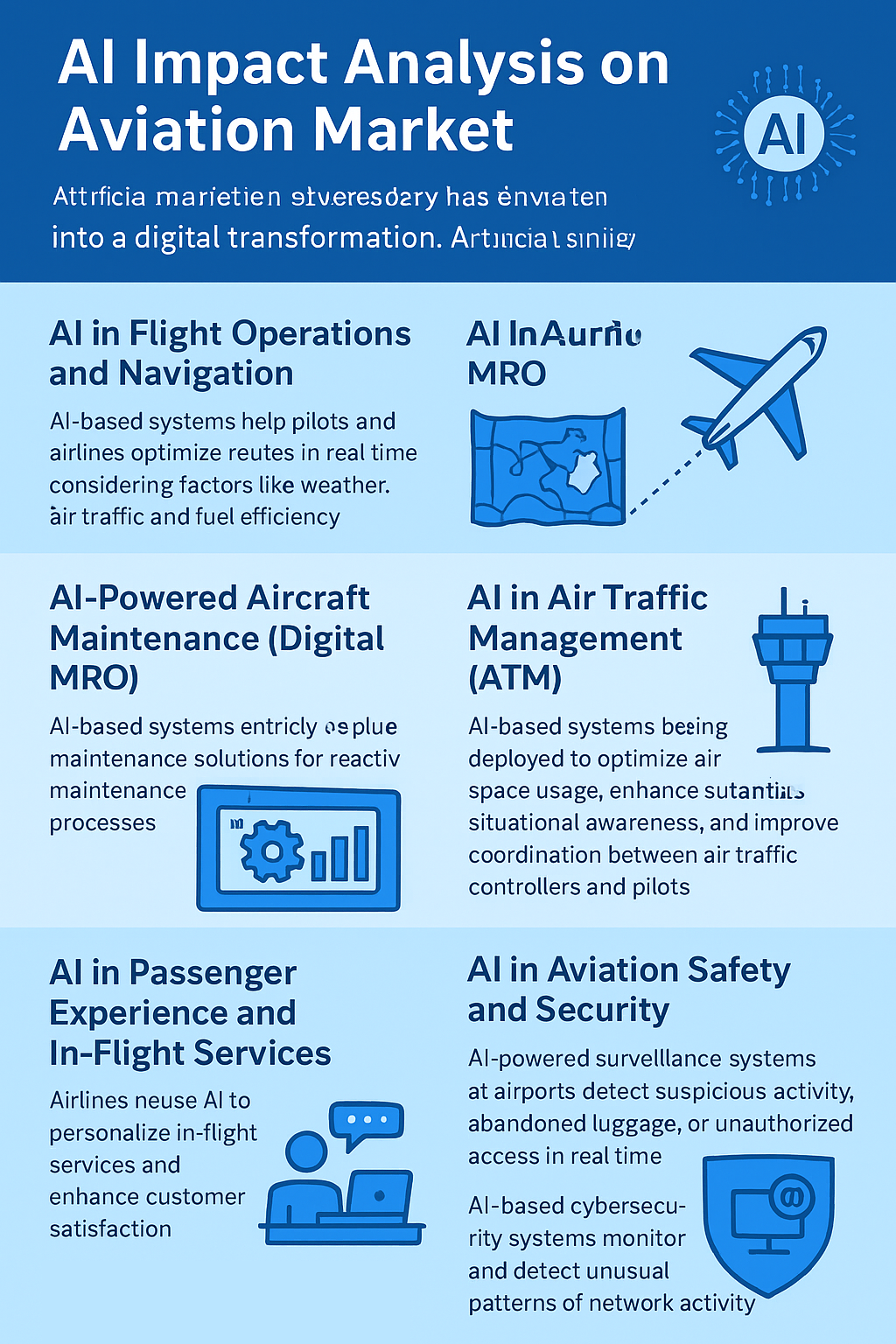
The role of AI in flight operations and navigation is one of the most groundbreaking developments in the aviation market. AI based systems help pilots and airlines optimize routes in real time, taking into account factors like weather, air traffic, and fuel efficiency. This enhances flight safety while reducing costs associated with delays and fuel consumption. AI driven autopilot technologies are advancing beyond traditional functions, enabling semi autonomous and eventually fully autonomous flights.
One key area of innovation lies in predictive analytics, which allows airlines to anticipate turbulence and weather disruptions. These AI enabled forecasting systems give pilots the ability to alter flight paths and prevent dangerous situations, ensuring passenger safety. Furthermore, integration of AI into next generation air navigation systems is enhancing global aviation safety by providing greater situational awareness, reducing the risk of mid air incidents, and allowing more efficient management of congested air routes.
AI-Powered Aircraft Maintenance (Digital MRO)
Maintenance, repair, and overhaul (MRO) is one of the costliest aspects of the aviation market, and AI is revolutionizing it through predictive maintenance solutions. Traditionally, airlines relied on scheduled inspections or reactive repairs, which often led to high downtime and operational inefficiency. AI driven digital MRO platforms use machine learning algorithms to predict potential failures before they occur. This not only reduces downtime but also saves millions in maintenance costs annually.
AI based systems monitor vast amounts of data collected from sensors installed across aircraft components. By analyzing engine performance, hydraulic systems, and avionics, AI can detect anomalies at an early stage, allowing timely interventions. Predictive maintenance is particularly critical for commercial aviation, where every grounded aircraft translates into revenue loss. Moreover, AI ensures higher levels of fleet safety by minimizing the risk of unexpected technical failures during flights.
The global aviation industry is moving toward adopting digital twins, AI powered virtual models of aircraft, to simulate and predict performance issues. These innovations will redefine MRO strategies, making aviation more efficient, reliable, and cost effective.
AI in Air Traffic Management (ATM)
Air traffic management is one of the most complex aspects of aviation, and AI is poised to transform it. With air travel demand continuously rising, managing congestion in the skies is a critical challenge. AI based systems are being deployed to optimize airspace usage, enhance situational awareness, and improve coordination between air traffic controllers and pilots.
AI tools process enormous amounts of real time flight and weather data to predict traffic bottlenecks. This predictive capability reduces delays, enhances fuel efficiency, and minimizes the risk of mid air collisions. Autonomous AI systems are also assisting in detecting potential conflicts in flight paths, enabling faster and safer decision making.
Air traffic congestion remains a global challenge, particularly in highly trafficked regions such as North America, Europe, and Asia Pacific. AI’s role in ATM provides a sustainable solution to reduce environmental impact through fuel savings while ensuring passenger safety and operational efficiency. As governments and regulatory bodies encourage modernization of air traffic systems, AI will be central to shaping future ATM strategies.
AI in Passenger Experience and In-Flight Services
Passenger experience has become a key competitive differentiator in the aviation market. Airlines are increasingly deploying AI to personalize in flight services and enhance customer satisfaction. AI algorithms analyze passenger data, such as travel history, preferences, and spending patterns, to deliver tailored experiences. This includes personalized recommendations for entertainment, meals, and upgrades.
Airlines are also using AI driven chatbots and virtual assistants to provide real time support for booking queries, check in procedures, and flight updates. This reduces dependency on human staff while improving response times. Inside aircraft cabins, AI is enabling voice controlled in flight systems that allow passengers to adjust lighting, temperature, or entertainment through simple commands.
Beyond in flight experiences, AI enhances airport operations by streamlining check ins, baggage handling, and security checks. Smart airports powered by AI technologies are becoming increasingly common, improving passenger flow and minimizing delays. These developments are redefining the aviation market into a more customer centric industry.
AI in Aviation Safety and Security
Safety and security are non negotiable priorities for the aviation industry, and AI is playing an indispensable role in strengthening them. AI powered surveillance systems are deployed at airports to detect suspicious activity, abandoned luggage, or unauthorized access in real time. Advanced facial recognition and biometric systems improve passenger identity verification, reducing the risk of security breaches.
AI is also critical in cyber defense for aviation networks. As airlines and airports adopt digital platforms, they face growing cybersecurity threats. AI based cybersecurity systems monitor and detect unusual patterns of network activity, preventing potential attacks before they cause disruptions. For flight safety, AI based monitoring tools continuously analyze flight data to identify anomalies that could signal safety risks, ensuring rapid response from crews.
The aviation market is increasingly dependent on AI not just for physical safety but also for digital resilience. By addressing both cyber and physical threats, AI establishes a secure foundation for the future growth of global aviation.
AI in Airline Revenue Management
Revenue optimization is a critical element for airlines, and AI provides sophisticated tools for demand forecasting and pricing strategies. Traditional models for ticket pricing often relied on historical data, but AI integrates real time market dynamics, competitor pricing, and passenger behavior to set optimal fares. This ensures airlines maximize revenue while staying competitive.
AI is also reshaping loyalty programs by analyzing customer spending patterns and predicting behaviors. Airlines can now offer personalized deals, upgrade options, and targeted promotions to increase customer retention. Additionally, AI driven systems manage ancillary revenues, such as baggage fees, onboard purchases, and premium services, enhancing overall profitability.
As the aviation market becomes more competitive, AI powered revenue management will be an essential driver of financial growth and sustainability for airlines worldwide.
Get AI Impact Analysis on Aviation Market, Request Pdf Brochure: https://www.marketsandmarkets.com/pdfdownloadNew.asp?id=106037016
AI in Cargo and Logistics Aviation
The aviation cargo and logistics segment is another major beneficiary of AI integration. AI driven scheduling and route optimization improve efficiency in freight operations. Airlines can now predict cargo demand, optimize aircraft utilization, and reduce costs associated with delays or empty flights.
AI is also crucial in managing cold chain logistics, especially for pharmaceuticals and perishable goods. By monitoring cargo conditions in real time and predicting potential risks, AI ensures sensitive goods are delivered safely and efficiently. As global e-commerce continues to grow, demand for AI driven cargo operations will rise significantly.
The aviation logistics market also leverages AI for customs clearance, reducing paperwork and expediting global trade. These advancements are making aviation cargo operations faster, more reliable, and highly competitive.
Regional Impact of AI on Aviation Market
The adoption of AI in aviation varies across regions, with North America and Europe leading due to advanced technological infrastructure and government support. North America hosts some of the largest aviation and AI technology companies, accelerating adoption in flight operations, air traffic management, and smart airports.
Europe is focusing heavily on sustainability, and AI is central to its strategies for reducing emissions and optimizing fuel efficiency. Asia Pacific is emerging as a fast growing region, with countries like China, India, and Japan investing in smart airport projects and AI enabled aviation technologies. The Middle East is also positioning itself as a hub for next generation aviation by integrating AI into its expanding air travel networks.
Each region’s regulatory environment, infrastructure readiness, and investment capacity play a major role in shaping AI adoption in the aviation market.
Future Outlook and Challenges for AI in Aviation
While AI presents immense opportunities for the aviation market, it also faces challenges related to safety, ethics, and regulation. One major concern is the risk of over reliance on AI systems, which may lead to vulnerabilities if systems fail or are hacked. Regulatory frameworks must evolve to ensure safe and ethical use of AI in aviation, particularly in autonomous flight and passenger data management.
Integration of AI with next generation technologies such as urban air mobility (UAM), drones, and sustainable aviation fuels will define the future of aviation. These advancements will require massive investments in infrastructure, workforce training, and cybersecurity.
The long term outlook for AI in aviation remains highly positive. With growing air travel demand, pressure for sustainability, and the need for efficiency, AI will be the cornerstone of future aviation growth. Stakeholders that embrace AI early will gain a strong competitive advantage in this evolving landscape.
The aviation market is undergoing a technological revolution, and artificial intelligence is at the core of this transformation. From flight operations and maintenance to passenger experience, air traffic management, and cargo logistics, AI is influencing every aspect of aviation. The future of the aviation market will depend on how effectively stakeholders balance innovation with safety, ethics, and regulation.
As AI adoption accelerates, the aviation industry will evolve into a smarter, safer, and more sustainable ecosystem. Airlines, airports, and regulators that leverage AI technologies will be well positioned to lead the global aviation market into its next era of growth.
Related Reports:
Artificial Intelligence (AI) in Aviation Market by Solution (Infrastructure, Software, Services), Business Function (Flight Operations, Maintenance & Safety, Airport Operation, R&D), End User (Airlines, Airports, OEM, MRO), Technology and Region – Global Forecast to 2030
This FREE sample includes market data points, ranging from trend analyses to market estimates & forecasts. See for yourself.
SEND ME A FREE SAMPLE

