AI Impact Analysis on Ballistic Protection Market
The global ballistic protection market is entering a transformative period as artificial intelligence reshapes the way protective equipment is designed, manufactured, tested, deployed, and maintained. For decades, ballistic protection solutions have relied primarily on advances in material science, engineering, and manufacturing processes to improve survivability against evolving battlefield threats. Today, however, the growing sophistication of modern warfare demands more than stronger armor. Military organizations require intelligent protection systems capable of adapting to dynamic operational environments, integrating with digital battlefield networks, and supporting data-driven decision-making. Artificial intelligence is becoming the technology that bridges this gap, transforming ballistic protection from passive defense into an intelligent component of future combat ecosystems.
Increasing geopolitical tensions, rising defense budgets, asymmetric warfare, urban combat operations, and growing homeland security requirements are accelerating demand for advanced ballistic protection systems. Military personnel, law enforcement officers, and security agencies are seeking lightweight body armor, armored vehicles, protective helmets, ballistic shields, and structural protection systems that provide superior survivability without sacrificing mobility. At the same time, manufacturers face pressure to accelerate product development, reduce production costs, improve testing efficiency, and introduce innovative materials capable of resisting increasingly sophisticated ballistic threats.
Artificial intelligence addresses these challenges across every stage of the ballistic protection lifecycle. Machine learning accelerates material discovery, digital twins optimize armor design, predictive analytics improve manufacturing quality, computer vision enhances inspection processes, and AI-driven simulations significantly reduce physical testing requirements. In operational environments, intelligent protection systems are beginning to integrate with battlefield management platforms, wearable sensors, autonomous vehicles, and next-generation soldier modernization programs.
Between 2025 and 2035, AI will fundamentally redefine the ballistic protection market by enabling adaptive armor systems, predictive lifecycle management, intelligent manufacturing, and highly connected force protection ecosystems. Organizations investing in AI-driven innovation today will establish technological leadership while delivering safer, lighter, and more effective protection solutions for tomorrow's operational environments.
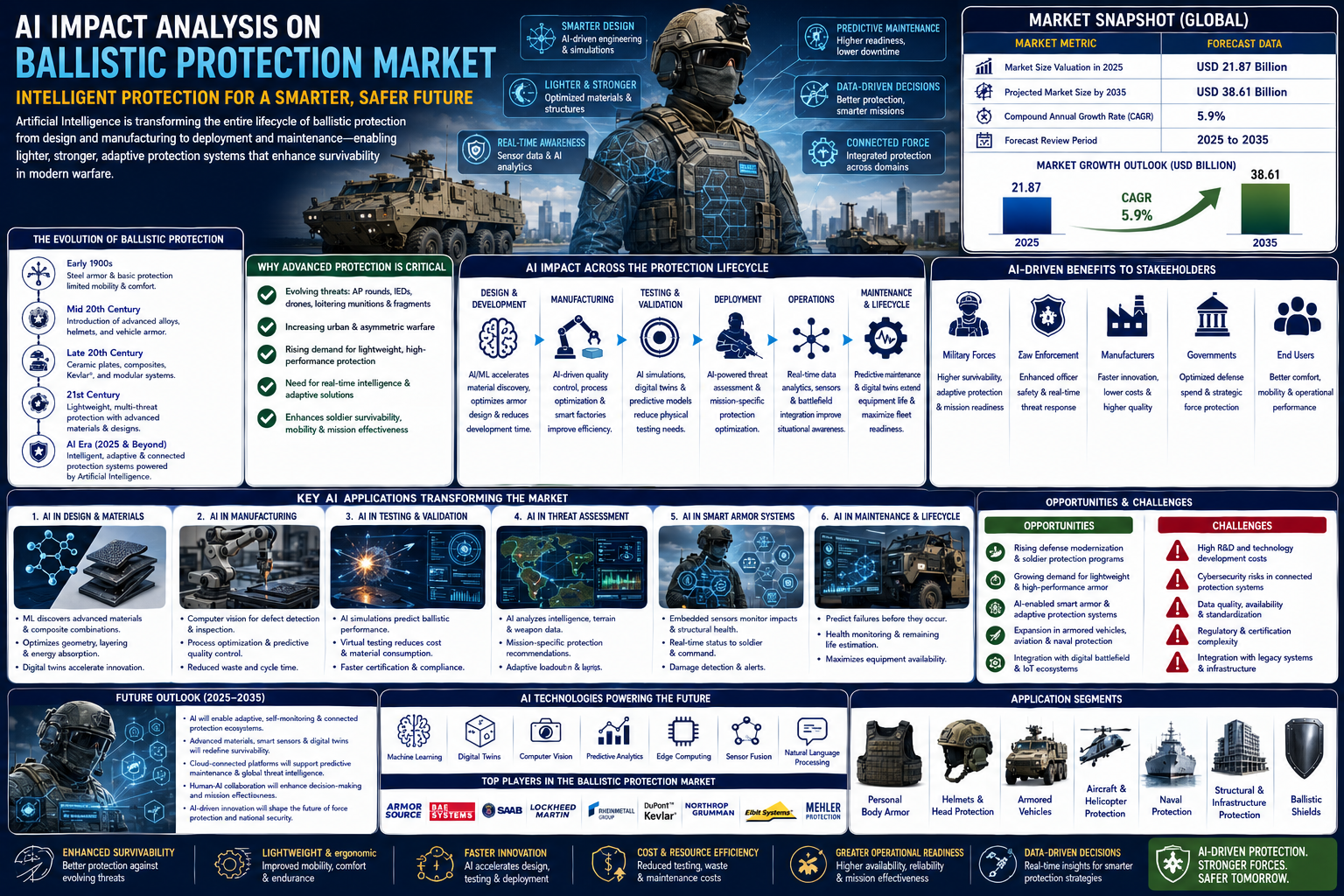
Introduction to the Ballistic Protection Market
The Evolution of Ballistic Protection Technologies
Ballistic protection has evolved significantly over the past century. Early protective equipment consisted primarily of heavy steel plates and rudimentary armor systems that offered limited mobility and comfort. As warfare evolved, advances in metallurgy, ceramics, composite materials, and synthetic fibers enabled the development of lighter, stronger, and more versatile protection solutions capable of defending against increasingly powerful ballistic threats.
Modern ballistic protection encompasses a wide range of products including personal body armor, ballistic helmets, vehicle armor, aircraft protection systems, naval armor, ballistic shields, blast-resistant structures, and protective equipment for critical infrastructure. These systems are designed to resist bullets, shrapnel, explosive fragments, and blast effects while minimizing weight and maximizing user mobility.
The growing diversity of battlefield threats has made ballistic protection increasingly complex. Modern conflicts involve conventional ammunition, armor-piercing rounds, improvised explosive devices, loitering munitions, drone-delivered weapons, and advanced fragmentation threats. Meeting these evolving challenges requires continuous innovation that extends beyond traditional engineering approaches.
Artificial intelligence is emerging as a key enabler of this next phase of innovation by combining computational intelligence with material science, engineering, manufacturing, and operational analytics.
Growing Demand Across Military and Security Applications
Global demand for ballistic protection continues to expand as governments strengthen defense capabilities and modernize military equipment. Armed forces increasingly require advanced protective solutions that improve soldier survivability without reducing operational effectiveness.
Special operations forces, infantry units, armored vehicle crews, aviation personnel, naval forces, and homeland security agencies all rely on specialized ballistic protection tailored to their operational requirements. Law enforcement organizations also continue upgrading protective equipment in response to increasingly sophisticated criminal threats and active shooter incidents.
Beyond defense applications, critical infrastructure operators, private security companies, diplomatic organizations, and emergency response agencies are investing in advanced ballistic protection systems to safeguard personnel and strategic assets.
Artificial intelligence supports these expanding requirements by enabling manufacturers to rapidly customize protection systems according to specific operational scenarios while maintaining high levels of performance and production efficiency.
The Shift Toward Lightweight High-Performance Protection
Historically, increasing ballistic protection often required heavier armor, reducing mobility and increasing physical fatigue. Modern military operations demand a different balance. Soldiers must remain agile while carrying increasingly sophisticated communication systems, sensors, weapons, batteries, and mission equipment.
Artificial intelligence plays a critical role in achieving this balance. Machine learning algorithms analyze millions of material combinations and structural configurations to identify designs that maximize protection while minimizing weight.
Rather than relying solely on lengthy experimental testing, engineers now use AI-driven computational models to optimize armor geometry, fiber orientation, ceramic placement, composite layering, and energy absorption characteristics.
This intelligent optimization enables manufacturers to develop next-generation protection systems that offer greater survivability without compromising operational mobility.
Artificial Intelligence as the Next Stage of Protection Innovation
Artificial intelligence is transforming ballistic protection from a static defensive technology into an intelligent engineering discipline driven by continuous optimization and data analysis.
Instead of developing products through repetitive physical prototyping alone, manufacturers increasingly rely on AI-powered simulation, digital twins, predictive modeling, and virtual validation to accelerate innovation. Operational feedback collected from deployed equipment further improves future designs through continuous machine learning.
As AI capabilities mature, ballistic protection systems themselves may become intelligent platforms capable of monitoring their own condition, assessing damage, communicating with battlefield networks, and supporting real-time force protection decisions.
This convergence of protective equipment and artificial intelligence represents one of the most significant technological shifts in the history of military survivability.
AI-Driven Design and Development of Ballistic Protection Systems
Accelerating Armor Design Through Machine Learning
The development of ballistic protection systems has traditionally required years of experimental testing involving numerous physical prototypes. Every modification in material composition, layer thickness, structural geometry, or manufacturing process required extensive laboratory evaluation before progressing toward production.
Artificial intelligence dramatically accelerates this process by allowing engineers to evaluate thousands of design alternatives digitally before constructing physical samples.
Machine learning algorithms analyze historical ballistic test results alongside computational models to predict how new armor configurations will perform against various threat types. These algorithms continuously improve prediction accuracy as additional testing data becomes available.
Instead of manually exploring design possibilities, engineers receive AI-generated recommendations identifying the most promising configurations for further evaluation.
This significantly shortens product development cycles while improving overall design quality.
Digital Twins Revolutionizing Product Development
Digital twin technology has become one of the most valuable applications of artificial intelligence within ballistic protection engineering.
A digital twin serves as a virtual representation of a physical armor system, accurately replicating material behavior, structural characteristics, manufacturing tolerances, and operational performance under numerous conditions.
Artificial intelligence continuously updates digital twins using data collected from laboratory testing, manufacturing processes, field evaluations, and operational deployments.
Engineers can expose virtual armor systems to thousands of simulated ballistic impacts involving different ammunition types, impact angles, environmental conditions, and structural loads without constructing physical prototypes.
This enables rapid optimization while substantially reducing development costs and testing timelines.
Optimizing Weight and Protection Balance
Achieving the ideal balance between protection and mobility represents one of the greatest engineering challenges in ballistic protection.
Increasing armor thickness generally improves survivability but reduces maneuverability, increases fatigue, and limits operational endurance. Artificial intelligence enables much more sophisticated optimization by simultaneously evaluating numerous design variables.
Machine learning considers projectile behavior, energy distribution, material density, structural stiffness, impact dynamics, manufacturing feasibility, ergonomic requirements, and mission profiles before recommending optimized solutions.
Rather than maximizing only one performance parameter, AI identifies balanced designs that satisfy multiple operational requirements simultaneously.
This multi-objective optimization allows manufacturers to develop protection systems specifically tailored for infantry, special operations, vehicle crews, aviation personnel, or law enforcement officers.
Virtual Validation Before Physical Testing
Artificial intelligence significantly reduces reliance on expensive physical testing by performing highly accurate virtual validation during early development stages.
Advanced computational models simulate ballistic impacts at microscopic levels, predicting crack propagation, fiber deformation, ceramic fracture, delamination, projectile penetration, and energy dissipation.
Machine learning compares simulation outputs with historical experimental data to continuously improve prediction reliability.
Only the most promising designs proceed to physical evaluation, dramatically reducing material consumption, laboratory costs, and overall development time.
Manufacturers can therefore introduce innovative protection technologies much more rapidly while maintaining rigorous quality standards.
Future AI-Driven Engineering Workflows
As artificial intelligence continues advancing, armor development will become increasingly autonomous.
Future AI engineering platforms will automatically generate design concepts, evaluate manufacturing feasibility, optimize material selection, perform virtual testing, recommend production methods, and estimate lifecycle performance before engineers review final recommendations.
Human engineers will increasingly focus on defining operational requirements and validating AI-generated innovations rather than performing repetitive computational analysis.
This collaboration between human expertise and artificial intelligence will dramatically accelerate innovation throughout the ballistic protection industry.
AI in Advanced Ballistic Materials and Smart Armor
Discovering Next-Generation Protective Materials
Material science remains the foundation of ballistic protection innovation. Artificial intelligence is revolutionizing this discipline by accelerating the discovery of entirely new protective materials that would have been extremely difficult to identify using traditional experimental methods.
Machine learning analyzes enormous scientific databases containing information about molecular structures, material properties, manufacturing techniques, and historical ballistic performance. By identifying relationships hidden within these datasets, AI predicts new material combinations capable of providing superior protection.
Researchers can evaluate millions of possible chemical compositions virtually before synthesizing only the most promising candidates for laboratory testing.
This dramatically shortens research timelines while expanding the range of potential protective materials.
Improving Composite Armor Systems
Composite armor combines multiple materials to achieve greater ballistic resistance than individual components alone. Ceramic strike faces, composite backings, high-strength fibers, metallic reinforcement, and energy-absorbing polymers each contribute unique protective characteristics.
Artificial intelligence optimizes these multilayer systems by determining ideal material sequences, layer thicknesses, bonding methods, and structural configurations.
Machine learning evaluates how individual layers interact during ballistic impact, predicting stress distribution, fracture behavior, and energy absorption with remarkable precision.
This enables manufacturers to produce lighter armor that delivers equal or superior ballistic performance compared with conventional designs.
Advancing Ceramic and Polymer Technologies
Ceramic materials remain essential components of modern ballistic protection because of their exceptional hardness and ability to disrupt incoming projectiles.
Artificial intelligence improves ceramic development by optimizing microstructures, grain orientation, sintering processes, and manufacturing parameters that influence ballistic resistance.
Similarly, AI accelerates development of advanced polymer fibers including ultra-high molecular weight polyethylene and aramid composites. Machine learning identifies manufacturing processes that improve fiber strength, flexibility, durability, and impact absorption.
These improvements collectively contribute to lighter, more comfortable protective equipment without sacrificing survivability.
Emergence of Smart Armor Systems
One of the most exciting developments enabled by artificial intelligence is the emergence of smart armor.
Rather than functioning solely as passive protection, future armor systems will incorporate embedded sensors capable of monitoring impact events, structural integrity, environmental conditions, soldier health, and equipment status.
Artificial intelligence processes this sensor information continuously, determining whether armor remains fully effective following impacts or requires replacement.
Commanders may receive real-time information regarding personnel protection status across entire units, improving medical response and operational decision-making.
Toward Adaptive Ballistic Protection
Future ballistic protection systems may actively adapt according to changing operational conditions.
Artificial intelligence could adjust embedded protective technologies based on anticipated threats, environmental conditions, or mission requirements. Advanced materials capable of changing mechanical properties under specific conditions are already being explored, and AI will play a central role in controlling these adaptive systems.
Although fully adaptive armor remains under development, artificial intelligence is accelerating research that may eventually produce protection systems capable of responding intelligently to evolving battlefield threats.
AI-Powered Threat Detection and Protection Optimization
From Passive Armor to Intelligent Protection
Traditional ballistic protection has historically been designed to provide passive defense against predetermined threats. Once deployed, body armor, helmets, vehicle armor, and protective structures offer the same level of protection regardless of mission type, threat intensity, or environmental conditions. While this approach has proven effective for decades, modern battlefields present highly dynamic threats that demand more adaptive and informed protection strategies.
Artificial intelligence is transforming ballistic protection from static equipment into an intelligent component of battlefield survivability. Rather than simply resisting incoming projectiles, AI enables protection systems to understand operational environments, analyze emerging threats, and recommend optimal protection configurations before missions begin.
By combining operational intelligence, historical combat data, geospatial analytics, and predictive modeling, AI provides commanders and soldiers with unprecedented insight into protection requirements for specific operational scenarios.
AI Driven Battlefield Threat Assessment
Every military mission presents a unique combination of threats influenced by geography, terrain, intelligence reports, adversary capabilities, and operational objectives. Artificial intelligence processes these diverse data sources simultaneously to generate comprehensive threat assessments.
Machine learning algorithms examine historical combat engagements, ammunition types, weapon effectiveness, drone activity, blast incidents, and enemy tactics across similar operational environments. These models continuously improve as additional battlefield data becomes available.
Instead of relying solely on standardized equipment configurations, military planners receive mission-specific recommendations identifying likely ballistic threats and corresponding protection requirements.
This intelligent assessment enables more efficient allocation of protective equipment while improving overall survivability.
Mission Specific Armor Optimization
Different military missions demand different protection priorities. Urban combat operations may require enhanced side protection against short-range rifle fire, while reconnaissance missions emphasize mobility and endurance. Vehicle crews, aviation personnel, naval operators, and special operations forces all operate under distinct operational conditions.
Artificial intelligence analyzes mission objectives alongside environmental variables to recommend optimized armor configurations.
Machine learning evaluates equipment weight, mobility requirements, expected engagement distances, anticipated ammunition threats, climate conditions, operational duration, and logistics constraints before generating personalized protection recommendations.
Rather than issuing identical equipment to every soldier, organizations can tailor ballistic protection to maximize operational effectiveness without unnecessary weight penalties.
Integration with Battlefield Intelligence
Artificial intelligence significantly improves ballistic protection by integrating armor selection with broader battlefield intelligence systems.
Data collected from reconnaissance drones, satellites, electronic surveillance platforms, intelligence reports, and command networks continuously updates threat assessments throughout operations.
If emerging intelligence indicates changing adversary tactics or new weapon systems, AI recommends adjustments to protective equipment for future missions.
This continuous adaptation ensures protection strategies evolve alongside rapidly changing battlefield conditions.
Enhancing Soldier Survivability
Ultimately, the objective of AI-driven threat optimization is improving soldier survivability.
Artificial intelligence assists commanders in balancing mobility, endurance, situational awareness, and ballistic protection according to mission priorities. Rather than maximizing protection indiscriminately, AI identifies the most effective balance between defensive capability and operational performance.
As battlefield awareness improves through continuous data analysis, soldiers gain greater confidence that their equipment has been optimized for anticipated operational challenges.
Future AI-enabled protection systems may further enhance survivability by integrating directly with soldier modernization programs, continuously monitoring operational risks and recommending protective actions during missions.
AI in Testing, Validation, and Performance Evaluation
Transforming Ballistic Testing Through Artificial Intelligence
Ballistic testing has traditionally required extensive physical experimentation involving controlled firing ranges, laboratory facilities, specialized instrumentation, and repeated destructive testing. While these methods remain essential for certification, they are expensive, time consuming, and often limit the number of design alternatives that can be evaluated.
Artificial intelligence is fundamentally changing ballistic testing by introducing highly accurate computational simulations capable of replicating real-world impact behavior before physical testing begins.
Rather than constructing numerous prototypes, manufacturers increasingly validate armor concepts through AI-driven virtual environments that simulate projectile interactions under countless operational conditions.
This approach dramatically accelerates product development while reducing testing costs.
Virtual Ballistic Simulations
Machine learning algorithms have significantly improved the accuracy of ballistic impact simulations.
Artificial intelligence models projectile velocity, impact angle, material deformation, fracture propagation, energy absorption, fragmentation behavior, and residual penetration using advanced computational physics combined with historical experimental data.
Engineers can evaluate thousands of potential impact scenarios involving different ammunition types, environmental conditions, armor configurations, and manufacturing tolerances within hours rather than months.
Virtual simulations enable rapid refinement of protective systems before physical prototypes enter laboratory evaluation.
Machine Learning for Performance Prediction
Artificial intelligence continuously learns from every ballistic test performed.
Machine learning compares simulation predictions with actual experimental results, identifying discrepancies and refining future prediction models. As larger datasets become available, AI becomes increasingly accurate at forecasting ballistic performance under conditions that may never have been physically tested.
This capability significantly reduces uncertainty during early design stages while allowing manufacturers to explore innovative materials and structural concepts with greater confidence.
Predictive modeling also helps identify performance limitations before products reach operational deployment.
Automated Quality Validation
Artificial intelligence enhances laboratory testing by automating analysis of high-speed imaging, pressure sensors, deformation measurements, acoustic signatures, and material failure patterns.
Computer vision systems evaluate projectile penetration, crack development, fragment distribution, and armor deformation far more consistently than manual inspection alone.
Engineers receive comprehensive analytical reports immediately following testing, accelerating certification decisions and product refinement.
Automation also improves repeatability by eliminating subjective interpretation of complex experimental data.
Digital Certification Support
Regulatory agencies increasingly require extensive documentation demonstrating ballistic performance across numerous operational scenarios.
Artificial intelligence simplifies certification by organizing experimental results, validating simulation accuracy, generating statistical analyses, and maintaining complete traceability throughout product development.
Digital certification workflows supported by AI reduce administrative effort while improving confidence in documented performance claims.
As international certification standards continue evolving, AI will become an increasingly valuable tool for demonstrating compliance across global defense markets.
AI in Manufacturing, Quality Control, and Supply Chain Management
Smart Manufacturing for Ballistic Protection Systems
Manufacturing ballistic protection products demands exceptional precision because small variations in material quality, fiber orientation, ceramic density, adhesive bonding, or structural alignment may significantly influence protective performance.
Artificial intelligence transforms manufacturing facilities into intelligent production environments capable of continuously monitoring quality, optimizing workflows, and minimizing production variability.
Machine learning evaluates every stage of production using sensor data collected from manufacturing equipment, environmental controls, robotic systems, and quality inspection stations.
This continuous optimization improves consistency while reducing manufacturing waste and production costs.
Machine Vision for Precision Inspection
Computer vision has become one of the most valuable AI applications within ballistic protection manufacturing.
High-resolution cameras combined with deep learning algorithms inspect ceramic plates, composite panels, ballistic fibers, adhesives, coatings, and finished armor systems throughout production.
Machine vision detects microscopic cracks, surface imperfections, voids, delamination, alignment deviations, and manufacturing inconsistencies that may not be visible during traditional inspections.
Continuous inspection ensures only products meeting strict quality standards proceed toward final assembly and certification.
Robotics and Intelligent Production
Artificial intelligence enables robotic manufacturing systems to perform increasingly sophisticated assembly operations.
Robotic systems precisely position composite layers, apply adhesives, align ceramic inserts, perform automated drilling, trim finished components, and package completed products while continuously adapting to manufacturing variations.
Machine learning further improves robotic efficiency by identifying opportunities to optimize movement patterns, reduce material waste, and minimize production bottlenecks.
These intelligent manufacturing systems significantly increase productivity while maintaining aerospace-grade quality standards.
Predictive Maintenance for Manufacturing Equipment
Manufacturing equipment used for ballistic protection production represents significant capital investment.
Artificial intelligence continuously monitors machinery through vibration analysis, thermal imaging, electrical performance, lubrication monitoring, and operational diagnostics.
Machine learning predicts equipment failures before production interruptions occur, allowing maintenance teams to schedule repairs proactively.
Reduced equipment downtime improves production capacity while minimizing costly manufacturing disruptions.
Intelligent Supply Chain Management
Global ballistic protection manufacturing depends upon complex international supply chains involving advanced ceramics, ballistic fibers, polymers, specialty metals, adhesives, electronic components, and precision manufacturing equipment.
Artificial intelligence continuously analyzes supplier reliability, inventory levels, transportation networks, geopolitical developments, demand forecasts, and procurement risks.
Predictive analytics identify potential supply disruptions early enough for manufacturers to secure alternative suppliers or adjust production schedules.
This enhanced visibility strengthens supply chain resilience while supporting uninterrupted production.
AI Integration with Soldier Modernization and Military Platforms
Building Intelligent Soldier Protection Ecosystems
Modern soldier modernization programs extend well beyond improved weapons and communication equipment. They aim to create highly connected combat systems where every component contributes to overall operational effectiveness.
Ballistic protection is becoming an integral part of these intelligent ecosystems.
Artificial intelligence enables body armor, helmets, wearable electronics, communication devices, biometric sensors, navigation systems, and command networks to function together as a unified protection architecture.
Rather than operating independently, protective equipment becomes part of an interconnected digital battlefield capable of continuously sharing operational information.
Smart Body Armor and Wearable Intelligence
Future body armor will incorporate embedded sensors capable of monitoring impact events, structural condition, environmental exposure, physiological status, and equipment performance.
Artificial intelligence processes this information continuously, providing both soldiers and commanders with real-time awareness of equipment condition.
Following ballistic impacts, AI determines whether armor remains operationally effective or requires replacement.
Wearable health monitoring systems integrated into body armor further assess heart rate, fatigue, hydration, stress levels, and injury indicators, enabling faster medical response during combat operations.
Intelligent Combat Helmets
Combat helmets are evolving from protective equipment into advanced information platforms.
Artificial intelligence enhances helmet systems by integrating augmented reality displays, environmental sensors, night vision equipment, communication systems, hearing protection, and threat warning technologies.
AI filters incoming information according to operational priorities, ensuring soldiers receive critical alerts without excessive cognitive overload.
Future helmets may automatically identify hostile activity, display navigation guidance, highlight friendly forces, and support real-time battlefield collaboration.
AI Enhanced Vehicle Protection
Ballistic protection extends beyond individual soldiers to include armored vehicles, aircraft, naval platforms, and tactical transport systems.
Artificial intelligence analyzes mission profiles, terrain conditions, historical threat data, and operational intelligence to recommend optimized vehicle armor configurations.
Machine learning also assists engineers in designing lighter modular armor packages that improve vehicle mobility without compromising survivability.
Future armored vehicles may dynamically monitor structural integrity and recommend maintenance following combat damage.
Human Machine Teaming for Force Protection
Artificial intelligence increasingly supports collaboration between soldiers and autonomous systems.
Ground robots, reconnaissance drones, autonomous logistics vehicles, and unmanned combat platforms continuously collect operational data that contributes to force protection.
AI integrates information from these platforms with soldier protection systems, providing commanders with comprehensive battlefield awareness.
This collaborative ecosystem enables faster decision-making while improving survivability across entire military formations.
AI in Predictive Maintenance and Lifecycle Management
Continuous Monitoring Throughout Service Life
Ballistic protection systems experience gradual degradation throughout operational service due to repeated use, environmental exposure, handling, transportation, and combat damage.
Traditional maintenance schedules rely primarily on periodic inspections and predetermined replacement intervals.
Artificial intelligence introduces continuous lifecycle monitoring that evaluates actual equipment condition throughout operational use.
Machine learning processes inspection records, environmental exposure data, operational history, storage conditions, and sensor information to determine remaining service life for every protection system.
This condition-based approach improves safety while reducing unnecessary replacement costs.
Predictive Replacement Scheduling
Rather than replacing protective equipment according to conservative timelines, AI predicts precisely when individual armor systems should be retired.
Algorithms evaluate cumulative operational stress, impact history, ultraviolet exposure, moisture absorption, thermal cycling, and manufacturing variability to estimate remaining protective capability.
Maintenance organizations receive advance recommendations allowing efficient procurement and inventory planning without compromising personnel safety.
Predictive scheduling improves equipment availability while optimizing defense budgets.
Digital Twins for Lifecycle Optimization
Digital twins continue supporting ballistic protection long after products enter operational service.
Each deployed protection system maintains a continuously updated virtual representation reflecting its unique operational history.
Artificial intelligence analyzes this digital twin to forecast future performance, recommend inspections, estimate degradation rates, and optimize maintenance planning.
Manufacturers also benefit by collecting anonymized operational data that improves future product development.
Supporting Operational Readiness
Military readiness depends upon confidence that protective equipment remains fully effective whenever required.
Artificial intelligence provides commanders with comprehensive readiness assessments across entire equipment inventories.
Instead of relying solely on inventory quantities, organizations understand the actual operational condition of every deployed protection system.
This improved visibility supports procurement decisions, maintenance planning, deployment readiness, and long-term force modernization strategies.
Challenges, Risks, and Ethical Considerations
Cybersecurity Risks in AI Enabled Ballistic Protection Systems
As ballistic protection systems become increasingly connected through artificial intelligence, cloud computing, Internet of Things sensors, and digital battlefield networks, cybersecurity emerges as one of the industry's most significant concerns. Unlike conventional armor, intelligent ballistic protection systems continuously collect, process, and transmit operational data across multiple defense platforms. While this connectivity enhances situational awareness and decision making, it also expands the potential attack surface available to cyber adversaries.
Hostile actors may attempt to manipulate AI algorithms, interfere with sensor networks, corrupt maintenance databases, or gain unauthorized access to operational information regarding protective equipment. Such attacks could compromise mission planning, degrade equipment reliability, or provide adversaries with valuable intelligence regarding military capabilities.
Defense organizations are therefore investing heavily in encrypted communications, secure edge computing architectures, zero trust cybersecurity frameworks, continuous network monitoring, and AI driven cyber defense systems. Artificial intelligence itself is increasingly being employed to detect abnormal system behavior, identify cyber intrusions, and respond automatically to emerging threats before operational disruption occurs.
The future success of AI powered ballistic protection will depend not only on physical survivability but also on the resilience of the digital infrastructure supporting these intelligent systems.
Ensuring Reliability of Artificial Intelligence Recommendations
Artificial intelligence has demonstrated remarkable capabilities in material optimization, threat analysis, predictive maintenance, and manufacturing intelligence. However, military organizations require absolute confidence that AI generated recommendations remain accurate under highly dynamic operational conditions.
Machine learning models depend upon extensive datasets collected from laboratory testing, operational deployments, combat simulations, and historical battlefield information. If these datasets contain inaccuracies, biases, or incomplete information, AI recommendations may become unreliable.
Manufacturers must therefore establish rigorous validation procedures that continuously compare AI predictions with physical testing and operational performance. Human engineers, scientists, and military experts remain responsible for validating AI generated decisions before implementation in mission critical applications.
Building trust requires transparency. Decision makers increasingly expect explainable artificial intelligence capable of demonstrating how specific recommendations were generated rather than functioning as opaque computational systems.
Data Quality and Availability Challenges
Artificial intelligence performs only as effectively as the information available for training its algorithms. Developing intelligent ballistic protection systems requires enormous quantities of accurate data covering projectile characteristics, material properties, manufacturing variables, environmental exposure, operational history, maintenance records, and battlefield performance.
Obtaining this information presents significant challenges because much of the required data originates from classified military programs, controlled laboratory testing, or operational deployments that cannot easily be shared across organizations.
Furthermore, new protective materials often lack sufficient historical performance data for robust machine learning development. Researchers must therefore combine experimental testing, computational modeling, and synthetic data generation to expand available datasets.
Future collaboration between governments, research institutions, defense manufacturers, and academic organizations will play a crucial role in improving data quality while maintaining appropriate security protections.
Integration with Legacy Defense Infrastructure
Many armed forces continue operating equipment that was designed decades before artificial intelligence became commercially viable. Integrating modern AI technologies into existing ballistic protection programs often presents substantial engineering and logistical challenges.
Legacy manufacturing facilities may lack digital sensors required for intelligent quality control. Existing maintenance systems may not support predictive analytics. Older military platforms may have limited computing capacity, preventing seamless integration with AI enabled protection technologies.
Manufacturers must therefore develop scalable solutions capable of supporting gradual modernization rather than requiring complete infrastructure replacement.
Hybrid approaches combining conventional engineering with AI driven analytics will likely dominate the industry during the coming decade as defense organizations transition toward fully digital operations.
Regulatory and Certification Requirements
Military protective equipment must satisfy exceptionally demanding certification standards before entering operational service. Every new material, manufacturing process, software platform, and intelligent capability requires extensive validation to ensure reliable performance under realistic combat conditions.
Artificial intelligence introduces additional certification complexity because machine learning algorithms continuously evolve as new information becomes available. Regulators must establish methodologies capable of evaluating adaptive software systems alongside traditional engineering requirements.
International standardization will become increasingly important as multinational defense programs expand and allied nations seek greater interoperability.
Developing common certification frameworks for AI enabled ballistic protection will accelerate technology adoption while maintaining rigorous safety standards.
Ethical Considerations in Intelligent Protection Systems
Artificial intelligence should strengthen human decision making rather than replace military judgment.
Commanders remain responsible for selecting appropriate protection strategies, evaluating operational risks, and safeguarding personnel under their command. AI provides valuable analytical support, but final decisions must remain under meaningful human oversight.
Transparency, accountability, fairness, and explainability will remain essential ethical principles governing future intelligent protection systems.
Military organizations must ensure that AI recommendations are free from unintended bias, respect operational doctrine, and remain consistent with established legal and ethical standards governing defense operations.
Responsible development will ensure artificial intelligence enhances force protection while preserving confidence among military personnel responsible for employing these advanced technologies.
Future Outlook: AI Powered Ballistic Protection Market (2035)
The Emergence of Intelligent Protection Ecosystems
By 2035, ballistic protection will no longer consist of isolated protective products operating independently. Instead, body armor, helmets, armored vehicles, unmanned systems, command centers, maintenance facilities, logistics networks, and intelligence platforms will function as interconnected components within comprehensive AI enabled protection ecosystems.
Artificial intelligence will continuously exchange operational information across these systems, enabling faster threat assessment, optimized resource allocation, predictive logistics, and improved battlefield survivability.
Rather than reacting to threats after they occur, future protection systems will increasingly anticipate operational risks before personnel enter dangerous environments.
Adaptive Ballistic Protection Technologies
One of the most exciting areas of future research involves adaptive protection systems capable of responding intelligently to changing operational conditions.
Advanced materials combined with embedded electronics, intelligent sensors, and AI driven control systems may eventually adjust structural characteristics according to anticipated threats.
Although fully adaptive armor remains under development, artificial intelligence is accelerating material research through computational modeling, molecular simulation, and predictive performance analysis.
Future protective equipment may automatically optimize weight distribution, structural stiffness, or protective configurations according to mission objectives and environmental conditions.
Self Monitoring Protective Equipment
Artificial intelligence will transform ballistic protection into continuously monitored intelligent assets.
Future body armor and vehicle protection systems will incorporate integrated sensors capable of detecting impacts, monitoring structural integrity, measuring environmental exposure, and evaluating remaining protective capability throughout operational service.
Machine learning algorithms will analyze this information continuously, providing immediate recommendations regarding inspection requirements, maintenance scheduling, or equipment replacement.
This proactive approach will improve personnel safety while maximizing equipment availability and reducing lifecycle costs.
Cloud Connected Protection Networks
Military organizations increasingly recognize the value of cloud enabled operational intelligence.
Future ballistic protection systems will securely exchange information with digital command networks, logistics platforms, maintenance organizations, and battlefield management systems through highly secure military cloud environments.
Artificial intelligence will analyze aggregated operational data collected from thousands of deployed protection systems worldwide, identifying emerging trends, optimizing maintenance strategies, and improving future product development.
Continuous global learning will enable manufacturers to introduce more effective protection technologies at unprecedented speed.
Artificial Intelligence Accelerating Material Innovation
Material science will remain one of the primary drivers of ballistic protection advancement.
Artificial intelligence will continue accelerating discovery of lighter, stronger, and more resilient protective materials through advanced computational chemistry, molecular simulation, and machine learning optimization.
Researchers will increasingly rely upon AI to identify entirely new composite architectures, ceramic formulations, nanomaterials, and multifunctional protective structures capable of exceeding current ballistic performance limits.
These breakthroughs will enable future protection systems that combine superior survivability with improved mobility and operational endurance.
Autonomous Manufacturing and Smart Factories
Manufacturing facilities producing ballistic protection will become increasingly autonomous during the coming decade.
Artificial intelligence will coordinate robotic assembly systems, optimize production scheduling, predict equipment maintenance requirements, manage supplier relationships, inspect finished products, and continuously improve manufacturing efficiency without significant human intervention.
Every stage of production will generate operational data that further strengthens machine learning algorithms, creating a cycle of continuous manufacturing improvement.
These intelligent factories will produce higher quality protection systems while reducing production costs and accelerating delivery schedules.
Supporting Multi Domain Military Operations
Future military operations will require seamless coordination across land, air, sea, space, and cyber domains.
Artificial intelligence will enable ballistic protection systems to integrate directly with these multi domain operational networks, ensuring protective equipment supports broader mission objectives rather than functioning as isolated defensive assets.
Real time intelligence sharing, predictive logistics, autonomous maintenance planning, and AI driven mission support will collectively improve force survivability across increasingly complex operational environments.
Strategic Importance of AI in Defense Modernization
Artificial intelligence has evolved beyond being simply another digital technology. It is becoming a strategic capability influencing defense procurement, military modernization, industrial competitiveness, and national security planning.
Countries investing aggressively in AI enabled ballistic protection research will gain advantages in force survivability, manufacturing efficiency, operational readiness, and technological leadership.
The competitive landscape of the global ballistic protection market will increasingly depend upon the ability of manufacturers to integrate artificial intelligence throughout research, development, production, deployment, and lifecycle management.
Artificial intelligence is fundamentally transforming the global ballistic protection market by redefining how protective equipment is conceived, engineered, manufactured, tested, maintained, and deployed. What was once primarily a field driven by advances in metallurgy and material science has evolved into a multidisciplinary industry where AI powered analytics, machine learning, digital twins, predictive maintenance, computer vision, and intelligent manufacturing work together to create smarter and more effective protection solutions.
Throughout the entire product lifecycle, artificial intelligence enables faster material discovery, optimized armor design, highly accurate virtual testing, automated quality assurance, intelligent supply chain management, predictive lifecycle monitoring, and seamless integration with modern soldier modernization programs. These innovations not only improve operational efficiency but also enhance survivability by ensuring that ballistic protection systems are lighter, stronger, more reliable, and better adapted to evolving battlefield threats.
Looking ahead to 2035, the ballistic protection market will continue moving toward intelligent protection ecosystems where body armor, helmets, armored vehicles, unmanned platforms, and battlefield command systems operate as interconnected digital assets. Artificial intelligence will support adaptive protection technologies, cloud connected maintenance networks, autonomous manufacturing, and continuous operational learning that collectively reshape the future of force protection.
Manufacturers, defense organizations, and research institutions that embrace AI driven innovation today will be better positioned to address the increasingly complex security challenges of tomorrow. As global defense modernization accelerates, artificial intelligence will become a defining force behind the next generation of ballistic protection technologies, ensuring that military personnel, law enforcement agencies, and security forces benefit from unprecedented levels of protection, operational readiness, and mission effectiveness.

This FREE sample includes market data points, ranging from trend analyses to market estimates & forecasts. See for yourself.
SEND ME A FREE SAMPLE






