AI Impact Analysis on Biodefense Industry
The 21st century has ushered in a new era of biological threats not only from naturally emerging diseases but also from engineered pathogens, bioterrorism, and laboratory accidents. The biodefense market, once narrowly focused on vaccines and protective equipment, has evolved into a complex, technology driven ecosystem encompassing genomics, surveillance, bioinformatics, and artificial intelligence.
Artificial Intelligence (AI) now stands at the forefront of Biodefense transformation. It enables early detection, real time monitoring, and predictive response to biological threats with a speed and accuracy that were previously unattainable. Between 2025 and 2035, the global biodefense market is expected to undergo rapid expansion, driven by growing security concerns, national preparedness programs, and AI driven innovation in biotechnology.
Understanding the Global Biodefense Market
The biodefense market involves all technologies, systems, and strategies aimed at protecting populations against biological warfare agents, infectious diseases, and synthetic biothreats. Its scope extends beyond defense and military use to include healthcare systems, emergency response agencies, and research institutions.
Historically, biodefense programs emerged during the Cold War to counter potential biological warfare threats. The COVID-19 pandemic redefined global biosecurity priorities, emphasizing prevention and rapid response. This shift from reactive to predictive biodefense marks a fundamental evolution one made possible largely by artificial intelligence.
Modern biodefense systems are no longer limited to vaccine stockpiling or biohazard detection. AI now enables genomic surveillance, threat modeling, and automated containment. Governments across the world are investing in dual use biotechnology research that can serve both medical and defense purposes. With AI as a unifying framework, biodefense strategies are becoming smarter, faster, and globally connected.
The Role of Artificial Intelligence in Biodefense
Artificial Intelligence acts as the digital nervous system of modern biodefense. It connects data, predicts outcomes, and autonomously coordinates responses across diverse networks of laboratories, defense installations, and healthcare systems.
Machine learning algorithms can analyze thousands of biological samples in seconds, detecting pathogens long before they cause outbreaks. Predictive models help decision makers anticipate the spread of infectious diseases and simulate containment strategies. Deep learning enables pattern recognition within genomic data, identifying mutations that may make a virus more transmissible or deadly.
AI is also being applied in real time biosurveillance, where sensors deployed in urban areas, airports, and public spaces continuously monitor for bioaerosols or anomalies in environmental data. By integrating defense intelligence with health data, AI provides a unified platform for national biosecurity allowing governments to move from crisis response to crisis prevention.
Between 2025 and 2035, AI will be the most critical differentiator between nations with resilient biodefense infrastructures and those vulnerable to biological crises.
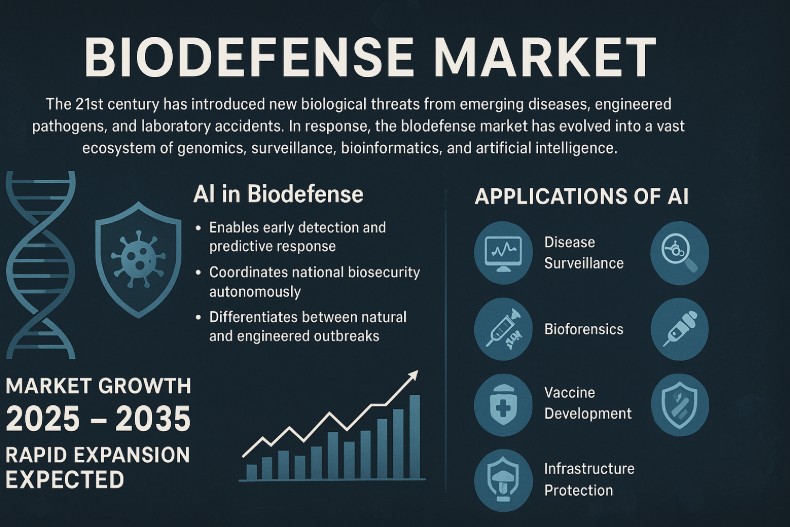
AI-Driven Early Detection and Disease Surveillance Systems
Early detection remains the cornerstone of biodefense. Artificial Intelligence is revolutionizing this domain by integrating data from diverse sources such as hospitals, environmental sensors, genomic databases, and even social media platforms.
AI algorithms identify unusual disease patterns before human analysts can. If an AI system detects an unusual cluster of pneumonia cases or unusual keyword patterns online, it can alert health authorities within hours. During future pandemics, AI powered predictive analytics will make it possible to model the spread of pathogens days or weeks in advance.
Satellite and drone data, when analyzed through AI, can detect ecological or animal health anomalies that precede zoonotic disease spillover. AI based biosensors deployed in airports or public spaces can detect biological agents in real time. These advancements mean that biodefense no longer starts at the laboratory but at the level of public infrastructure.
The combination of real time biosurveillance, predictive analytics, and global data fusion is enabling a shift from reactive medical countermeasures to proactive biological threat anticipation.
AI in Bioforensics and Pathogen Identification
When biological incidents occur, rapid identification of the causative agent is essential. AI has made it possible to perform forensic level analysis of pathogens faster and with greater precision than ever before.
AI assisted genomic sequencing can differentiate between natural outbreaks and deliberate releases of engineered pathogens. By comparing genetic fingerprints, AI helps investigators trace the source of an outbreak and determine whether it was accidental or malicious.
Machine learning models can analyze vast genomic datasets to classify new pathogens and predict their behavior in human hosts. In biodefense laboratories, AI driven microscopes and imaging tools accelerate microbial detection and pattern recognition, making it easier to spot anomalies that could indicate genetic manipulation.
In the context of global security, AI based bioforensics provides the evidence required to hold perpetrators accountable for biological attacks. It also enhances transparency and verification in compliance with international treaties such as the Biological Weapons Convention (BWC).
AI in Vaccine and Therapeutic Development
Artificial Intelligence is dramatically accelerating the discovery of vaccines and therapeutics, a process that traditionally took years but can now be achieved in months.
AI models analyze molecular structures and predict how pathogens interact with the human immune system. By identifying likely antigens and simulating immune responses, AI helps design vaccines that are more effective and adaptable to evolving threats. During the COVID-19 crisis, AI systems from companies like DeepMind and Moderna revolutionized vaccine development timelines.
In biodefense, this acceleration is critical. AI driven bioinformatics can quickly identify potential countermeasures against emerging bioweapons or engineered viruses. It also aids in repurposing existing drugs to treat new infections, saving valuable time in emergency response.
Generative AI systems can design entirely new therapeutic molecules, while digital twin simulations test vaccine efficacy virtually before clinical trials begin. By 2035, AI is expected to become an integral part of national biodefense strategies, ensuring rapid medical readiness for biological crises.
Get AI Impact Analysis on Biodefense Market, Request Pdf Brochure: https://www.marketsandmarkets.com/pdfdownloadNew.asp?id=119088131
AI and Biosecurity Infrastructure Protection
Securing biodefense infrastructure is as important as developing vaccines or detectors. Laboratories handling high risk pathogens, such as Biosafety Level-4 (BSL-4) facilities, require advanced security protocols and AI is redefining how these protocols are enforced.
AI driven surveillance systems monitor laboratory environments in real time, ensuring that safety procedures are followed. Smart sensors can detect air leaks, equipment malfunctions, or contamination events instantly. Facial recognition and biometric access controls powered by AI enhance personnel verification and prevent unauthorized entry.
AI also plays a vital role in cyberbiosecurity, protecting genomic databases, lab networks, and research data from cyberattacks. With synthetic biology and AI converging, data integrity has become a national security issue. Predictive AI models can detect abnormal data access patterns or potential insider threats before damage occurs.
AI powered predictive maintenance ensures that biodefense facilities operate without critical downtime, reducing the risk of accidental exposure or system failure. This integration of AI into infrastructure not only enhances security but also builds trust in global biosafety standards.
Regional Developments in AI-Powered Biodefense
The integration of AI into biodefense strategies varies across regions, reflecting geopolitical priorities and technological maturity.
The United States remains a global leader, with agencies such as DARPA investing heavily in AI for biointelligence and pandemic preparedness. The U.S. Department of Defense has initiated programs to create AI driven biosurveillance networks that link military, public health, and intelligence systems.
China is rapidly expanding its AI biotech sector, leveraging its massive genomic databases and AI research capabilities to strengthen national biosecurity. The integration of AI into its public health infrastructure demonstrates the dual use nature of technology in both civilian and defense applications.
Japan and South Korea have invested in AI driven health analytics and epidemic forecasting tools, while India is emerging as a key player in integrating AI with biotechnology under its “Digital Health Mission” and defense modernization programs. Europe, meanwhile, focuses on ethical AI frameworks, emphasizing privacy and transparency while promoting AI based pathogen detection and research networks.
These regional advancements illustrate that biodefense is no longer confined to military institutions it is now a multidisciplinary, cross sectoral effort where AI serves as the universal enabler.
Key Market Players and Emerging AI Technologies
The biodefense market is being driven by collaborations between defense contractors, biotech firms, and AI companies. Leading defense enterprises are incorporating AI tools to improve detection, modeling, and decision making. Biotechnology giants are deploying AI to optimize vaccine pipelines and biomanufacturing.
Technology leaders such as IBM, Google DeepMind, and Palantir are providing AI infrastructure for biosurveillance and intelligence analysis. Startups focused on synthetic biology and AI driven drug discovery, like BenevolentAI and Atomwise, are contributing to defense readiness through rapid innovation.
Governments are increasingly funding public private partnerships that merge AI expertise with biodefense research. Cloud based AI ecosystems are being established to analyze global health data, predict biothreats, and simulate emergency responses.
AI simulation platforms are also being used to train military and emergency personnel through virtual outbreak scenarios, improving coordination and readiness. This fusion of biotechnology, AI, and defense technology represents the new frontier of global security.
Ethical, Regulatory, and Security Challenges
While the benefits of AI in biodefense are profound, they come with significant ethical and regulatory challenges. The dual use nature of AI its ability to serve both defensive and offensive purposes raises complex questions about oversight and accountability.
Autonomous AI systems capable of identifying or even synthesizing pathogens could be misused by non state actors or rogue regimes. This risk underscores the need for international frameworks governing AI applications in biology. Transparency, traceability, and explainable AI are essential to prevent unintended consequences.
Cybersecurity is another major concern. AI based biodefense systems depend on massive datasets, often combining health, genomic, and defense information. Protecting this data from cyber threats is crucial to maintaining global trust and stability.
Algorithmic bias or false positives in AI systems could trigger unnecessary alarm or resource deployment, making human oversight indispensable. Regulatory harmonization across nations will be critical to ensuring that AI driven biodefense innovation proceeds safely, ethically, and effectively.
AI-Powered Global Biodefense by 2035
The decade ahead will witness the emergence of a fully AI integrated global biodefense ecosystem. Autonomous AI systems will continuously monitor the biosphere, detect anomalies, and initiate containment measures long before threats escalate.
Quantum computing will enhance AI’s predictive capabilities, allowing real time modeling of complex biological systems and viral evolution. Digital twin technologies will enable nations to simulate entire pandemics virtually, testing containment strategies in silico before implementing them in reality.
AI will make it possible to design personalized vaccines tailored to individual immune profiles, while bio command centers will integrate data from satellites, drones, and biosensors into unified defense networks. The future of biodefense will not rely on a single system but on an intelligent global web capable of learning, adapting, and responding collaboratively.
By 2035, AI powered biodefense will not just protect nations from bioterrorism it will safeguard humanity against the next pandemic, the next engineered virus, and the next unforeseen biological threat. The synergy of AI, biotechnology, and defense will define the next generation of global security.
Related Reports:
Biodefense Market by Technology (GHz-band Wave, Microwave Heating, RF-EMR, Cold Plasma, Gamma, UV), Product (Decontamination (Sterilization Devices, Disinfection Units), Biosensors, AI Surveillance), Application, Region - Global Forecast to 2030

This FREE sample includes market data points, ranging from trend analyses to market estimates & forecasts. See for yourself.
SEND ME A FREE SAMPLE






