AI Impact Analysis on Border Security Industry
In an era defined by digital transformation and rising geopolitical complexity, the global border security market is undergoing a profound shift. The traditional model of manpower intensive border management is being replaced by an intelligent, automated, and data driven ecosystem, largely powered by Artificial Intelligence (AI). The need to manage illegal migration, cross border terrorism, trafficking, and territorial incursions has never been greater. Between 2025 and 2035, AI is set to become the core technological enabler that will redefine how nations secure their borders across land, air, and sea.
AI enhances border security by fusing real time surveillance data, predictive analytics, and autonomous systems to create dynamic, self learning defense networks. It offers border forces the ability to detect threats proactively, predict high risk movements, and respond in milliseconds. This convergence of AI, biometrics, drones, robotics, and satellite communication is transforming border management into a digitally intelligent defense framework that balances national security with operational efficiency.
The Evolving Border Security Market Landscape
The global border security market has historically relied on manpower, physical infrastructure, and sensor based surveillance. The evolving threat landscape spanning terrorism, illegal smuggling, cyber infiltration, and humanitarian crises demands smarter, faster, and more integrated systems. Nations are investing in AI to enhance their capacity for situational awareness, risk analysis, and real time response.
From the U.S.–Mexico border to India’s northern frontiers, and from Europe’s Schengen Zone to maritime chokepoints in the Indo-Pacific, governments are deploying AI enabled technologies to secure vast and complex boundaries. Border protection today extends far beyond fences and checkpoints; it encompasses satellite networks, AI driven drones, and integrated command systems that analyze terabytes of sensor data every second.
According to industry forecasts, the global border security market is expected to surpass USD 35 billion by 2030, driven by AI innovation. As national defense strategies evolve, border agencies are transitioning from passive monitoring to active intelligence, where AI not only detects but also predicts, adapts, and acts.
AI’s Role in Transforming Border Security Operations
Artificial Intelligence is redefining how border operations are managed across the entire defense ecosystem. Unlike traditional systems that rely on human interpretation of data, AI operates on predictive logic, transforming raw information into actionable intelligence.
Machine learning algorithms are trained to analyze live video feeds, radar signals, and communication intercepts to detect irregular movements or patterns that may indicate infiltration or smuggling. AI can prioritize alerts based on threat probability, allowing security forces to focus resources efficiently. The integration of AI with command, control, and communication systems enables multi agency collaboration, ensuring that decision makers have real time visibility into every segment of the border.
AI is also enabling adaptive learning in border operations. As smugglers and infiltrators modify their routes and methods, AI models evolve by learning from new data patterns. This constant feedback loop allows border systems to remain resilient and effective even against emerging tactics. By 2035, many nations are expected to deploy fully autonomous AI systems capable of 24/7 monitoring, analysis, and response coordination without direct human oversight.
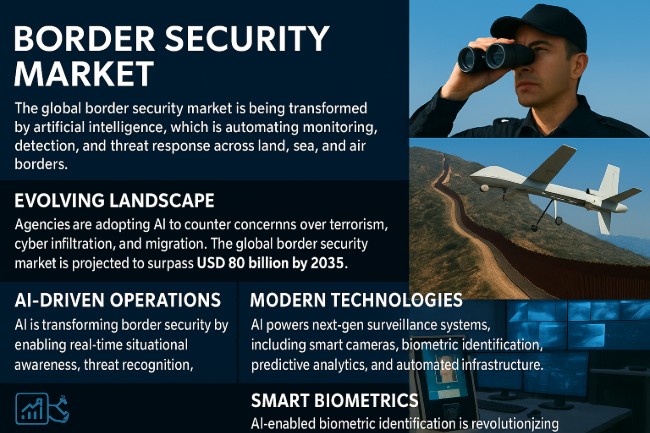
AI in Surveillance, Detection, and Monitoring Systems
Modern border surveillance is no longer limited to watchtowers and patrol vehicles. AI powered surveillance networks combine satellite imagery, drones, thermal cameras, radar, and acoustic sensors to create multi dimensional awareness. Through AI driven sensor fusion, these systems integrate and interpret data in real time, transforming fragmented inputs into coherent, actionable insights.
Computer vision and deep learning technologies enhance object recognition, allowing systems to distinguish between animals, vehicles, and humans even under poor lighting or weather conditions. Autonomous drones, powered by AI navigation algorithms, can patrol remote or high risk border regions, transmit live imagery, and relay instant alerts to command centers.
At maritime borders, AI algorithms process sonar and radar data to track unidentified vessels, monitor coastal activities, and detect illegal fishing or smuggling operations. In airspace management, AI helps radar systems predict aerial intrusions and coordinate with anti drone defenses.
The combination of AI based predictive analytics and high resolution imaging provides border authorities with unprecedented precision. Instead of reacting to incursions, AI allows for anticipation predicting where, when, and how violations are likely to occur.
AI and Biometrics: The New Frontier of Border Identification
AI driven biometrics have revolutionized identity management at international borders. Advanced facial recognition, iris scanning, and fingerprint systems now form the backbone of global travel and immigration networks. Unlike manual verification methods, AI based biometric systems perform identification in seconds, minimizing delays while enhancing accuracy.
Machine learning algorithms can recognize individuals even when physical appearances change due to aging, disguise, or poor environmental conditions. AI’s integration into national identity databases and immigration systems allows for instant cross referencing with watchlists and law enforcement data.
Deep learning based predictive profiling systems can identify behavioral anomalies in travelers, enabling early detection of high risk individuals or potential threats. Autonomous biometric kiosks powered by AI now facilitate seamless verification at airports, land checkpoints, and seaports.
By 2035, biometric systems will be part of a global AI network that connects border agencies, airlines, and security organizations. This interconnected intelligence will not only streamline travel but also create an integrated security web capable of identifying threats before they reach the border.
AI in Border Infrastructure and Smart Fencing
Smart border infrastructure represents one of the most significant advancements in the AI driven security ecosystem. AI powered “smart fences” embedded with sensors, radar, and motion detectors are replacing traditional physical barriers. These intelligent perimeters can detect vibration, movement, or sound anomalies and instantly notify security forces of potential breaches.
AI enables predictive maintenance across border infrastructures, ensuring that sensors, power systems, and communication lines remain fully operational. Machine learning algorithms also optimize energy use across remote surveillance stations, reducing operational costs and environmental impact.
In high risk zones, AI based ground sensors combined with radar imagery can identify tunneling activities or underground movements a major challenge in regions prone to smuggling. Satellite linked AI systems provide macro level awareness, correlating on ground data with aerial and orbital observations to track large scale movement patterns.
The future of border infrastructure will be defined by adaptive AI systems that respond autonomously to changing conditions, from weather disruptions to security threats, creating a self managing and self defending border environment.
Get AI Impact Analysis on Border Security Market, Request Pdf Brochure: https://www.marketsandmarkets.com/pdfdownloadNew.asp?id=103309188
AI in Command, Control, and Communication (C3) Systems
The integration of AI into command and control (C3) frameworks has fundamentally transformed the coordination of border operations. In traditional models, human operators analyzed fragmented reports and manually relayed information to response teams. Today, AI systems fuse inputs from multiple surveillance nodes, drones, and ground stations into a unified operational picture.
AI driven C3 platforms enable predictive decision making by analyzing real time data from across the border network. They can simulate potential scenarios, optimize resource allocation, and recommend tactical responses before threats escalate. In multilingual environments, AI based natural language processing facilitates communication between agencies and across borders.
AI also strengthens cybersecurity within C3 networks by detecting anomalies, intrusion attempts, or data manipulation in real time. By 2035, command centers are expected to operate largely through AI augmented intelligence, where human officers oversee and validate decisions generated by automated analytics engines.
The synergy between AI, big data, and cloud computing ensures that modern border forces are not just reactive but anticipatory prepared to detect, analyze, and neutralize threats before they materialize.
Regional Developments and Key Defense Programs
AI driven border security initiatives are expanding rapidly across different regions, reflecting distinct geopolitical challenges and defense priorities. In North America, the U.S. Department of Homeland Security is pioneering AI surveillance programs that combine drones, ground sensors, and biometric databases to enhance southern and northern border control.
India has launched integrated border management systems using AI based drones and smart fences along its borders with Pakistan and China. The European Union, through Frontex and the Schengen Information System, is adopting AI to monitor migration flows and detect irregular crossings across land and maritime borders.
China, with its emphasis on advanced surveillance and internal stability, has developed AI powered recognition systems capable of real time monitoring across massive border stretches. Israel continues to lead in smart fencing and AI based radar technologies, leveraging its expertise in autonomous defense systems.
In the Asia Pacific and Middle East, AI is being used for maritime border security, where illegal fishing, piracy, and smuggling are major concerns. Africa and Latin America, while still in early stages, are rapidly integrating AI in surveillance and patrol operations with support from global defense contractors.
Key Market Players and Emerging AI Technologies
The border security market is witnessing an influx of collaborations between established defense contractors, technology companies, and AI startups. Firms like Thales Group, Elbit Systems, Lockheed Martin, and Raytheon Technologies are investing heavily in AI enhanced surveillance and sensor fusion platforms.
Technology companies such as NVIDIA, Microsoft, and IBM provide the computing infrastructure and AI algorithms necessary for large scale data processing. Meanwhile, startups specializing in computer vision, drone automation, and predictive analytics are developing niche AI applications tailored for border defense.
AI chip manufacturers are enhancing edge computing capabilities, allowing border surveillance systems to process data locally without relying on central servers. This is critical for remote areas with limited connectivity. Governments are also collaborating with private AI research labs to develop indigenous solutions that align with national security frameworks.
By 2035, the integration of cloud based AI-as-a-Service (AIaaS) platforms will allow countries to rapidly deploy scalable border security solutions, combining affordability with high performance analytics.
Ethical, Legal, and Policy Challenges in AI-Driven Border Security
Despite its transformative potential, the integration of AI in border security raises serious ethical and policy challenges. The use of AI powered surveillance and biometrics blurs the line between national security and individual privacy. Automated systems that classify or profile travelers based on behavior or data patterns risk introducing bias or discrimination.
Lack of transparency in AI decision making, often referred to as the “black box problem,” creates accountability concerns when errors occur. False positives in AI threat detection could lead to wrongful detentions or human rights violations.
Cybersecurity remains a major vulnerability, as border databases are prime targets for espionage and cyberattacks. Regulatory inconsistencies between nations also hinder data sharing agreements vital for cross border coordination.
To mitigate these risks, governments must establish ethical frameworks for AI deployment, emphasizing transparency, oversight, and human-in-the-loop governance. The balance between security efficiency and human rights will define the moral success of AI in border management.
The AI-Powered Smart Borders of 2035
By 2035, borders will be defined less by geography and more by data. AI will enable the creation of “smart borders” virtual perimeters where surveillance, communication, and defense systems operate in a synchronized digital ecosystem.
Fully autonomous drones and robotics will patrol remote or hostile terrains, while predictive AI will forecast migration trends, environmental changes, and potential security threats. Quantum AI computing will allow real time analysis of massive data streams, enabling nations to make split second strategic decisions.
Smart border networks will integrate with 6G communication systems, blockchain based identity platforms, and global satellite grids. This interconnected system will allow nations to share intelligence seamlessly, enhancing both security and humanitarian response during crises.
AI will not only protect borders but also redefine them turning traditional boundaries into intelligent, adaptive systems capable of safeguarding sovereignty, trade, and human movement in a globalized world.
Related Report:
Border Security Market by Domain (Land, Maritime, Airborne), Vertical (Military, Homeland Security), System (Surveillance Systems, Detection Systems, Communication Systems, Command and Control Systems), Installation & Region – Global Forecast to 2029

This FREE sample includes market data points, ranging from trend analyses to market estimates & forecasts. See for yourself.
SEND ME A FREE SAMPLE

