AI Impact Analysis on Digital MRO Industry
The aviation industry is undergoing a profound shift in how it approaches maintenance, repair, and overhaul (MRO) services, driven largely by the integration of Artificial Intelligence. The traditional MRO model often manual, reactive, and documentation heavy is increasingly being replaced by digital first strategies that emphasize efficiency, cost savings, and predictive decision making. Artificial Intelligence is the backbone of this transformation. It empowers aircraft operators and service providers to anticipate component failures, automate routine tasks, and extract actionable insights from complex data systems. This shift is critical not only for reducing aircraft downtime and extending asset life but also for ensuring regulatory compliance and minimizing operational risks. In the digital MRO landscape, AI serves as the strategic enabler that bridges aviation engineering with the data revolution, reshaping the market's trajectory for years to come.
Predictive Maintenance: AI Transforming Aircraft Health Monitoring
One of the most impactful contributions of AI to the digital MRO ecosystem is its role in predictive maintenance. Unlike traditional scheduled or reactive maintenance practices, AI powered predictive systems monitor the real time condition of aircraft components using data from sensors, flight logs, and maintenance records. Machine learning algorithms process this data to forecast potential failures before they occur, enabling airlines to replace parts just in time and avoid unplanned groundings. These models learn from historical performance patterns to detect anomalies in engines, avionics, hydraulics, and landing gear systems. For instance, AI can identify subtle shifts in engine vibration or oil pressure that human technicians might miss, flagging issues days or weeks in advance. This transition to predictive maintenance helps operators improve safety, optimize MRO scheduling, and reduce costs associated with unnecessary preventive procedures.
AI-Powered Inspection and Defect Detection in MRO
Inspections are a critical part of MRO operations, and AI is fundamentally reshaping how they are conducted. Traditional manual inspections rely on visual checks and technician experience, which can be time consuming and prone to human error. AI powered systems, especially those using computer vision, are now being deployed to scan aircraft surfaces and internal structures with unmatched precision. High resolution cameras mounted on drones or robotic arms capture images of airframes, engines, and composite parts. Deep learning algorithms analyze these images to detect cracks, corrosion, dents, or fatigue damage. These AI systems can distinguish between surface anomalies and structural defects, prioritizing findings based on severity. This not only accelerates the inspection process but also improves its accuracy and consistency. As a result, aircraft can return to service faster, and safety margins are enhanced. By integrating AI into visual inspection workflows, MRO providers are achieving higher throughput with fewer errors and better documentation.
Digital Twins and AI in Aircraft Lifecycle Management
Digital twins virtual replicas of physical aircraft and their components are increasingly being used in conjunction with AI to manage lifecycle maintenance more intelligently. These digital representations are continuously updated with real time data from onboard sensors and maintenance systems. AI enhances digital twin functionality by enabling predictive simulation, performance modeling, and what if scenario analysis. By comparing real world performance against the digital baseline, AI can pinpoint emerging inefficiencies or signs of component degradation. For example, a digital twin of an aircraft engine might track fuel burn, thrust, and temperature to forecast turbine blade wear. AI driven insights allow operators to adjust usage patterns, schedule maintenance proactively, or even redesign maintenance intervals. In fleet wide applications, digital twins allow MRO providers to benchmark aircraft against each other and make data informed decisions about asset deployment and lifecycle investment. AI in digital twin systems is driving a paradigm shift from reactive maintenance to strategic asset management.
AI in Spare Parts Forecasting and Inventory Optimization
Managing spare parts inventory is one of the most challenging aspects of MRO operations due to the unpredictability of demand and the high cost of carrying excess stock. AI is solving this problem through advanced forecasting and inventory optimization models. By analyzing historical usage trends, flight schedules, seasonal demand, and aircraft specific maintenance histories, AI can predict which parts will be needed and when. These systems also account for part lead times, supplier reliability, and failure rates to optimize reorder points. The result is a leaner, more responsive supply chain that minimizes excess inventory while reducing the risk of part shortages. Additionally, AI can dynamically adjust inventory strategies based on fleet utilization patterns, airworthiness directives, and real time telemetry. This reduces capital expenditure and improves service level agreements. AI in inventory management is not only improving operational readiness but also strengthening supplier relationships and cost transparency in the digital MRO ecosystem.
Automation of Workflows and Planning Through AI Algorithms
AI is playing a crucial role in automating maintenance planning and operational workflows, a function that was once highly manual and time intensive. AI algorithms can analyze fleet health data, maintenance records, technician availability, and regulatory constraints to generate optimized work plans. These systems prioritize tasks, assign work orders, and schedule resources based on urgency, part availability, and technician skill sets. The AI driven automation ensures that tasks are executed in the most efficient sequence, reducing aircraft downtime and labor costs. For example, if a particular aircraft requires both avionics updates and engine inspections, AI can schedule these activities concurrently, ensuring no conflicts in technician availability or resource allocation. AI powered planning tools also incorporate compliance rules and OEM guidelines, reducing administrative overhead and audit risks. This automation frees human planners to focus on exception handling and strategic decisions, enhancing the overall agility and efficiency of MRO operations.
AI in MRO Training and Knowledge Management
The MRO industry faces a growing knowledge gap as experienced technicians retire and newer workers enter the field with less hands on experience. AI is addressing this challenge by transforming how knowledge is captured, shared, and applied in MRO environments. Intelligent knowledge management systems use natural language processing to extract maintenance insights from service bulletins, historical records, and technician notes. These insights are structured into searchable databases that technicians can query using voice or text, improving access to critical information at the point of use. AI is also enabling immersive training through augmented reality (AR) and virtual reality (VR), where smart systems guide technicians through complex procedures in simulated environments. These AI enhanced training modules adapt to user performance, offering personalized learning paths and real time feedback. By democratizing access to expertise and enabling continuous learning, AI is raising the technical proficiency of the MRO workforce and ensuring consistent maintenance quality across global operations.
Get AI Impact Analysis on Digital MRO Market, Request Pdf Brochure: https://www.marketsandmarkets.com/pdfdownloadNew.asp?id=165029525
Cybersecurity and AI Integration in MRO Systems
As MRO operations become increasingly digital, the importance of cybersecurity has grown significantly. Aircraft data, maintenance logs, and operational systems are all vulnerable to cyber threats that could compromise safety or cause operational disruption. AI is emerging as a key component of cybersecurity strategies within digital MRO platforms. AI driven security systems monitor network traffic, detect anomalies, and identify potential threats in real time. These systems learn from evolving threat patterns, making them more effective than static rules based defenses. In maintenance environments, AI can detect unauthorized access to digital records, flag unusual user behavior, and protect sensitive equipment firmware from tampering. Additionally, AI enables secure integration of IoT devices, drones, and remote diagnostics tools, which are essential to modern MRO. As cyber threats become more sophisticated, AI’s adaptive and proactive capabilities make it indispensable for maintaining the integrity and safety of digital MRO infrastructure.
AI-Driven Data Analytics for MRO Cost and Efficiency Optimization
The massive volume of data generated in aircraft maintenance operations presents both a challenge and an opportunity. AI is unlocking the value of this data by providing actionable insights that drive cost and efficiency improvements. By analyzing patterns in maintenance time, part consumption, technician productivity, and failure rates, AI identifies areas for process improvement and cost control. For example, it can recommend changes to inspection intervals based on actual part wear rather than fixed schedules, reducing unnecessary maintenance. AI also enables benchmarking of performance across fleets, facilities, and technician teams, helping MRO providers set realistic KPIs and track progress. Cost modeling powered by AI helps finance teams evaluate the ROI of maintenance investments and prioritize initiatives with the greatest impact. By centralizing data and automating analysis, AI creates a continuous improvement loop that ensures digital MRO systems evolve with the demands of the business and the industry.
Market Trends and Future Outlook for AI in Digital MRO
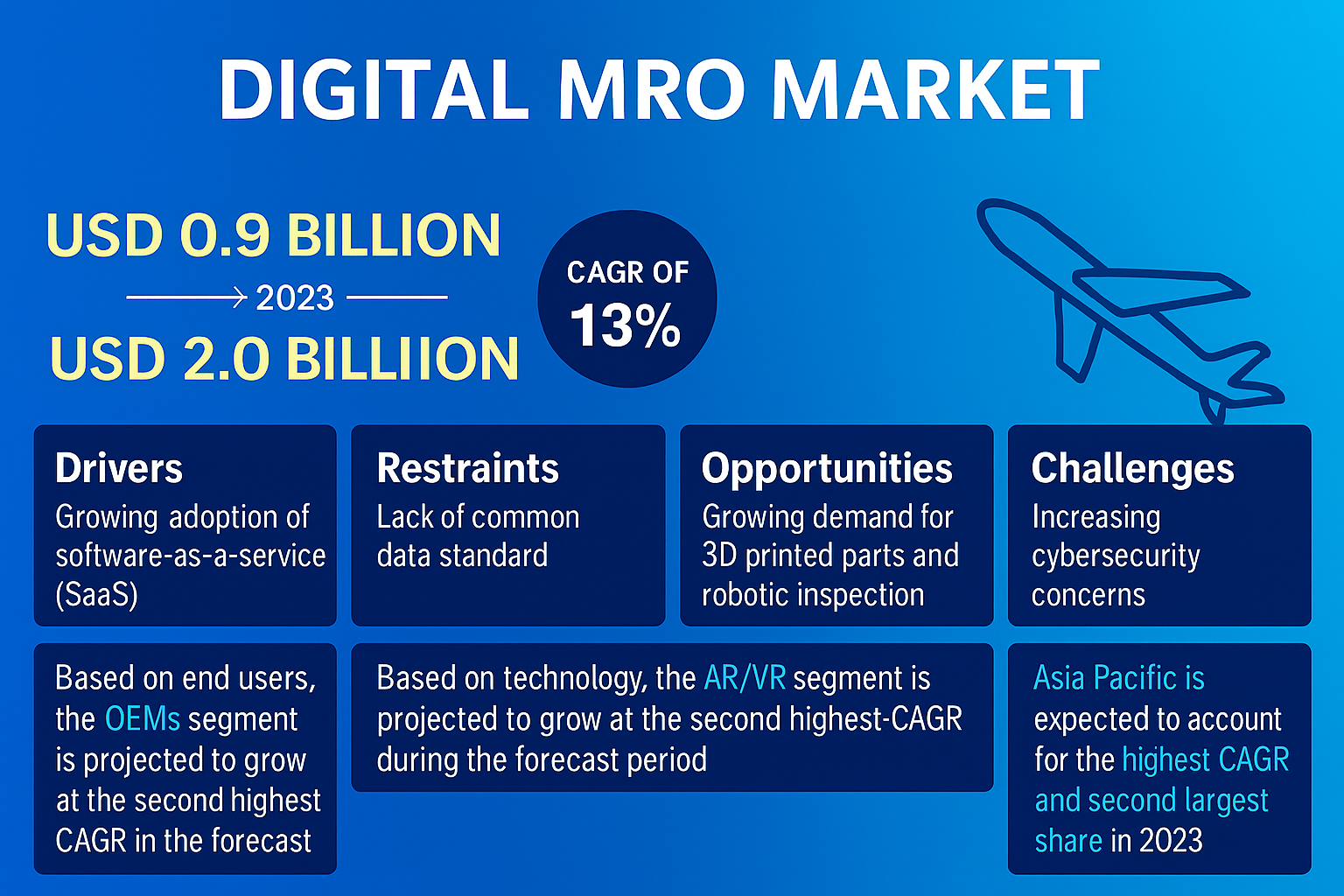
The global market for digital MRO solutions is poised for significant growth, with AI at the core of this evolution. Airlines, MRO providers, and OEMs are increasing investments in AI technologies to modernize their maintenance operations and remain competitive. The next wave of innovation will likely focus on AI driven autonomy, where aircraft systems can self diagnose issues and automatically coordinate MRO responses. The convergence of AI with technologies like 5G, blockchain, and edge computing will enable real time data exchange and distributed intelligence across global maintenance ecosystems. Additionally, regulatory bodies are beginning to embrace AI in maintenance oversight, recognizing its potential to improve safety and compliance. Regional trends indicate strong adoption in North America and Europe, with Asia-Pacific rapidly catching up due to fleet expansion and OEM partnerships. As these technologies mature, the digital MRO market will shift from early adoption to mainstream integration, transforming maintenance from a cost center into a strategic enabler of operational excellence and customer satisfaction.
Artificial Intelligence is driving a revolution in the digital MRO market, offering capabilities that redefine how aircraft are maintained, inspected, and managed throughout their lifecycle. From predictive maintenance and intelligent inspections to automated planning and knowledge management, AI is reshaping every facet of MRO operations. Its ability to analyze data, anticipate needs, and automate complex workflows is delivering substantial gains in efficiency, safety, and cost control. As aviation and defense sectors demand higher reliability and faster turnaround times, AI will continue to be the catalyst for smarter, more connected, and proactive maintenance strategies. The future of MRO lies not only in advanced machinery and skilled labor but in the intelligent systems that empower both to perform at their highest potential. In this landscape, AI is not just a tool it is the foundation of next generation digital maintenance excellence.
Related Report:
Digital MRO Market by Application (Inspection, Predictive Maintenace, Parts Replacement, Performance Monitoring, Training, Inventory Management, Mobility), Technology (AR/VR, 3D Printing, Blockchain, Others), End User, and Region - Global Forecast to 2030

This FREE sample includes market data points, ranging from trend analyses to market estimates & forecasts. See for yourself.
SEND ME A FREE SAMPLE

