AI Impact Analysis on Directed Energy Weapon Industry
AI-Enabled Revolution in Directed Energy Weapons: A Transformative Force
The integration of Artificial Intelligence into the Directed Energy Weapons (DEW) Market marks a transformative phase in global defense strategies. These systems, including high-energy lasers, microwave weapons, and particle beams, have traditionally relied on complex optics, energy delivery systems, and human-controlled targeting mechanisms. However, AI is now changing the game, enabling systems to adapt, react, and optimize autonomously. The fusion of AI with DEW platforms is driving a paradigm shift toward intelligent, responsive, and scalable combat solutions. Governments and defense contractors are increasingly investing in AI-driven DEWs to tackle the growing threats of unmanned systems, hypersonic weapons, and electronic warfare. The 2025 outlook of the global DEW market highlights AI as a central pillar shaping innovation, procurement, and deployment.
Enhancing Target Acquisition and Tracking with Artificial Intelligence
AI is fundamentally enhancing the precision and responsiveness of target acquisition in DEWs. By integrating real-time computer vision, machine learning, and sensor fusion algorithms, AI enables DEW systems to identify, classify, and prioritize threats with unmatched speed. This capability is crucial in a modern battlefield characterized by fast-moving drones, stealthy missiles, and complex electromagnetic environments. AI's predictive modeling allows these systems to track multiple moving targets simultaneously and anticipate their future positions. This not only improves kill probabilities but also significantly reduces collateral damage. AI-enhanced DEWs are capable of operating in both human-in-the-loop and autonomous configurations, offering flexibility based on the operational context. Such developments are redefining how armed forces engage adversarial assets and ensuring strategic superiority through rapid, informed responses.
Beam Control and Energy Optimization Through AI Algorithms
One of the core challenges in DEW deployment is maintaining beam accuracy and energy efficiency, especially over long distances and varying atmospheric conditions. AI addresses this by dynamically adjusting beam focus, alignment, and intensity in real-time. Through continuous data analysis and feedback loops, AI algorithms manage power consumption, predict energy requirements for different targets, and reduce operational strain on power sources. This enables DEWs to neutralize threats with greater precision while conserving energy for sustained engagements. Advanced beam control is particularly vital in multi-target scenarios where prioritization and sequential engagement are key. AI ensures that each energy pulse is tailored for optimal effect, minimizing waste and enhancing system longevity. These enhancements are accelerating the operational readiness of DEWs across both ground-based and airborne platforms.
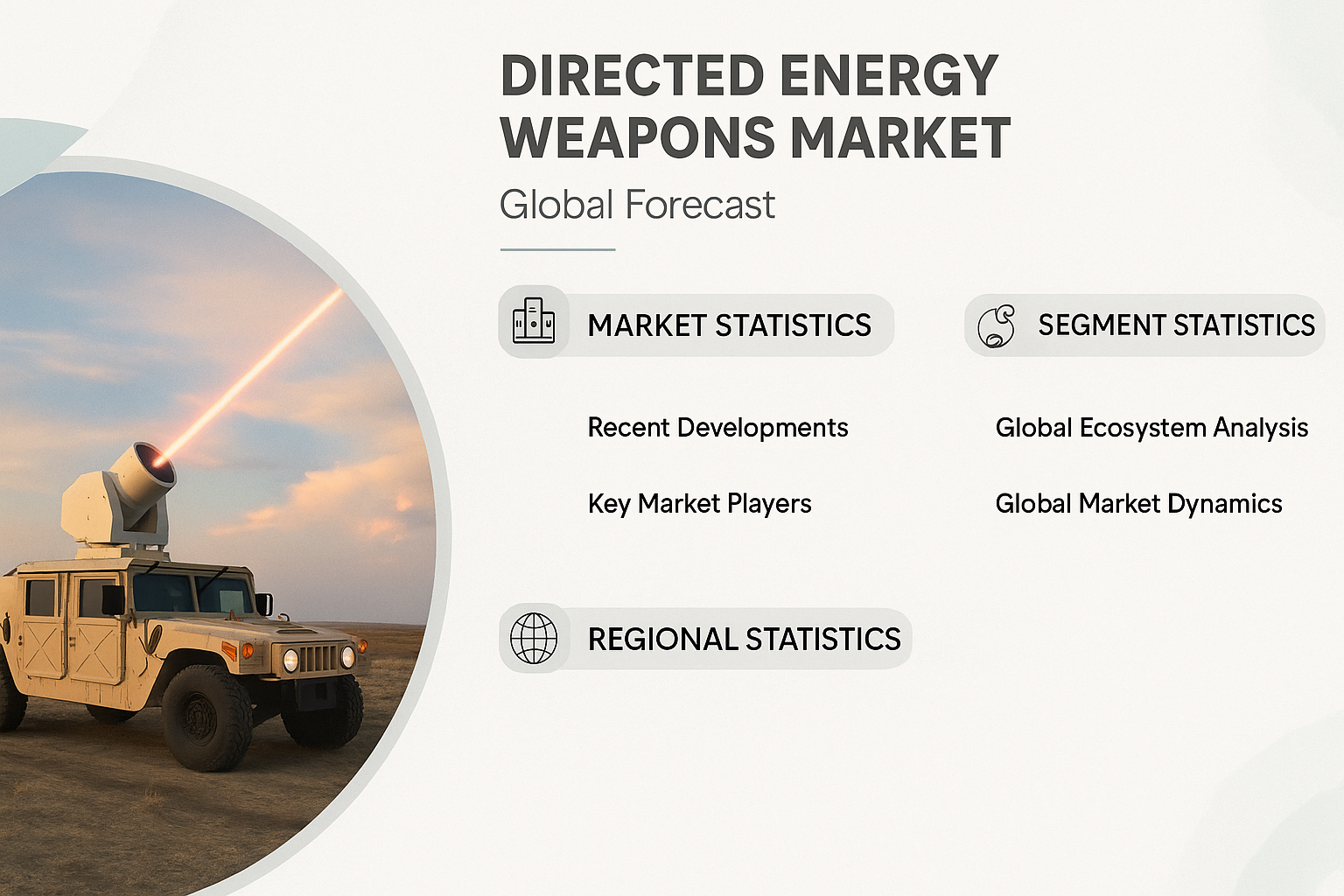
Directed Energy in Counter-UAS and AI's Strategic Edge
Countering Unmanned Aerial Systems (C-UAS) has become a top defense priority, with drone swarms posing a significant challenge to traditional defense mechanisms. AI-augmented DEWs offer a decisive edge by autonomously detecting, tracking, and neutralizing multiple drone threats in real time. Deep learning models help distinguish between friendly and hostile drones, while AI-driven control systems orchestrate precise engagements based on real-time threat assessments. The ability to operate without latency is critical in swarm scenarios where milliseconds matter. AI also enables predictive modeling of swarm behaviors, enhancing the strategic deployment of energy weapons against complex attack formations. This makes AI-integrated DEWs not only effective but also scalable against the evolving threat landscape of autonomous and semi-autonomous UAVs.
AI-Driven Situational Awareness and Combat Decision Support
Situational awareness is the bedrock of any effective military operation. AI enhances this by aggregating, analyzing, and visualizing vast streams of data from DEWs and associated surveillance assets. Through advanced data fusion techniques, AI constructs a comprehensive battlefield picture, identifies anomalies, and highlights emergent threats. This data is then used to support human commanders with timely, data-backed decision-making. DEWs equipped with AI can interface with broader Command, Control, Communications, Computers, Intelligence, Surveillance, and Reconnaissance (C4ISR) networks to enable coordinated responses. These systems assess threat trajectories, suggest optimal engagement strategies, and continuously learn from outcomes to improve future operations. AI’s role as a digital battlefield assistant is vital in ensuring DEWs operate as cohesive elements of larger military architectures.
Get AI Impact Analysis on Directed Energy Weapons Market, Request Pdf Brochure: https://www.marketsandmarkets.com/pdfdownloadNew.asp?id=19132295
Simulation, Testing, and Training Enhanced by AI Modeling
Before deployment, DEWs undergo rigorous simulation and testing to ensure operational efficacy. AI plays a crucial role in this phase by creating virtual environments that simulate diverse combat scenarios, including electronic warfare and multi-domain operations. Reinforcement learning algorithms are used to train DEW systems in these environments, enabling adaptive behaviors based on simulated outcomes. This approach reduces the need for expensive live-fire testing and accelerates development cycles. For military personnel, AI also powers immersive training platforms that simulate DEW controls and response protocols under varying conditions. This hands-on experience, guided by intelligent feedback, enhances operator readiness and system familiarity. Overall, AI-infused simulation and training frameworks are bridging the gap between conceptual design and battlefield performance.
Predictive Maintenance and System Health Monitoring Through AI
Maintaining high operational availability of DEW systems is crucial, especially during prolonged deployments. AI-based predictive maintenance tools are revolutionizing this aspect by analyzing real-time system telemetry, identifying wear patterns, and predicting component failures before they occur. These insights enable preemptive maintenance actions, reducing downtime and extending system lifespans. AI-driven diagnostic systems also detect anomalies in beam quality, power supply, and cooling mechanisms, ensuring that DEWs remain battle-ready under diverse environmental conditions. By integrating with digital twin technologies, AI provides a virtual replica of the DEW system for in-depth analysis and stress testing. This proactive approach to maintenance is not only cost-effective but also pivotal for mission assurance in dynamic combat zones.
Strategic, Ethical, and Legal Implications of AI-Enabled DEWs
While the military advantages of AI-powered DEWs are clear, they also raise complex ethical and legal challenges. The prospect of autonomous lethal systems operating without human oversight has sparked global debate on accountability, compliance with the laws of armed conflict, and potential misuse. There is increasing pressure to define clear rules of engagement and maintain a human-in-the-loop framework, especially for systems capable of lethal force. International bodies and defense alliances are beginning to draft regulations and guidelines for the responsible development and use of AI-DEWs. Transparency, traceability, and decision-logging mechanisms are being incorporated into AI models to ensure ethical compliance. These considerations are vital in ensuring that AI integration into DEWs enhances security without undermining global stability or human rights.
Market Dynamics and Investment Trends in the AI-DEW Landscape
The global defense market is witnessing a surge in investments directed toward AI-integrated DEW systems. Nations like the United States, China, Israel, and Russia are spearheading R&D initiatives, often in collaboration with private defense tech firms. Venture capital is increasingly flowing into AI-military startups focused on energy weapons, signaling strong commercial confidence. Defense contractors are entering strategic partnerships to co-develop AI-driven DEWs and scale production capabilities. Government procurement policies are also evolving to favor modular, upgradable platforms that leverage AI for performance optimization. This competitive landscape is accelerating innovation and pushing the boundaries of what AI and DEWs can achieve together. By 2025, the AI-DEW segment is expected to become one of the most dynamic and strategically vital areas within the broader defense industry.
Forecasting the Future: AI and the Next Generation of Directed Energy Weapons
Looking ahead, the convergence of AI and directed energy technology will define the next generation of military dominance. Future DEWs will be smarter, faster, and more autonomous, capable of operating seamlessly across land, sea, air, and space domains. AI will enable these systems to learn from engagements, optimize power usage in real time, and collaborate with other autonomous platforms. Quantum computing and advanced neural networks may further enhance targeting accuracy and response speed. Integration with space-based systems and hypersonic intercept platforms will also expand the strategic utility of DEWs. As AI continues to mature, its role in mission planning, threat detection, and autonomous decision-making will deepen, making it the central nervous system of directed energy warfare. Nations that successfully harness this synergy will set the standard for military technology in the coming decades.
Related Reports:
Directed Energy Weapons Market by Technology (High Energy Lasers, High-power Radio Frequency, Electromagnetic Weapons, Sonic Weapons), Platform (Land, Airborne, Naval, Space), Application, Product, Range and Region - Global Forecast to 2027

This FREE sample includes market data points, ranging from trend analyses to market estimates & forecasts. See for yourself.
SEND ME A FREE SAMPLE

