AI Impact Analysis on Full Body Scanner Market
The Global Full Body Scanners Market is entering a decade defined by rapid technological transformation, driven largely by artificial intelligence and the growing need for high throughput, high accuracy security screening. Traditionally, full body scanners have played a critical role in aviation security, border control, correctional facilities, critical infrastructure protection, and government security programs. As security threats evolve, scanners must be capable of detecting smaller, more sophisticated concealed weapons, non metallic contraband, explosive materials, and increasingly creative concealment techniques employed by adversaries.
Full body scanners relied historically on millimeter wave imaging and backscatter X ray technologies, with human operators interpreting raw images or algorithmically processed body outlines. These systems achieved acceptable performance for their time but faced limitations in detection sensitivity, processing speed, privacy protection, operational throughput, and the risk of human error. As global passenger traffic increases and threats grow more complex, the shortcomings of legacy scanners have become increasingly apparent.
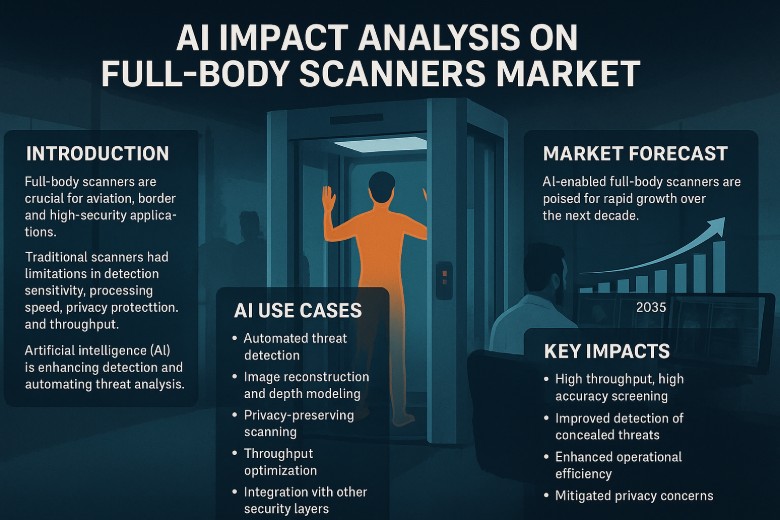
Artificial intelligence now represents the most significant breakthrough in the sector’s evolution. AI enhances detection, automates image interpretation, strengthens privacy protection, improves throughput, and integrates full body scanners into multi layered security ecosystems. AI enabled full body scanners are becoming more precise, faster, more reliable, more autonomous, and better capable of distinguishing real threats from harmless items. Between 2025 and 2035, AI will redefine the market’s trajectory, enabling intelligent, automated, privacy preserving screening systems that meet the next generation of global security demands.
This blog provides an in depth exploration of how AI transforms the full body scanners market across ten key domains that will shape the industry’s growth and technological direction through the next decade.
Introduction to the AI-Driven Full-Body Scanners Market
Full body scanners have long been essential components of airport and border security infrastructure. Rising global passenger numbers, geopolitical instability, organized crime, smuggling networks, and new forms of concealed threats have increased demand for sophisticated screening systems. The market historically relied on two primary technologies: active millimeter wave scanners and backscatter X ray scanners. Millimeter wave scanners are preferred today because they avoid ionizing radiation and provide rapid imaging.
Despite these advancements, legacy systems were limited in their ability to detect low visibility threats such as powdered narcotics, thin sheets of explosives, ceramic weapons, or contraband hidden within body folds or prosthetics. Interpretation required trained human operators, creating inconsistencies in threat detection and long wait times during peak hours.
Artificial intelligence has emerged as the catalyst to overcome these limitations. AI allows scanners to interpret complex millimeter wave signatures, reconstruct three dimensional body images, identify anomalies with higher sensitivity, protect passenger privacy automatically, and integrate with broader security networks. AI powered automation reduces the burden on human operators and enables faster, more reliable, and more secure scanning.
As global airports transition toward touchless and frictionless travel, AI enabled full body scanners will become core elements of next generation security architecture.
AI Enhancing Image Processing and Automated Threat Detection
One of the most transformative applications of AI in the full body scanners market is its ability to improve image processing and automate threat detection. AI driven image interpretation eliminates the need for human operators to examine raw body scans, which reduces errors and improves throughput. Machine learning algorithms trained on millions of threat and non threat examples enable scanners to recognize concealed items under various types of clothing, body positions, and movement conditions.
AI enhances resolution by improving noise reduction, contrast enhancement, and texture analysis. Deep learning models identify anomalies by comparing incoming scan signatures against predefined threat templates or latent representations learned during training. This enables the detection of smaller, thinner, and less conspicuous items that might escape manual scrutiny.
AI’s ability to process image data in real time accelerates decision making, allowing passengers to pass through the scanner faster without compromising safety. Automated detection also ensures consistency regardless of operator skill level. Over the next decade, AI driven image processing will enable next level accuracy and reliability, making full body scans far more effective in identifying threats such as plastic weapons, shaped explosive charges, and contraband hidden under multiple layers of clothing.
AI in Millimeter-Wave Image Reconstruction and Depth Modeling
Millimeter wave scanners are the preferred full body scanning technology due to their non ionizing nature and speed of operation. However, millimeter wave signals often produce noisy images with interference patterns and reflection distortions. Artificial intelligence significantly improves the reconstruction of millimeter wave images by using neural networks to analyze wave propagation, interpret signal reflections, and generate clearer, more coherent images of the scanned subject.
Deep learning enhances depth perception in millimeter wave scans by creating more accurate representations of body contours, surface irregularities, and objects hidden under clothing. AI improves image reconstruction by compensating for body movement during scanning, automatically aligning frames into a stable image sequence. In dense environments such as crowded airports, AI optimizes scanning parameters to reduce environmental noise and ensure consistent performance across high traffic periods.
AI also improves the detection of soft materials, organic threats, and items with irregular shapes that would otherwise blend into millimeter wave noise. As algorithms evolve, millimeter wave scanners will produce higher resolution three dimensional images without exposing individuals to radiation or requiring excessive scanning time.
AI enhanced millimeter wave imaging ensures that full body scanners remain capable of detecting emerging threats while maintaining safety, speed, and operator independence.
AI in Privacy-Preserving Full-Body Scanning
One of the most controversial aspects of early full body scanners was the level of anatomical detail revealed in the scans. Public concerns about privacy and personal dignity created significant resistance to their deployment. AI now enables privacy preserving scanning that eliminates the display of raw body images. Instead, the system presents a neutral avatar or generic silhouette that highlights only the location of anomalies.
AI automatically masks sensitive anatomical features, eliminates identifiable details, and replaces raw body scans with abstract threat focused representations. This ensures compliance with international privacy regulations such as GDPR and enhances public confidence in security screening. AI algorithms adjust privacy settings dynamically depending on context, such as heightened security alerts or country specific privacy laws.
Artificial intelligence strengthens privacy by filtering sensitive content without compromising threat detection performance. This balance is essential for maintaining public trust in full body scanning technologies. As privacy expectations rise globally, AI enabled privacy by design architectures will become mandatory for next generation scanning systems.
AI-Driven Throughput Optimization and Passenger Flow Management
Airports and border checkpoints face ongoing challenges as passenger volumes rise. Traditional body scanners, even with efficient technology, can create bottlenecks during high traffic periods. AI plays a critical role in throughput optimization by analyzing passenger flow in real time, predicting peak periods, and adjusting scanning speeds and procedures accordingly.
AI can estimate wait times, forecast congestion, and recommend operational adjustments to optimize lane usage. Automated resource allocation enables security teams to deploy additional personnel or open new screening lanes when needed. AI also adjusts scanner sensitivity and scanning cycles based on perceived passenger risk levels, optimizing scan times without compromising security.
By integrating full body scanners with airport management systems, AI supports a seamless flow of passengers through terminals. It reduces the burden on staff, speeds up screening, and enhances the overall travel experience. As airports move toward smart terminal concepts, AI enabled throughput management will become essential for balancing efficiency, security, and passenger satisfaction.
AI Integration with Multi-Layer Security Ecosystems
Full body scanners are increasingly being integrated into broader security ecosystems that include surveillance cameras, biometric databases, access control systems, behavior analysis tools, and baggage scanners. AI enables these systems to collaborate intelligently by analyzing and correlating data across multiple security layers.
When an anomaly is detected on a full body scanner, AI cross references data from facial recognition systems, travel history, threat intelligence databases, and surveillance feeds to generate a more comprehensive risk assessment. This multi layered approach improves decision making and enhances situational awareness for security personnel.
AI supports unified command centers where data from various security solutions is fused into a single operational picture. By reducing the cognitive load on human operators, AI enables faster and more informed responses. The integration of full body scanners into a unified AI driven ecosystem represents the future of airport and border security, where multiple technologies collaborate seamlessly to identify risks proactively.
Get AI Impact Analysis on Full-Body Scanners Market, Request Pdf Brochure: https://www.marketsandmarkets.com/pdfdownloadNew.asp?id=145680532
AI in Predictive Maintenance and Operational Reliability
Full body scanners operate continuously in high pressure environments where downtime can disrupt passenger flow and weaken security. AI enables predictive maintenance by constantly monitoring system performance, identifying degradation patterns, and forecasting potential failures before they occur.
AI tracks millimeter wave emitter performance, identifies fading antenna elements, and detects calibration drift that could impact image quality. Automated self diagnostic routines ensure that scanners remain operational and accurate during peak hours. Predictive algorithms optimize maintenance schedules, reducing downtime and extending equipment lifespan.
AI improves energy efficiency by managing power consumption intelligently based on usage patterns. These capabilities reduce operational costs while ensuring reliable performance. As full body scanners become more complex, AI based reliability tools will become essential for maintaining mission critical availability in demanding security environments.
AI in Manufacturing, Testing, and Quality Assurance of Scanners
AI plays a major role in the production of advanced full body scanners, where precise calibration, defect detection, and component quality heavily influence final system performance. AI driven machine vision systems inspect antennas, waveguides, detectors, and mechanical components with greater accuracy than manual inspection.
Robotic assembly guided by AI ensures consistent alignment of sensitive components, reducing manufacturing variability. AI algorithms tune waveforms, calibrate imaging systems, and verify scanner performance across different body types and scanning scenarios during the testing phase.
Digital twins allow manufacturers to simulate scanner behavior, test new features, and model environmental factors without building physical prototypes. This reduces development time, improves efficiency, and accelerates innovation cycles in the scanner market. AI enhanced testing and manufacturing ensure that new scanners meet strict quality, safety, and regulatory requirements before deployment.
Risks, Challenges, and Ethical Issues of AI-Enabled Full-Body Scanners
As AI becomes central to full body scanning technologies, new risks emerge. AI based systems must address concerns about bias, cybersecurity, data integrity, and algorithmic transparency. If AI misidentifies a threat or fails to detect one, the consequences can be severe. Ensuring that AI models are trained on diverse datasets is essential to minimize bias in detection performance.
Cybersecurity threats targeting AI based scanners can compromise screening integrity. Adversarial attacks may attempt to manipulate AI algorithms, distort scan patterns, or introduce false negatives or positives. Maintaining cybersecurity resilience is critical for protecting sensitive data collected by scanners.
Ethical concerns arise when sensitive personal data is processed by AI systems. Ensuring privacy, fairness, and explainability in automated decision making is essential for maintaining public trust. Governments and manufacturers must develop frameworks that regulate the responsible use of AI in full body scanners to ensure transparency, accountability, and ethical deployment.
Future Outlook: AI-Driven Full-Body Scanners in 2035
By 2035, AI powered full body scanners will operate autonomously in smart airports, border crossings, and secure government facilities. These systems will conduct seamless, touchless scans with rapid threat analysis, providing real time insights to security teams. AI algorithms will detect both conventional and emerging threats with unprecedented accuracy, forming the backbone of next generation security infrastructure.
AI will enable walk through, frictionless scanning that requires no passenger pauses, significantly improving travel convenience. Mobile body scanning units will support military deployments and field operations. Integration with biometric systems will reduce identity fraud and improve security verification processes.
The convergence of AI, millimeter wave imaging, biometric analytics, and autonomous security systems will reshape global security architecture. Full body scanners will become smarter, faster, safer, and more privacy respectful, marking a significant technological milestone in global threat detection capabilities.
Related Report:
Full-Body Scanners Market by Type (single view, dual view, 3D), Detection (Manual, Automatic), Component (Hardware, Software), End Use (Transport, Critical Infrastructure), Technology (X-ray, Millimeter Wave), and Region - Global Forecast

This FREE sample includes market data points, ranging from trend analyses to market estimates & forecasts. See for yourself.
SEND ME A FREE SAMPLE






