AI Impact Analysis on Marine Sensors Market
The marine sensors market is at the center of one of the most transformative technological revolutions of the twenty first century. Oceans cover more than seventy percent of the Earth’s surface, shaping global climate systems, supporting maritime trade, enabling naval superiority, and serving as a vast arena for commercial energy exploration. As ocean borders become more contested, maritime trade expands, and climate driven uncertainties increase, the demand for high precision marine sensing technologies has reached unprecedented levels.
This rapidly evolving environment coincides with the breakthrough advancement of Artificial Intelligence. AI is not merely enhancing marine sensors; it is fundamentally redefining how oceans are monitored, how threats are detected, how environmental changes are understood, and how surface and underwater operations are executed. Artificial Intelligence transforms marine sensing from passive measurement tools into active, intelligent, adaptive systems capable of perception, learning, analysis, prediction, and autonomous decision making.
Between 2025 and 2035, the convergence of AI, robotics, autonomous vessels, underwater acoustics, advanced radar, optical sensors, and environmental intelligence will reshape the global marine sensors market. This blog explores in detail how AI impacts every layer of this industry, from underwater warfare and oceanographic research to shipping, border control, offshore energy, and environmental conservation.
Understanding the Global Marine Sensors Market in the AI Era
Marine sensors form the backbone of maritime operations. They are designed to measure, detect, or monitor underwater acoustics, temperature, pressure, salinity, movement, chemicals, biological organisms, weather, currents, seabed structure, and surface activity. These sensors feed critical information to warships, submarines, AUVs, offshore drilling platforms, coastal surveillance stations, environmental research vessels, and climate monitoring buoys.
Traditionally, marine sensors operated independently, collecting raw data that required human interpretation and manual analysis. AI completely changes this paradigm. Instead of merely recording environmental variables, AI enabled sensors interpret data, classify patterns, detect anomalies, and generate real time decisions. This transition creates a new category of “intelligent marine sensing,” where sensors continuously learn from their environment, evolve with new data, and work cooperatively across multi sensor networks.
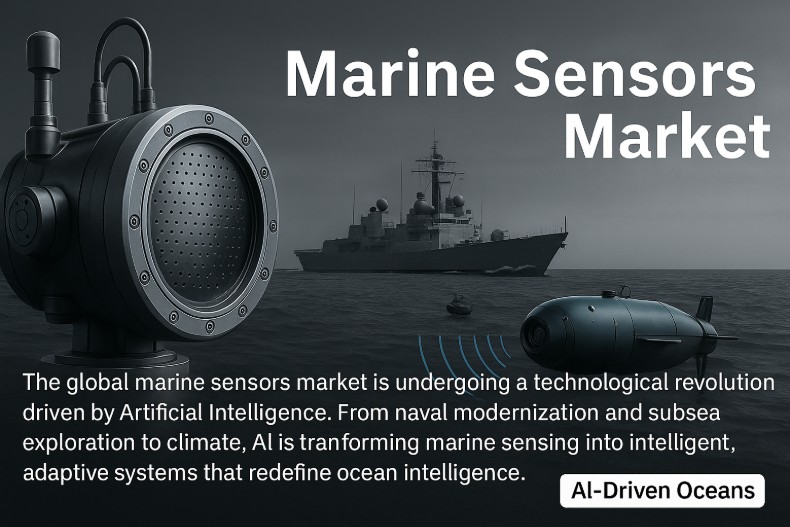
The global marine sensors market is expanding rapidly due to naval modernization programs, rising maritime security threats, growth in offshore renewable energy infrastructure, demand for enhanced subsea communication, and global commitments to climate monitoring. AI strengthens this market further by enabling mission critical capabilities such as autonomous surveillance, predictive ocean modeling, advanced anti submarine warfare detection, unmanned maritime navigation, environmental forecasting, and subsea asset management.
The next decade will witness the creation of AI powered oceans smart marine environments where underwater and surface sensors operate as a coordinated intelligence grid.
AI as the Core Driver of Next-Generation Marine Sensing Systems
Artificial Intelligence introduces capabilities that traditional marine sensors could never achieve. AI provides marine systems with the ability to recognize patterns, adapt to environmental variability, filter noise, and make independent judgments in unpredictable maritime conditions.
In hostile underwater environments where sound propagation is distorted by salinity, temperature gradients, and pressure, AI models can predict acoustic behavior in real time. In surface operations, AI enhances navigation and collision avoidance, while in environmental monitoring, AI detects chemical or biological anomalies that human analysts may overlook.
AI turns marine sensors from static measurement devices into dynamic computational entities. Instead of waiting for sensor operators to analyze data, AI processes, organizes, and interprets information as it is captured. This reduces human workload, increases reaction speed, and improves accuracy.
The greatest transformation occurs when AI bridges the gap between different sensor categories. Through sensor fusion, AI combines sonar, radar, optical, thermal, chemical, and inertial data streams into a unified situational awareness picture. This integration allows maritime forces and commercial operators to make decisions based on holistic, real time insights rather than isolated data readings.
As AI models become more advanced, marine sensors will evolve into intelligent perception systems capable of autonomous mission execution and complex behavioral interpretation.
AI in Underwater Acoustic Sensors and Sonar Systems
Underwater acoustics represent the most critical element of marine sensing due to the behavior of sound underwater. Sonar systems are the primary tools for submarine detection, underwater navigation, seabed mapping, anti mine operations, and underwater exploration. AI enhances sonar capabilities in ways that fundamentally change the underwater battlespace.
AI based noise filtering models can distinguish meaningful acoustic signals from background noise caused by waves, marine life, or ship movement. This dramatically improves detection accuracy, especially in littoral zones where sonar clutter is extremely high. Machine learning algorithms classify underwater objects based on acoustic signatures, enabling real time identification of submarines, torpedoes, marine mammals, and artificial structures.
AI also supports passive acoustic monitoring systems by identifying patterns in ambient noise that may indicate stealth submarine movement or illegal undersea activities. In naval warfare, AI driven sonar systems can rapidly analyze echoes, predict target depth and speed, and assist in precision targeting.
Additionally, AI enhances seabed mapping by interpreting large volumes of sonar data to generate high resolution bathymetric maps. This supports offshore construction, cable and pipeline monitoring, and geological analysis.
Through continuous learning, AI equipped sonar systems become smarter with each mission, adapting to new ocean conditions and evolving submarine tactics.
AI in Surface and Navigation Sensors
Surface vessels rely on radar, optical sensors, LIDAR, AIS tracking, GNSS receivers, and weather sensors for safe navigation. AI significantly improves the performance and intelligence of these systems.
In radar systems, AI enhances clutter suppression, reducing interference from sea waves or atmospheric distortions. Machine learning models improve target detection accuracy, helping vessels identify approaching ships, aircraft, or floating debris in dense maritime traffic. AI also enhances long range tracking and classification, which is critical for naval operations and coastal surveillance.
In optical and infrared sensors, AI powered machine vision enables automated recognition of vessels, buoys, obstacles, and icebergs. Autonomous ships rely on AI to interpret visual input in real time, enabling safe navigation even in zero visibility scenarios.
AI enriches marine weather prediction by analyzing real time sensor data and historical oceanographic datasets to predict sea state, wave intensity, and storm formation. This provides commercial and defense vessels with enhanced route optimization capabilities.
Through multi sensor fusion, AI integrates radar, optical, thermal, and AIS data to create a 360-degree situational awareness environment essential for autonomous navigation, maritime border control, and remote vessel operation.
AI in Environmental and Oceanographic Sensors
The health of the oceans is closely tied to climate stability, biodiversity, and global environmental resilience. Oceanographic sensors measure temperature, salinity, chemical composition, biological activity, wave patterns, and deep sea conditions. AI elevates these sensors by enabling predictive environmental intelligence.
AI models predict ocean currents, tides, and wave dynamics with greater precision by learning from historical and real time sensor data. These predictions support navigation, offshore energy operations, fisheries management, and climate research. AI enhances chemical and biological sensors by identifying anomalies such as oil spills, pollutant concentration changes, harmful algal blooms, or oxygen depletion zones.
AI enabled environmental sensors help scientists track coral reef degradation, monitor species migration, detect marine heatwaves, and map deep sea ecosystems. In climate science, AI supports global warming impact models by interpreting vast amounts of sensor data collected from buoys, gliders, and underwater observatories.
As ocean conditions become increasingly unpredictable due to climate change, AI will become essential for interpreting complex environmental shifts and delivering accurate forecasts.
AI in Marine Defense and ISR Sensor Networks
Maritime defense operations depend on broad networks of sensors covering surface, sub surface, and air domains. AI strengthens these networks by accelerating intelligence processing, enhancing threat detection, and enabling predictive modeling.
AI driven ISR systems integrate sonar, radar, infrared, electromagnetic, and communication sensors into a unified surveillance grid capable of identifying potential threats long before human operators could. AI models classify vessel behavior, detect suspicious movement patterns, and monitor maritime borders autonomously.
AI is transforming anti submarine warfare by analyzing acoustic anomalies that may indicate stealth submarine presence. AI enabled mine detection systems identify buried or stealth mines in complex seabed environments, significantly improving naval safety.
Autonomous underwater drones equipped with AI sensors execute long endurance ISR missions without human supervision. AI driven surface drones monitor maritime zones and relay intelligence data to command headquarters in real time.
Predictive AI models simulate enemy movement, assess risk, and optimize resource allocation across naval forces. This significantly enhances maritime situational awareness and operational advantage.
Get AI Impact Analysis on Marine Sensors Market, Request Pdf Brochure: https://www.marketsandmarkets.com/pdfdownloadNew.asp?id=170439590
AI in Autonomous Marine Vehicles: AUVs, USVs, ROVs
Autonomous underwater vehicles (AUVs), unmanned surface vessels (USVs), and remotely operated vehicles (ROVs) rely heavily on marine sensors for navigation, mapping, inspection, and ISR missions. AI is becoming the central intelligence system for these platforms.
Underwater navigation is extremely challenging due to the absence of GPS signals. AI supports localization through SLAM (Simultaneous Localization and Mapping), enabling AUVs to build maps of underwater environments in real time.
AI assists unmanned surface vessels with obstacle detection and avoidance, target recognition, and autonomous route planning. In offshore energy, AI enabled ROVs perform structural inspections, leak detection, pipeline monitoring, and maintenance with minimal human intervention.
AI enhances swarm robotics, enabling fleets of AUVs or USVs to communicate, collaborate, and execute missions collectively. These swarms are becoming essential tools for ocean floor mapping, mine countermeasures, and environmental surveys.
The future of autonomous marine systems will be defined by the intelligence and adaptability of their onboard AI sensor architecture.
AI in Marine Sensor Manufacturing, Testing, and Calibration
Manufacturing marine sensors requires precision engineering, environmental resilience testing, and strict calibration protocols. AI is streamlining these processes through automation, predictive modeling, and intelligent quality control.
AI calibrates sensors automatically by analyzing performance variance, environmental factors, and historical calibration data. This enables self calibrating sensors that adjust automatically to salinity, pressure, or temperature variations.
AI simulates sensor performance under deep sea pressures, thermal gradients, and acoustic interference, accelerating development and reducing the need for expensive field tests. Machine learning models predict manufacturing defects and guide robotic assembly processes to maintain strict quality standards.
Digital twins of marine sensors provide virtual replicas for testing and performance optimization, significantly shortening the development cycle.
As demand increases for fleet scale deployment of marine sensors, AI enabled manufacturing will become critical for meeting global supply needs.
Market Challenges, Cybersecurity, and Ethical Considerations
Despite its benefits, AI adoption introduces challenges that must be addressed strategically. AI driven marine sensors depend on constant data flow, making them vulnerable to cybersecurity threats such as spoofing, data interception, and algorithm manipulation. Protecting sensor networks from cyberattacks is now a crucial maritime priority.
Ethical challenges also arise from autonomous surveillance, especially in coastal borders and territorial waters. The use of AI for large scale marine monitoring must balance security needs with privacy considerations.
Environmental concerns emerge when underwater sensors and drones disturb marine ecosystems. AI must be used responsibly to minimize ecological impacts, especially in sensitive habitats.
Regulatory frameworks must evolve to govern the use of AI in naval operations, offshore industries, and environmental monitoring. Global coordination will be essential to ensure safe, secure, and compliant AI adoption.
Future Outlook: AI-Powered Marine Sensing Ecosystem 2035
By 2035, AI will transform the marine sensors market into a fully autonomous, intelligent, and interconnected ocean monitoring system. Underwater sensor grids will communicate through AI driven acoustic networks. Autonomous vessels will patrol maritime zones with minimal human oversight.
Deep sea exploration will accelerate through AI supported AUV fleets capable of reaching depths previously unexplored. Offshore wind farms, oil platforms, and marine research stations will rely on constant AI enabled predictive monitoring.
Climate change mitigation will depend heavily on AI driven forecasting models derived from global sensor networks. Naval warfare will move toward intelligent ocean dominance, where AI sensor fusion provides unmatched maritime situational awareness.
The future of ocean intelligence belongs to AI reshaping how humanity interacts with the sea, defends its waters, harvests ocean resources, and protects marine ecosystems.
Related Report:
Marine Sensors Market by Sensor Type (Pressure Sensors, Temperature Sensors, Force Sensors, Torque Sensors, Speed Sensors, Position and Displacement Sensors, Others), Application, Ship Type, End-use, Connectivity, and Region - Global Forecast

This FREE sample includes market data points, ranging from trend analyses to market estimates & forecasts. See for yourself.
SEND ME A FREE SAMPLE

