AI Impact Analysis on the Military Ammunition Market (2025–2035)
The Global Military Ammunition Market is undergoing a profound transformation as artificial intelligence becomes a central force shaping modern warfare. Ammunition, once viewed as a purely mechanical and consumable asset, is evolving into an intelligent, data driven component of defense systems. From small arms cartridges to precision guided munitions, the integration of AI is redefining how ammunition is designed, manufactured, deployed, and managed across the battlefield.
Modern warfare is no longer defined solely by firepower volume but by precision, speed, and intelligence. Militaries worldwide are shifting from traditional mass fire strategies to highly targeted operations that minimize collateral damage while maximizing effectiveness. This shift is driven by the need for efficiency, cost control, and compliance with international laws governing armed conflict. Artificial intelligence plays a critical role in enabling this transition by enhancing targeting accuracy, optimizing logistics, and improving decision making processes.
Between 2025 and 2035, AI will reshape every aspect of the military ammunition market, from smart munitions and advanced fire control systems to predictive supply chains and autonomous combat platforms. This blog explores how AI is transforming the military ammunition landscape across ten key domains that define the future of defense operations.
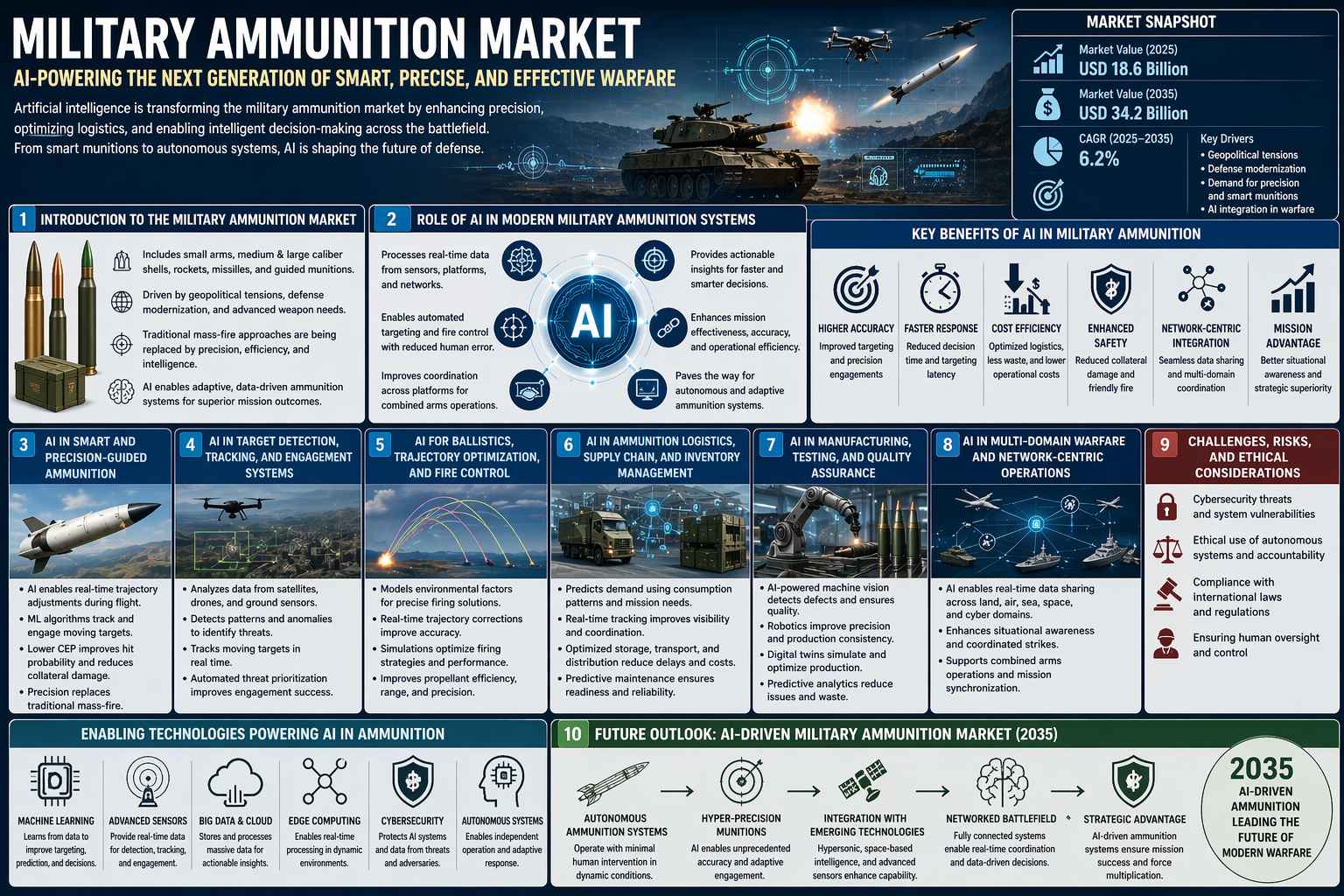
Introduction to the Military Ammunition Market
The military ammunition market encompasses a wide range of products, including small caliber rounds, medium and large caliber shells, rockets, missiles, and advanced guided munitions. These systems are essential for maintaining operational readiness and ensuring that armed forces can respond effectively to threats across various domains. The demand for ammunition is driven by factors such as geopolitical tensions, defense modernization programs, and the need for advanced weapon systems.
Historically, ammunition was designed for reliability and mass production, with limited emphasis on intelligence or adaptability. The increasing complexity of modern warfare has exposed the limitations of conventional ammunition. Urban combat environments, mobile targets, and electronic warfare require more precise and flexible solutions.
Artificial intelligence is emerging as a transformative force in this market, enabling the development of intelligent ammunition systems that can adapt to changing conditions and improve operational outcomes. By integrating AI into ammunition systems, militaries can achieve greater accuracy, efficiency, and effectiveness in combat operations.
Role of AI in Modern Military Ammunition Systems
Artificial intelligence is revolutionizing the way ammunition systems are integrated into modern military operations. By providing real time data analysis and decision support, AI enhances the effectiveness of weapon systems and improves overall mission performance.
AI enabled systems can process vast amounts of data from sensors, reconnaissance platforms, and communication networks to generate actionable insights. This allows military operators to make informed decisions quickly, reducing response times and improving accuracy.
The integration of AI with fire control systems enables automated targeting and engagement, minimizing human error and increasing efficiency. AI also supports coordination between different weapon platforms, ensuring that ammunition is used effectively in combined arms operations.
As AI continues to evolve, it will enable the development of autonomous ammunition systems capable of operating independently and adapting to dynamic battlefield conditions.
AI in Smart and Precision-Guided Ammunition
One of the most significant impacts of AI in the military ammunition market is the development of smart and precision guided munitions. These systems use advanced guidance technologies to improve accuracy and reduce collateral damage.
AI enhances guidance systems by enabling real time trajectory adjustments based on environmental conditions and target movement. Machine learning algorithms analyze sensor data to identify and track targets, ensuring that munitions can adapt to changing conditions during flight.
The integration of AI reduces the circular error probable of munitions, increasing the likelihood of a successful strike. This not only improves operational efficiency but also reduces the number of rounds required to achieve mission objectives.
Smart ammunition systems represent the future of military operations, where precision and intelligence replace traditional mass fire approaches.
AI in Target Detection, Tracking, and Engagement Systems
Effective targeting is critical for maximizing the impact of military ammunition. AI enhances target detection and tracking by analyzing data from multiple sources, including satellites, drones, and ground based sensors.
Machine learning algorithms identify patterns and anomalies, enabling the detection of potential threats in complex environments. AI powered systems can track moving targets in real time, providing accurate data for fire control systems.
The integration of AI reduces targeting latency, allowing military forces to respond quickly to emerging threats. Automated threat prioritization ensures that high value targets are engaged first, improving mission effectiveness.
By enhancing situational awareness and improving targeting accuracy, AI significantly increases the effectiveness of military ammunition systems.
AI for Ballistics, Trajectory Optimization, and Fire Control
Ballistics and trajectory optimization are critical factors in determining the accuracy and effectiveness of ammunition. AI enhances these processes by providing advanced modeling and predictive capabilities.
Machine learning algorithms analyze environmental factors such as wind speed, temperature, and terrain to generate precise firing solutions. AI enables real time adjustments to trajectories, ensuring that munitions remain on course even in dynamic conditions.
Simulation based modeling allows military organizations to test different scenarios and optimize firing strategies. AI also improves propellant efficiency, enabling longer ranges and better performance.
By enhancing ballistics and fire control systems, AI ensures that ammunition is used more effectively, reducing waste and improving mission outcomes.
Get AI Impact Analysis on Ammunition Market, Request Pdf Brochure: https://www.marketsandmarkets.com/pdfdownloadNew.asp?id=923
AI in Ammunition Logistics, Supply Chain, and Inventory Management
Logistics and supply chain management are critical components of military operations. AI enhances these processes by providing predictive analytics and real time visibility into inventory levels.
Machine learning algorithms analyze consumption patterns and operational requirements to forecast demand, ensuring that ammunition is available when needed. AI also enables real time tracking of ammunition, improving coordination and reducing delays.
By optimizing storage and transportation, AI reduces costs and improves efficiency. Predictive maintenance ensures that storage facilities and equipment remain in optimal condition, reducing the risk of failures.
AI driven logistics systems enhance readiness and ensure that military forces can sustain operations in challenging environments.
AI in Manufacturing, Testing, and Quality Assurance
The production of military ammunition requires high levels of precision and reliability. AI enhances manufacturing processes by automating quality control and improving efficiency.
Machine vision systems detect defects in components, ensuring that only high quality products are delivered. AI driven robotics streamline assembly processes, reducing errors and improving consistency.
Digital twin technology allows manufacturers to simulate production processes and optimize performance. Predictive analytics identify potential issues before they occur, reducing waste and improving efficiency.
By enhancing manufacturing and quality assurance, AI enables the production of advanced ammunition systems that meet the demands of modern warfare.
AI in Multi-Domain Warfare and Network-Centric Operations
Modern warfare relies on the integration of multiple domains, including land, air, sea, and cyber. AI enables ammunition systems to operate as part of a network centric environment, where data is shared across platforms to enhance coordination.
AI driven communication systems enable real time data sharing, improving situational awareness and decision making. This integration allows for coordinated strikes and enhances the effectiveness of combined arms operations.
By enabling seamless communication and coordination, AI ensures that ammunition systems can operate effectively in complex and dynamic environments.
Challenges, Risks, and Ethical Considerations
The integration of AI into military ammunition systems presents several challenges and risks. Cybersecurity is a major concern, as AI driven systems may be vulnerable to attacks that could disrupt operations or compromise data.
Ethical considerations arise from the use of autonomous systems in warfare. The potential for AI to make targeting decisions raises questions about accountability and control.
Ensuring that AI systems operate within established ethical and legal frameworks is essential for maintaining trust and compliance with international regulations.
Future Outlook: AI-Driven Military Ammunition Market (2035)
The future of the military ammunition market will be defined by the continued integration of AI and advanced technologies. Autonomous systems capable of operating with minimal human intervention will become increasingly common.
AI will enable the development of hyper precision munitions that can adapt to changing conditions and engage targets with unprecedented accuracy. The integration of AI with emerging technologies such as hypersonic systems and space based intelligence will further enhance capabilities.
By 2035, AI driven ammunition systems will play a central role in modern warfare, providing militaries with the tools needed to achieve strategic advantage.
Related Report:
Ammunition Market by Rifle (5.45 MM, 5.56 MM, 7.62 MM), Handgun (9 X 19 MM PARABELLUM, 5.7 X 28 MM), Sniper (0.338 LAPUA MAGNUM, 0.338 NORMA MAGNUM), Shotgun (12, 20 gauge), Autocannon (20 MM, 25 MM, 30 MM, 35 MM), Launched Grenades (40 MM), Artillery (105 MM, 130 MM, 155 MM, 203 MM), Tank (105 MM, 120 MM, 125 MM), Mortar (60 MM, 81 MM, 120 MM), Naval (57 MM, 76 MM, 127 MM), Rocket Artillery (70 MM, 122 MM), Guidance, Component, End-user, Region - Global Forecast to 2031

This FREE sample includes market data points, ranging from trend analyses to market estimates & forecasts. See for yourself.
SEND ME A FREE SAMPLE






