AI Impact Analysis on Military Laser Systems Market
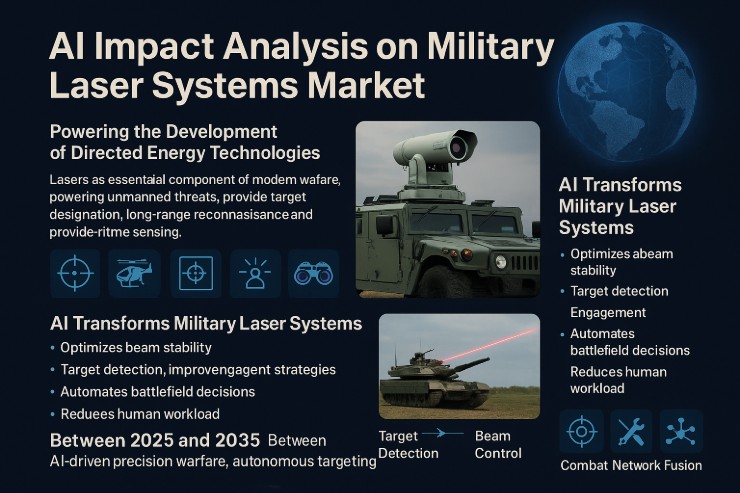
The Military Laser Systems Market is entering a decisive era as artificial intelligence becomes a foundational force shaping the development, deployment, and effectiveness of directed energy technologies. Lasers have become essential components of modern warfare, powering systems that conduct precision engagement, counter unmanned threats, provide target designation, enable long range reconnaissance, and deliver real time sensing. With increasing geopolitical tensions, rising drone based warfare, and the need for faster defensive responses, military organizations around the world are accelerating their investments in high energy lasers, laser designators, laser rangefinders, and laser based sensing systems.
The next leap in directed energy dominance will not come from increasing power levels alone, but from integrating artificial intelligence across every layer of the laser ecosystem. AI transforms military laser systems by optimizing beam stability, enhancing target detection, improving engagement strategies, automating battlefield decisions, and reducing human workload. As lasers evolve from standalone components to intelligent, networked combat assets, AI becomes the catalyst for higher accuracy, improved lethality, and real time adaptability.
Between 2025 and 2035, the global military laser systems market will be shaped by AI driven precision warfare, autonomous targeting, predictive maintenance, and intelligent threat assessment. This in depth blog explores how AI is reinventing military laser weapons, sensors, manufacturing, battlefield integration, and future force design.
Introduction to the AI-Driven Military Laser Systems Market
The military laser systems market encompasses a wide range of technologies including high energy laser weapons, lower power laser rangefinders, laser designators for precision guided munitions, laser dazzlers, and laser based sensing systems. Each plays a distinct role in air, land, naval, and space domains. The rapid evolution of warfare, characterized by drone swarms, hypersonic threats, information dense battlefields, and contested environments, requires laser systems capable of faster decision cycles, higher accuracy, and adaptive performance.
Lasers offer significant advantages over traditional weapon systems. They provide near instantaneous engagement, deep magazines limited primarily by power availability, silent operation, and extremely low cost per shot. These characteristics are transforming the calculus of modern air defense, particularly in countering drones, rockets, artillery, and cruise missiles.
Artificial intelligence is reshaping this market by enabling lasers to sense the battlefield autonomously, classify targets with machine intelligence, maintain precision under difficult environmental conditions, optimize firing sequences, and operate as nodes within a broader combat network. Without AI, high energy lasers would struggle to operate effectively in real world environments where motion, turbulence, clutter, and uncertainty define battlefield reality.
AI represents the next step forward in military laser capability, acting as the intelligence layer that transforms raw power into battlefield dominance.
AI-Enabled Target Detection, Tracking, and Engagement
Traditional targeting systems face limitations when confronted with fast moving, low signature, or evasive threats. AI transforms targeting by analyzing signals from electro optical, infrared, radar, and laser sensors, then generating real time classification of objects in complex, cluttered environments. Artificial intelligence enhances the sensor-to-shooter cycle by predicting target behavior, prioritizing threats, and identifying the optimal moment for engagement.
In dynamic combat scenarios, targets may maneuver unpredictably. AI’s ability to process motion trajectories helps laser systems compute exact lead points, predict where a target will be in the next milliseconds, and maintain engagement through evasive maneuvers. This is especially critical against hypersonic weapons, loitering munitions, and small drones that exhibit erratic flight patterns.
AI driven computer vision supports precise lock on capabilities, even when targets are partially obscured by smoke, dust, fog, or environmental debris. Neural models trained on vast datasets help laser systems interpret target characteristics, classify friend-or-foe signatures, and reduce false positives.
By embedding AI directly into the targeting pipeline, militaries achieve faster reaction times, improved accuracy, and higher lethality, making laser systems significantly more reliable in real world operational environments.
AI in Beam Control, Stabilization, and Propagation
Laser beam quality and stability determine the effectiveness of high energy laser weapons. Environmental disturbances such as vibration, wind, platform motion, and atmospheric turbulence can distort the beam, reducing its destructive capability. AI addresses these challenges by enabling intelligent beam control systems that continuously adjust optics, compensate for motion, and shape the beam for maximum impact.
Machine learning models predict distortions before they occur, enabling the system to correct for jitter, thermal blooming, and turbulence in real time. Adaptive optics controlled by AI algorithms optimize wavefront correction, ensuring the laser beam maintains coherence over long distances. This improves performance across airborne, naval, and ground based platforms.
AI enhanced propagation modeling also accounts for environmental variables such as humidity, particulate density, temperature gradients, and battlefield obscurants. By predicting how these elements affect beam intensity and trajectory, AI enables laser systems to optimize power output, adjust firing angles, and maintain consistent destructive energy on the target.
As militaries deploy lasers on aircraft, combat vehicles, naval ships, and satellites, AI driven stabilization becomes essential for enabling precise, long range engagement in rapidly changing environments.
AI in Counter-Drone and Air Defense Laser Systems
The proliferation of unmanned aerial systems has transformed modern warfare, creating urgent demand for cost effective counter drone solutions. Lasers are uniquely suited to counter drones through directed energy engagement, but require precise detection, tracking, and timing to defeat small, fast, maneuvering aerial threats. AI enables laser systems to achieve this level of sophistication.
AI driven recognition models analyze drone signatures, distinguishing between tactical threats, decoys, and benign aerial objects. AI identifies drone payloads, flight patterns, and potential mission intentions, helping operators prioritize which targets pose the greatest risk.
In swarm scenarios, AI becomes indispensable. Autonomous swarms maneuver collectively, making traditional countermeasures less effective. AI enabled lasers adapt by calculating engagement sequences that minimize energy expenditure while maximizing threat neutralization.
AI also integrates laser systems with radar and infrared sensors, enabling a multi layered detection system that ensures rapid, accurate tracking even when drones perform evasive actions. The result is a significantly faster and more scalable air defense architecture.
Autonomous defensive actions become increasingly possible as AI evolves from assisting operators to executing real time engagement decisions during fast paced aerial incursions.
AI in Military Laser Rangefinders, Designators, and Sensors
Laser based tools such as rangefinders and target designators are foundational to modern battlefield operations. AI increases their effectiveness by improving measurement accuracy, enhancing sensor interpretation, and automating complex tasks that once required extensive operator skill.
AI augments laser rangefinders by analyzing environmental factors such as dust, wind, and fog, adjusting algorithms for more precise measurement. In laser designators, AI improves lock on capability by identifying the most valid reflective surfaces even in chaotic combat environments.
AI enabled data fusion integrates laser returns with visual, thermal, and radar inputs, generating a clear and unified battlefield picture. This enhances reconnaissance, surveillance, and target acquisition systems used by forward observers, UAVs, and autonomous platforms.
In precision guided munitions, AI helps refine designator accuracy in real time, improving strike precision, reducing collateral damage, and increasing mission success. As autonomous and semi autonomous systems take over battlefield sensing, AI enabled lasers will become critical tools for real time intelligence generation.
AI Integration in High-Energy Laser Weapons (HELW)
High energy laser weapons represent the cutting edge of directed energy technology, offering the potential to engage threats at the speed of light. But HEL systems require careful management of power distribution, thermal loads, and beam sustainment. AI plays a critical role in enhancing HEL performance.
AI models monitor power system behavior, predicting shortfalls or overloads and adjusting distribution to maintain optimal beam output. Intelligent modulation ensures that lasers apply just enough energy to neutralize a threat without overtaxing power reserves.
AI predicts material burn through rates on targets, enabling more accurate assessments of time on target requirements. When targeting drones, AI determines the weakest structural point and calculates the energy needed to cause critical failure.
AI enables HEL systems to engage multiple threats simultaneously by managing beam switching sequences, allocating energy reserves, and optimizing firing priorities. Self protection mechanisms powered by AI prevent overheating, manage cooling systems, and prevent damage to optical components.
HEL systems rely heavily on real time data for situational awareness. AI automates battle damage assessment, determining whether a target has been neutralized or requires follow up engagement, enabling lasers to function at peak efficiency.
Get AI Impact Analysis on Military Laser Systems Market, Request Pdf Brochure: https://www.marketsandmarkets.com/pdfdownloadNew.asp?id=154285551
AI in Manufacturing, Testing, and Simulation of Laser Systems
The development of military laser systems requires precision engineering, extensive testing, and exact calibration. AI transforms manufacturing by enhancing quality control, reducing production variability, and accelerating prototyping cycles.
AI driven computer vision systems inspect optics, diodes, and mirrors for imperfections on a microscopic scale. Predictive analytics determine which components are likely to fail, enabling proactive replacement during assembly.
AI powered robotics handle delicate alignment tasks, assembling complex optical configurations with consistent accuracy. Digital twin simulations allow engineers to test laser behavior under stress without needing physical prototypes. These virtual environments simulate thermal expansion, vibration, and atmospheric interference, providing insights that improve reliability and performance.
Machine learning models predict the optimal production sequences to minimize errors and reduce cost. AI also enhances calibration by automatically adjusting optical alignments based on performance data, improving accuracy and reducing downtime.
AI in Battlefield Integration and Combat Network Fusion
Modern militaries rely on networks that connect ground forces, air assets, naval platforms, satellites, cyber systems, and unmanned systems. AI transforms laser systems into fully integrated nodes within these networks.
AI driven sensor fusion integrates information from laser rangefinders, radar systems, EO/IR sensors, battlefield analytics platforms, and C4ISR networks. This unified data stream supports rapid decision making, improved threat anticipation, and coordinated strikes.
In multi domain operations, AI synchronizes laser weapons across air, land, and sea environments. Real time battlefield algorithms analyze incoming data to determine the best platform to engage a target, whether it be a ground vehicle, aircraft, or unmanned swarm.
Autonomous laser equipped vehicles and drones communicate through AI networks, coordinating movements, sharing target information, and distributing missions without human intervention. This level of battlefield integration increases operational efficiency and elevates the impact of laser systems in high intensity conflicts.
Challenges, Risks, and Ethical Considerations in AI-Driven Laser Warfare
AI enabled military systems raise significant concerns related to reliability, autonomy, ethical use, and long term strategic impact. Autonomous systems that make lethal decisions without human oversight are controversial, prompting intense global debate. The risk of unintended escalation increases when machines operate at speeds beyond human comprehension.
AI models in laser systems must also withstand cyberattacks, data poisoning, and adversarial manipulation. If AI algorithms are compromised, laser systems could misidentify targets, fail during critical moments, or be hijacked. Ensuring secure training data, encrypted communication links, and hardened AI architectures becomes essential.
Regulatory challenges arise from treaties governing directed energy weapons and autonomous systems. Nations must balance military advantage with international stability and ethical responsibility.
Future Outlook for AI-Powered Military Laser Systems (2035)
By 2035, AI will enable military laser systems to operate as intelligent, autonomous, and highly adaptive weapons. Lasers will form defensive grids that protect military bases, naval fleets, and armored units with minimal human input. AI will improve hypersonic missile interception by predicting flight paths with microsecond precision.
Autonomous space based laser systems could emerge for missile defense, anti satellite operations, and space security missions. Miniaturized AI powered lasers will enhance infantry capabilities, while advanced HEL platforms will defend against massed drone swarms and long range threats.
Laser warfare will evolve into a data driven ecosystem powered by AI, capable of operating at unprecedented speed, scale, and accuracy.
Related Report:
Military Laser Systems Market by Application (Weapons and Non-weapons), Technology (Solid-state Laser, Fiber Laser, Semiconductor Laser, Gas Laser, Liquid Laser, Free-electron Laser), Platform, End Use, Output Power, and Region - Global Forecast

This FREE sample includes market data points, ranging from trend analyses to market estimates & forecasts. See for yourself.
SEND ME A FREE SAMPLE






