AI Impact Analysis on Optical Satellite Communication Industry
How AI Is Transforming Optical Satellite Comm
Optical Satellite Communication, powered by laser beams instead of radio waves, promises gigabit speeds, low latency, and enhanced security. As mega constellations and defense networks expand, AI systems are rising to manage the intricacies of signal integrity, tracking accuracy, bandwidth optimization, and fault resilience. This blog explores ten crucial ways AI is shaping this niche yet high impact market.
Enhancing Signal Processing in Optical Satcom
AI plays a key role in real time signal filtering and noise reduction within optical satellite links. Machine learning models enable photon level detection accuracy and can automatically distinguish between atmospheric interference or signal loss. Adaptive optics systems now employ AI to correct beam distortions caused by turbulence or misalignment. By applying neural networks to forecast signal fading, AI systems maintain link stability even under low signal to noise ratio (SNR) conditions, paving the way for more reliable laser communication between space and ground.
AI Driven Beam Tracking and Pointing Accuracy
Sustaining precise laser beams across moving satellites requires microsecond level tracking accuracy. Reinforcement learning techniques provide continuous feedback loops to correct beam alignment. AI systems process onboard telemetry, vibration, and atmospheric data to minimize pointing errors, significantly reducing acquisition time. Advanced tracking algorithms adapt to satellite drift or jitter, ensuring the beam stays locked on the receiver aperture. A recent study in ML based beam tracking shows how dynamic gain prediction minimizes error in real world satellite to ground free space optics systems.
Optimizing Data Throughput and Latency with AI
Optical constellations thrum with variable data demands. AI powered models allocate bandwidth dynamically and compress data intelligently to maximize throughput. Predictive analytics guide real time link quality assessments, adjusting routing accordingly to avoid bottlenecks. By tracking link performance, AI selects optimal satellite paths for data flow, ensuring minimal packet loss and latency. As 5G integration expands, adaptive AI protocols guarantee laser links deliver gigabit speeds consistently .
AI in Ground Station and Optical Network Management
Ground stations equipped with optical terminals benefit from AI managed load balancing. Based on weather forecasts and atmospheric turbulence data, AI chooses optimal downlink windows, switching between satellites to maintain high throughput. AI also automates handovers, seamlessly transitioning data between nodes. Ground systems now self diagnose hardware faults like aperture misalignment or internal delays, often resolving minor issues without human involvement.
Securing Optical Links Using AI Encryption and Threat Detection
While laser links are inherently more secure than RF, threats such as spoofing, denial of link attempts, or quantum key extraction remain pressing. AI systems detect subtle signature anomalies in quantum key distribution channels and adjust protocol parameters in real time to neutralize threats. By integrating pattern recognition and dynamic routing, AI safeguards the physical and cryptographic integrity of optical satellite communication.
Intelligent Network Scalability for Optical Mega-Constellations
Optical constellations like SpaceX Starlink, OneWeb, and Warpspace rely on scalable inter satellite links. AI coordinates dynamic routing across hundreds of laser terminals, optimizing network topology. With nodes appearing/disappearing due to orbits, AI ensures seamless traffic distribution and reconfiguration. Predictive topology algorithms anticipate congestion, rerouting traffic before links saturate. This autonomous coordination reduces reliance on human controllers.
Get AI Impact Analysis on Optical Satellite Communication Market, Request Pdf Brochure: https://www.marketsandmarkets.com/pdfdownloadNew.asp?id=181507372
Fault Prediction and Autonomous Maintenance of Optical Terminals
AI based diagnostics monitor laser terminal performance, predicting failures by flagging sensor drift, thermal spikes, or power fluctuations. Because ground station uptime is mission critical, predictive tools can perform preemptive calibrations or switch paths to alternative terminals. Fault prediction is vital for satellites where physical maintenance isn’t possible, making AI a key enabler of sustainable optical satcom.
AI in Optical Inter-Satellite Communication Links (OISLs)
AI algorithms enhance synchronization across fast moving satellites by tracking orientation, orbital dynamics, and link quality. During link handovers, AI makes split second decisions to reroute beams and maintain the mesh backbone. Real time load balancing ensures satellite clusters share traffic efficiently, enabling all time global coverage with smooth data flows.
Role of AI in Enabling Quantum Optical Communication
Next gen laser networks anticipate integrating quantum optical links for ultra secure communications. AI plays a vital role in entanglement distribution and photon pair stability, adjusting phase shifts in real time. Machine learning also corrects quantum errors and optimizes repeaters in space. While largely experimental, AI controlled quantum optical networks are becoming a critical frontier in secure communication .
Market Acceleration and Commercialization Through AI Integration
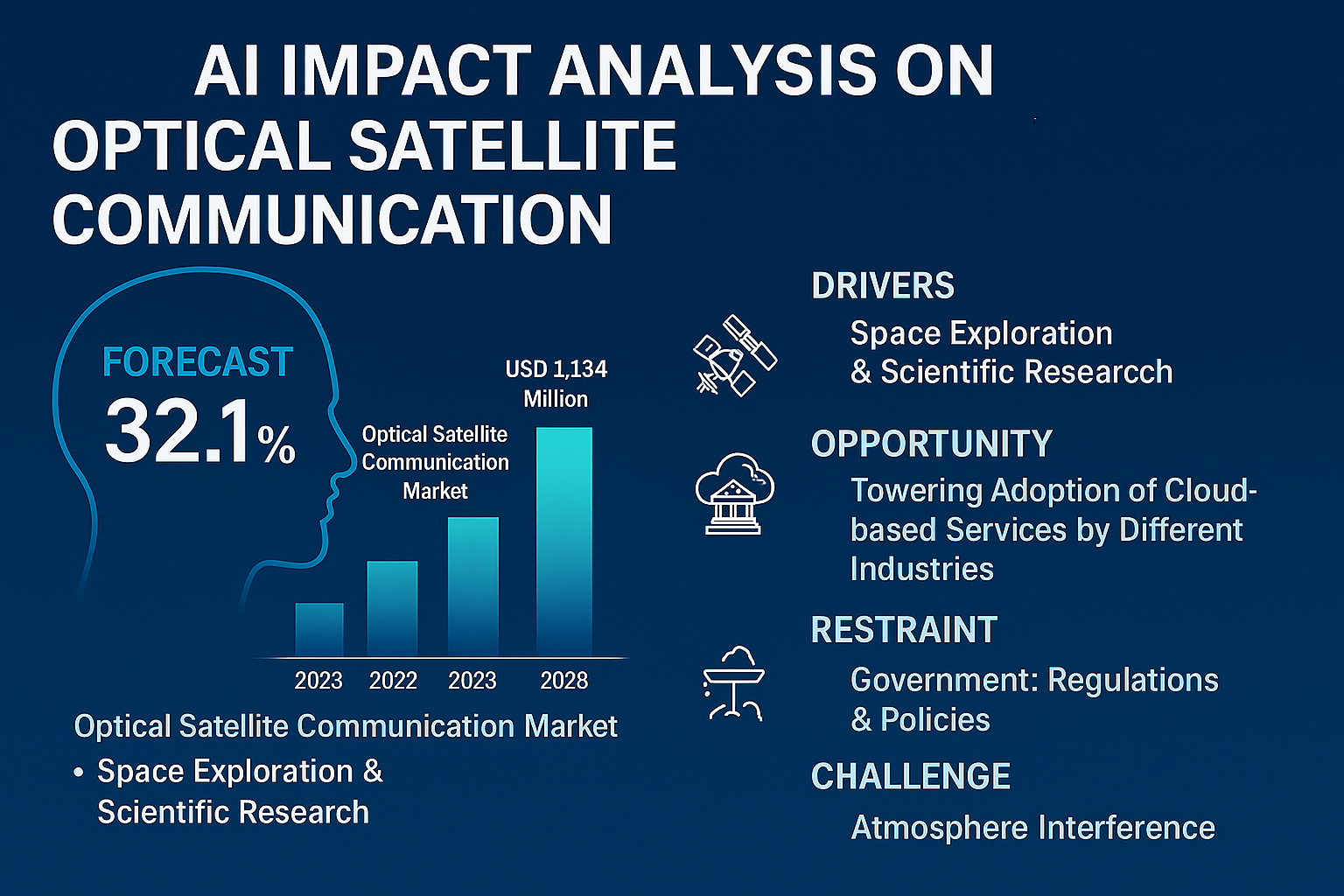
Commercial adoption of optical satellite communication relies on ROI. AI driven automation reduces OPEX significantly. Market reports forecast growth from USD 0.62 billion in 2025 to over USD 1.56 billion by 2030 (CAGR 20.4%). AI lowers barriers by streamlining design, managing constellations, enabling near real time applications like 5G backhaul, defense, and enterprise services. Startups like Mynaric and Stellar Project are using AI to build scalable laser terminals for small and large satellites. Through AI based network steering and autonomous ground control, optical satcom is rapidly transitioning from experimental to mainstream.
Future Outlook: AI at the Core of Laser Satcom Ecosystems
Over the next decade, AI will become the central nerve system of optical satellite communication networks. We will see AI driven constellation planners, smart ground stations that autonomously manage weather related link outages, and commercial services offering on demand high speed laser connections. Defense applications will push for encrypted, low interception communications. Onboard AI in satellites will monitor components and relay laser links, minimizing life cycle costs. Coordination between AI and quantum optical systems will help reach new levels of secure data transmission. The optical satellite communication market is moving beyond niche labs toward mainstream global infrastructure and AI is the driving force.
The marriage of AI and optical satellite communication delivers unmatched performance, security, and scale with laser based links. From gigabit beam steering and constellation scaling to ground station autonomy and quantum encryption, AI is unlocking the full potential of laser satcom. As adoption transitions from testbeds to global networks, AI integration will define the market’s growth, shaping how information flows between Earth and space in the coming decades.
Related Report:
Optical Satellite Communication Market by Type (Satellite-to-Satellite, Ground-to-Satellite Communication), Component (Transmitter, Receivers, Amplifiers, Transponders, Antenna, Converter), Application, Laser Type and Region - Global Forecast

This FREE sample includes market data points, ranging from trend analyses to market estimates & forecasts. See for yourself.
SEND ME A FREE SAMPLE






