AI Impact Analysis on Sonar Systems Industry
The sonar systems market is undergoing a major technological revolution driven by the rapid integration of artificial intelligence. As naval operations, subsea exploration, and marine surveillance become increasingly complex and data intensive, traditional sonar technologies face limitations in speed, interpretation, and adaptability. AI is bridging this gap by enabling sonar systems to process acoustic signals faster, adapt to changing marine conditions, and autonomously identify underwater threats. Whether in anti submarine warfare, underwater mapping, or oceanographic research, AI is unlocking unprecedented capabilities in sonar systems. With global investments accelerating in both military and commercial maritime sectors, the future of sonar technology is being defined by intelligent automation and predictive analytics.
AI-Driven Signal Processing in Sonar Applications
One of the most significant transformations AI brings to the sonar systems market lies in signal processing. Conventional sonar systems generate massive volumes of acoustic data that require intensive human analysis to interpret and classify. With AI, machine learning models can now filter, clean, and enhance sonar signals in real time. These models excel in recognizing patterns within noisy environments, isolating meaningful echoes from marine clutter and biologics. Deep learning algorithms are trained to detect anomalies, classify objects, and improve the resolution of sonar imagery. This shift from manual to automated processing reduces response time, increases detection accuracy, and enables decision making at the edge. For naval missions, this means faster threat recognition and strategic targeting. In commercial applications, such as seabed mapping and fisheries management, it leads to more efficient operations and higher data integrity.
Autonomous Underwater Vehicles (AUVs) and AI-Based Sonar Integration
Autonomous Underwater Vehicles (AUVs) are becoming vital platforms for underwater surveillance, exploration, and mine detection. Their effectiveness hinges on advanced sonar systems and intelligent navigation. AI plays a central role in enhancing AUV sonar capabilities by enabling the vehicle to interpret sonar feedback autonomously. Instead of transmitting all data to surface operators, AI onboard the AUV can assess sonar inputs, identify objects of interest, and make real time navigational decisions. Reinforcement learning techniques are used to optimize pathfinding and obstacle avoidance, while deep neural networks guide adaptive mission behavior based on sonar returns. This level of autonomy significantly extends the operational reach of AUVs and allows them to conduct complex missions in deep sea environments, under ice, or in contested naval zones without constant human supervision. AI driven sonar integration turns these unmanned platforms into intelligent, self sufficient systems with real time decision making abilities.
AI in Anti-Submarine Warfare (ASW) and Threat Detection
In military applications, sonar systems are critical for anti submarine warfare (ASW), where rapid detection and classification of stealthy undersea threats can determine the outcome of conflict. AI is revolutionizing ASW by dramatically improving sonar detection accuracy and reducing false positives. Machine learning models are trained on large libraries of submarine acoustic signatures, allowing sonar systems to quickly and reliably differentiate between enemy submarines, marine life, and decoys. AI systems are capable of real time signal classification, enabling automated threat prioritization and faster decision making under combat conditions. Furthermore, AI enhances multi static sonar configurations, where multiple sonar sources and receivers collaborate to track quiet or deep diving submarines. By processing data from distributed nodes, AI allows for more precise triangulation and dynamic threat modeling. As underwater stealth technologies evolve, AI driven sonar remains the most promising line of defense in maintaining undersea dominance.
Machine Learning in Underwater Object Classification and Identification
Beyond threat detection, AI is transforming the broader scope of underwater object classification. Traditional sonar returns can be ambiguous, often requiring expert interpretation to distinguish between shipwrecks, underwater mines, natural rock formations, and marine animals. With machine learning, especially convolutional neural networks, sonar systems are now capable of autonomously identifying objects with high confidence. These models learn from labeled sonar imagery and acoustic data to classify shapes, sizes, and movement patterns. In mine countermeasure (MCM) operations, AI powered sonar reduces mission times by eliminating the need for manual review of sonar images. In archaeological and oceanographic missions, AI assists researchers in cataloging underwater structures and features with minimal human input. As datasets expand and training algorithms improve, underwater object identification will become more precise, paving the way for fully autonomous subsea operations across defense, commercial, and scientific applications.
AI-Powered Passive vs Active Sonar Performance Optimization
Modern sonar systems employ both passive and active modes depending on mission requirements. Passive sonar listens for acoustic signatures, while active sonar emits pulses and listens for echoes. AI is enhancing the performance of both modalities by intelligently managing their deployment based on operational context. In passive sonar, AI filters ambient noise and hones in on target signals with greater precision. It learns from oceanographic data to predict sound propagation characteristics and adjust sensor sensitivity accordingly. In active sonar, AI optimizes ping frequencies, pulse durations, and beam patterns to reduce detection by adversaries while maintaining signal clarity. Adaptive AI systems can also switch between passive and active modes in real time, depending on environmental noise levels, threat presence, and stealth considerations. This smart modulation significantly enhances sonar effectiveness in cluttered or hostile underwater environments, ensuring optimal performance across varied mission profiles.
Predictive Maintenance and Health Monitoring of Sonar Equipment Using AI
Maintenance of sonar systems, especially those installed on submarines, surface ships, and AUVs, is essential to mission reliability. AI is advancing predictive maintenance by analyzing performance data from sonar transducers, power supplies, processing units, and communication interfaces. Using machine learning, these systems detect subtle signs of wear, calibration drift, or impending component failures before they manifest as mission critical issues. Digital twin models simulate sonar performance under various conditions, enabling proactive health monitoring and logistics planning. For defense operations, predictive maintenance reduces downtime and ensures sonar systems remain combat ready. In commercial maritime sectors, it optimizes operational efficiency and reduces lifecycle costs. AI’s ability to detect maintenance needs ahead of time is particularly valuable in remote deployments, where returning assets to port for inspection can be logistically complex and expensive.
Get AI Impact Analysis on Sonar Systems Market, Request Pdf Brochure: https://www.marketsandmarkets.com/pdfdownloadNew.asp?id=142612945
AI Integration in Multi-Static and Networked Sonar Systems
Multi static sonar systems and networked acoustic arrays are being increasingly deployed for wide area underwater surveillance. These systems consist of multiple sonar nodes that work collaboratively, sharing data to enhance detection range and accuracy. AI is critical in processing the vast amounts of data generated by these arrays and transforming it into actionable intelligence. By fusing inputs from distributed sonar platforms, AI generates a coherent underwater picture that accounts for spatial and temporal variations. Advanced algorithms reconcile conflicting data, eliminate redundancies, and prioritize targets. In naval operations, this enables superior tracking of underwater threats over large distances and in complex topographies. In civil applications, such as monitoring marine life or tracking ocean currents, AI integrated networks provide valuable insights. The future of sonar lies in scalable, intelligent networks where AI ensures seamless integration, real time responsiveness, and adaptive performance across all operational domains.
AI in Environmental Adaptation and Noise Cancellation for Sonar
Underwater acoustic environments are dynamic, with variables such as salinity, temperature, current, and marine life constantly influencing sonar performance. AI enables sonar systems to adapt to these changes in real time. Environmental data collected by onboard sensors or external networks is fed into AI models that predict how sound propagates under current conditions. The system then adjusts signal processing parameters, beamforming angles, and filter settings to maintain optimal performance. AI also enhances noise cancellation techniques, identifying and subtracting environmental and mechanical noise sources that interfere with target signals. This is particularly valuable in shallow water or harbor environments, where background noise can be intense and variable. As sonar systems move toward more autonomous modes of operation, the ability to self optimize in response to environmental inputs becomes a key differentiator enabled by artificial intelligence.
Future Trends and Market Outlook for AI in Sonar Systems
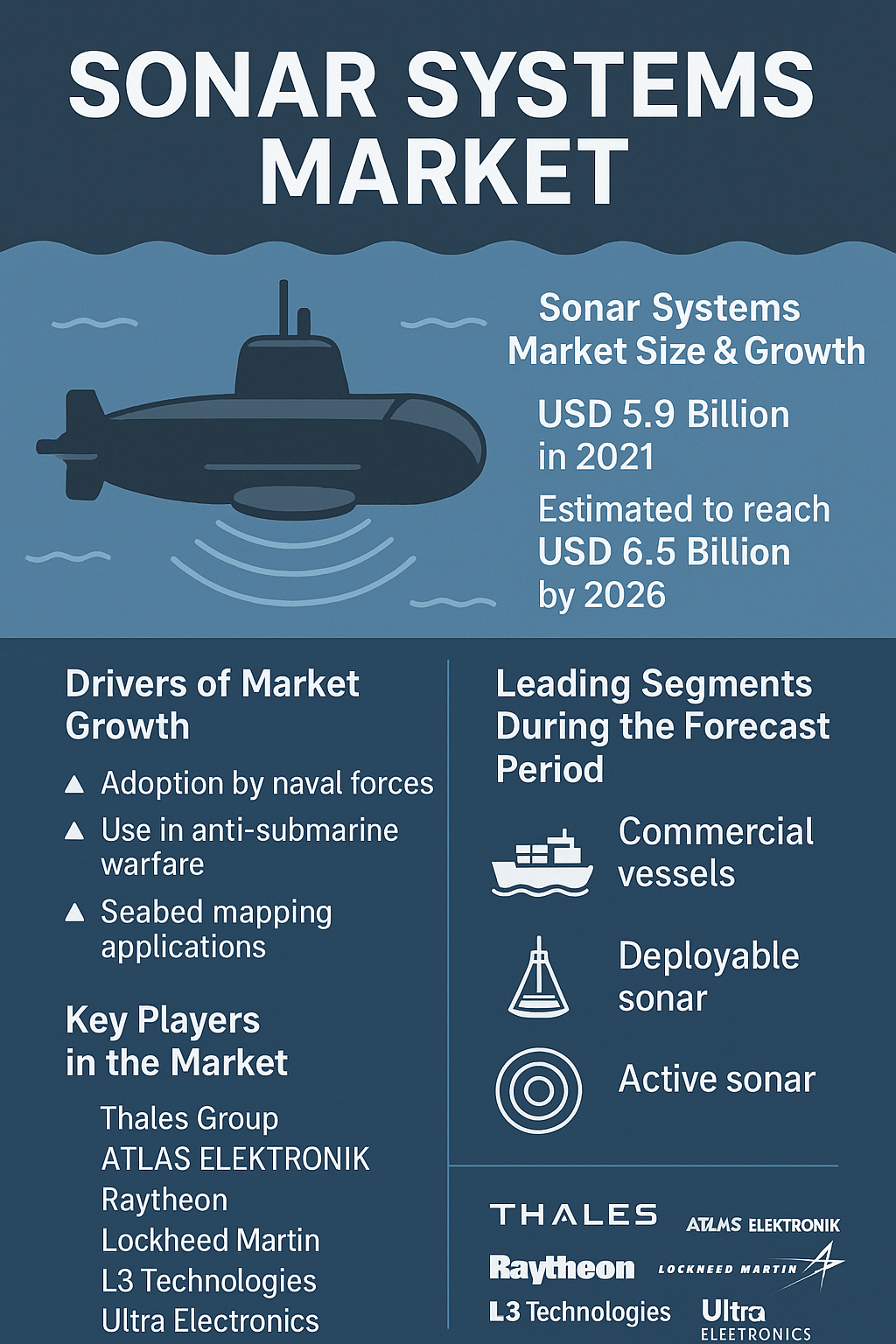
The integration of AI into sonar systems is no longer experimental it is becoming a baseline requirement for next generation maritime operations. The global sonar systems market is projected to witness robust growth, with AI emerging as a central value driver. Militaries around the world are accelerating R&D into smart sonar technologies as part of broader modernization programs. Defense OEMs are embedding AI into new builds, while existing fleets are undergoing AI retrofits. Commercial applications, including oil & gas exploration, fisheries management, and underwater infrastructure monitoring, are also benefiting from AI’s ability to deliver greater precision and automation. Future developments may include quantum enhanced sonar AI, 6G connected underwater networks, and bio inspired sonar systems powered by neuromorphic computing. As autonomy becomes standard in both manned and unmanned platforms, the demand for intelligent sonar systems will rise exponentially. Strategic partnerships between AI firms and defense/naval contractors will play a pivotal role in shaping this high stakes, innovation driven market over the next decade.
Artificial Intelligence is ushering in a new era of efficiency, precision, and autonomy in the sonar systems market. From signal processing and autonomous underwater navigation to predictive maintenance and adaptive environmental tuning, AI is enhancing sonar capabilities in ways that were previously unimaginable. These advancements are transforming both military and commercial maritime operations, creating a more intelligent and responsive underwater domain. As the world navigates the dual imperatives of maritime security and sustainable ocean resource management, AI enabled sonar systems will play a defining role in shaping outcomes. The convergence of AI and sonar marks not only a technological evolution but also a strategic leap forward in our ability to explore, monitor, and defend the oceans.
Related Report:
Sonar Systems Market by Application, Platform (Commercial vessels, Defence vessels, Unmanned Underwater Vehicles, Aircrafts, and Ports), Type, Material, and Region (North America, Europe, APAC, Middle East, & RoW)

This FREE sample includes market data points, ranging from trend analyses to market estimates & forecasts. See for yourself.
SEND ME A FREE SAMPLE






