AI Impact Analysis on Underwater Warfare Industry
AI in Underwater Warfare
The underwater warfare market is undergoing a dramatic transformation with the integration of artificial intelligence, which has become a core driver of modernization in naval defense. Historically, underwater warfare relied heavily on traditional sonar, manned submarines, and human led reconnaissance missions. However, in the twenty first century, the growing complexity of naval threats, coupled with advancements in machine learning and robotics, has shifted the paradigm. AI is now enabling autonomous underwater operations, intelligent surveillance systems, and enhanced strategic capabilities that redefine how navies engage in undersea combat and deterrence. This transition is not just technological but also geopolitical, as major maritime nations view AI as a decisive factor in gaining superiority in the underwater domain.
AI-Driven Autonomous Underwater Vehicles
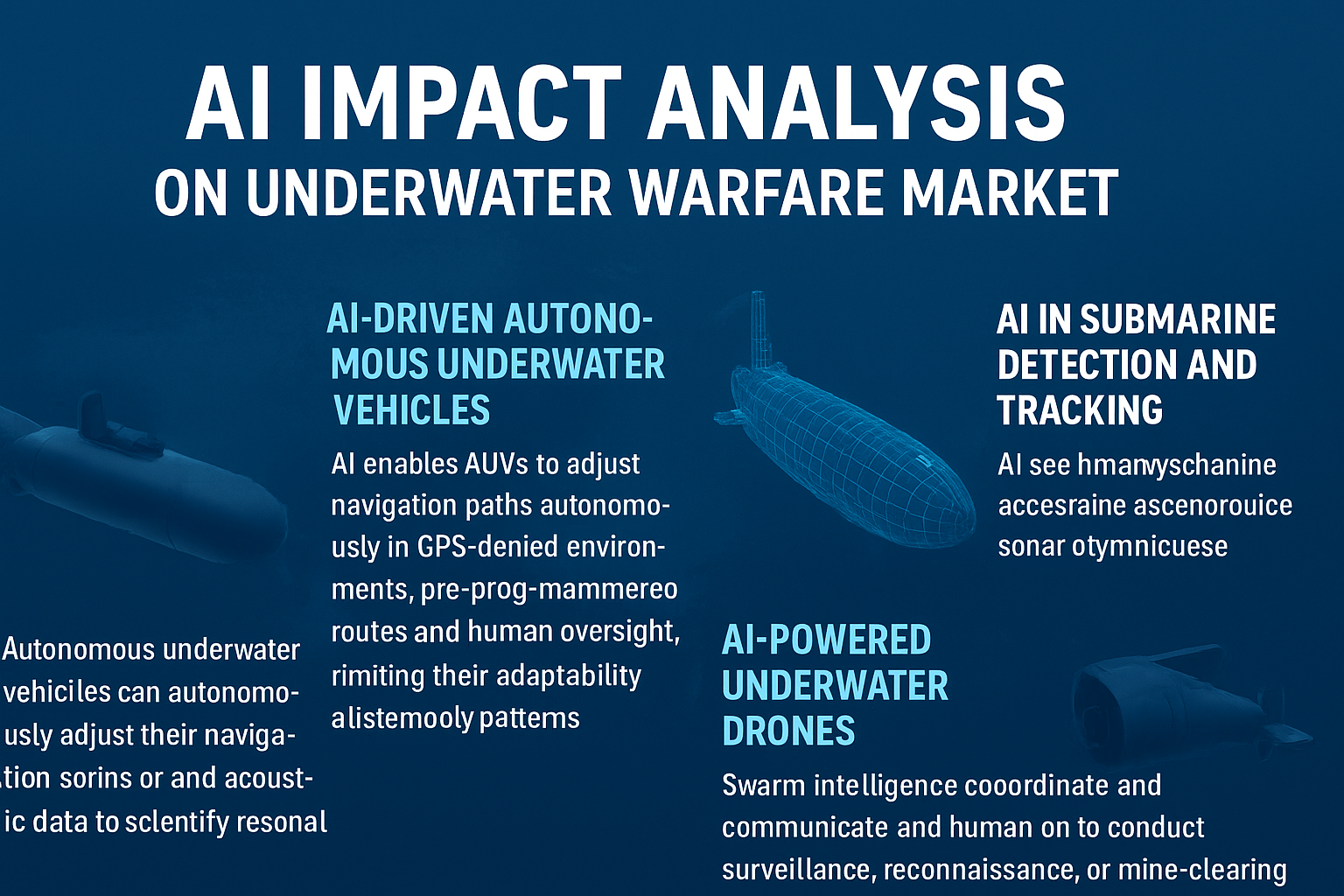
Autonomous underwater vehicles have long been used for exploration, mine detection, and reconnaissance, but with AI integration, their capabilities have multiplied. Traditional AUVs required pre programmed routes and human oversight, limiting their adaptability. AI enabled AUVs, on the other hand, can autonomously adjust their navigation paths based on changing underwater conditions. This adaptability allows for improved performance in GPS denied environments, where conventional navigation methods fail. Moreover, machine learning algorithms enable AUVs to identify patterns in sonar and acoustic data, making them capable of classifying vessels or underwater objects in real time. These advancements extend the operational reach of naval forces, enabling them to monitor vast ocean territories more efficiently while reducing risks to human operators.
AI in Submarine Detection and Tracking
One of the most challenging aspects of underwater warfare has always been detecting submarines, as they are designed to remain stealthy and operate undetected. AI has begun to revolutionize submarine detection and tracking through advanced sonar data interpretation and acoustic signature recognition. By training machine learning models on massive datasets of submarine noise patterns, navies can now identify subtle acoustic cues that would otherwise be indistinguishable to human operators. These AI driven detection systems also adapt to evolving submarine designs, ensuring that newer, quieter models do not evade tracking. Furthermore, AI assisted sonar systems enhance accuracy and reduce false positives, allowing navies to act decisively without hesitation. In the context of undersea warfare, where seconds can determine victory or defeat, the integration of AI into detection and tracking systems provides an undeniable edge.
AI-Powered Underwater Drones
Underwater drones are fast becoming essential tools in naval warfare, and artificial intelligence is playing a pivotal role in their evolution. Unlike traditional remotely operated vehicles, AI powered underwater drones can execute missions autonomously with minimal human oversight. One of the most significant applications is swarm intelligence, where multiple drones coordinate and communicate to conduct surveillance, reconnaissance, or mine clearing operations collectively. The use of AI in swarm control ensures that drones can adjust their positions and strategies in real time, adapting to environmental challenges and enemy countermeasures. Real time data processing further enhances decision making by providing commanders with accurate and timely insights into underwater conditions. These capabilities not only increase efficiency but also reduce operational risks, as drones can be deployed in high risk environments without endangering human lives.
AI in Underwater Communication Systems
Communication in underwater warfare has always been a bottleneck due to the limitations of radio waves underwater. Acoustic communication, while effective, is prone to bandwidth restrictions and latency. AI is addressing these challenges by developing adaptive communication protocols that optimize bandwidth usage based on mission needs and environmental conditions. Machine learning algorithms can analyze interference patterns and dynamically select optimal frequencies, thereby reducing delays and improving message clarity. Furthermore, AI enables seamless integration between different communication platforms, ensuring interoperability among submarines, surface vessels, and unmanned underwater systems. This advancement not only enhances situational awareness but also allows for coordinated strategies across naval assets, strengthening overall operational effectiveness.
Predictive Maintenance with AI in Naval Assets
The complexity of modern submarines and underwater systems makes them susceptible to unexpected failures that can jeopardize missions. AI driven predictive maintenance is transforming how naval forces manage their assets. By analyzing vast amounts of operational data, AI can predict when a component is likely to fail and recommend timely maintenance before breakdowns occur. This approach reduces downtime, lowers maintenance costs, and extends the operational lifespan of critical systems. For submarines operating in remote and hostile environments, predictive maintenance ensures higher mission readiness and reliability. The use of AI based diagnostics also empowers naval engineers with precise insights, enabling them to address issues more effectively and with fewer resources.
Get AI Impact Analysis on Underwater Warfare Market, Request Pdf Brochure: https://www.marketsandmarkets.com/pdfdownloadNew.asp?id=139048367
AI for Underwater Mine Detection and Neutralization
Naval mines pose a persistent threat in maritime conflicts, and detecting them has traditionally been time consuming and dangerous. AI is enhancing mine detection by processing sonar and imaging data with deep learning algorithms that can distinguish mines from harmless debris. This significantly reduces false alarms and accelerates detection times. Furthermore, AI powered autonomous mine countermeasure systems are now capable of not only identifying mines but also neutralizing them without human intervention. These advancements dramatically improve the safety of naval personnel and allow for faster clearance of mine infested waters. As naval warfare continues to evolve, AI based mine detection and neutralization systems are becoming indispensable components of maritime security.
AI in Underwater Cybersecurity and Electronic Warfare
The digitization of underwater warfare introduces new vulnerabilities, as communication networks and data systems become targets for cyberattacks and electronic jamming. AI is being employed to safeguard underwater networks through intelligent intrusion detection systems that analyze patterns of network activity to identify potential threats. These systems can distinguish between legitimate traffic and malicious interference, thereby preventing disruptions before they escalate. Additionally, AI powered countermeasures against electronic warfare enable naval forces to adapt quickly to adversary tactics. By continuously learning from new attack vectors, AI enhances the resilience of underwater communication and operational systems, ensuring uninterrupted mission performance even in contested environments.
AI-Enhanced Simulation and Training for Underwater Warfare
Training naval personnel for underwater warfare is a resource intensive endeavor that requires realistic scenarios. AI powered simulation platforms are redefining training by creating virtual environments that replicate the complexities of underwater combat. These simulations incorporate real world data and AI driven decision making, providing trainees with authentic experiences that closely mirror actual missions. AI also enables adaptive learning, tailoring training programs to individual strengths and weaknesses. This approach ensures that crews are better prepared for unpredictable underwater encounters and can respond effectively to high pressure situations. By reducing the need for expensive live exercises, AI enhanced training not only saves resources but also accelerates skill development in naval forces.
Future Outlook: AI and Next-Gen Underwater Warfare Systems
The future of underwater warfare is inseparable from artificial intelligence, as emerging technologies continue to shape the strategic landscape. The integration of AI with quantum sensors promises unparalleled detection capabilities, enabling navies to track even the stealthiest submarines. Robotics and advanced materials are enhancing the durability and efficiency of autonomous underwater vehicles, while AI ensures their effective coordination in large scale operations. From real time threat assessment to automated strategic planning, AI will increasingly influence decision making at both tactical and strategic levels. The geopolitical implications are significant, as nations with advanced AI driven underwater warfare capabilities will command greater influence in maritime conflicts and deterrence strategies. Looking ahead, AI is not just a tool but a force multiplier that will redefine dominance beneath the waves.
Related Report:
Underwater Warfare Market by Systems (Sonar, Electronic Warfare, Weapons, Communications, Unmanned), Platform (Submarine, Surface Ship, Naval Helicopter), Capability (Attack, Protect, Support) and Region - Global Forecast to 2028

This FREE sample includes market data points, ranging from trend analyses to market estimates & forecasts. See for yourself.
SEND ME A FREE SAMPLE






