AI Impact Analysis on Vertiports Industry
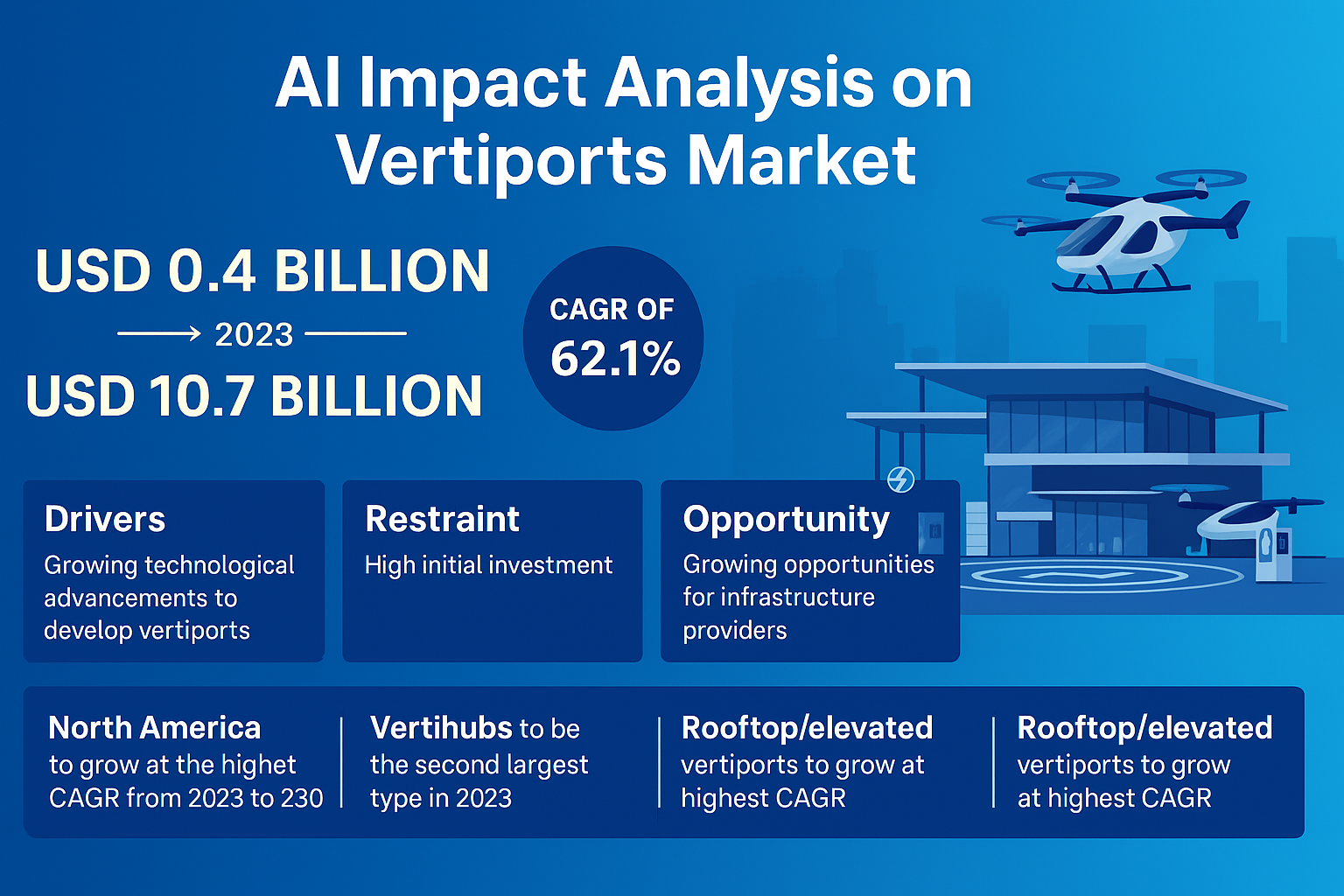
As urban air mobility takes off, vertiports ground facilities for eVTOL operations are poised to become critical nodes in tomorrow’s transportation. These sites will not only handle takeoffs and landings but also manage charging, security, passenger movement, and integration with traditional transport. Artificial intelligence is emerging as the indispensable tool to ensure vertiports are functional, efficient, scalable, and safe. By embedding AI into design, operations, energy systems, security, and strategic planning, vertiports can transition from conceptual hubs to smart infrastructure capable of supporting the next wave of urban aviation.
AI in Vertiport Design and Infrastructure Planning
Creating a vertiport involves more than creating a pad: it requires integration of airspace, charging systems, passenger amenities, and urban context. AI driven simulations can model flight path trajectories, drone traffic patterns, and noise contours to optimize placement of pads, taxiways, and clearance zones. Predictive analytics using demographic data, commuting flows, and event patterns inform demand forecasting for expected usage levels. Machine learning supports modular designs that can scale from small community vertiports to large urban hubs. AI can even assist in navigating zoning and regulatory compliance, ensuring siting decisions align with local planning codes, noise restrictions, and environmental impact assessments.
Intelligent Air Traffic Management for eVTOL Operations
Unlike traditional airports, vertiports may accommodate dozens of eVTOLs per hour, each taking off and landing vertically on limited landing pads. AI controlled traffic management systems coordinate flight slots in real time, decreasing separation times while preventing conflicts. Dynamic congestion forecasting reroutes flights through the airspace network, balancing safety with efficiency. Reinforcement learning systems enable autonomous flow control, guiding eVTOLs through vertical and horizontal transitions in shared urban air corridors. Vertiport AI integrates with existing air traffic control and UAV systems to maintain unified situational awareness, enabling complex multilayer traffic solutions.
Predictive Maintenance of Vertiport Equipment
In a vertiport, reliability means uptime. AI powered predictive maintenance systems use sensor data tracking vibrations, electrical load, wear patterns on key infrastructure like charging pads, elevators, automated vehicles, and runway surfaces. By forecasting failures before they occur, AI scheduling ensures timely servicing and avoids operational disruptions. Real time monitoring supports condition based servicing, prolonging equipment life while optimizing supply chains and staff scheduling. As these vertiport networks scale, centralized AI systems will coordinate maintenance across sites to maximize availability.
AI in Passenger Flow and Safety Management
Vertiports must handle eVTOL commuters smoothly and securely. AI driven vision systems track crowd movement from landing pad to lounge to boarding gates, optimizing paths to prevent bottlenecks. Facial recognition and biometric scanning streamline identity verification while maintaining privacy and speed. In emergencies, AI models simulate evacuation scenarios, identifying optimal exit routes and alerting staff when flows approach risk thresholds. Smart surveillance systems monitor passenger areas for unsafe behavior or accidents. By automating queuing, security checks, and crowd control, vertiport AI enhances both experience and safety.
Energy Management and Charging Optimization
eVTOL batteries require efficient charging to sustain high operational tempos. AI manages power loads to prevent grid strain, predicting peak demand periods from scheduled flights. Machine learning optimizes charge timing and temperature to maximize battery life and turnaround. Smart storage systems including onsite battery banks or solar arrays are coordinated by AI to minimize costs and maintain supply even during outages. These systems reduce energy bills and improve green credentials, aligning vertiports with urban sustainability initiatives.
Smart Revenue and Demand Forecasting Models
The business case for vertiports depends on demand forecasting and dynamic pricing. AI models analyze flight bookings, commuter patterns, seasonal variation, and local events to predict ridership. These insights feed revenue strategies that adjust pricing based on demand, with off peak coupons or surge pricing models. Analysis of passenger demographics supports targeted retail or hospitality offerings. Over time, AI refines business models through continuous feedback, projecting long term traffic flows and helping operators monetize infrastructure through cargo, advertising, or leasing auxiliary services.
Get AI Impact Analysis on Vertiports Market, Request Pdf Brochure: https://www.marketsandmarkets.com/pdfdownloadNew.asp?id=255138501
AI Driven Vertiport Security and Threat Detection
Vertiports face unique security risks from unauthorized access to cyber threats to tampering with aircraft. AI enabled machine vision systems monitor perimeter fences, roof access points, and restricted zones. Behavioral analytics detect suspicious behavior before incidents escalate. Vertiport AI integrates with national aviation security networks for real time alerts. Intelligence driven cybersecurity systems protect operational networks, data systems, and charging interfaces. With AI powered threat analysis and response, vertiports become secure nodes rather than vulnerability points in UAM networks.
Weather Prediction and Flight Scheduling Integration
Local weather dramatically impacts eVTOL safety and scheduling. AI models that process historical data, IoT sensors, and microclimate models can predict disruptions from wind shear, rain, or turbulence often better than traditional forecasts. These predictions are integrated into scheduling systems, adjusting pad availability and flight windows dynamically. AI systems propose alternate routing or temporary delay advisories to passengers, maintaining service despite changing conditions. Vertiport AI ensures compliance with flight rules and enhances operational resilience.
AI in Multi-Modal Transportation Integration
Vertiports rarely exist in isolation. Effective UAM relies on seamless connections between aircraft, transit, rideshare, and pedestrian flows. AI orchestrates multimodal scheduling, aligning eVTOL departures with local buses, trains, or taxis. Real time traffic data helps reorganize pick up zones or reroute feeders. AI enrollment of users on one system to another improves journey planning and reduces wait times across handoffs. Integrating broadly with citywide mobility platforms, vertiport AI helps urban ecosystems synchronize diverse transit options.
Market Planning and Investment Strategy with AI
Investing in vertiports demands strategic insight. AI uses location data, regulatory frameworks, and population growth to assess return on investment. Predictive analysis evaluates where UAM demand will mature fastest. Scenario modelling weighs factors like vehicle types, municipal incentives, or ride frequency. These models support public–private partnership efforts by estimating development value, offering data for grant proposals, or targeting grants. Adaptive planning tools allow stakeholders to adjust for policy shifts, technology adoption rates, or energy standards.
Future Outlook: AI as the Backbone of Vertiport Networks
In the coming decade, vertiports will evolve into interconnected UAM hubs powered by AI. Autonomous systems will manage discrete functions but connect across shared platforms enabling regional networks of vertiports tailored to community scale or urban density. AI will coordinate vertiport clusters, enabling dynamic routing across eVTOL fleets while balancing load and public safety. Sustainability, interoperability, and user experience will define adoption success.
Vertiport ecosystems will integrate airside safety, ground transit, building operations, and power infrastructure through unified digital twins. Real time analytics will help planners adapt network configurations, and augment staff performance. Strategic investments will shift from individual vertiports to integrated, AI optimized networks similar to how telecom operators manage cell grids.
AI as the Architect of Vertiport Futures
Artificial intelligence stands at the core of vertiport viability from foundational design to daily operations and future scaling. By optimizing layout, safety, energy, operations, and business models, AI ensures that vertiports can deliver efficient, safe, and profitable urban air mobility. As technology converges with policy, infrastructure, and public adoption, AI will shape the pathways that take people not just through space, but seamlessly between them.
Related Report:
Vertiports Market by Type (Vertihubs, Vertibases, Vertipads), Solution (Landing Pads, Terminal Gates, Ground Support Equipment, Charging Stations, Ground Control Stations), Landscape, Location, Topology, and Region - Global Forecast to 2030

This FREE sample includes market data points, ranging from trend analyses to market estimates & forecasts. See for yourself.
SEND ME A FREE SAMPLE






