AI Impact on the Autonomous Last Mile Delivery Market
Artificial intelligence is becoming the foundation of autonomous last mile delivery, turning drones, ground bots, and self-driving vans from experimental hardware into reliable logistics systems. It enables these platforms to perceive their environment, make intelligent decisions, and operate at scale while reducing costs and improving efficiency.
AI enhances perception and environment understanding through advanced computer vision, sensor fusion, and semantic mapping, which allow autonomous systems to detect obstacles, pedestrians, and suitable landing or parking areas in real time. This improves safety and supports the growing use of beyond visual line of sight operations for drones. Localization also benefits from AI, as it helps vehicles maintain accuracy even in GPS-degraded environments by combining visual odometry and map-matching. The result is fewer aborted missions and more consistent delivery performance.
The autonomous last mile delivery market is valued at USD 0.9 billion in 2023 and is projected to reach USD 4.2 billion by 2030, at a CAGR of 22.7%. The market for autonomous last mile delivery has experienced remarkable growth in recent years, driven by several key factors. One of the primary drivers is the rapid growth of e-commerce and online shopping.
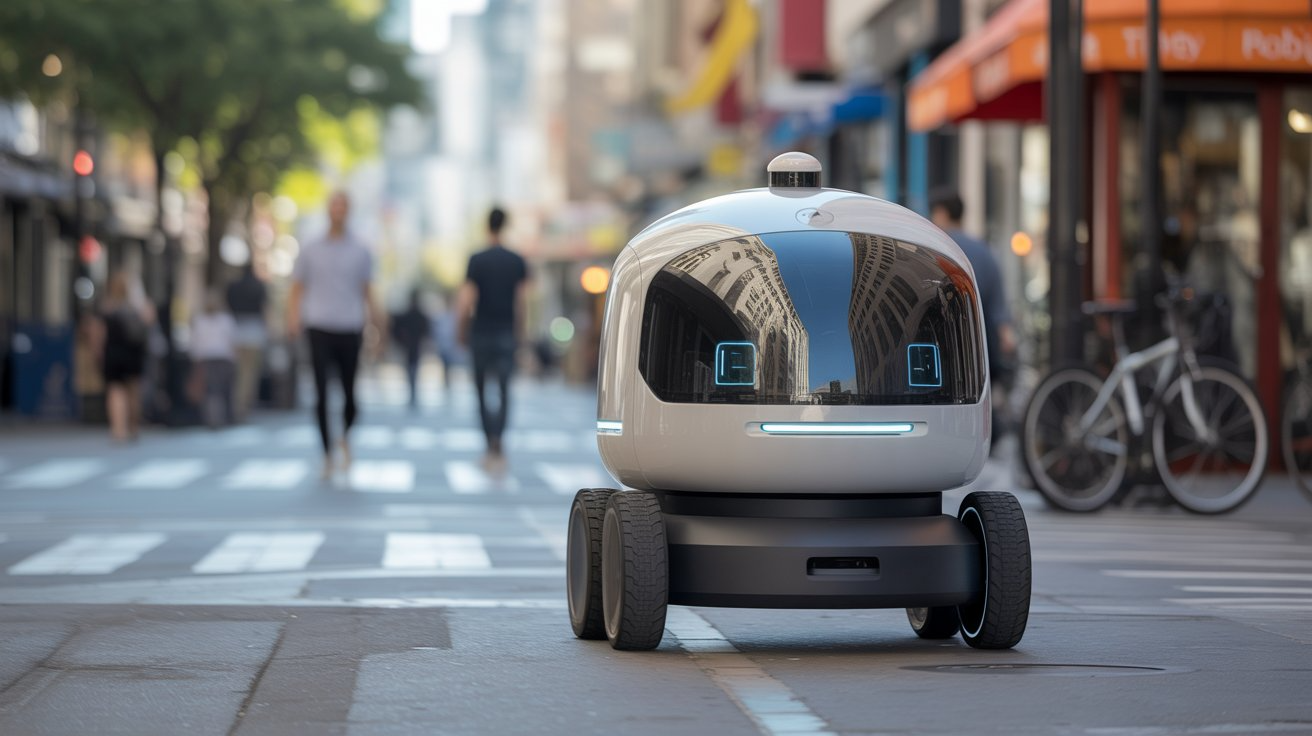
Planning and control are another critical area where AI plays a role. Machine learning models help vehicles generate safe trajectories, perform dynamic rerouting, and interact predictably with human road users. On a fleet level, AI-driven orchestration platforms optimize dispatching by allocating tasks across mixed fleets of drones, bots, and vans based on delivery cost, time, payload, battery state, and regulatory restrictions. This leads to higher asset utilization and faster deliveries.
AI also drives predictive maintenance by analyzing telematics, battery performance, and component behavior to identify potential failures before they occur. This reduces downtime and lifecycle costs. At the same time, demand forecasting powered by machine learning helps position inventory within micro-fulfillment centers, ensuring faster response times and improved first-attempt delivery rates.
Customer experience is enhanced by AI through adaptive delivery times, natural language interfaces, and vision-based proof of delivery, which collectively build trust and reduce failed attempts. For regulators, AI provides explainability, safety assurance, and detailed data logs, which make certification and approval processes smoother while building confidence among insurers and stakeholders.
The measurable business impact of AI can be seen across several key performance indicators. Cost per delivery decreases as route inefficiencies are minimized and dependence on human labor is reduced. First-time delivery success rates improve through better prediction and interaction with recipients. Average delivery times fall thanks to dynamic routing and smarter dispatching, while fleet utilization rises as AI ensures assets are deployed effectively. Predictive maintenance increases mean time between failures, lowers unscheduled downtime, and optimizes battery and energy usage per delivery. Together, these improvements contribute to stronger unit economics and faster scalability.
High-value use cases are already emerging. In urban quick-commerce, AI coordinates short-window deliveries using drones and bots to achieve under one-hour fulfillment. In healthcare, autonomous drones powered by AI are being deployed for critical supply deliveries to hospitals and rural communities. Nighttime logistics is also being redefined, as AI enables quiet, efficient operations during off-peak hours. Hybrid models that involve air-to-ground handoffs further showcase how AI orchestrates complex delivery chains in real time.
Despite these benefits, challenges remain. Data quality is a major obstacle, as AI systems require extensive and diverse training datasets to handle edge cases effectively. Models trained in simulations often fail in real-world scenarios unless supported by continual learning pipelines. Safety certification is another hurdle since regulators demand transparency and explainability, which black-box models struggle to provide. Privacy concerns also arise from the use of vision-based sensors, and the threat of adversarial attacks on machine learning models introduces additional security risks. Finally, edge computing limitations such as processing power, latency, and energy use constrain how sophisticated AI models can be on lightweight platforms like drones.
To overcome these barriers, companies must adopt hybrid AI architectures that balance on-edge processing for real-time safety with cloud-based intelligence for planning and analytics. Continuous learning pipelines, supported by robust simulation environments, are essential for improving performance over time. Strong logging, explainability, and auditing systems are necessary to gain regulatory approval, while secure AI engineering practices protect against cyber threats. Successful operators also build cross-functional teams that integrate technical expertise with regulatory, operational, and public engagement skills.
The path to adoption is unfolding in phases. In the near term, AI will power pilot deployments in controlled environments such as campuses, residential clusters, and predefined corridors. Over the medium term, the focus will shift toward scaling mixed fleets, predictive maintenance, and expanding micro-fulfillment networks in partnership with city authorities. Over the long term, full city-scale autonomous delivery systems will rely on AI-enabled air-ground traffic management, standardized APIs for curb and airspace access, and integrated insurance frameworks tailored to autonomous operations.
For logistics providers, the priority should be to invest in AI-based dispatch, routing, and maintenance systems that directly improve delivery economics. Vehicle manufacturers need to design modular perception stacks with over-the-air update capabilities to stay adaptable. Retailers can leverage AI-driven demand forecasting and fulfillment placement to reduce stem miles and enhance customer loyalty. Regulators and city planners should create sandbox programs that allow data sharing and testing under real-world conditions. Investors, meanwhile, should focus on companies that combine strong data pipelines with defensible intellectual property in simulation, perception, and fleet orchestration.
AI is not an optional feature in the autonomous last mile delivery market; it is the differentiator that separates pilot projects from commercially viable systems. It enables safe operations, scalability, and cost efficiency while delivering superior customer experiences. With e-commerce demand rising, labor constraints intensifying, and regulatory frameworks maturing, AI is set to become the driving force that unlocks the next wave of growth in last mile logistics.
Related Report:

This FREE sample includes market data points, ranging from trend analyses to market estimates & forecasts. See for yourself.
SEND ME A FREE SAMPLE






