Sustainable Aviation Fuel (SAF) Market Outlook

How Government Mandates and Airline Investments Are Creating a Multi-Billion-Dollar Sustainable Aviation Fuel Market

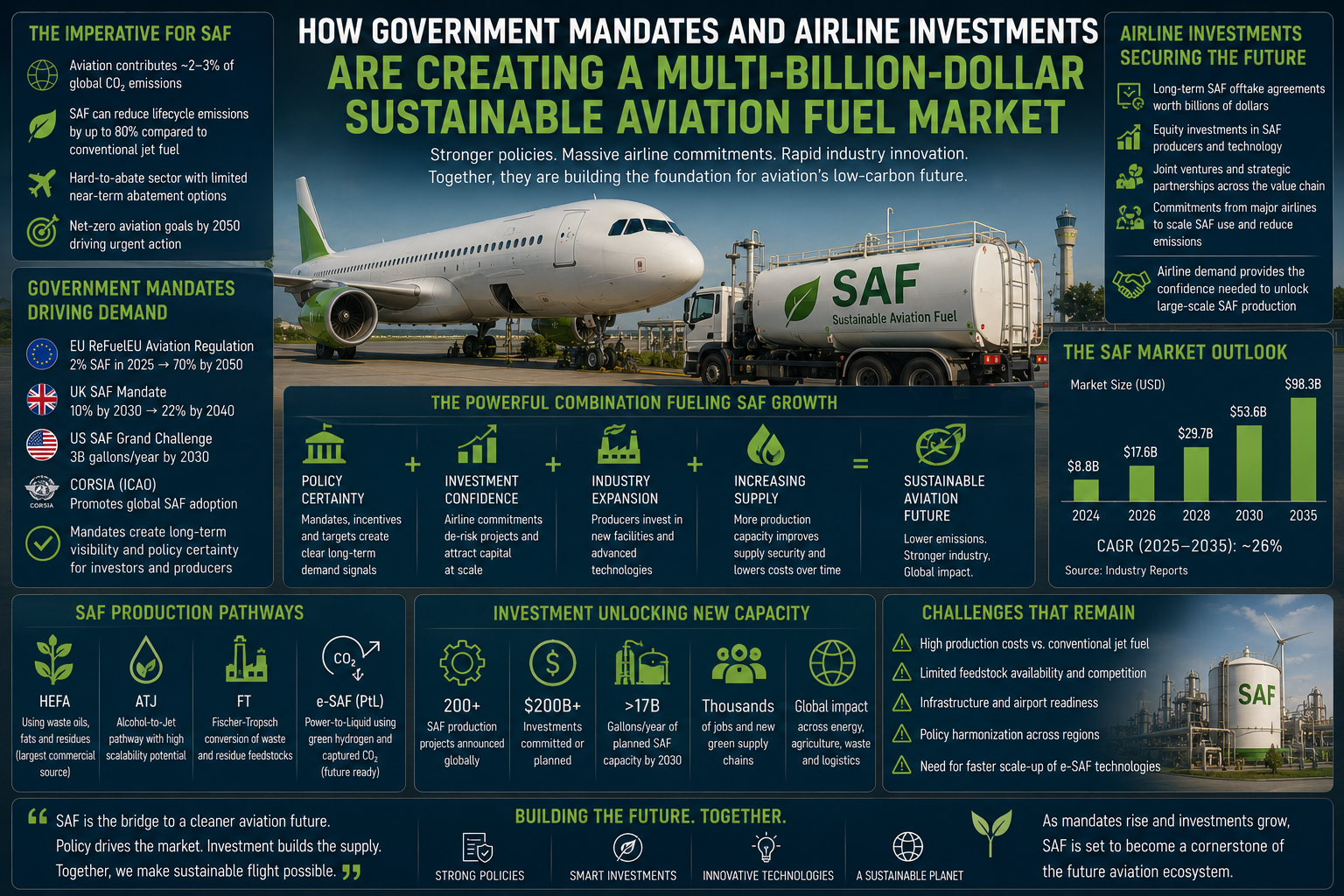
The global aviation industry is undergoing a profound transformation as sustainability becomes a central priority for governments, airlines, fuel producers, and aircraft manufacturers. Faced with mounting pressure to reduce greenhouse gas emissions and achieve ambitious climate targets, the sector is increasingly turning to Sustainable Aviation Fuel (SAF) as the most practical near-term solution for decarbonizing air travel. The combination of supportive government mandates and substantial airline investments is accelerating the development of a multi-billion-dollar SAF market, creating new opportunities across the aviation and energy value chains.

Government Policies Are Accelerating Market Expansion

Government intervention has emerged as one of the most powerful drivers of Sustainable Aviation Fuel adoption. Policymakers around the world recognize that aviation is one of the most challenging sectors to decarbonize and that market forces alone may not be sufficient to achieve large-scale SAF deployment. As a result, regulators are implementing mandates, incentives, and funding programs designed to stimulate both production and consumption.

SAF blending requirements are becoming increasingly common across major aviation markets. These mandates require fuel suppliers or airlines to incorporate a minimum percentage of sustainable fuel into their aviation fuel supply, creating a guaranteed source of demand. Such regulatory frameworks provide long-term market certainty for investors and encourage fuel producers to expand production capacity.

In addition to blending mandates, governments are introducing tax credits, grants, loan guarantees, and renewable energy incentives to reduce financial barriers associated with SAF production. These measures are helping accelerate commercialization while improving the economic competitiveness of sustainable fuels relative to conventional jet fuel.

Airline Investments Are Strengthening Market Confidence

Alongside government support, airlines are making substantial investments to secure future SAF supplies and advance their sustainability commitments. Major carriers across North America, Europe, Asia-Pacific, and the Middle East have announced long-term procurement agreements with SAF producers, often spanning multiple years and involving significant purchase volumes.

These agreements serve a dual purpose. They help airlines meet corporate emissions reduction targets while providing fuel manufacturers with predictable demand that supports investment decisions. Long-term offtake contracts are becoming a critical mechanism for financing new production facilities and scaling the industry's capacity to meet future fuel requirements.

Airlines increasingly view SAF as a strategic necessity rather than an optional sustainability initiative. With growing pressure from regulators, investors, corporate travel customers, and environmentally conscious passengers, carriers are incorporating SAF procurement into broader business and operational strategies.

The Economics of Scale Are Beginning to Emerge

Historically, one of the primary barriers to SAF adoption has been its higher cost compared to conventional jet fuel. Limited production capacity, feedstock constraints, and immature supply chains have contributed to elevated prices. However, the combination of policy support and growing demand is beginning to create economies of scale that can improve market economics.

As production facilities expand and technological efficiencies improve, manufacturing costs are expected to decline over time. Increased competition among producers and advancements in conversion technologies are further supporting efforts to make SAF more commercially viable. The market is gradually transitioning from pilot-scale projects to large commercial operations capable of supplying significant fuel volumes to global airlines.

New Production Technologies Are Expanding Opportunities

Technological innovation is playing a vital role in the growth of the Sustainable Aviation Fuel market. While current production is largely based on Hydroprocessed Esters and Fatty Acids (HEFA) derived from waste oils and fats, emerging pathways are significantly expanding future supply potential.

Technologies such as Alcohol-to-Jet (ATJ), Fischer-Tropsch synthesis, and Power-to-Liquid (PtL) fuel production are enabling greater feedstock flexibility and increasing long-term scalability. Electro-Sustainable Aviation Fuel (e-SAF), produced using renewable electricity, green hydrogen, and captured carbon dioxide, is attracting growing attention as a potential solution for achieving deeper emissions reductions.

These innovations are expected to diversify fuel supply sources, reduce dependence on limited feedstocks, and support the industry's long-term growth trajectory.

Investment Across the Value Chain Is Accelerating

The rapid expansion of the SAF market is attracting investment from a wide range of stakeholders beyond airlines and fuel producers. Energy companies, infrastructure developers, airports, financial institutions, and technology firms are all increasing their involvement in sustainable aviation initiatives.

Large-scale investments are flowing into production facilities, feedstock collection networks, hydrogen infrastructure, carbon capture systems, and fuel distribution capabilities. Strategic partnerships are becoming increasingly common as industry participants seek to share risks, leverage expertise, and accelerate commercialization.

This broad ecosystem of investment is helping build the foundation for a resilient and scalable SAF industry capable of meeting future demand.

Sustainability Targets Are Driving Long-Term Demand

Global aviation organizations and individual airlines have established ambitious targets aimed at achieving net-zero emissions by 2050. Meeting these objectives will require substantial reductions in carbon emissions from existing aircraft fleets, making SAF an indispensable component of future sustainability strategies.

Unlike alternative propulsion technologies that may require new aircraft designs and infrastructure, SAF can be integrated into current aviation operations with minimal disruption. This compatibility allows airlines to reduce emissions immediately while longer-term technologies such as hydrogen-powered and electric aircraft continue to develop.

As sustainability commitments become more stringent, demand for SAF is expected to increase steadily throughout the coming decade.

Regional Markets Are Emerging as Growth Leaders

Different regions are adopting unique approaches to SAF development, creating diverse growth opportunities across the global market. North America is benefiting from strong policy incentives and growing production investments. Europe is advancing adoption through regulatory mandates and aggressive climate objectives. Meanwhile, Asia-Pacific is increasingly investing in SAF production capacity as regional air travel demand continues to expand.

The emergence of regional SAF hubs is expected to strengthen global supply networks and create new opportunities for fuel producers, technology providers, and investors seeking exposure to the low-carbon aviation sector.

Challenges Remain Despite Strong Momentum

Although the market outlook remains highly positive, several challenges must still be addressed. Feedstock availability, production costs, infrastructure requirements, and supply chain development remain key considerations for industry stakeholders. Meeting future demand will require substantial increases in production capacity and continued technological innovation.

Nevertheless, the combined influence of government mandates and airline investments is creating an environment in which these challenges are increasingly viewed as opportunities for growth and innovation rather than barriers to adoption.

Conclusion

Government mandates and airline investments are transforming Sustainable Aviation Fuel from a niche alternative into a cornerstone of aviation decarbonization. Regulatory support is creating stable demand and encouraging production expansion, while airline commitments are providing the commercial certainty needed to accelerate market development. Together, these forces are laying the groundwork for a multi-billion-dollar SAF market that will play a critical role in the future of low-carbon aviation. As technology advances, investment grows, and sustainability targets tighten, Sustainable Aviation Fuel is expected to become one of the most important drivers of the aviation industry's transition toward a cleaner and more sustainable future.


Sustainable Aviation Fuel Market Size,  Share & Growth Report
Report Code
AS 7756
RI Published ON
6/19/2026
Choose License Type
BUY NOW
ADJACENT MARKETS
REQUEST BUNDLE REPORTS
X
GET A FREE SAMPLE

This FREE sample includes market data points, ranging from trend analyses to market estimates & forecasts. See for yourself.

SEND ME A FREE SAMPLE

  • Call Us
  • +1-888-600-6441 (Corporate office hours)
  • +1-888-600-6441 (US/Can toll free)
  • +44-800-368-9399 (UK office hours)
CONNECT WITH US
ABOUT TRUST ONLINE
©2026 MarketsandMarkets Research Private Ltd. All rights reserved
DMCA.com Protection Status
Get Free Sample Pages

Get Free Sample Pages of the Report

Request Now



