Sustainable Aviation Fuel (Biofuel) Market Outlook

The Race for Aviation Decarbonization: Opportunities and Challenges in the Sustainable Aviation Fuel Market

The global aviation industry is accelerating its efforts to achieve net-zero emissions as governments, airlines, aircraft manufacturers, and fuel producers confront the growing urgency of climate change. As one of the most difficult transportation sectors to decarbonize, aviation faces increasing pressure to reduce its environmental footprint while continuing to support global connectivity and economic growth. At the center of this transition is Sustainable Aviation Fuel (SAF), which has emerged as the most practical and scalable near-term solution for reducing aviation-related carbon emissions. While the SAF market presents enormous opportunities for innovation and growth, significant challenges remain as the industry races toward a more sustainable future.
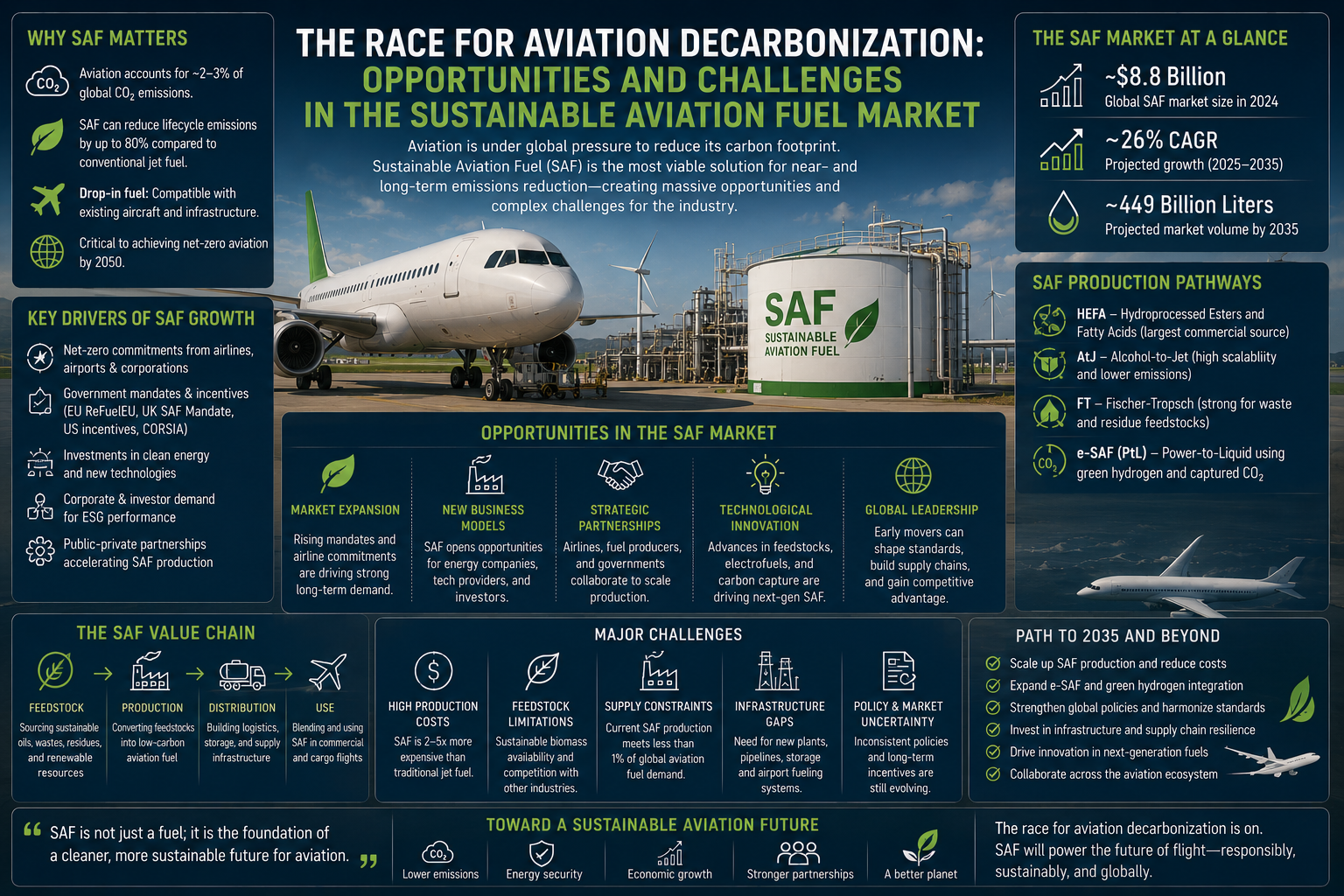

Sustainable Aviation Fuel Emerging as the Cornerstone of Aviation Decarbonization

The aviation sector contributes a substantial share of global greenhouse gas emissions, and unlike road transportation, it has limited immediate alternatives to conventional liquid fuels. Sustainable Aviation Fuel offers a viable pathway for reducing lifecycle carbon emissions without requiring major modifications to existing aircraft engines, fueling infrastructure, or airport operations.

Produced from renewable feedstocks such as used cooking oil, agricultural residues, forestry waste, municipal solid waste, and synthetic fuel pathways, SAF can significantly lower emissions compared to traditional jet fuel. This compatibility with current aviation infrastructure has positioned SAF as a critical component of the industry's decarbonization roadmap.

Growing Regulatory Support Creating Market Opportunities

Government policies are becoming one of the strongest catalysts for Sustainable Aviation Fuel adoption. Across major aviation markets, regulators are implementing SAF blending mandates, emissions reduction targets, tax incentives, and funding programs designed to stimulate investment and accelerate production capacity.

These policy initiatives are creating favorable conditions for fuel producers, technology developers, and investors. As environmental regulations become more stringent and airlines face increasing pressure to meet sustainability commitments, demand for SAF is expected to rise substantially over the coming decade. This regulatory momentum is opening new opportunities for companies across the aviation fuel value chain.

Rising Airline Commitments Driving Demand

Airlines worldwide are increasingly incorporating Sustainable Aviation Fuel into their long-term sustainability strategies. Many carriers have announced ambitious net-zero targets and are signing multi-year SAF offtake agreements to secure future fuel supplies.

These commitments are providing greater market certainty and encouraging investment in production infrastructure. Airlines recognize that SAF represents one of the few immediately available solutions capable of reducing emissions from existing fleets while maintaining operational reliability. As passenger and corporate demand for sustainable travel continues to grow, airline adoption is expected to become a major driver of market expansion.

Technological Innovation Unlocking New Growth Pathways

Rapid advances in fuel production technologies are creating new opportunities for SAF market development. Traditional pathways such as Hydroprocessed Esters and Fatty Acids (HEFA) continue to dominate commercial production, but emerging technologies are expanding the industry's long-term potential.

Innovations in Alcohol-to-Jet (ATJ), Fischer-Tropsch synthesis, Power-to-Liquid (PtL) fuels, and electro-Sustainable Aviation Fuel (e-SAF) are enabling greater feedstock flexibility and improved scalability. Green hydrogen production and carbon capture technologies are also supporting the development of synthetic aviation fuels with near-zero lifecycle emissions.

As these technologies mature and production efficiencies improve, SAF is expected to become increasingly cost-competitive with conventional jet fuel.

Investment Momentum Strengthening the Industry

The growing focus on sustainable transportation and clean energy is attracting significant investment into the Sustainable Aviation Fuel ecosystem. Energy companies, financial institutions, aircraft manufacturers, and fuel producers are allocating substantial capital toward SAF production facilities, feedstock supply chains, and supporting infrastructure.

Strategic partnerships among airlines, airports, technology providers, and renewable energy companies are accelerating commercialization efforts and helping establish robust supply networks. This wave of investment is expected to play a crucial role in scaling production and supporting long-term market growth.

Feedstock Availability Remains a Major Challenge

Despite its strong growth potential, the Sustainable Aviation Fuel market faces several obstacles that could slow adoption. One of the most significant challenges is the availability of sustainable feedstocks.

Current SAF production relies heavily on limited feedstock sources such as used cooking oil and waste fats. As global demand increases, competition for these resources may intensify, creating supply constraints and upward pressure on costs. Expanding feedstock diversity through agricultural waste, forestry residues, municipal waste streams, and synthetic fuel pathways will be essential for supporting future market growth.

High Production Costs Continue to Impact Adoption

The cost differential between Sustainable Aviation Fuel and conventional jet fuel remains a significant barrier to widespread adoption. SAF production processes are generally more complex and expensive than traditional refining methods, resulting in higher fuel prices.

Although government incentives and corporate sustainability programs are helping offset costs, long-term market expansion will require continued technological advancements, economies of scale, and increased production capacity. Reducing production costs remains one of the industry's most important priorities as stakeholders work toward broader commercialization.

Infrastructure and Supply Chain Development Challenges

Scaling the SAF market will also require substantial investment in transportation, storage, blending, and distribution infrastructure. Existing fuel supply chains were designed around conventional petroleum-based fuels and must evolve to accommodate growing volumes of sustainable alternatives.

Building a reliable global SAF ecosystem will require close collaboration among fuel producers, airports, airlines, logistics providers, and policymakers. Ensuring consistent fuel availability across major aviation hubs remains a critical challenge as the industry expands production capacity.

Green Hydrogen and e-SAF Represent the Next Frontier

Looking toward the future, green hydrogen and e-SAF technologies are expected to play an increasingly important role in aviation decarbonization. e-SAF is produced by combining renewable hydrogen with captured carbon dioxide, creating synthetic jet fuel capable of delivering substantial emissions reductions.

As renewable energy deployment expands and hydrogen production costs decline, these next-generation fuels could significantly increase SAF availability while reducing dependence on biological feedstocks. Their development represents one of the most promising opportunities for achieving deep aviation decarbonization by 2050.

The Path Forward for Low-Carbon Aviation

The race for aviation decarbonization is accelerating as industry stakeholders work to balance environmental objectives with economic and operational realities. Sustainable Aviation Fuel stands at the center of this transition, offering an immediate and scalable solution capable of reducing emissions from today's aircraft fleet.

Success will depend on continued policy support, technological innovation, infrastructure investment, and collaboration across the aviation ecosystem. Addressing challenges related to feedstock availability, production costs, and supply chain development will be critical to unlocking the market's full potential.

Conclusion

The Sustainable Aviation Fuel Market represents one of the most important opportunities in the global effort to decarbonize aviation. Driven by supportive regulations, airline commitments, technological advancements, and increasing investment, SAF is positioned to become a cornerstone of low-carbon air transport. However, overcoming challenges related to cost, feedstock supply, and infrastructure development will be essential for achieving widespread adoption. As the aviation industry continues its journey toward net-zero emissions, Sustainable Aviation Fuel will remain at the forefront of innovation, investment, and sustainable growth.


Sustainable Aviation Fuel Market Size,  Share & Growth Report
Report Code
AS 7756
RI Published ON
6/18/2026
Choose License Type
BUY NOW
ADJACENT MARKETS
REQUEST BUNDLE REPORTS
X
GET A FREE SAMPLE

This FREE sample includes market data points, ranging from trend analyses to market estimates & forecasts. See for yourself.

SEND ME A FREE SAMPLE

  • Call Us
  • +1-888-600-6441 (Corporate office hours)
  • +1-888-600-6441 (US/Can toll free)
  • +44-800-368-9399 (UK office hours)
CONNECT WITH US
ABOUT TRUST ONLINE
©2026 MarketsandMarkets Research Private Ltd. All rights reserved
DMCA.com Protection Status
Get Free Sample Pages

Get Free Sample Pages of the Report

Request Now



