Military Robots Market Outlook

Why Defense Agencies Are Investing Billions in Autonomous Military Robot Ecosystems

The global defense landscape is experiencing a major transformation as military organizations increasingly adopt artificial intelligence, autonomous systems, and advanced robotics to address evolving security challenges. Rising geopolitical tensions, the emergence of multi-domain warfare, and the need for enhanced operational effectiveness are driving defense agencies to invest billions of dollars in autonomous military robot ecosystems. Rather than focusing solely on individual unmanned platforms, modern defense strategies are centered on interconnected networks of autonomous ground vehicles, aerial drones, maritime systems, and AI-powered command architectures that operate collaboratively across the battlefield
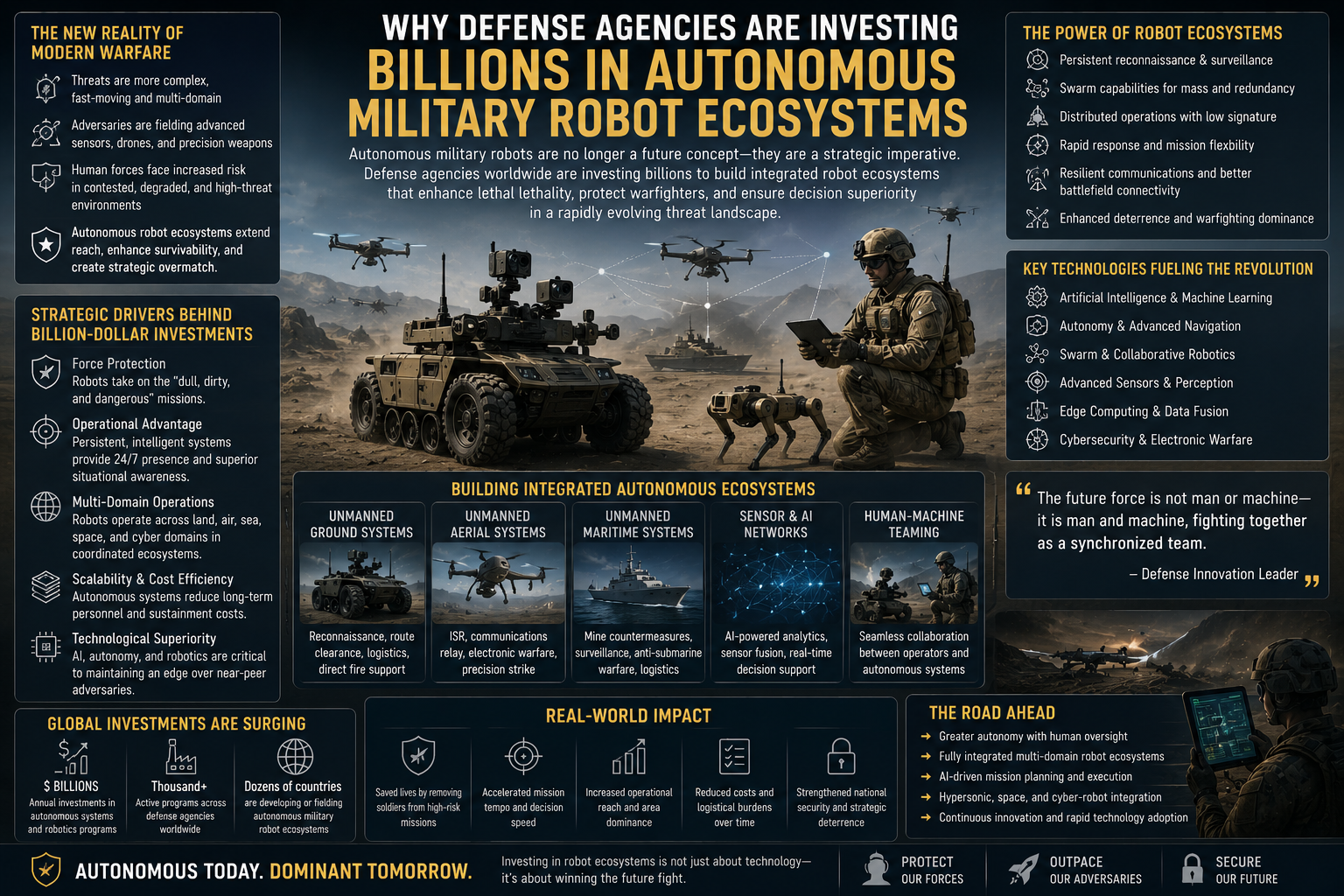

The Evolution from Individual Platforms to Integrated Ecosystems

Military robotics has evolved far beyond remotely operated systems designed for isolated missions. Defense agencies are now developing comprehensive autonomous ecosystems capable of connecting multiple robotic assets into a unified operational framework. These ecosystems enable unmanned systems to share intelligence, coordinate missions, and support decision-making processes in real time.

In future combat environments, an autonomous aerial platform may identify a target, transmit data to a robotic ground vehicle, and relay information to a command-and-control network simultaneously. This level of integration improves battlefield awareness, accelerates response times, and enhances mission effectiveness across multiple operational domains. As a result, military organizations view autonomous ecosystems as a critical component of next-generation defense capabilities.

Artificial Intelligence Driving Autonomous Warfare Capabilities

Artificial intelligence serves as the technological foundation of modern military robot ecosystems. AI-powered systems are capable of processing vast amounts of battlefield information, identifying threats, analyzing patterns, and supporting commanders with actionable intelligence. These capabilities allow military forces to make faster and more informed decisions in highly dynamic operational environments.

Advancements in machine learning, computer vision, sensor fusion, and edge computing are enabling robotic systems to navigate complex terrain, recognize targets, adapt to changing conditions, and coordinate with other autonomous platforms. As defense agencies seek to shorten decision cycles and gain operational advantages, investments in AI-enabled robotic technologies continue to accelerate.

Force Protection Remains a Strategic Priority

One of the most compelling reasons behind the rapid adoption of military robotics is the ability to reduce risks to personnel. Autonomous systems can perform dangerous missions that would otherwise expose soldiers to significant threats. Robotic platforms are increasingly used for explosive ordnance disposal, reconnaissance operations, mine clearance, perimeter security, and hazardous environment monitoring.

By deploying robots in high-risk situations, military organizations can preserve human lives while maintaining operational effectiveness. This emphasis on force protection has become particularly important as armed forces prepare for increasingly complex and contested battlefields where traditional approaches may place personnel at greater risk.

Supporting the Future of Multi-Domain Operations

Modern military strategies emphasize the integration of capabilities across land, air, sea, space, and cyber domains. Autonomous military robot ecosystems play a crucial role in enabling this vision by creating interconnected networks that facilitate real-time information sharing and coordinated mission execution.

These systems allow commanders to maintain a comprehensive operational picture while synchronizing activities across multiple theaters. Autonomous ground vehicles, unmanned aerial systems, robotic maritime platforms, and AI-driven command networks collectively contribute to a more agile and responsive force structure. As multi-domain warfare becomes a central component of defense planning, autonomous ecosystems are emerging as essential enablers of operational success.

Military Logistics and Sustainment Are Becoming Increasingly Automated

Beyond combat operations, defense agencies are investing heavily in robotic technologies to transform logistics and sustainment activities. Autonomous supply vehicles, AI-driven maintenance systems, and robotic transportation platforms are improving the efficiency and resilience of military supply chains.

Future military operations will depend on the rapid movement of equipment, fuel, ammunition, and medical supplies across dispersed operational environments. Autonomous logistics systems can help ensure continuous support while reducing manpower requirements and minimizing exposure to enemy threats. These capabilities enhance overall force readiness and contribute to long-term operational sustainability.

Swarm Robotics Expanding Battlefield Possibilities

The development of swarm robotics is opening new opportunities for defense organizations seeking scalable and adaptable military capabilities. Swarms of autonomous drones or ground robots can operate collaboratively, distribute tasks across multiple platforms, and continue missions even when individual units are compromised.

This distributed operational model provides enhanced resilience, greater battlefield coverage, and increased mission flexibility. As swarm technologies mature, defense agencies are investing in research programs designed to leverage collective robotic intelligence for surveillance, reconnaissance, electronic warfare, and tactical operations. These capabilities are expected to play an increasingly important role in future military campaigns.

Defense Modernization Programs Fueling Investment Growth

Governments worldwide recognize that maintaining military superiority requires continuous technological advancement. Autonomous military robot ecosystems align closely with broader defense modernization initiatives aimed at enhancing operational agility, improving force effectiveness, and addressing emerging threats.

Countries across North America, Europe, Asia-Pacific, and the Middle East are expanding investments in autonomous systems as part of long-term modernization roadmaps. Public-private partnerships, increased research funding, and collaboration between defense contractors and technology companies are accelerating the development of next-generation robotic capabilities. These investments are creating a rapidly evolving defense technology landscape centered on autonomy and artificial intelligence.

The Future of Autonomous Military Ecosystems

Looking ahead, autonomous military robot ecosystems are expected to become increasingly sophisticated, interconnected, and capable of supporting a wide range of operational missions. Future systems will feature greater autonomy, enhanced decision-support capabilities, improved communications resilience, and deeper integration with human operators.

As advances in artificial intelligence, robotics, and digital warfare continue to reshape military operations, autonomous ecosystems will serve as critical force multipliers capable of enhancing situational awareness, improving mission success rates, and supporting strategic objectives across all domains of warfare.

Conclusion

Defense agencies are investing billions in autonomous military robot ecosystems because they offer a transformative combination of operational efficiency, force protection, battlefield intelligence, and multi-domain integration. These interconnected networks of intelligent robotic systems are redefining how military forces prepare for and conduct future operations. As technological innovation accelerates and defense modernization efforts expand, autonomous military robot ecosystems will become an increasingly vital pillar of global military capability and strategic deterrence.


Military Robots Market Size,  Share & Growth Report
Report Code
AS 3952
RI Published ON
6/19/2026
Choose License Type
BUY NOW
ADJACENT MARKETS
REQUEST BUNDLE REPORTS
X
GET A FREE SAMPLE

This FREE sample includes market data points, ranging from trend analyses to market estimates & forecasts. See for yourself.

SEND ME A FREE SAMPLE

  • Call Us
  • +1-888-600-6441 (Corporate office hours)
  • +1-888-600-6441 (US/Can toll free)
  • +44-800-368-9399 (UK office hours)
CONNECT WITH US
ABOUT TRUST ONLINE
©2026 MarketsandMarkets Research Private Ltd. All rights reserved
DMCA.com Protection Status
Get Free Sample Pages

Get Free Sample Pages of the Report

Request Now



