Electronic Warfare Market 2035: AI, Quantum Technologies, and Software-Defined Defense Systems
Executive Brief: The Battle for Spectrum Superiority Has Entered a New Era
The future of military superiority may depend less on physical territory and more on control of an invisible battlefield.
Every modern military operation relies on access to the electromagnetic spectrum. Communications, radar systems, navigation technologies, satellite links, sensors, targeting systems, and intelligence networks all depend on uninterrupted signal availability.
As military forces become increasingly connected, adversaries are developing new methods to disrupt, deceive, manipulate, and exploit these systems.
Electronic warfare has consequently evolved from a specialized military capability into a strategic pillar of national defense.
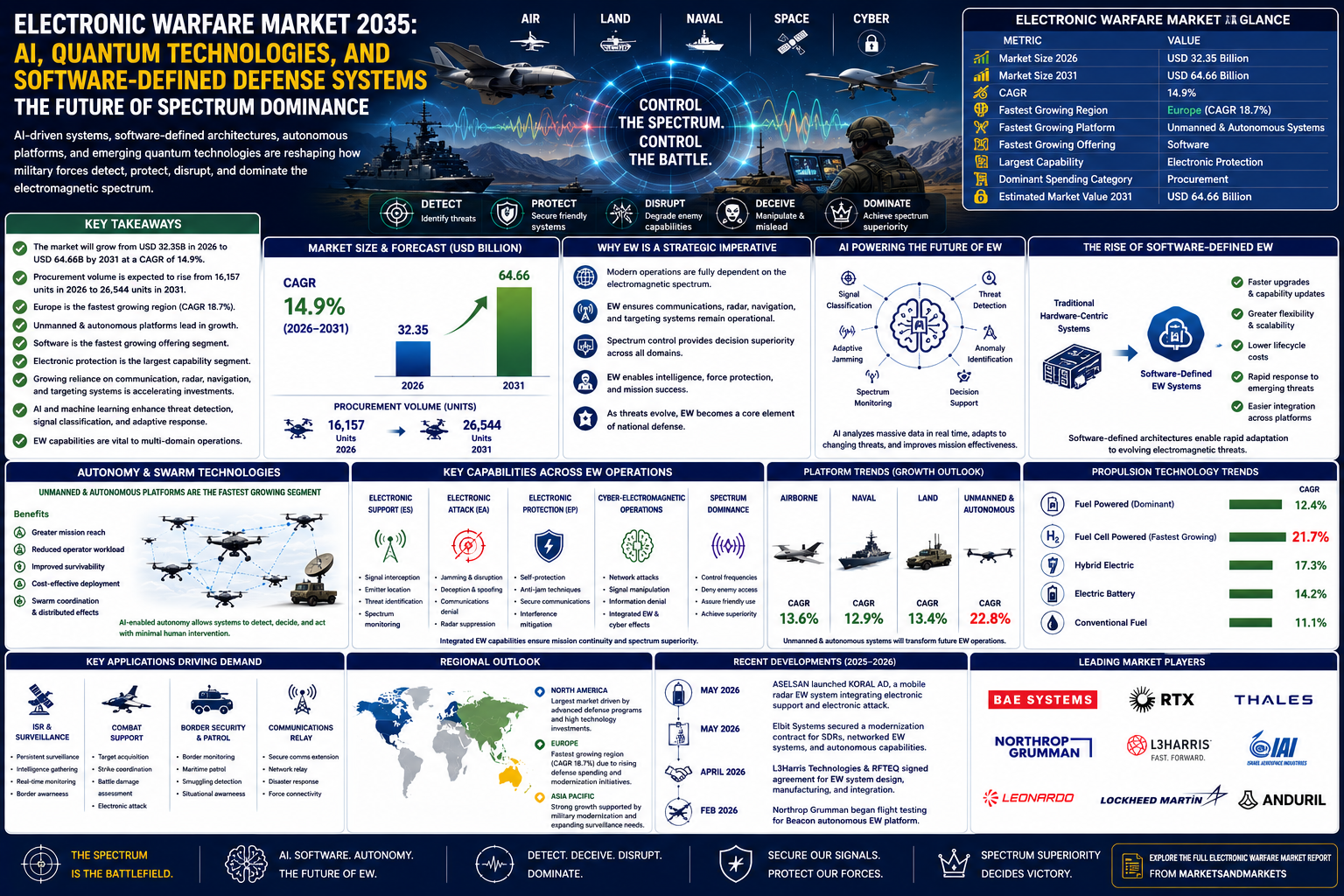
According to MarketsandMarkets, the Electronic Warfare Market is projected to grow from USD 32.35 billion in 2026 to USD 64.66 billion by 2031, reflecting a CAGR of 14.9%.
While current investments focus on advanced jamming, signal intelligence, and electronic protection capabilities, the next decade is expected to introduce transformative technologies including artificial intelligence, software defined architectures, autonomous electronic warfare systems, advanced cyber electromagnetic operations, and potentially quantum enabled sensing and communications technologies.
These developments are laying the foundation for what many defense planners believe will become the defining battlespace of the future.
Key Takeaways
-
The Electronic Warfare Market is projected to grow from USD 32.35 billion in 2026 to USD 64.66 billion by 2031 at a CAGR of 14.9%.
-
Software is expected to be the fastest growing offering segment during the forecast period.
-
Unmanned and autonomous platforms are projected to record the highest CAGR of 23.7%.
-
Europe is expected to be the fastest growing regional market with a CAGR of 18.7%.
-
AI enabled electronic warfare systems are accelerating signal detection, classification, and response.
-
Software defined architectures are improving adaptability against rapidly changing threats.
-
Electronic protection remains the largest capability segment across military EW programs.
-
Spectrum superiority is becoming a strategic requirement across modern military operations.
-
Autonomous platforms are increasing demand for intelligent EW systems.
-
Future electronic warfare ecosystems will increasingly combine AI, cyber capabilities, software defined architectures, and advanced signal processing technologies.
Frequently Asked Questions
What is driving growth in the Electronic Warfare Market?
Growing dependence on communication, navigation, radar, targeting, and intelligence systems is increasing the need for spectrum control and electronic protection capabilities.
Why is AI becoming important in electronic warfare?
AI improves signal classification, threat identification, adaptive jamming, and decision support in highly contested electromagnetic environments.
How are software defined systems changing electronic warfare?
Software defined systems allow faster updates, improved adaptability, and more effective responses to evolving threats without requiring extensive hardware modifications.
Which region is expected to grow the fastest?
Europe is projected to register the highest growth rate due to increasing defense spending and military modernization initiatives.
What role will autonomous systems play in future electronic warfare?
Autonomous systems will increasingly perform spectrum monitoring, signal intelligence, threat detection, and adaptive electronic attack missions with limited human intervention.
Explore Comprehensive Electronic Warfare Market Intelligence
Organizations seeking detailed forecasts, competitive analysis, technology trends, and strategic opportunities can access the complete Electronic Warfare Market research report.
Read Full Report: https://www.marketsandmarkets.com/Market-Reports/electronic-warfare-market-1301.html
Download Sample Report: https://www.marketsandmarkets.com/requestsampleNew.asp?id=1301
Electronic Warfare Market at a Glance
| Metric | Value |
|---|---|
| Market Size 2026 | USD 32.35 Billion |
| Market Size 2031 | USD 64.66 Billion |
| CAGR | 14.9% |
| Fastest Growing Region | Europe |
| Fastest Growing Platform | Unmanned and Autonomous Systems |
| Fastest Growing Offering | Software |
| Largest Capability | Electronic Protection |
| Dominant Spending Category | Procurement |
The market's expansion highlights the growing importance of spectrum control, electronic protection, and intelligent threat response capabilities across military operations.
Why Electronic Warfare Is Becoming a Core Defense Capability
Military operations today are increasingly dependent on digital connectivity.
Communication systems coordinate forces across multiple domains. Radar systems enable surveillance and targeting. Navigation networks support aircraft, ships, missiles, and autonomous platforms. Data links connect sensors with commanders and operators.
Any disruption to these systems can directly impact operational effectiveness.
The Strategic Importance of Spectrum Dominance
Electronic warfare capabilities enable military organizations to:
-
Monitor signal activity
-
Detect hostile emitters
-
Protect communications
-
Disrupt adversary networks
-
Support intelligence collection
-
Improve force protection
Control of the electromagnetic spectrum is increasingly viewed as a prerequisite for operational success.
Electronic Warfare Has Become Essential to Mission Readiness
Modern military forces rely on EW systems to maintain communication resilience, optimize threat detection, and preserve operational continuity in contested environments.
This growing dependence explains why electronic warfare spending continues to rise across major defense modernization programs.
Artificial Intelligence Is Reshaping Electronic Warfare Operations
AI is rapidly becoming one of the most disruptive technologies in the electronic warfare sector.
Traditional EW systems relied heavily on predefined threat libraries and manual analysis. Modern electromagnetic environments are significantly more dynamic.
AI enables military forces to respond at machine speed.
Faster Signal Classification
AI powered systems can rapidly analyze signal characteristics to identify potential threats.
Capabilities include:
-
Signal classification
-
Pattern recognition
-
Threat prioritization
-
Emitter identification
-
Anomaly detection
These functions improve situational awareness while reducing operator workload.
Adaptive Threat Response
Adversaries continuously modify frequencies, waveforms, communication methods, and jamming techniques.
AI systems improve adaptability by learning from operational environments and generating faster responses to emerging threats.
Machine Learning Supports Operational Agility
| AI Capability | Operational Benefit |
|---|---|
| Signal Analysis | Faster threat identification |
| Threat Detection | Improved awareness |
| Adaptive Jamming | Greater mission effectiveness |
| Spectrum Monitoring | Better operational visibility |
| Decision Support | Accelerated response times |
Software Defined Electronic Warfare Is Transforming Defense Modernization
One of the strongest opportunities within the Electronic Warfare Market involves software defined architectures.
Unlike traditional hardware centric systems, software defined EW platforms can evolve rapidly through updates and reprogramming.
Why Software Is Becoming the Fastest Growing Segment
Military organizations increasingly require systems capable of responding to evolving threats without lengthy upgrade cycles.
Software defined architectures provide:
-
Greater flexibility
-
Faster deployment
-
Reduced lifecycle costs
-
Improved scalability
-
Better interoperability
Supporting Rapid Threat Evolution
Modern adversaries continuously modify electronic attack techniques.
Software driven systems allow military organizations to update threat libraries, signal databases, and response mechanisms far more efficiently than hardware dependent alternatives.
Access Detailed Technology Forecasts and Competitive Analysis
Download PDF Brochure: https://www.marketsandmarkets.com/pdfdownloadNew.asp?id=1301
The Rise of Autonomous Electronic Warfare Systems
Autonomous and unmanned platforms are projected to register the highest CAGR among platform segments through 2031.
Expanding Operational Roles
Unmanned platforms increasingly support:
-
Spectrum monitoring
-
Signal intelligence
-
Threat detection
-
Electronic attack
-
Communications support
AI and Autonomy Are Converging
The combination of AI and autonomous systems enables electronic warfare operations with greater speed and efficiency.
Future autonomous EW platforms may be capable of independently identifying threats, selecting responses, and coordinating activities across multiple systems.
This trend is expected to become a major driver of future market growth.
Looking Toward 2035: The Potential Impact of Quantum Technologies
Although AI and software defined systems are driving current market growth, defense planners are increasingly evaluating the long term implications of quantum technologies.
Why Quantum Technologies Matter
Future quantum technologies could influence:
-
Signal detection
-
Secure communications
-
Navigation systems
-
Encryption methods
-
Sensor performance
Preparing for Future Disruptions
While commercial deployment remains at an early stage, defense organizations are monitoring developments closely.
Quantum technologies have the potential to introduce new capabilities while simultaneously challenging existing communication and security frameworks.
For electronic warfare operators, understanding these future developments will be essential for maintaining spectrum superiority.
Electronic Protection Remains the Foundation of Modern EW Programs
Electronic protection is currently the largest capability segment within the market.
Protecting Critical Military Systems
Electronic protection safeguards:
-
Radar systems
-
Communications networks
-
Navigation technologies
-
Mission software
-
Data links
Ensuring Operational Continuity
Maintaining operational effectiveness requires protection against:
-
Jamming
-
Signal interference
-
Electronic attack
-
Cyber electromagnetic threats
As military networks become increasingly interconnected, the importance of electronic protection will continue growing.
Commercial Use Cases Highlight Operational Impact
Several advanced EW programs demonstrate the strategic value of modern electronic warfare capabilities.
| System | Use Case | Strategic Benefit |
|---|---|---|
| EA-37B Compass Call | Long range electromagnetic attack | Disrupts enemy communications and radar |
| Attack Stand In Jammer | Operations near air defenses | Supports missions in contested environments |
| AN/ASQ-239 EW Suite | Integrated F-35 protection | Improves survivability and threat awareness |
These examples illustrate how electronic warfare capabilities increasingly influence operational outcomes across multiple domains.
Regional Outlook: Why Europe Is Emerging as a Growth Leader
Europe is expected to record the highest growth rate during the forecast period.
Rising Defense Investments
European nations are expanding investments in:
-
Spectrum dominance
-
Multi domain operations
-
Electronic protection
-
Intelligence systems
-
Defense modernization initiatives
Security Considerations Drive Adoption
Growing regional security concerns are accelerating demand for advanced electronic warfare technologies capable of supporting modern military operations.
Explore Regional Forecasts and Market Opportunities
Read Full Report: https://www.marketsandmarkets.com/Market-Reports/electronic-warfare-market-1301.html
Download Sample Report: https://www.marketsandmarkets.com/requestsampleNew.asp?id=1301
Competitive Landscape: The Companies Defining Electronic Warfare Innovation
Star Players
MarketsandMarkets identifies:
-
BAE Systems
-
RTX
-
Thales
as leading market participants based on market presence and product capabilities.
Emerging Leaders
Lockheed Martin continues expanding its electronic warfare portfolio through technology innovation and platform integration efforts.
Key Market Participants
-
BAE Systems
-
RTX
-
Thales
-
Northrop Grumman
-
L3Harris Technologies
-
Israel Aerospace Industries
-
Lockheed Martin
-
Leonardo S.p.A.
These companies continue shaping the evolution of electronic warfare technologies through research, development, and modernization initiatives.
Recent Developments Reflect Industry Momentum
May 2026
ASELSAN launched KORAL AD, a mobile radar EW system integrating electronic support and electronic attack capabilities.
May 2026
Elbit Systems secured a modernization contract involving software defined radios, networked EW systems, and autonomous technologies.
April 2026
L3Harris Technologies and RFTEQ announced cooperation on EW system design, manufacturing, and integration for defense applications.
These developments demonstrate continued investment in advanced electronic warfare capabilities.
MarketsandMarkets Perspective: What the Data Suggests
Several themes are shaping the future trajectory of the Electronic Warfare Market.
First, software is becoming increasingly important as military organizations seek flexible and upgradeable capabilities.
Second, AI is accelerating the speed and effectiveness of signal intelligence, threat detection, and adaptive response operations.
Third, autonomous systems are creating new opportunities for distributed electronic warfare missions.
Finally, spectrum superiority is becoming a central component of defense modernization strategies worldwide.
The Road Ahead for Electronic Warfare
The future of electronic warfare will likely be defined by intelligent systems capable of operating across increasingly complex electromagnetic environments.
Artificial intelligence, software defined architectures, autonomous platforms, cyber electromagnetic integration, and emerging quantum technologies are expected to reshape how military organizations detect, protect, disrupt, and control signals.
As military forces continue modernizing communications, sensors, navigation systems, and operational networks, the ability to achieve spectrum superiority will become even more critical.
Organizations seeking deeper insights into market forecasts, technology developments, competitive intelligence, and strategic opportunities can access the complete MarketsandMarkets Electronic Warfare Market research.

This FREE sample includes market data points, ranging from trend analyses to market estimates & forecasts. See for yourself.
SEND ME A FREE SAMPLE






