Expendable Drone Market: Production Scale, Procurement Quantities and Industrial Readiness
Understanding the economics and production signals behind expendable loitering weapons
Expendable drones are defined by what happens at the end of their mission: the aircraft is intended to be consumed rather than recovered after attack. In the loitering munitions segment, that design choice changes the meaning of procurement scale. A military can require continuing replenishment, while manufacturers must sustain predictable assembly, component availability, quality controls and delivery schedules. Recent contracts show why manufacturing readiness is now as important to industry analysis as aircraft design.
Market outlook at a glance
MarketsandMarkets estimates that the global loitering munitions market will expand from USD 5.36 billion in 2025 to USD 13.26 billion by 2030, representing a 19.9% compound annual growth rate. The published forecast covers multiple system types, ranges, endurance categories, warheads, navigation sensors, launch modes, end users, and regions. This total should not be presented as an independent revenue forecast for any single informal search term.
The vocabulary surrounding the sector requires care. “Kamikaze drone,” “suicide drone,” and “one-way attack drone” are frequently used as overlapping descriptions, but they do not create three additive markets. A loitering munition is usually defined by its ability to remain in flight while awaiting or developing an engagement opportunity; an ordinary one-way drone may follow a preplanned course without a comparable loitering capability. Recoverability is a separate design attribute. Market comparisons are meaningful only after these boundaries are held constant.
Why volumes need careful interpretation
An equipment count is useful only if the counting unit is clear. A set of loitering munitions may include multiple aircraft as well as launch equipment, operators’ consoles, spare equipment and support. Therefore 1,000 sets cannot automatically be described as 1,000 drones. Likewise, a ceiling under an indefinite-delivery contract is not the same as orders released against it. These distinctions are essential when deriving average selling price or annual production demand from announcements.
Poland’s quantity framework as an industrial signal
WB Group disclosed a framework agreement signed in May 2025 covering nearly 10,000 WARMATE loitering munitions and almost 1,000 sets, with expected implementation through subsequent agreements toward 2035. The disclosed quantity and duration give an indication of the potential production horizon. Yet the agreement does not by itself establish annual delivery rates, unit selling prices, or the quantity already received by the armed forces.
The U.S. contract model
AeroVironment’s February 2026 disclosure of a USD 186 million U.S. Army Switchblade delivery order offers an example of a funded procurement action. The underlying USD 990 million five-year indefinite-delivery agreement provides a maximum procurement vehicle, not guaranteed revenue. For market sizing, it is important to avoid counting both the delivery order and the full ceiling as separate purchases. Product configuration and associated services may also complicate simple price-per-airframe estimates.
Verified purchases and recent developments
|
Country |
Date |
Disclosed scope |
Classification |
Evidence |
|
Poland |
May 2025 |
Nearly 10,000 WARMATE munitions |
Framework scope to 2035 |
Poland WARMATE framework |
|
United States |
Feb 2026 |
USD 186m Switchblade systems |
Delivery order |
US Switchblade order |
|
United States |
FY2026 |
USD 74.972m LASSO RDT&E |
Research/development/testing budget; not purchase |
US Army FY2026 LASSO budget |
Note: Contract ceilings, frameworks, R&D budgets, partnerships and tests are not counted as firm delivery orders.
Where production constraints emerge
An expendable munition relies on an ecosystem of structural parts, guidance electronics, sensors, communications equipment, propulsion components, energetic materials, launch packaging and test infrastructure. Production risks can arise even when the airframe itself is inexpensive. Electronics lead times, product qualification, traceability, component substitution approvals and final acceptance testing all influence the rate at which completed systems can be supplied.
Lifecycle economics without misleading unit prices
Unlike a reusable aircraft, an expendable weapon does not ordinarily return after a successful strike. Its operating economics must therefore incorporate replacement demand, storage conditions, shelf life, training consumption, obsolescence and the support system. Public contract totals often combine hardware with accessories and services, so dividing contract value by a headline unit count can create an inaccurate per-drone price. Comparable pricing requires the scope of each contracted lot.
Why an expendable unit requires more than a unit price
A low purchase price can be meaningful only when matched with the platform configuration and the cost of associated equipment. Launcher reuse, operator training, storage life, battery arrangements, payload sophistication and maintenance procedures can all change the economics of one-way systems. Contract values may bundle equipment and services, while announced quantities can reflect sets rather than rounds. Published headline figures therefore establish industrial signals, not a universal average selling price for the category.
From investment announcements to reliable output
Industrial plans should be assessed through manufacturing throughput and acceptance milestones, not solely through factory-capacity headlines. A line that can assemble airframes may still depend on imported electronics, energy systems or specialist test equipment. Government orders may require staged deliveries, variant qualification and replacement inventories that affect when reported quantities reach military units. The capacity question also changes when a product family includes several configurations sharing only part of the same components. Manufacturers may report annual potential output while armed forces disclose only aggregate system counts. Without matching the period, equipment definition and contracting stage, apparent comparisons of supply and demand can become misleading. A robust view of the expendable market therefore connects material availability, testing capability, production scheduling, stockpile replenishment and contracting authority. These factors influence which procurement signals can translate into stable production over a multiyear forecast.
Visual market indicators
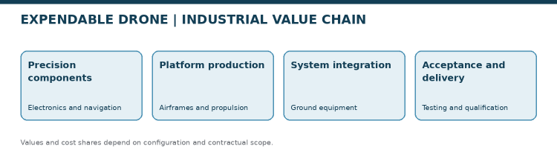
Infographic 1. Published procurement and market interpretation.
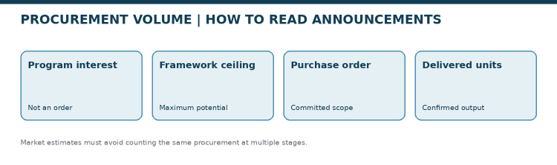
Infographic 2. Qualitative comparison of system or contract characteristics.
What the market forecast indicates
With MarketsandMarkets projecting USD 13.26 billion for the overall loitering munitions market in 2030, expendable systems remain central to a market organized around different mission ranges, endurance classes, launch modes and warhead choices. Future competitive advantage is likely to rely on system-level reliability, repeatable manufacturing and delivery performance, not merely claims of low acquisition cost.
Conclusion
The growth of the global loitering munitions market reflects a progression from technical demonstrations to funded programs and increasingly differentiated product families. The category described by this article should be interpreted as part of the wider loitering munitions market, not an additional market layered on top of it. Transparent contract classifications, consistent equipment definitions, and a common approach to regional and technical segmentation remain essential for interpreting developments through 2030.

This FREE sample includes market data points, ranging from trend analyses to market estimates & forecasts. See for yourself.
SEND ME A FREE SAMPLE