AI Impact Analysis on Software Defined Radio (SDR) Market
The Software Defined Radio Market is undergoing a fundamental transformation as artificial intelligence becomes increasingly integrated into communication, spectrum management, signal processing, electronic warfare, cybersecurity, and network centric operations. Software Defined Radio technology has already changed the architecture of modern communication systems by shifting many traditionally hardware based radio functions into software. This flexibility allows a single radio platform to support multiple frequencies, waveforms, communication standards, and mission requirements. The integration of artificial intelligence is taking this flexibility further by enabling radios to analyze their electromagnetic environment, adapt communication parameters, identify interference, optimize spectrum usage, and support increasingly autonomous network operations.
Modern military forces, public safety organizations, commercial communication providers, transportation operators, and other users require communication systems capable of operating across increasingly complex electromagnetic environments. The rapid proliferation of connected devices, unmanned platforms, satellite communication systems, private wireless networks, and advanced radar technologies is increasing demand for flexible spectrum utilization. At the same time, communication networks must remain reliable despite congestion, interference, cybersecurity threats, and rapidly changing operational conditions.
Artificial intelligence provides the computational capabilities required to address these challenges. Machine learning algorithms can process large volumes of radio frequency information, identify patterns, predict spectrum conditions, optimize waveforms, detect anomalies, and support real time communication decisions. Instead of functioning as programmable hardware that simply executes predefined instructions, AI enabled SDR platforms can increasingly interpret their environment and adjust their behavior according to changing requirements.
Between 2025 and 2035, artificial intelligence is expected to influence almost every major aspect of the Software Defined Radio ecosystem. AI will contribute to cognitive radio capabilities, adaptive communications, signal processing, network management, predictive maintenance, cybersecurity, electronic spectrum operations, and interoperability. The result will be a transition from software configurable radios toward intelligent communication platforms capable of continuously adapting to their operating environment.
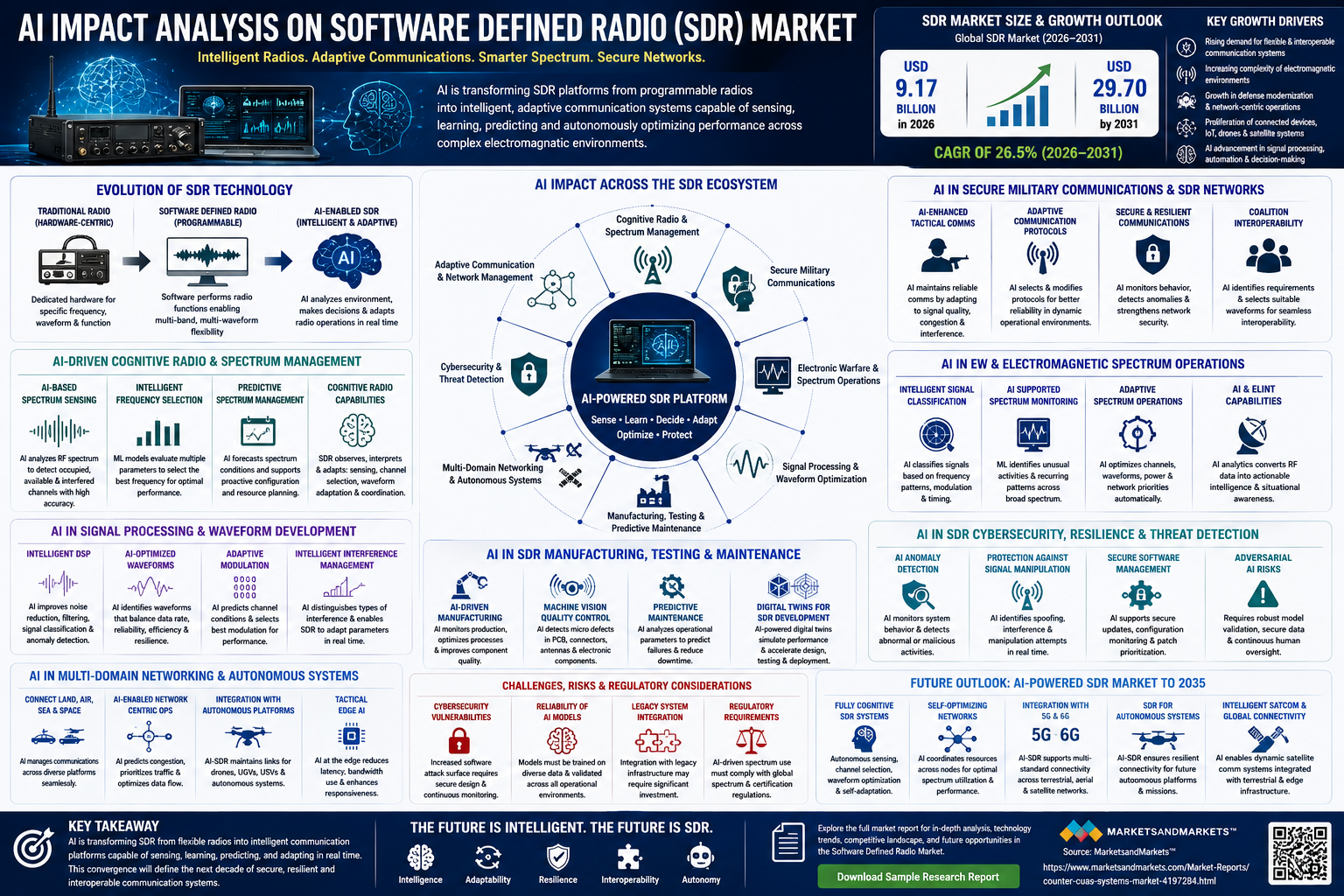
Introduction to the Software Defined Radio Market
Evolution of Software Defined Radio Technology
Traditional radio systems were built around dedicated hardware components designed for specific frequencies, modulation schemes, and communication standards. Changing a radio's functionality often required replacing or physically modifying hardware components. This limited flexibility became increasingly problematic as communication requirements expanded across military and commercial environments.
Software Defined Radio introduced a different architecture in which software performs many functions traditionally handled by dedicated hardware. Digital signal processing, modulation, demodulation, filtering, waveform management, and communication protocols can be implemented or modified through software. This enables a single platform to support multiple communication requirements.
The flexibility of SDR has made it particularly valuable for organizations operating across multiple communication environments. Military forces can use programmable radios across different platforms and mission requirements, while commercial and public safety organizations can use configurable systems to support multiple communication standards.
Artificial intelligence builds on this flexibility by allowing radios to make data driven decisions about how they should operate. Instead of relying exclusively on predefined configurations, AI enabled SDR platforms can analyze operational conditions and recommend or automatically implement suitable communication parameters.
Growing Demand for Flexible Communication Networks
Communication networks are becoming increasingly heterogeneous. Modern organizations may simultaneously rely on terrestrial wireless networks, satellite communications, tactical radios, cellular systems, mesh networks, and specialized communication channels.
This complexity increases the importance of interoperable communication equipment. SDR platforms can bridge different communication standards and provide a flexible foundation for multi network connectivity.
Artificial intelligence further strengthens this capability by helping SDR systems identify available communication resources and determine which configurations are most appropriate for current conditions.
The demand for resilient communication is particularly significant in environments where connectivity may be interrupted by physical obstacles, network congestion, interference, or infrastructure failures. AI enabled SDR technology provides opportunities to create communication systems capable of adapting rapidly to these conditions.
Artificial Intelligence as a Transformation Driver
AI is shifting SDR technology from programmability toward intelligence. Machine learning can evaluate radio frequency environments, identify recurring patterns, detect unusual signals, and optimize communication performance.
This capability is particularly valuable because electromagnetic environments are dynamic. Spectrum availability changes continuously, interference can appear unexpectedly, and communication requirements can vary according to location, mission, network demand, and environmental conditions.
AI enables radios to respond to these changes much faster than conventional manual configuration approaches. This creates opportunities for more efficient spectrum utilization, improved communication reliability, and reduced operator workload.
AI Driven Cognitive Radio and Intelligent Spectrum Management
AI Based Spectrum Sensing
Spectrum sensing is a fundamental capability for intelligent communication systems. AI enables SDR platforms to analyze large portions of the radio frequency spectrum and identify occupied, available, or potentially interfered channels.
Machine learning models can recognize signal characteristics and distinguish communication activity from background noise. Over time, these models can improve their ability to classify signals based on historical observations.
This capability allows SDR platforms to develop a more comprehensive understanding of their electromagnetic surroundings and supports dynamic communication management.
Intelligent Frequency Selection
Conventional radios generally operate according to predefined frequency plans. AI enabled SDR platforms can evaluate multiple communication parameters and identify suitable frequencies according to network requirements and observed spectrum conditions.
Machine learning can consider signal quality, interference levels, network demand, and historical spectrum behavior when supporting frequency selection.
This creates more adaptive communication networks that can respond to changing electromagnetic conditions without requiring constant manual intervention.
Predictive Spectrum Management
AI can move spectrum management from reactive decision making toward predictive optimization. Historical spectrum information can be analyzed to identify patterns associated with congestion, interference, and communication demand.
Machine learning models can forecast likely spectrum conditions and support proactive configuration decisions.
Predictive spectrum management is especially valuable for large communication networks where thousands of devices compete for limited spectrum resources.
Cognitive Radio Capabilities
The combination of SDR flexibility and AI intelligence provides the foundation for cognitive radio systems. These platforms can observe their operating environment, interpret available information, evaluate communication requirements, and adapt selected parameters.
Cognitive functionality may include spectrum sensing, channel selection, waveform adaptation, power management, and network coordination.
The long term development of cognitive SDR technology could result in radios capable of optimizing communication performance continuously without requiring extensive manual configuration.
AI in Secure Military Communications and SDR Networks
AI Enhanced Tactical Communications
Military communication networks require flexibility because operational environments can change rapidly. Software Defined Radios provide a programmable foundation for communication across different platforms and network architectures.
AI enhances this flexibility by supporting adaptive communication decisions based on network conditions. Machine learning can analyze connectivity, signal quality, congestion, and interference to identify opportunities for maintaining reliable communications.
This capability supports resilient communication without requiring operators to manually adjust every radio parameter.
Adaptive Communication Protocols
AI can help communication systems select or modify communication strategies according to operational conditions. Machine learning models analyze network behavior and identify configurations associated with improved reliability.
Adaptive protocols can support more efficient communication when networks experience changing demand, mobility, or environmental constraints.
The combination of programmable radios and AI driven protocol optimization creates communication systems capable of responding more effectively to unpredictable network conditions.
Secure and Resilient Communications
Security is becoming increasingly important as military communication systems become more connected and software intensive. AI can support cybersecurity by monitoring communication behavior and identifying anomalies that may indicate unauthorized activity or attempted network compromise.
AI based monitoring can also help identify unusual traffic patterns and potential communication disruptions.
This creates opportunities for SDR platforms that continuously evaluate both communication performance and security conditions.
Coalition and Interoperable Communications
Modern defense operations frequently involve multiple organizations operating different communication systems. SDR platforms provide an important mechanism for interoperability because they can support multiple waveforms and communication standards.
AI can further improve interoperability by identifying communication requirements and helping select suitable configurations for communication with different networks.
This capability can simplify coordination across heterogeneous communication environments while reducing the need for multiple specialized radio systems.
AI in Electronic Warfare and Electromagnetic Spectrum Operations
Intelligent Signal Classification
The electromagnetic spectrum contains enormous quantities of communication and noncommunication signals. AI can process these signals and identify patterns that may be difficult to detect through conventional analysis.
Machine learning models can classify signals based on characteristics such as frequency behavior, modulation patterns, timing, and signal structure.
This capability supports broader electromagnetic awareness and enables communication systems to respond more effectively to changing spectrum conditions.
AI Supported Spectrum Monitoring
SDR platforms can monitor broad portions of the electromagnetic spectrum while AI processes the resulting data.
Machine learning can identify unusual activity, recognize recurring patterns, and distinguish expected communication behavior from anomalies.
This creates a foundation for intelligent spectrum monitoring systems that can provide operators with more comprehensive information about their communication environment.
Adaptive Electronic Spectrum Operations
AI can support the optimization of communication parameters when interference or congestion is detected. SDR technology provides the programmable foundation while AI supplies the decision support required to select appropriate adjustments.
At a high level, this may include changing communication channels, modifying waveform characteristics, adjusting network priorities, or coordinating communication resources.
These capabilities strengthen electromagnetic resilience without requiring detailed manual management of every radio system.
AI and Electronic Intelligence
Software Defined Radios can collect large volumes of radio frequency information, while artificial intelligence can process this information into structured observations.
AI based analytics can identify patterns across large datasets, helping analysts understand changes in spectrum activity over time.
The convergence of SDR data collection and AI analytics is therefore creating new opportunities for advanced electromagnetic situational awareness.
AI in Signal Processing, Waveform Development, and Modulation
Intelligent Digital Signal Processing
Digital signal processing is one of the fundamental technologies behind SDR systems. Artificial intelligence can improve signal processing by identifying patterns in noisy or complex data.
Machine learning techniques can support noise reduction, signal classification, anomaly detection, and adaptive filtering.
These capabilities may improve communication quality while reducing computational resources required for certain processing tasks.
AI Optimized Waveforms
Waveforms determine how information is transmitted and received. Different operational environments may require different waveform characteristics.
AI can analyze communication conditions and help identify waveform configurations that balance data rate, reliability, spectrum efficiency, and resilience.
The combination of programmable waveform architectures and AI driven optimization creates a more adaptable communication environment.
Adaptive Modulation
Adaptive modulation enables communication systems to change transmission characteristics according to current channel conditions.
AI improves this process by predicting channel behavior and recommending suitable configurations. Machine learning can evaluate historical communication performance and identify patterns associated with different environmental conditions.
This supports more efficient utilization of available communication capacity.
Intelligent Interference Management
Interference remains a major challenge for wireless communication networks. AI can analyze interference patterns and distinguish between persistent, temporary, and unexpected interference.
SDR systems can then use programmable capabilities to modify communication parameters in response.
The combination of AI analysis and software configurability creates an important foundation for resilient communication systems.
AI in SDR Manufacturing, Testing, and Predictive Maintenance
AI Driven SDR Manufacturing
The complexity of modern SDR platforms creates opportunities for artificial intelligence throughout the manufacturing process.
AI powered production systems can monitor component quality, identify manufacturing variations, optimize assembly processes, and improve production efficiency.
Machine learning can analyze historical production information to identify factors associated with defects or performance variations.
This enables manufacturers to improve product consistency while reducing manufacturing waste.
Machine Vision for Quality Control
Machine vision systems can inspect circuit boards, connectors, antennas, electronic components, and other SDR hardware during production.
AI algorithms identify defects that may not be immediately visible through conventional inspection processes.
Automated inspection improves consistency and allows manufacturers to identify quality problems earlier in the production cycle.
Predictive Maintenance
SDR platforms contain numerous electronic components that may experience degradation over time. AI can analyze temperature, power consumption, signal quality, processor performance, and other operational parameters to identify potential component problems.
Predictive maintenance allows organizations to address developing issues before they result in system failure.
This approach improves availability while reducing unnecessary maintenance activities.
Digital Twins for SDR Development
Digital twins create virtual representations of physical radio systems. Engineers can use AI enhanced digital twins to simulate communication performance under different environmental and operational conditions.
This supports faster product development and allows manufacturers to identify potential design issues before physical prototypes are completed.
Digital twins can also support lifecycle management after deployment by incorporating real world performance data.
AI Integration with Multi Domain Military Networks
Connecting Land, Air, Sea, and Space Platforms
Modern defense communication networks increasingly operate across multiple domains. Aircraft, naval vessels, ground vehicles, satellites, unmanned systems, and command centers must exchange information despite different communication architectures.
SDR provides the flexibility required to connect these systems, while AI supports intelligent network management.
Machine learning can analyze communication conditions across different domains and support decisions regarding network routing, resource allocation, and communication priorities.
AI Enabled Network Centric Communications
Network centric operations depend upon the rapid movement of information between distributed platforms.
AI can analyze network performance and identify opportunities to improve information flow. This includes predicting congestion, prioritizing critical communications, and identifying connectivity problems.
SDR platforms provide the programmable communication infrastructure required to implement these adjustments.
Integration with Autonomous Platforms
Unmanned aerial vehicles, autonomous ground systems, and maritime platforms require flexible communication architectures because they may operate beyond direct human supervision.
AI enabled SDR systems can help these platforms maintain communication connectivity as operating conditions change.
The result is a more resilient communication environment supporting increasingly autonomous systems.
Tactical Edge AI
Processing information at the edge reduces dependence on centralized infrastructure and can improve response times.
SDR platforms equipped with edge AI capabilities can analyze local spectrum conditions and communication performance without continuously transmitting all raw data to remote servers.
This approach reduces latency and bandwidth requirements while improving operational responsiveness.
AI in SDR Cybersecurity, Resilience, and Threat Detection
AI Based Anomaly Detection
SDR platforms are increasingly software intensive, creating new cybersecurity considerations.
Artificial intelligence can continuously monitor system behavior and identify deviations from normal operating patterns. Unexpected configuration changes, unusual communication activity, or abnormal software behavior can trigger alerts for further investigation.
This provides an additional layer of protection for software configurable communication systems.
Protection Against Signal Manipulation
AI can analyze received signals to identify characteristics inconsistent with expected communication patterns.
Machine learning models can support detection of anomalies associated with spoofing, interference, or other forms of signal manipulation.
Although AI cannot eliminate all communication security risks, it can provide faster identification of unusual conditions.
Secure Software Management
Software updates are essential for SDR platforms because their capabilities depend heavily on software and firmware.
AI can support software lifecycle management by monitoring configuration changes, identifying unusual update behavior, and helping organizations prioritize security patches.
This becomes increasingly important as SDR deployments grow in scale.
Adversarial AI Risks
The same AI technologies used to protect SDR systems may also create new vulnerabilities. Attackers may attempt to manipulate machine learning models, introduce misleading data, or exploit weaknesses in AI based classification systems.
Future SDR cybersecurity architectures must therefore incorporate robust model validation, secure datasets, continuous monitoring, and human oversight.
Challenges, Risks, and Regulatory Considerations
Cybersecurity and Software Vulnerabilities
Increasing software dependence creates new attack surfaces. SDR platforms require secure development practices, encrypted communications, authenticated software updates, and continuous monitoring.
Organizations must treat cybersecurity as an integral component of SDR design rather than an additional feature added after deployment.
Reliability of AI Models
AI recommendations must remain reliable across diverse electromagnetic environments. Models trained under limited conditions may perform poorly when exposed to unfamiliar signals or unexpected interference.
Continuous validation, diverse training datasets, simulation, and human supervision will remain essential.
Legacy System Integration
Many organizations continue operating legacy radio infrastructure. Integrating AI enabled SDR platforms with these systems may require substantial investment in interfaces, software, network architecture, and cybersecurity.
Hybrid modernization strategies will therefore remain important throughout the transition period.
Regulatory Requirements
Software Defined Radios operate within regulated spectrum environments. AI driven spectrum management must comply with applicable frequency allocation rules, communication standards, certification requirements, and national regulations.
As autonomous spectrum management becomes more common, regulators will need to develop frameworks addressing AI based decision making.
Future Outlook: AI Powered Software Defined Radio Market to 2035
Fully Cognitive SDR Systems
By 2035, Software Defined Radios are expected to become increasingly cognitive. Instead of simply executing predefined software configurations, advanced SDR systems will continuously analyze their electromagnetic environment and adapt communication strategies according to changing conditions.
AI will support autonomous spectrum sensing, channel selection, waveform optimization, network coordination, and predictive communication management.
Self Optimizing Communication Networks
Future SDR networks will increasingly operate as intelligent ecosystems rather than collections of individual radios.
AI will coordinate communication resources across multiple nodes, identify congestion before it occurs, optimize spectrum utilization, and dynamically balance network demand.
This capability will be particularly valuable for large scale defense, public safety, satellite, and commercial communication networks.
Integration with 5G and 6G
The evolution of 5G and emerging 6G communication technologies will create additional opportunities for SDR.
AI enabled SDR platforms may support multiple communication standards simultaneously, enabling flexible connectivity across terrestrial, aerial, and satellite networks.
Software based architectures will help organizations adapt communication systems as new standards emerge without requiring complete hardware replacement.
SDR for Autonomous Systems
Autonomous drones, robotic vehicles, unmanned maritime systems, and future advanced mobility platforms will require highly flexible communication systems.
AI powered SDRs can support these platforms by continuously optimizing connectivity according to location, network availability, and mission requirements.
This convergence of autonomy and intelligent communications will become an important growth opportunity for the SDR Market.
Intelligent Satellite Communications
Space based communication networks are increasingly becoming integrated with terrestrial communication infrastructure.
AI enabled SDR technology can support flexible satellite communication architectures by allowing communication systems to adapt to changing network requirements.
The combination of SDR, AI, satellite connectivity, and edge computing will contribute to increasingly interconnected global communication ecosystems.
Long Term Market Transformation
The Software Defined Radio market is moving toward an era in which intelligence becomes as important as programmability.
The original value proposition of SDR was flexibility. The next generation will add adaptability, prediction, automation, and continuous learning.
Artificial intelligence will influence product design, spectrum management, signal processing, cybersecurity, manufacturing, maintenance, and network operations. Companies that successfully integrate AI with programmable radio architectures will be positioned to address growing demand for resilient, interoperable, and intelligent communication systems.
Future Outlook
Artificial intelligence is transforming the Software Defined Radio market from a flexible communication technology into an increasingly intelligent communications platform. SDR has already established a strong foundation by replacing many fixed hardware functions with programmable architectures. AI now adds a new layer of intelligence capable of analyzing spectrum conditions, optimizing communication parameters, identifying anomalies, supporting predictive maintenance, and improving network performance.
Across cognitive radio, secure communications, signal processing, electronic spectrum operations, manufacturing, cybersecurity, and multi domain networking, AI is creating opportunities to improve efficiency and resilience. The integration of machine learning with software configurable radio architectures also supports the growing requirements of autonomous systems, connected defense platforms, satellite networks, public safety organizations, and next generation wireless infrastructure.
Between 2025 and 2035, the competitive landscape will increasingly depend on the ability of SDR manufacturers and communication technology providers to combine flexible hardware with intelligent software. Future radios will not simply execute predefined instructions. They will increasingly understand their operating environment, evaluate communication conditions, and adapt their behavior to improve network performance.
As global communication environments become more congested, interconnected, and dynamic, AI powered Software Defined Radio systems will become an increasingly important foundation for secure, flexible, interoperable, and resilient communications.

This FREE sample includes market data points, ranging from trend analyses to market estimates & forecasts. See for yourself.
SEND ME A FREE SAMPLE

