Kamikaze Drone Market: How Product Innovation Is Redrawing the Competitive Landscape
Introduction: a broader category than a single drone design
The term “kamikaze drone” is widely used for unmanned weapons that engage targets by striking them directly, often after a period of loitering or target observation. In formal market analysis, these systems are usually studied within the loitering munitions category. The category encompasses compact weapons operated by ground formations as well as larger systems with substantially different range, endurance, payload and launch requirements. Consequently, the label should not be treated as a uniform product class or a single price point. Recoverable loitering munitions are also part of the wider market, although a recovered platform has not completed a destructive strike.
Market outlook: growth is increasingly linked to structured acquisition
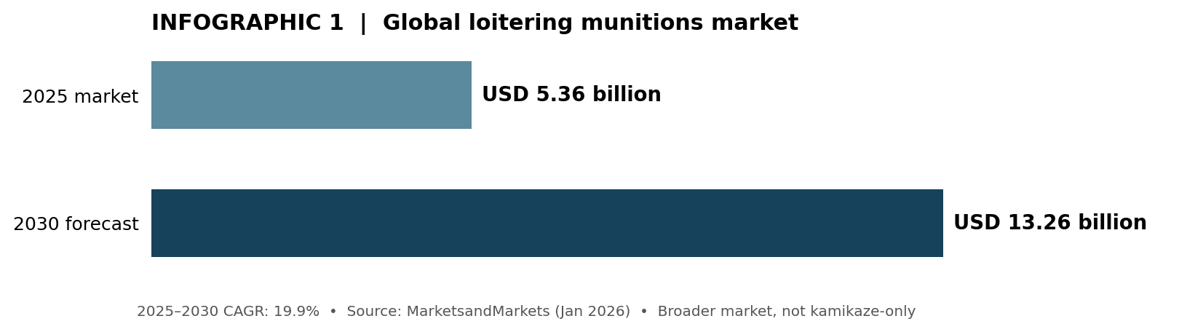
MarketsandMarkets estimates that the global loitering munitions market will rise from USD 5.36 billion in 2025 to USD 13.26 billion by 2030, equivalent to a 19.9% compound annual growth rate. This projection applies to the entire loitering munitions market, rather than to kamikaze drones as an independently priced category. The difference is important when interpreting forecasts: expendable and recoverable platforms, various range bands, and different military end users are covered within the headline market value. Demand is supported by modernization programs, growing attention to tactical precision strike systems, and the integration of unmanned systems with existing military command arrangements.
A competitive landscape built around different mission classes
Competition extends far beyond a comparison of headline maximum ranges. AeroVironment’s Switchblade 300 and 600 families illustrate differentiated tactical and longer-reach offerings; WB Group’s WARMATE portfolio is associated with Poland’s expanding domestic procurement framework. Israel Aerospace Industries markets HAROP as a long-endurance platform, while Elbit Systems describes SkyStriker with electric propulsion and an optional recovery arrangement. UVision’s HERO family includes multiple configurations. These examples show the diversity of products in the category; they are not a performance ranking and do not establish manufacturer market shares. Product offerings also change over time, making variant-specific comparisons more informative than broad brand-level claims.
What published defense purchases actually show
In May 2025, Poland’s Armament Agency and WB Group signed a framework for nearly 1,000 WARMATE sets, covering close to 10,000 munitions under implementing agreements planned through 2035. It signals significant intended acquisition scale, but a framework is not the same as completed deliveries. Poland subsequently announced agreements covering GLADIUS, FLYEYE and WARMATE in May 2026; those broader unmanned-systems arrangements should not be represented as purchases solely of kamikaze drones. In August 2026, AeroVironment announced a USD 51 million U.S. Army order for Switchblade 600, reflecting an additional disclosed acquisition within an established military procurement pathway. These different announcement types must be distinguished in any comparison of market demand.
Selected procurement and program developments
|
Date |
Disclosure |
Interpretation |
|
May 2025 |
Poland: WARMATE framework, nearly 10,000 munitions |
Framework; follow-on implementing orders |
|
May 2026 |
Poland: GLADIUS, FLYEYE and WARMATE agreements |
Multi-system procurement; not all loitering munitions |
|
Aug 2026 |
U.S.: USD 51m Switchblade 600 order |
Disclosed purchase order |
Innovation priorities: sensors, resilience and mission integration
Product development is being shaped by the need for improved observation and operator decision support. Electro-optical and infrared imaging enables visual confirmation in different operating conditions, while navigation architectures and communications are increasingly assessed against electronic interference. The relevance of each capability depends on how the weapon is employed and the system’s intended environment. Integrating the air vehicle with launch equipment, ground control stations and command networks remains essential. Equally significant are the procedures surrounding target confirmation, human authorization and mission cancellation. None of these characteristics can be reduced to a universal measure of technical superiority, because trade-offs differ by configuration and operational requirement.
Production readiness is becoming part of market differentiation
Procurement announcements can create expectations of larger manufacturing volumes, but production scale is not determined by the number of aircraft alone. A deployable loitering-munition capability may include launchers, control equipment, spare parts, training support, software and integration services. Contract figures can therefore exceed the price of the airborne weapon itself. Industrial readiness also depends on stable component sourcing, qualification processes, delivery schedules and the ability to maintain quality across production batches. A large framework value or multi-year ceiling should not be mistaken for annual revenue, while a program announcement should not be counted as confirmed deliveries unless the public record supports that conclusion.
Range and endurance create distinct market segments
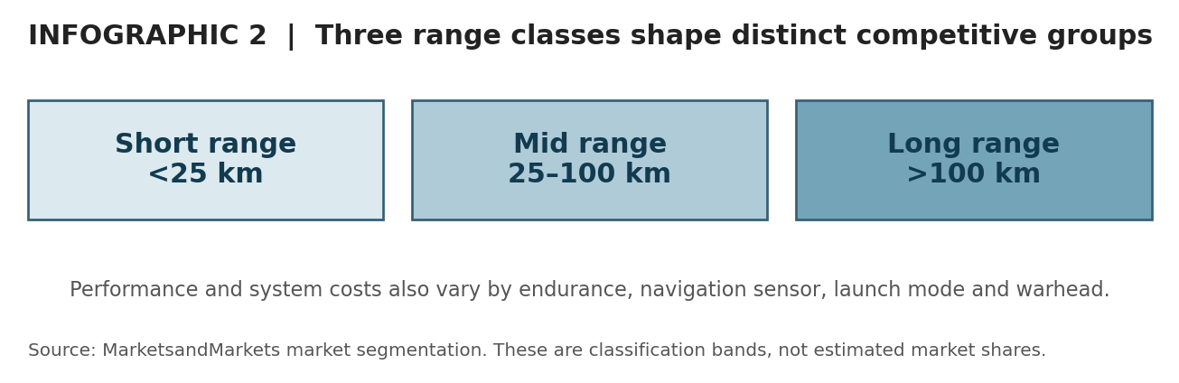
The published MarketsandMarkets segmentation separates short-range systems below 25 km, mid-range systems from 25 km to 100 km, and long-range systems above 100 km. It also distinguishes short, medium and long endurance, warhead type, navigation sensor, launch mode and end user. These dimensions help explain why seemingly comparable products can address different procurement programs. A short-range platform may emphasize portability and ease of deployment, while larger systems can require different launch arrangements, communications infrastructure and support equipment. A robust market assessment must account for these boundaries before comparing prices, growth rates or competitive positions.
Geographic opportunity depends on national acquisition models
The United States has an established acquisition base for loitering weapons and continues to issue orders under active procurement arrangements. Poland provides a different example, with substantial domestic-framework activity supporting locally supplied systems. Other markets are shaped by defense industrial policy, export controls, national qualification requirements and partnership arrangements. For this reason, reports of rising interest across regions should not automatically be translated into equal demand or identical market accessibility. Procurement status, delivery horizons and local manufacturing requirements determine how much of an announced opportunity may materialize over the forecast period.
Outlook to 2030
The kamikaze drone industry is evolving from a relatively narrow set of recognizable systems into a wider group of products distinguished by mission class, sensor capability, integration requirements and production maturity. Published orders and frameworks show that procurement interest is measurable, but the commercial significance of each announcement must be interpreted accurately. The global loitering munitions outlook points to strong market expansion through 2030, while the real competitive landscape will continue to depend on the specific range, endurance, launch configuration and military requirement served by each platform. MarketsandMarkets’ Loitering Munition Market study assesses these divisions alongside market forecasts and company activity.

This FREE sample includes market data points, ranging from trend analyses to market estimates & forecasts. See for yourself.
SEND ME A FREE SAMPLE