Military Cloud Computing Market Trends 2026: AI, Hybrid Clouds, and Tactical Edge Computing Reshape Defense Networks
Key Takeaways
-
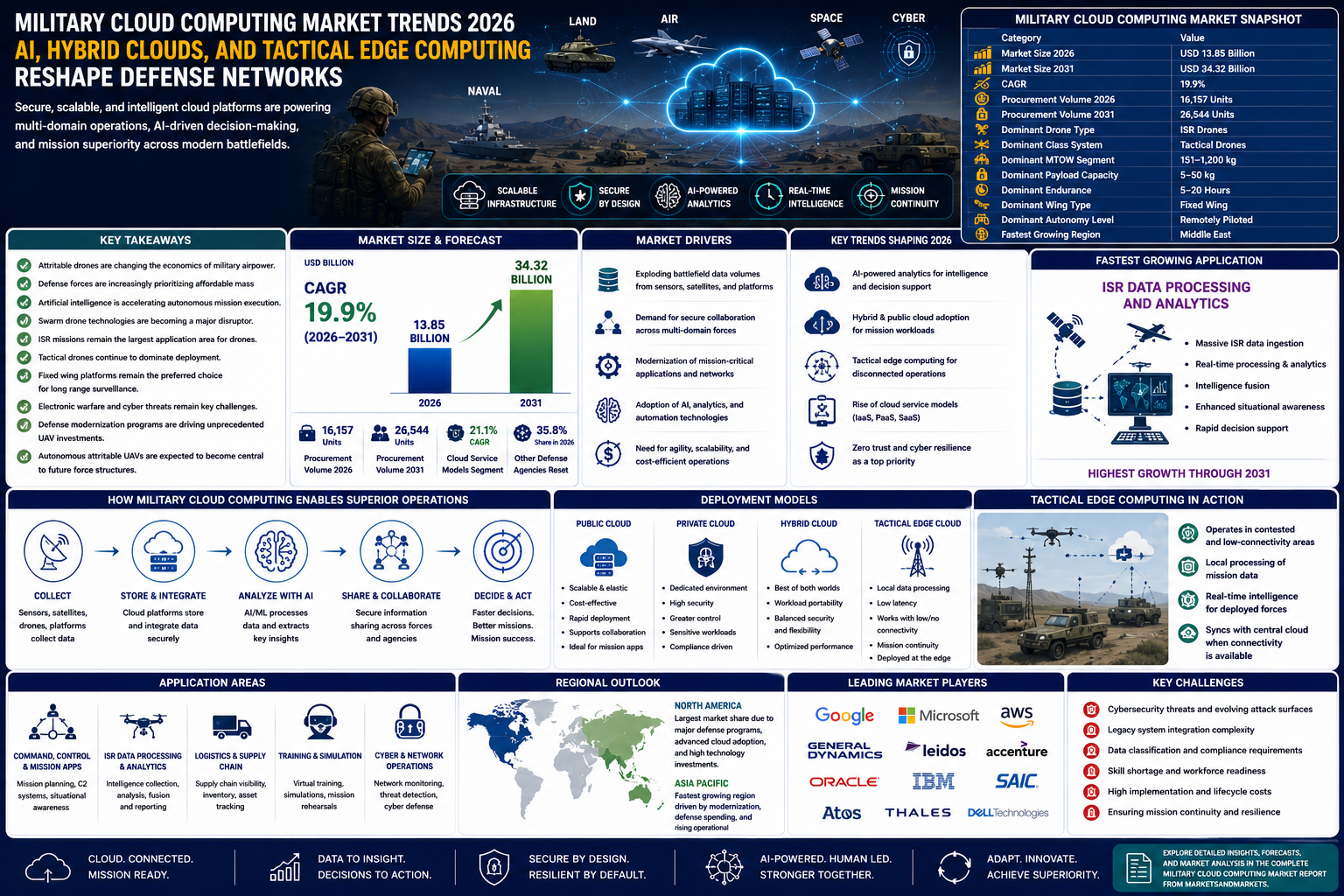
The Military Cloud Computing Market is projected to grow from USD 13.85 billion in 2026 to USD 34.32 billion by 2031 at a CAGR of 19.9%.
-
Defense organizations are moving mission critical applications, ISR workloads, logistics platforms, and command systems to secure cloud environments.
-
Cloud service models are expected to register the highest growth rate as defense users seek scalable infrastructure and software capabilities.
-
Command, control, and mission applications remain the largest application segment across military cloud deployments.
-
ISR data processing and analytics is emerging as the fastest growing workload category.
-
North America remains the largest regional market, while Asia Pacific is expected to record the fastest growth.
-
Tactical edge computing is becoming essential for operations in contested and low connectivity environments.
-
Hybrid and public cloud environments are supporting military modernization initiatives across land, naval, air, and space forces.
-
Cybersecurity remains one of the most significant challenges for military cloud adoption.
-
AI powered analytics is transforming intelligence gathering, mission planning, and operational decision making.
Frequently Asked Questions
What is driving growth in the Military Cloud Computing Market?
The growing volume of battlefield data, increasing demand for secure information sharing, modernization of defense networks, and adoption of AI enabled mission systems are driving market growth.
Why are defense agencies investing in cloud computing?
Cloud computing provides scalable infrastructure for mission applications, ISR processing, logistics management, readiness programs, and command systems while improving operational efficiency.
What role does AI play in military cloud environments?
AI enables faster intelligence analysis, predictive maintenance, automated threat detection, mission planning support, and enhanced situational awareness.
Which region leads the Military Cloud Computing Market?
North America is expected to hold the largest market share due to significant defense cloud investments and major programs supporting military modernization.
What is tactical edge computing?
Tactical edge computing brings cloud capabilities closer to deployed forces, enabling local data processing and mission support even when connectivity is limited.
Why Military Cloud Computing Is Becoming a Strategic Defense Priority in 2026
Military organizations are facing a challenge unlike anything seen in previous decades. The amount of data generated during modern operations continues to expand at an unprecedented pace. Intelligence feeds, surveillance platforms, satellite imagery, logistics systems, autonomous vehicles, command centers, and battlefield sensors all generate continuous streams of information that must be processed, analyzed, secured, and shared in near real time.
Traditional defense IT architectures were not designed for this scale. Many were developed for isolated networks, fixed infrastructure, and limited data exchange between military branches. As warfare becomes increasingly data driven, defense organizations are turning to cloud computing as a strategic capability rather than simply an information technology upgrade.
The Military Cloud Computing Market reflects this transformation. The market is projected to grow from USD 13.85 billion in 2026 to USD 34.32 billion by 2031, representing a CAGR of 19.9%. This growth highlights how cloud infrastructure has become central to modern military operations, intelligence activities, logistics management, readiness programs, training systems, and mission execution.
Military cloud adoption is no longer limited to data center modernization. Today, cloud platforms support operational missions, intelligence workflows, secure collaboration, and battlefield decision making. The integration of artificial intelligence, hybrid cloud architectures, and tactical edge computing is further accelerating this shift.
Read the Full Military Cloud Computing Market Report: https://www.marketsandmarkets.com/Market-Reports/military-cloud-market-133363531.html
Download Sample Report: https://www.marketsandmarkets.com/requestsampleNew.asp?id=133363531
Explore Deeper Military Cloud Computing Insights
Organizations seeking detailed forecasts, segment analysis, competitive benchmarking, and regional outlooks can explore the complete Military Cloud Computing Market Report from MarketsandMarkets.
Military Cloud Computing Market at a Glance
| Metric | Value |
|---|---|
| Market Size 2026 | USD 13.85 Billion |
| Market Size 2031 | USD 34.32 Billion |
| CAGR | 19.9% |
| Largest Region | North America |
| Fastest Growing Region | Asia Pacific |
| Largest Application | Command, Control, and Mission Applications |
| Fastest Growing Application | ISR Data Processing and Analytics |
| Fastest Growing Offering | Cloud Service Models |
| Largest End User | Other Defense Agencies |
| Leading Deployment Model | Public Cloud |
The pace of growth demonstrates that military cloud computing is becoming one of the most significant areas of investment across defense modernization programs worldwide.
AI Is Becoming the Operational Backbone of Defense Cloud Infrastructure
Artificial intelligence is increasingly dependent on cloud environments to operate at scale. Defense organizations generate enormous quantities of intelligence and operational data that must be analyzed rapidly to support decision making.
Military cloud platforms provide the computational resources needed to run advanced AI algorithms across multiple mission environments. Intelligence teams can process surveillance data, identify threats, monitor patterns, and generate actionable insights more efficiently than through traditional systems.
AI Powered Intelligence Operations
ISR missions rely on information collected from satellites, aircraft, drones, ships, and ground systems. As data volumes increase, cloud platforms enable faster processing and analysis.
AI applications help defense organizations:
-
Analyze imagery and video feeds
-
Detect unusual activity
-
Support intelligence assessments
-
Improve threat identification
-
Enhance battlefield awareness
Predictive Maintenance and Readiness
Military fleets generate large amounts of operational and maintenance data. Cloud based AI systems can analyze performance metrics to predict equipment failures before they occur.
This capability improves readiness, reduces downtime, and enables more efficient maintenance planning across defense organizations.
Accelerating Decision Cycles
Modern military operations increasingly depend on rapid decision making. AI supported cloud environments help commanders access information faster, improving operational responsiveness and mission effectiveness.
Hybrid Cloud Architectures Are Becoming the Defense Standard
Defense organizations operate across diverse environments ranging from highly secure headquarters facilities to remote operational theaters. No single deployment model can support all requirements.
As a result, hybrid cloud architectures are emerging as the preferred approach for military cloud deployments.
Balancing Security and Flexibility
Hybrid environments allow defense users to maintain sensitive workloads within secure infrastructures while leveraging scalable cloud services for broader operational requirements.
Benefits include:
-
Enhanced scalability
-
Improved workload distribution
-
Better resource utilization
-
Greater operational resilience
-
Simplified modernization initiatives
Why Public Cloud Leads Deployment Growth
The public cloud segment is expected to dominate the market because defense users increasingly require scalable capacity without managing every infrastructure component themselves.
Public cloud services support mission applications, logistics systems, readiness programs, ISR workloads, and secure collaboration across multiple agencies.
Tactical Edge Computing Brings Cloud Capabilities to the Battlefield
One of the most significant developments in military cloud computing is the rise of tactical edge computing.
Traditional cloud architectures often rely on centralized processing. However, battlefield operations frequently occur in environments where connectivity is degraded, disrupted, or unavailable.
Tactical edge computing addresses this challenge by moving computing resources closer to deployed forces.
Why Tactical Edge Matters
Military personnel require immediate access to information regardless of network conditions.
Tactical edge environments support:
-
Local data processing
-
Real time intelligence analysis
-
Mission applications
-
Secure communications
-
Operational continuity
Supporting Disconnected Operations
Field units operating in remote locations may not have continuous access to centralized cloud infrastructure. Tactical edge cloud systems allow critical applications to function independently while synchronizing with broader cloud networks when connectivity becomes available.
This capability is creating new demand for specialized cloud solutions designed specifically for military operations.
ISR Workloads Are Creating the Next Wave of Cloud Demand
ISR data processing and analytics is projected to register the highest growth rate among military cloud applications during the forecast period.
Defense organizations increasingly depend on ISR assets to monitor activities, identify threats, and support operational planning.
Data Volumes Continue to Rise
Modern ISR operations generate data from:
-
Satellites
-
Drones
-
Aircraft
-
Ships
-
Ground sensors
-
Surveillance systems
Managing these datasets requires cloud environments capable of storing, integrating, and analyzing information at scale.
Faster Intelligence Cycles
Cloud computing enables intelligence teams to process large datasets more efficiently, helping commanders make informed decisions faster.
The growing importance of ISR analytics explains why this segment is becoming one of the strongest growth drivers within the Military Cloud Computing Market.
Command and Mission Applications Continue to Dominate Spending
While ISR analytics is growing rapidly, command, control, and mission applications remain the largest application segment.
Military organizations depend on cloud platforms to connect operational users across multiple domains.
Supporting Multi Domain Operations
Cloud based command systems facilitate:
-
Information sharing
-
Mission coordination
-
Operational planning
-
Resource management
-
Situational awareness
These capabilities help connect land, naval, air, space, and defense agency operations through a common digital environment.
Faster Decisions in Complex Environments
Military leaders increasingly require access to real time operational information. Cloud enabled command systems support faster decision making and improved coordination across joint operations.
The Cybersecurity Challenge Facing Military Cloud Environments
As cloud adoption increases, cybersecurity becomes even more critical.
Military cloud systems store mission critical information and support operational activities that represent valuable targets for adversaries.
Expanding Attack Surfaces
Cloud migration introduces new considerations involving:
-
Identity management
-
Data movement
-
API security
-
Third party applications
-
Hybrid environments
Each area requires robust security controls.
Managing Risk in Cloud Ecosystems
Defense organizations must balance modernization objectives with strict security requirements.
Cloud security strategies increasingly focus on:
-
Access control
-
Continuous monitoring
-
Authorization frameworks
-
Secure workload management
-
Operational resilience
The ability to secure military cloud environments will remain a major factor influencing adoption rates.
Tactical Edge Solutions Are Creating New Growth Opportunities
An important market opportunity is emerging around field level cloud deployments.
Defense users require cloud capabilities closer to operational environments, particularly where communications infrastructure may be limited.
The Rise of Edge Cloud Platforms
Tactical edge systems support:
-
Local intelligence processing
-
Mission applications
-
Operational data sharing
-
Secure collaboration
-
Battlefield analytics
As military organizations expand deployments into challenging environments, demand for edge cloud capabilities is expected to increase significantly.
Commercial Deployments Demonstrate Real World Adoption
Several recent implementations illustrate how cloud technologies are supporting defense modernization efforts.
| Company | Deployment | Strategic Benefit |
|---|---|---|
| AWS | JWCC Program | Supports mission applications and secure workload hosting |
| Google Public Sector | Mobility Guardian 2025 | Tactical edge cloud operations in low bandwidth environments |
| Dell EMC Tactical Azure Stack | Rugged edge deployments | Hybrid cloud operations closer to deployed forces |
These deployments demonstrate how military organizations are applying cloud technologies beyond traditional enterprise IT functions.
Regional Outlook: Where Military Cloud Investments Are Accelerating
North America Remains the Largest Market
North America is expected to account for the largest market share during the forecast period.
Several factors support this position:
-
High defense cloud spending
-
Large scale modernization programs
-
Extensive use of secure cloud environments
-
Strong demand for mission applications and ISR systems
The region continues to lead adoption across public, private, hybrid, and tactical edge cloud deployments.
Asia Pacific Emerges as the Fastest Growing Region
Asia Pacific is projected to record the highest growth rate through the forecast period.
Growth is being supported by:
-
Rising defense budgets
-
Military modernization programs
-
Increasing adoption of digital defense systems
-
Expanding ISR requirements
-
Greater emphasis on joint operations
Countries across the region are investing in technologies that improve connectivity, operational awareness, and mission effectiveness.
Access Regional Market Insights and Forecasts: https://www.marketsandmarkets.com/Market-Reports/military-cloud-market-133363531.html
Download Sample Report: https://www.marketsandmarkets.com/pdfdownloadNew.asp?id=133363531
Competitive Landscape: Who Is Shaping the Military Cloud Computing Market?
Competition in the market includes cloud providers, defense contractors, managed service providers, and systems integrators.
Star Players
MarketsandMarkets identifies several organizations as star players based on market presence and capabilities:
-
Google
-
Microsoft
-
General Dynamics Corporation
Emerging Participants
Wind River has established a strong position within specialized cloud and edge computing environments and is recognized as a promising emerging player.
Key Market Participants
-
General Dynamics Corporation
-
Microsoft
-
Amazon
-
Leidos
-
Accenture
-
Oracle
-
IBM
-
SAIC
-
Atos SE
-
Thales
What Military Cloud Computing Means for Defense Leaders and Investors
The rapid growth of military cloud computing reflects a broader transformation occurring across defense organizations worldwide.
For defense leaders, cloud platforms offer opportunities to improve mission effectiveness, operational agility, and information sharing.
For technology providers, demand is expanding across cloud migration, integration, managed operations, security, compliance, and tactical edge deployments.
For investors, the market represents an area where defense modernization, artificial intelligence, cybersecurity, and digital infrastructure intersect.
MarketsandMarkets Perspective: What the Data Suggests
Several themes stand out across the Military Cloud Computing Market.
First, cloud service models remain the foundation of military cloud spending because they support mission applications, analytics, secure access, and operational scalability.
Second, defense agencies continue to represent a major source of demand due to their responsibility for large scale mission data, intelligence activities, and cross service operations.
Third, ISR processing and analytics is becoming one of the fastest growing workload categories as defense organizations generate increasing volumes of intelligence data.
Finally, tactical edge computing is evolving from a niche capability into a core requirement for modern military operations.
Explore Comprehensive Military Cloud Computing Market Intelligence
Military cloud computing is rapidly evolving as defense organizations modernize mission systems, intelligence operations, logistics networks, and command infrastructures. Understanding future technology trends and investment opportunities requires a comprehensive view of the market landscape.
Read the Full Military Cloud Computing Market Report: https://www.marketsandmarkets.com/Market-Reports/military-cloud-market-133363531.html
Download PDF Brochure: https://www.marketsandmarkets.com/pdfdownloadNew.asp?id=133363531
The Road Ahead for Military Cloud Computing
Military cloud computing is entering a new phase of growth driven by data intensive operations, AI enabled analytics, hybrid architectures, and tactical edge deployments.
Defense organizations are increasingly viewing cloud infrastructure as a strategic operational asset rather than a technology support function. As cloud environments continue to expand, they will become central to intelligence gathering, command and control, logistics management, readiness programs, and mission execution.
The convergence of AI, cloud computing, and edge technologies is expected to redefine how military forces process information, coordinate operations, and maintain decision superiority in increasingly complex environments.
Organizations seeking deeper insights into market forecasts, competitive positioning, deployment trends, and future growth opportunities can explore the complete Military Cloud Computing Market research from MarketsandMarkets.

This FREE sample includes market data points, ranging from trend analyses to market estimates & forecasts. See for yourself.
SEND ME A FREE SAMPLE

