Military Robots Market Outlook 2035
- HOME
- Aerospace and Defence
- Military Robots Market 2035: AI, Swarm Intelligence, and Multi-Domain Operations Shape the Next Growth Wave
Military Robots Market 2035: AI, Swarm Intelligence, and Multi-Domain Operations Shape the Next Growth Wave
The global military robotics market is entering a new phase of growth as defense organizations accelerate investments in autonomous systems, artificial intelligence (AI), and advanced battlefield automation technologies. Once limited to reconnaissance drones and explosive ordnance disposal platforms, military robots are now evolving into highly intelligent systems capable of supporting combat operations, logistics, surveillance, electronic warfare, and multi-domain missions. As geopolitical tensions rise and military modernization programs expand worldwide, robotic systems are becoming a critical component of future force structures.
By 2035, the convergence of AI, swarm intelligence, autonomous decision-making, and network-centric warfare is expected to fundamentally reshape defense operations. Governments are increasingly viewing military robotics not simply as force multipliers but as strategic assets capable of enhancing operational effectiveness, reducing personnel risk, and maintaining battlefield superiority in contested environments.
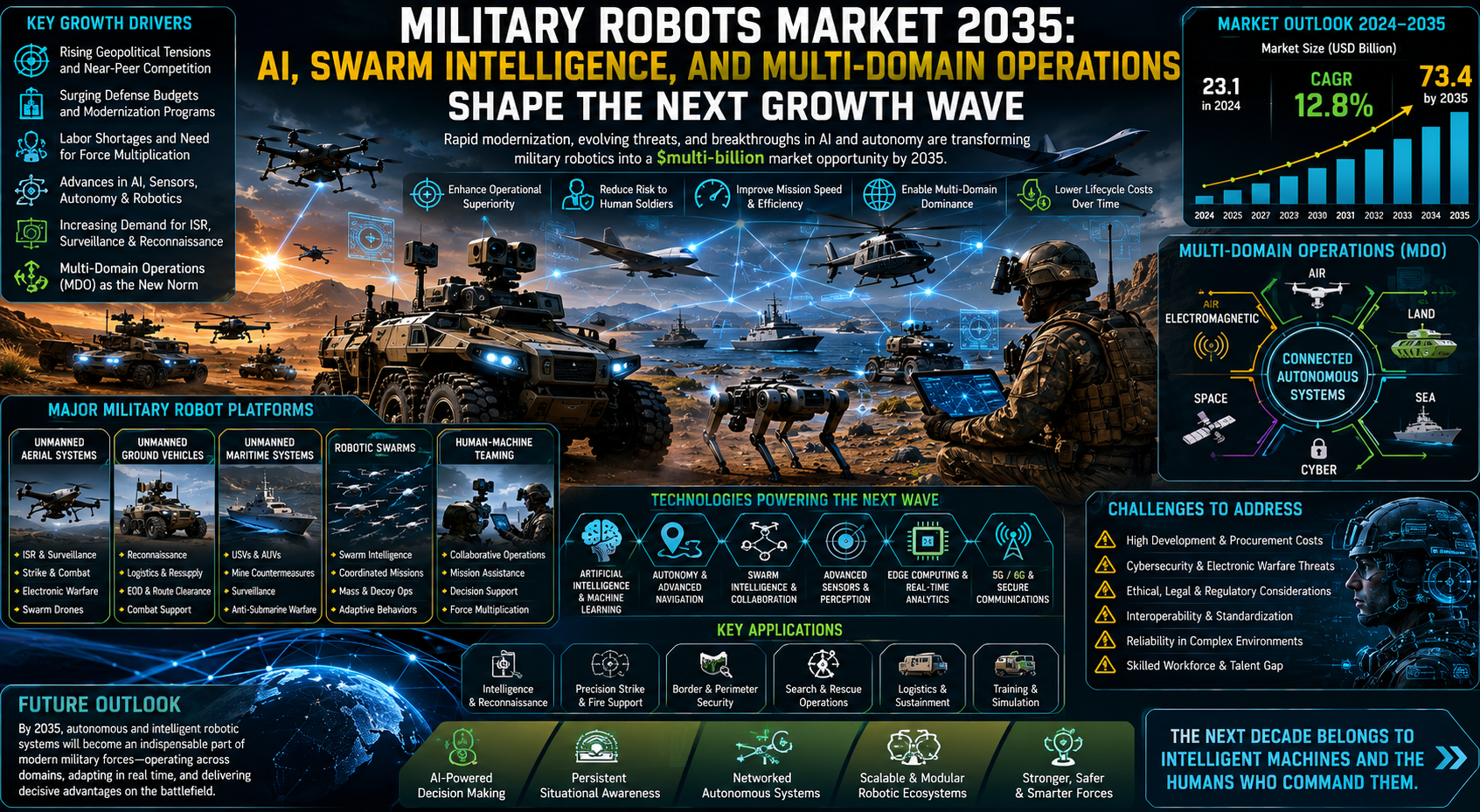
Rising Defense Modernization Programs Driving Market Growth
Military forces worldwide are pursuing modernization initiatives designed to address rapidly evolving security challenges.
Key drivers include:
- Near-peer military competition
- Multi-domain warfare requirements
- Increasing operational complexity
- Personnel shortages
- Demand for force multiplication
- Growing autonomous warfare capabilities
- Escalating geopolitical tensions
As defense budgets continue to increase across North America, Europe, Asia-Pacific, and the Middle East, military robotics programs are receiving significant funding to support future operational requirements.
Autonomous systems are increasingly viewed as essential tools for maintaining military readiness while improving mission effectiveness across diverse operational environments.
Artificial Intelligence Becoming the Core of Military Robotics
Artificial intelligence is emerging as the foundational technology powering next-generation military robotic systems.
AI enables robots to perform functions such as:
- Autonomous navigation
- Threat recognition
- Target classification
- Route optimization
- Predictive maintenance
- Mission planning
- Sensor fusion
Modern AI systems can process vast amounts of battlefield information in real time, helping commanders make faster and more informed decisions.
As machine learning algorithms continue to improve, military robots are expected to operate with greater autonomy while maintaining human oversight and mission control.
The integration of AI is transforming robotic platforms from remotely controlled tools into intelligent battlefield assets capable of supporting complex military operations.
Human-Machine Teaming Defining Future Combat Operations
One of the most important trends shaping the military robotics market is the emergence of human-machine teaming.
Future military operations are expected to rely heavily on collaboration between soldiers and autonomous systems rather than complete robotic independence.
Human-machine teaming offers several advantages:
- Enhanced situational awareness
- Faster operational decision-making
- Reduced cognitive workload
- Improved mission coordination
- Increased force survivability
- Greater battlefield flexibility
Robotic systems can analyze data, identify threats, and provide decision-support recommendations while human operators retain authority over mission-critical actions.
This collaborative approach is expected to become a central pillar of future military doctrine.
Swarm Intelligence Revolutionizing Autonomous Warfare
Swarm robotics represents one of the most disruptive technologies within the military robotics sector.
Swarm systems consist of multiple autonomous platforms capable of coordinating actions through distributed intelligence and real-time communication networks.
Potential applications include:
- Intelligence gathering
- Electronic warfare
- Area surveillance
- Precision strike missions
- Air defense penetration
- Decoy operations
- Logistics support
Unlike traditional military platforms, swarm systems offer scalability, redundancy, and operational resilience.
The ability to deploy large numbers of low-cost autonomous systems presents significant challenges for adversaries while enhancing military flexibility and mission effectiveness.
Defense agencies worldwide are investing heavily in swarm technologies as part of broader autonomous warfare initiatives.
Autonomous Ground Robots Expanding Battlefield Roles
Ground-based military robots are rapidly evolving beyond traditional support functions.
Modern unmanned ground vehicles (UGVs) support missions such as:
- Reconnaissance and surveillance
- Explosive ordnance disposal
- Route clearance
- Logistics resupply
- Casualty evacuation
- Perimeter security
- Combat support operations
Future ground robots are expected to feature advanced autonomy, AI-enabled navigation, and enhanced interoperability with other battlefield systems.
These capabilities improve operational efficiency while reducing risks to personnel operating in contested environments.
Unmanned Aerial Systems Driving Market Expansion
Military drones remain one of the largest and fastest-growing segments of the military robotics market.
Advanced unmanned aerial systems support:
- Intelligence, surveillance, and reconnaissance (ISR)
- Precision strike operations
- Communications relay
- Electronic warfare
- Border security
- Maritime surveillance
- Autonomous swarm missions
The integration of AI and advanced sensors is enabling drones to operate with greater independence while supporting increasingly complex mission profiles.
Future aerial robotic systems are expected to play a critical role in multi-domain military operations.
Autonomous Maritime Systems Enhancing Naval Operations
Naval forces are increasingly investing in unmanned maritime platforms to improve operational reach and reduce risks to crewed vessels.
Emerging technologies include:
Unmanned Surface Vessels (USVs)
Supporting surveillance, mine countermeasures, and maritime security missions.
Autonomous Underwater Vehicles (AUVs)
Conducting intelligence gathering, seabed mapping, and anti-submarine warfare operations.
Robotic Logistics Platforms
Supporting autonomous resupply and sustainment operations.
These systems provide cost-effective solutions for expanding naval capabilities across contested maritime environments.
Multi-Domain Operations Driving Robotics Integration
Modern military doctrine increasingly emphasizes Multi-Domain Operations (MDO), which require synchronized activities across Land, Air, Sea, Space, Cyber, Electromagnetic spectrum. Military robots are becoming critical enablers of MDO by providing persistent sensing, communications, intelligence collection, and operational coordination capabilities.
Robotic platforms can support:
- Cross-domain information sharing
- Distributed operations
- Joint-force integration
- Real-time battlefield awareness
- Dynamic mission execution
The ability to operate seamlessly across multiple domains is becoming a key requirement for next-generation military robotic systems.
Autonomous Logistics Transforming Defense Sustainment
Military logistics is undergoing significant transformation through the adoption of autonomous technologies.
Emerging solutions include:
- Autonomous supply vehicles
- Logistics drones
- Robotic warehousing systems
- AI-driven inventory management
- Autonomous maritime resupply platforms
These systems improve supply chain efficiency, enhance battlefield sustainment, and reduce risks associated with contested logistics operations.
As military organizations prioritize operational readiness, autonomous logistics capabilities are becoming increasingly important components of defense modernization programs.
Electronic Warfare and Cyber Resilience Becoming Critical Requirements
Future military robots must operate effectively in highly contested electromagnetic environments.
Challenges include:
- GPS denial
- Communications jamming
- Cyberattacks
- Electronic warfare interference
- Data manipulation
To address these threats, defense organizations are investing in:
- Resilient communications networks
- AI-enabled cyber defense systems
- Autonomous navigation technologies
- Secure battlefield connectivity
- Electronic warfare countermeasures
Cyber resilience is becoming a critical design requirement for next-generation robotic platforms.
Challenges Facing Military Robotics Adoption
Despite strong growth prospects, several challenges remain.
Ethical and Legal Considerations
Ensuring appropriate human oversight of autonomous combat systems.
Technology Reliability
Maintaining performance in complex operational environments.
Interoperability Requirements
Integrating robotic systems across diverse military platforms and allied networks.
Cybersecurity Risks
Protecting autonomous systems from sophisticated cyber threats.
Development Costs
Advanced robotics programs require substantial investment and long-term research commitments.
Addressing these challenges will be essential for achieving widespread deployment of autonomous military systems.
Future Outlook
The military robotics market is expected to experience significant expansion through 2035 as AI, autonomy, and advanced networking technologies continue to reshape defense operations. Future robotic ecosystems will move beyond individual platforms toward highly connected networks of intelligent systems capable of operating collaboratively across multiple domains.
Several trends are expected to define the next growth wave:
- AI-powered combat robots
- Autonomous drone swarms
- Human-machine teaming ecosystems
- Multi-domain robotic operations
- Autonomous logistics networks
- Intelligent battlefield decision-support systems
- Self-learning robotic platforms
As defense organizations continue investing in advanced robotics, autonomous systems will become indispensable components of future military capabilities. The convergence of artificial intelligence, swarm intelligence, multi-domain operations, and autonomous warfare technologies is creating a new generation of military robotic ecosystems that will enhance operational effectiveness, improve force survivability, and shape the future of global defense through 2035 and beyond.

This FREE sample includes market data points, ranging from trend analyses to market estimates & forecasts. See for yourself.
SEND ME A FREE SAMPLE






