Military Robots Market Size, Share, Growth & Trends

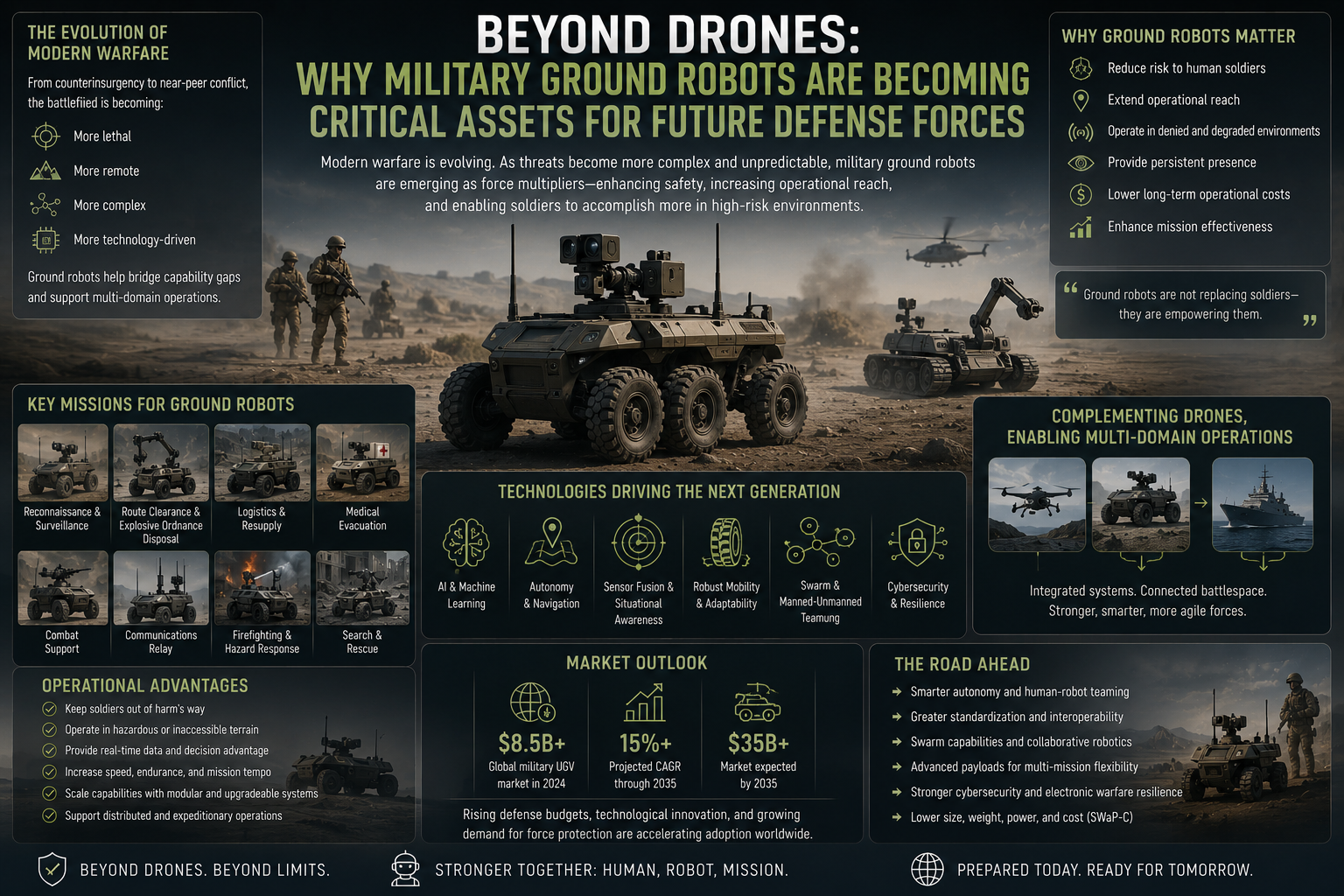
Beyond Drones: Why Military Ground Robots Are Becoming Critical Assets for Future Defense Forces

The rapid evolution of modern warfare is driving military organizations to invest in a new generation of autonomous and semi-autonomous technologies that extend beyond aerial drone capabilities. While unmanned aerial systems have transformed intelligence gathering and precision strike operations, military ground robots are emerging as equally important assets for future defense forces. Equipped with advanced sensors, artificial intelligence, autonomous navigation systems, and mission-specific payloads, these robotic platforms are enhancing battlefield effectiveness, reducing operational risks, and supporting defense modernization efforts across the globe. the military robots market size was valued at USD 18.19 billion in 2024 and is projected to reach USD 26.49 billion by 2029, growing at a CAGR of 7.8% from 2024 to 2029.

Expanding the Role of Unmanned Ground Systems

Military ground robots, commonly referred to as Unmanned Ground Vehicles (UGVs), are designed to perform a wide range of missions in complex and contested environments. Unlike aerial drones, ground robots can operate directly within urban areas, rugged terrain, underground facilities, and high-risk combat zones where human access may be dangerous or limited.

Modern UGVs are increasingly deployed for reconnaissance, surveillance, explosive ordnance disposal (EOD), logistics support, route clearance, perimeter security, and direct combat support. Their versatility is making them indispensable tools for military operations across conventional and asymmetric warfare scenarios.

Military Robots market Trends

Reducing Risk to Military Personnel

One of the most significant advantages of military ground robots is their ability to perform dangerous tasks while minimizing risks to soldiers. Defense forces are increasingly using robotic systems to detect improvised explosive devices (IEDs), dispose of unexploded ordnance, inspect hazardous environments, and conduct reconnaissance missions in contested areas.

By placing robotic platforms in harm's way rather than personnel, military organizations can significantly reduce casualties while maintaining operational effectiveness. This capability has become especially valuable in urban warfare, counterinsurgency operations, and border security missions where threats are often unpredictable.

Download Free Sample of Report: https://www.marketsandmarkets.com/Market-Reports/military-robots-market-245516013.html

Artificial Intelligence Enhancing Autonomous Operations

Advances in artificial intelligence are transforming military ground robots from remotely controlled machines into increasingly autonomous systems capable of making intelligent decisions in dynamic environments.

AI-powered navigation, obstacle avoidance, computer vision, sensor fusion, and real-time data processing enable robotic platforms to operate with minimal human intervention. These technologies allow ground robots to identify threats, adapt to changing battlefield conditions, and execute mission objectives more efficiently.

As machine learning capabilities continue to improve, future UGVs are expected to demonstrate higher levels of autonomy while maintaining human oversight for critical decision-making processes.

Supporting Multi-Domain Warfare Strategies

Modern military operations increasingly rely on coordinated actions across land, air, maritime, space, and cyber domains. Ground robots play a crucial role within this multi-domain framework by serving as intelligence nodes, force multipliers, and operational support assets.

Unmanned ground systems can work alongside aerial drones, manned vehicles, and command-and-control networks to provide real-time situational awareness and battlefield intelligence. This integration enhances operational coordination and enables faster, more informed decision-making across military formations.

As armed forces continue developing network-centric warfare capabilities, ground robots will become increasingly interconnected within broader defense ecosystems.

Transforming Military Logistics and Sustainment

Beyond combat operations, military ground robots are revolutionizing logistics and sustainment activities. Autonomous transport vehicles are capable of delivering ammunition, fuel, medical supplies, and equipment to frontline units without exposing personnel to enemy threats.

AI-driven logistics platforms can optimize routes, monitor cargo status, and support resupply operations in contested environments. These capabilities improve operational readiness, enhance supply chain resilience, and reduce the logistical burden on military personnel.

As defense organizations prioritize operational efficiency, robotic logistics solutions are expected to become a major area of investment.

Enabling Human-Machine Teaming

The future battlefield will increasingly depend on effective collaboration between human operators and autonomous systems. Human-machine teaming concepts are allowing soldiers and ground robots to work together in ways that maximize the strengths of both.

Ground robots can carry heavy equipment, conduct reconnaissance ahead of troops, provide perimeter security, and support tactical maneuvers while soldiers retain strategic oversight and decision-making authority. This collaborative approach enhances mission effectiveness while improving force protection.

Human-machine teaming is rapidly becoming a central component of military modernization programs worldwide.

Technological Innovations Driving Market Growth

Several emerging technologies are accelerating the development of advanced military ground robots:

  • Artificial intelligence and machine learning
  • Autonomous navigation and path-planning systems
  • Computer vision and sensor fusion technologies
  • Edge computing and real-time data analytics
  • Advanced communications and secure networking
  • Swarm robotics and collaborative autonomous systems
  • Hybrid-electric propulsion and energy management
  • Modular payload architectures

These innovations are expanding the operational capabilities of ground robots and enabling new mission applications across defense sectors.

Defense Modernization Programs Accelerating Adoption

Governments worldwide are increasing investments in autonomous ground systems as part of broader defense modernization initiatives. Rising geopolitical tensions, evolving threat environments, and the need for force protection are driving demand for robotic solutions that enhance operational flexibility and combat effectiveness.

Military organizations across North America, Europe, Asia-Pacific, and the Middle East are actively pursuing programs focused on autonomous combat vehicles, robotic reconnaissance platforms, and AI-enabled battlefield systems. These investments are expected to accelerate adoption and innovation throughout the coming decade.

Explore In-Depth Industry Analysis: https://www.marketsandmarkets.com/Market-Reports/military-robots-market-245516013.html

The Future of Military Ground Robotics

The next generation of military ground robots will feature greater autonomy, enhanced mobility, improved battlefield awareness, and seamless integration with manned and unmanned systems. Future platforms are expected to support autonomous convoy operations, swarm-based missions, intelligent reconnaissance, and collaborative combat scenarios.

As artificial intelligence, robotics, and advanced sensing technologies continue to mature, ground robots will become increasingly capable of operating independently in complex environments while supporting broader military objectives.

While aerial drones continue to dominate discussions around military autonomy, ground robots are rapidly emerging as critical assets for future defense forces. Their ability to reduce risks to personnel, enhance operational efficiency, support logistics, and contribute to multi-domain warfare makes them indispensable components of modern military strategies. As defense modernization accelerates and autonomous technologies evolve, military ground robots will play an increasingly important role in shaping the future of warfare and strengthening the capabilities of armed forces worldwide.


Military Robots Market Size,  Share & Growth Report
Report Code
AS 3952
RI Published ON
6/16/2026
Choose License Type
BUY NOW
ADJACENT MARKETS
REQUEST BUNDLE REPORTS
X
GET A FREE SAMPLE

This FREE sample includes market data points, ranging from trend analyses to market estimates & forecasts. See for yourself.

SEND ME A FREE SAMPLE

  • Call Us
  • +1-888-600-6441 (Corporate office hours)
  • +1-888-600-6441 (US/Can toll free)
  • +44-800-368-9399 (UK office hours)
CONNECT WITH US
ABOUT TRUST ONLINE
©2026 MarketsandMarkets Research Private Ltd. All rights reserved
DMCA.com Protection Status
Get Free Sample Pages

Get Free Sample Pages of the Report

Request Now



