A New Era of Military Mobility
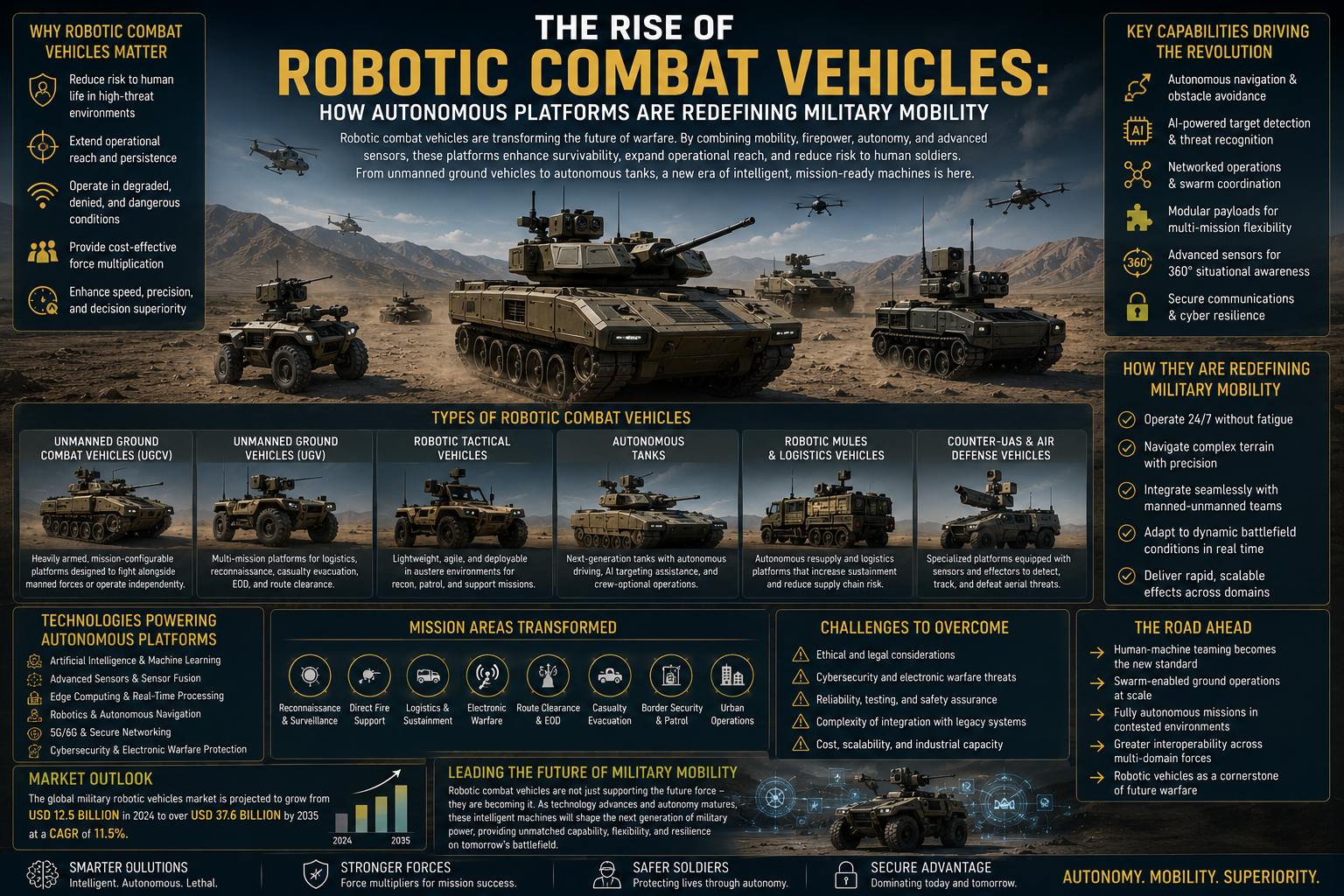
Traditional military vehicles have long served as the backbone of land warfare, providing mobility, firepower, and protection for ground forces. However, evolving threat landscapes and the increasing complexity of modern combat operations are driving demand for more adaptable and autonomous solutions. Robotic combat vehicles represent a significant leap forward, combining mobility with intelligent decision-support capabilities that allow them to operate with reduced human intervention.
These platforms can maneuver through challenging terrain, navigate urban environments, and support military operations in areas where risks to personnel are exceptionally high. By extending the operational reach of ground forces, robotic combat vehicles are becoming a critical element of future battlefield mobility strategies.
Artificial Intelligence Enabling Autonomous Operations
Artificial intelligence is at the heart of the robotic combat vehicle revolution. Advanced AI algorithms enable these platforms to process battlefield information in real time, identify obstacles, assess threats, and determine optimal routes with minimal operator input.
Machine learning, computer vision, and sensor fusion technologies allow autonomous vehicles to interpret complex environments and adapt to changing conditions. This capability significantly enhances operational efficiency and allows military units to deploy robotic systems in reconnaissance missions, convoy operations, surveillance activities, and combat support roles.
As autonomy technologies continue to mature, future robotic combat vehicles are expected to demonstrate increasingly sophisticated decision-making capabilities while remaining under appropriate human supervision for critical engagement decisions.
Enhancing Force Protection on the Battlefield
One of the primary advantages of robotic combat vehicles is their ability to reduce risks to military personnel. By performing missions in hazardous environments, autonomous platforms can minimize soldier exposure to enemy fire, improvised explosive devices, and other battlefield threats.
Military organizations are increasingly exploring the use of robotic vehicles for reconnaissance, route clearance, perimeter security, and high-risk logistics missions. These systems can enter contested areas, gather intelligence, and support tactical operations without placing human operators directly in harm's way.
This emphasis on force protection aligns closely with modern defense strategies focused on preserving combat effectiveness while reducing casualties.
Supporting Human-Machine Teaming Concepts
Rather than replacing soldiers, robotic combat vehicles are designed to work alongside human operators as part of integrated human-machine teams. This collaborative approach allows military forces to combine human judgment and strategic decision-making with the speed, endurance, and precision of autonomous systems.
In future combat scenarios, robotic vehicles may scout ahead of manned formations, provide intelligence updates, transport equipment, or support combat operations while soldiers maintain command oversight. This partnership enhances battlefield awareness and allows military units to operate more effectively in dynamic operational environments.
Human-machine teaming is becoming a central pillar of defense modernization initiatives and is expected to play an increasingly important role in future military doctrines.
Expanding Roles Across Combat and Support Missions
The versatility of robotic combat vehicles is one of the key factors driving their adoption. These platforms are capable of supporting a wide range of military missions beyond traditional combat roles.
Autonomous ground vehicles can conduct reconnaissance, surveillance, logistics transport, casualty evacuation, electronic warfare support, and force protection operations. Some advanced platforms are being developed with modular architectures that allow rapid reconfiguration for different mission requirements.
This flexibility enables defense forces to maximize operational value while adapting to diverse battlefield challenges and evolving mission demands.
Integration with Multi-Domain Operations
Modern warfare increasingly requires coordinated action across land, air, maritime, cyber, and space domains. Robotic combat vehicles contribute to this multi-domain approach by serving as connected nodes within broader military networks.
Through secure communications and real-time data sharing, robotic vehicles can exchange information with unmanned aerial systems, command centers, intelligence assets, and other battlefield platforms. This interconnected environment improves situational awareness and supports faster, more informed decision-making.
As defense organizations continue to pursue network-centric warfare strategies, robotic combat vehicles will become increasingly integrated into multi-domain operational frameworks.
Technological Advancements Accelerating Adoption
Rapid progress in several key technologies is driving the evolution of robotic combat vehicles. Advances in artificial intelligence, autonomous navigation, edge computing, advanced sensors, and secure communications are expanding the capabilities of these systems.
Improved battery technologies, hybrid-electric propulsion systems, and energy management solutions are also enhancing vehicle endurance and operational performance. At the same time, developments in cybersecurity and resilient communications are helping ensure reliable operation in contested environments.
These innovations are enabling robotic combat vehicles to perform more complex missions with greater autonomy and efficiency than ever before.
Defense Modernization Programs Fueling Market Growth
Governments worldwide are investing heavily in robotic combat vehicle development as part of broader military modernization efforts. Rising geopolitical tensions, evolving security threats, and the growing importance of technological superiority are encouraging defense agencies to accelerate the adoption of autonomous ground systems.
Major military powers are funding research programs, conducting operational trials, and integrating robotic vehicles into future force structures. Collaboration between defense contractors, technology firms, and military organizations is further accelerating innovation and commercialization across the sector.
As modernization programs continue to expand, robotic combat vehicles are expected to become a key area of defense spending and technological development.
The Future of Autonomous Ground Warfare
The next generation of robotic combat vehicles will feature higher levels of autonomy, improved mobility, enhanced battlefield awareness, and deeper integration with other autonomous systems. Future platforms may operate in coordinated formations, support swarm-based operations, and execute increasingly sophisticated missions across complex environments.
Artificial intelligence will continue to enhance decision support, navigation, and mission adaptability, enabling robotic vehicles to function as intelligent force multipliers on the battlefield. As technology advances, these platforms will play a central role in shaping the future of land warfare and military mobility.
Conclusion
Robotic combat vehicles are transforming the nature of military mobility by combining autonomous technologies, advanced sensing capabilities, and intelligent battlefield integration. Their ability to enhance force protection, support human-machine teaming, and operate effectively across a wide range of missions makes them a critical component of modern defense strategies. As military organizations continue investing in autonomous ground systems, robotic combat vehicles will play an increasingly important role in redefining battlefield operations and shaping the future of warfare.








