One-Way Attack Drone Market: Why Military Orders Are Reshaping Unmanned Strike Procurement
From battlefield terminology to a formal acquisition category
One-way attack drones are unmanned systems designed to strike a target rather than return after engagement. Some can loiter while an operator observes, identifies and authorizes an engagement; others follow a more direct route. This distinction matters because not every one-way drone is a loitering munition. Within the wider loitering munitions market, the one-way design is most closely associated with expendable systems. The public terminology is broad and can encompass vehicles with very different sizes, payloads, endurance and operational roles. Market comparisons therefore require a consistent equipment definition, not simply a shared popular name.
A market forecast needs a clear boundary
MarketsandMarkets values the global loitering munitions market at USD 5.36 billion in 2025 and forecasts USD 13.26 billion by 2030, a compound annual growth rate of 19.9%. This projection measures the whole loitering munitions market, including recoverable types, and must not be presented as the valuation of all one-way attack drones. It also covers differing range classes, navigation sensors, launch modes, warheads and end users. The fast expansion indicates interest in precision unmanned strike as a category, but an individual product or country will not necessarily follow the same growth rate.
Procurement announcements are the clearest leading indicators
Disclosed government orders provide a more actionable picture of the market than generic descriptions of drone adoption. In August 2026, Defense Daily reported a USD 51 million U.S. Army order for Switchblade 600 systems, including a foreign military sales element. The order was placed under a five-year arrangement with a potential ceiling of USD 990 million. The ceiling should not be equated with booked revenue or deliveries. Poland offers a different procurement model: a 2025 framework envisaged nearly 10,000 WARMATE munitions, with implementing agreements expected over several years. The public quantity speaks to planned industrial scale, not to immediate completed deliveries.
Why identical dollar figures rarely mean identical equipment
An acquisition can purchase munitions alone, but it can also include launchers, ground control equipment, training, spares, software integration and logistical services. In other instances, a ceiling grants contracting authority without obligating the entire amount. Even disclosed unit quantities may refer to complete launch sets rather than individual air vehicles. Comparing apparent per-drone prices across procurement releases without reconciling these differences is misleading. Operational specifications such as range, endurance, payload and sensor type also change product cost, making market segmentation indispensable.
Deployment requirements are diversifying
Tactical formations often value compact storage, straightforward launcher preparation and close integration with observation systems. Longer-range designs can demand more extensive communications infrastructure, mission planning and support equipment. The U.S. Army's Low Altitude Stalking and Striking Ordnance activity illustrates how forces are still evaluating practical architectures for tactical loitering strike capability. Such test programs are meaningful signs of user requirements, although trials alone do not equal procurement awards.
Technology development focuses on dependable control
Current design discussions emphasize the relationship between surveillance sensors, navigation resilience, operator workload and the authorization process. Electro-optical and infrared payloads help confirm the selected target; robust communications and positioning arrangements matter under interference. The ability to cancel or redirect a mission, when supported by the configuration, also influences operational evaluation. Performance claims need to be associated with actual variants rather than entire manufacturer families. Systems optimized for short engagements are not directly interchangeable with larger aircraft intended for extended missions.
Industrial factors determine whether demand becomes deliveries
A long-term contract announcement places pressure on manufacturing lines, testing processes, component sourcing and quality assurance. Production capacity can be constrained by electronic components, propulsion assemblies, specialized materials and final inspection. A supplier with an attractive demonstration platform still needs reliable throughput, traceable parts and contractual compliance. The resulting market spans multiple elements of the acquisition ecosystem, even when the public procurement headline mentions only a single drone family.
An international market with different national approaches
The United States combines military testing with repeated formal orders; Poland has used a broad domestic procurement framework; European states are studying affordable unmanned strike and countermeasure capabilities. Demand in Asia Pacific depends on domestic manufacturing policies, defense budgets, qualification rules and security requirements. These markets should not be treated as uniformly accessible or equally funded. Announced interest, budget authorization, framework signing and equipment acceptance each indicate a different maturity stage.
Selected publicly disclosed procurement activity
|
Date |
Program |
Status and interpretation |
|
2025 |
Poland WARMATE |
Framework for nearly 10,000 munitions; not delivered volume |
|
Aug 2026 |
U.S. Army Switchblade 600 |
USD 51m delivery order reported by Defense Daily |
|
2024–2029 |
U.S. Army contract vehicle |
Potential ceiling up to USD 990m; not an award total |
Separating market demand from observed deployments
Reports of battlefield usage demonstrate that one-way systems are operationally relevant, but use intensity cannot be converted into defense-market revenue without replacement prices, contracting evidence and an agreed system definition. A country may operate domestically assembled systems, imported equipment and experimental variants simultaneously. Public descriptions may omit the launch system, intelligence support or navigation architecture, limiting direct comparison. The market outlook therefore requires triangulating defense budget provisions, formal orders, delivery disclosures and industry capacity. Another important boundary is whether a product belongs to the formal loitering-munition segment or to a broader one-way attack UAV classification. Maintaining this separation helps avoid double counting. Finally, hardware procurement is only one part of military adoption: training, integration and sustainment determine whether new equipment becomes a routine operational capability. These considerations give procurement announcements their context and preserve the distinction between planned military modernization and realized demand.
Visual market indicators
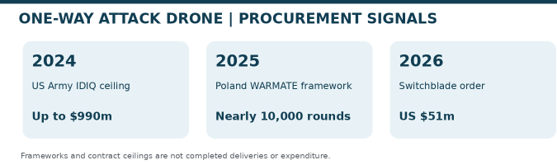
Infographic 1. Published procurement and market interpretation.
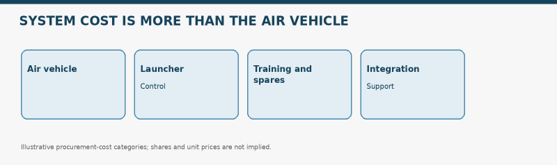
Infographic 2. Qualitative comparison of system or contract characteristics.
Outlook to 2030
As the market matures, meaningful comparisons will depend less on the phrase one-way attack drone and more on mission class, range, endurance, warhead, integration needs and procurement status. The MarketsandMarkets global loitering munitions study supplies a structured way to examine these segment boundaries alongside regional market forecasts and competitive developments. Public defense announcements add context about current programs, but they must be classified precisely before being used as evidence of spending or delivered quantities.

This FREE sample includes market data points, ranging from trend analyses to market estimates & forecasts. See for yourself.
SEND ME A FREE SAMPLE