Recoverable Drone Market: Reuse, Mission Abort and the Economics of Loitering Munitions
How recovery capability changes technical and economic evaluation
Recoverable loitering munitions occupy a distinctive position between conventional expendable weapons and reusable uncrewed aircraft. Their significance rests on a narrow but important condition: when a mission ends without a strike, some designs can return for recovery rather than be intentionally consumed. A recovery option does not mean that an explosive engagement leaves the aircraft intact. The technology raises questions about mission flexibility, safety, training and lifecycle economics, but it should not be assumed to produce savings in every application.
Market outlook at a glance
MarketsandMarkets estimates that the global loitering munitions market will expand from USD 5.36 billion in 2025 to USD 13.26 billion by 2030, representing a 19.9% compound annual growth rate. The published forecast covers multiple system types, ranges, endurance categories, warheads, navigation sensors, launch modes, end users, and regions. This total should not be presented as an independent revenue forecast for any single informal search term.
The vocabulary surrounding the sector requires care. “Kamikaze drone,” “suicide drone,”, "Recoverable Drone" and “one-way attack drone” are frequently used as overlapping descriptions, but they do not create three additive markets. A loitering munition is usually defined by its ability to remain in flight while awaiting or developing an engagement opportunity; an ordinary one-way drone may follow a preplanned course without a comparable loitering capability. Recoverability is a separate design attribute. Market comparisons are meaningful only after these boundaries are held constant.
Understanding the meaning of recoverability
Recovery capability is different from the ability to abort an attack. An operator may cancel engagement and continue loitering without having a safe means to retrieve the vehicle. Conversely, a specifically designed recovery mechanism can create the possibility of landing and future reuse if the aircraft has not struck a target and conditions permit. This distinction separates a software-controlled maneuver from an operational lifecycle capability.
A documented product example
Elbit Systems identifies optional recovery as a feature of SkyStriker and separately describes a parachute arrangement allowing a unit to be brought back and potentially reused. The manufacturer also lists mission abort, go-around and re-engagement functions. These claims should be attributed to Elbit and should not be generalized to every recoverable platform. Payload configuration, inspection and mission conditions remain important when assessing whether a recovered unit is suitable for another sortie.
Why total cost of ownership is conditional
The simplest comparison—purchase price divided by potential missions—omits several costs. A recoverable system can require recovery personnel or equipment, inspection, consumable replacement, transport, maintenance and retesting. Some attempted recoveries may fail. Economic attractiveness depends on how often engagements are aborted, the value of recoverable components, attrition levels and the cost of preparing a returned aircraft for reuse. No universal recoverable-system savings percentage can be defended from public descriptions alone.
Verified purchases and recent developments
|
Platform / area |
Disclosed feature / event |
Evidence status |
Source |
|
SkyStriker |
Abort and go-around |
Manufacturer-documented |
SkyStriker product |
|
SkyStriker |
Optional recovery via parachute |
Manufacturer-documented |
SkyStriker recovery |
|
Germany |
Elbit–Diehl cooperation |
Partnership, no disclosed purchase |
Elbit–Diehl partnership |
Note: Contract ceilings, frameworks, R&D budgets, partnerships and tests are not counted as firm delivery orders.
Training and readiness considerations
Recovery may be useful in training and repeated mission rehearsal because operators can observe complete flight sequences without necessarily consuming the airframe. However, the ability to reuse equipment does not remove the need for separate weapon safety, realistic training and qualification procedures. Procurement evaluations need to define what the manufacturer means by recovery-ready and what checks follow retrieval before subsequent use.
How recoverable products fit the broader market
MarketsandMarkets identifies recoverable and expendable types within its loitering munitions segmentation. They are not two independent global forecasts: both belong to the USD 5.36 billion market in 2025 and USD 13.26 billion projection for 2030. Search interest in recoverable drones is also broader than the armed loitering munition subset, since ordinary surveillance drones are routinely recovered. A defensible market assessment must exclude conventional reusable UAVs unless equipped and classified as the weapon system in scope.
Emerging industrial positioning
Elbit and Diehl announced a June 2026 partnership to offer SkyStriker to Germany, conditional on future selection. It is a useful indication of the international commercialization of a platform with optional recovery functionality, not evidence that Germany purchased a recoverable loitering munition fleet. Tracking technology features alongside actual program status prevents the market from being inflated by unawarded opportunities.
Recovery does not guarantee a lower total cost
The economic case for recovering an unused weapon depends on the likelihood of successful retrieval, the frequency of cancelled missions, post-recovery checks and refurbishment needs. Any reuse advantage disappears following a destructive engagement. Some platforms advertise mission-abort or go-around capability without an identical level of physical recovery functionality. These terms should be evaluated separately in both procurement analysis and product comparisons. Public descriptions of recovery-capable designs are best treated as configuration-specific rather than as evidence that all weapons in a product family are reusable.
A distinct segment, not a universal design trend
Recoverable options address a different operating trade-off from systems designed solely for one-way use. The presence of a recovery mechanism can add equipment, software logic and post-flight inspection obligations, while the potential to recover an unused system can preserve asset value. Outcomes vary with operating environment, mission cancellation rates and recovery conditions; no single saving ratio applies across users. Published descriptions may use words such as return, abort, retarget and reuse in close proximity, although they describe separate capabilities. In particular, redirecting a munition away from a target does not by itself prove safe landing and relaunch. Comparative market analysis should distinguish supported recovery configuration, disclosed in-service status and demonstrations from proposed concepts. The forecast for the full loitering munitions market cannot be converted into a recoverable-only value without an evidenced type-level allocation. This distinction is essential to technical and financial analysis.
Visual market indicators
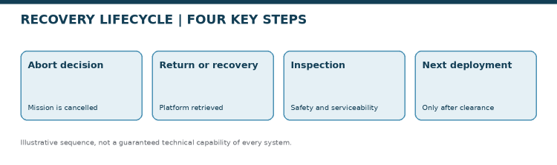
Infographic 1. Published procurement and market interpretation.
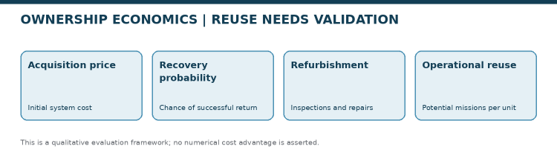
Infographic 2. Qualitative comparison of system or contract characteristics.
The outlook for recoverable designs
Recoverable systems will continue to be evaluated against expendable alternatives using operational requirements, acceptable risk, training needs and lifecycle budgets. Recovery may be attractive in some scenarios and less useful in others. The key market question is not whether reuse is inherently superior, but where specific missions and procurement conditions justify the additional design and operating complexity.
Conclusion
The growth of the global loitering munitions market reflects a progression from technical demonstrations to funded programs and increasingly differentiated product families. The category described by this article should be interpreted as part of the wider loitering munitions market, not an additional market layered on top of it. Transparent contract classifications, consistent equipment definitions, and a common approach to regional and technical segmentation remain essential for interpreting developments through 2030.

This FREE sample includes market data points, ranging from trend analyses to market estimates & forecasts. See for yourself.
SEND ME A FREE SAMPLE