RFID Market Size, Share & Growth Analysis Report, 2034
The global RFID market was valued at USD 13,714.5 million in 2024 and is projected to reach USD 30,472.0 million by 2034, growing at a CAGR of 8.5% during 2025 to 2034. Expansion of retail digitization, rising supply chain visibility requirements, increasing automation investments, and broader adoption of connected asset tracking technologies are accelerating market demand across industries.
Top 10 Key Takeaways
-
RFID adoption is shifting from isolated tracking projects toward enterprise-wide digital transformation initiatives. - Intelligent tagging ecosystems are becoming central to inventory visibility strategies.
- AI-enabled analytics platforms are expanding RFID value beyond tracking into decision intelligence.
- Integration complexity and interoperability remain key deployment challenges.
- Retail continues to shape large-scale RFID implementation strategies.
- Businesses increasingly prioritize real-time visibility across distributed operations.
- Demand is shifting toward sensor-enabled and data-rich RFID solutions.
- Sustainability initiatives are influencing material innovation and lifecycle tracking.
- Investments are increasingly focused on cloud-connected RFID platforms and analytics.
- Competitive intensity is moving toward ecosystem partnerships and integrated solution portfolios.
To know about the assumptions considered for the study download the pdf brochure
Market Introduction
RFID technologies have evolved from niche identification systems into critical infrastructure for connected operations. Organizations increasingly rely on RFID solutions to improve inventory accuracy, automate workflows, reduce manual intervention, and enable real-time operational intelligence. Across manufacturing, logistics, healthcare, retail, and transportation, RFID has become closely linked with broader digital transformation initiatives.
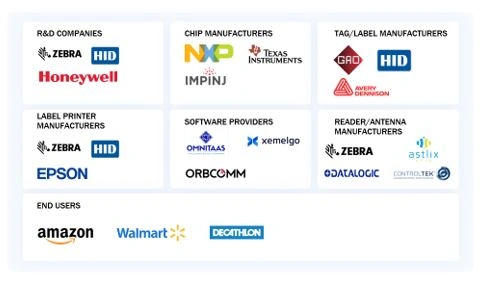
The ecosystem supporting RFID adoption continues to expand across chip manufacturers, tag providers, software developers, reader suppliers, and system integrators. Enterprise buyers are increasingly looking for interoperable ecosystems that combine hardware, analytics, and cloud integration capabilities.
Market Trends
RFID innovation is increasingly being shaped by AI, edge intelligence, automation, and sustainability priorities. Enterprises are combining RFID-generated data streams with analytics platforms to create predictive inventory management systems, automate replenishment, and optimize workforce productivity.
Sensor-enabled RFID tags are expanding into condition monitoring applications, while cloud-native platforms are improving scalability across multi-site operations. Procurement priorities are also evolving toward interoperable architectures, cybersecurity readiness, and long-term platform flexibility.
Sustainability has emerged as another strategic focus area. Businesses increasingly evaluate recyclable materials, lower-waste labeling solutions, and digital product passports to support compliance and circular economy objectives.
Market Drivers & Opportunities
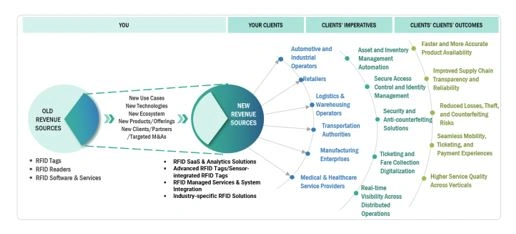
Growth in omnichannel retail, warehouse automation, supply chain modernization, and real-time asset tracking is accelerating RFID adoption. Organizations increasingly require higher inventory accuracy, lower shrinkage, and improved visibility across complex networks. Investments in automation infrastructure, smart factories, and connected operations continue creating strong demand conditions.
Opportunities are expanding in healthcare, pharmaceutical traceability, smart logistics, contactless ecosystems, and sensor-enabled tracking applications. Emerging economies are also investing heavily in digital infrastructure programs that support long-term RFID deployment opportunities.
Challenges & Restraints
Deployment complexity remains a major challenge, particularly for enterprises integrating RFID with legacy ERP, warehouse management, and enterprise software environments. High upfront implementation costs, infrastructure upgrades, and customization requirements can slow deployment cycles.
Supply chain disruptions, semiconductor availability concerns, cybersecurity risks, regulatory compliance requirements, and shortages of skilled implementation professionals continue influencing project timelines. Organizations must also address interoperability challenges across multi-vendor ecosystems.
Segment Insights
By Offering: Tags represent the dominant category due to their widespread use across retail, logistics, healthcare, and industrial applications. Tags are also expected to experience the fastest growth as organizations scale item-level tracking initiatives.
By Form Factor: Labels lead adoption because they provide cost efficiency and flexibility across multiple industries. Sensor-based tags are gaining momentum as enterprises seek enhanced visibility, environmental monitoring, and intelligent tracking capabilities.
By Frequency Range: High-frequency solutions maintain strong market leadership because of established use cases in access control, ticketing, and retail. Ultra-high frequency technologies are expanding rapidly due to superior read ranges and supply chain applications.
By Vertical: Retail remains the largest adopter because inventory optimization and omnichannel fulfillment require high visibility. Medical, healthcare, and pharmaceutical applications are expanding rapidly as traceability requirements intensify.
By Application: Inventory and asset management remain core use cases because organizations prioritize operational visibility. Contactless payment applications continue gaining traction through digital commerce and frictionless customer experiences.
By Material: Paper-based RFID materials dominate due to cost efficiency and broad applicability. Paper materials are also seeing strong growth because sustainability priorities are influencing purchasing decisions.
Regional Analysis
North America remains a leading market driven by advanced retail ecosystems, strong technology adoption, and large-scale investments in supply chain modernization. Enterprises across the US and Canada continue expanding RFID integration programs across logistics, healthcare, and industrial operations.
Asia Pacific represents the fastest-growing region supported by manufacturing expansion, retail digitization, government-backed digital initiatives, and rising automation investments. China, Japan, South Korea, and India continue strengthening regional RFID ecosystems.
Europe emphasizes sustainability, product traceability, and regulatory alignment. The Middle East, Africa, and South America are increasingly investing in logistics modernization and infrastructure digitization.
Key Company Insights
The RFID market remains highly competitive with participants focusing on ecosystem expansion, software integration, analytics capabilities, and vertical specialization. Strategic partnerships, acquisitions, and product innovation remain central to competitive positioning.
The top 5 companies for this market are Zebra, Avery Dennison, HID Global, Honeywell, and Impinj. Zebra focuses on intelligent operations platforms and enterprise mobility integration. Avery Dennison strengthens digital identification through connected product ecosystems. HID Global expands secure identity and authentication solutions. Honeywell leverages industrial automation expertise to support enterprise deployments. Impinj continues driving innovation across RAIN RFID platforms and connectivity solutions.
Recent Developments
- In October 2024, Avery Dennison opened a new RFID and digital ID technologies facility in Querétaro, Mexico, to expand production capabilities and accelerate innovation initiatives.
- In January 2024, Zebra Technologies showcased new RFID-enabled retail solutions at NRF 2024 aimed at improving inventory visibility and operational intelligence.
- In 2024, Avery Dennison introduced RFID inlay solutions designed for fresh food applications to expand intelligent labeling opportunities.
- In 2024, Impinj highlighted expanded edge intelligence capabilities around its RFID ecosystem to support autonomous reading applications.
- In 2024, multiple retailers and logistics operators expanded RFID deployments to support automation and inventory visibility initiatives.
Conclusion & Future Outlook
RFID technologies are increasingly moving from operational tools to enterprise intelligence platforms. As organizations pursue automation, digital supply chains, and real-time visibility, RFID will play a larger role in enabling connected operations.
AI integration, sensor innovation, cloud-native architectures, and analytics-driven decision making will reshape future deployment strategies. Competitive differentiation will increasingly depend on ecosystem strength, scalability, and integration capabilities.
Long-term growth prospects remain supported by digital transformation priorities, expanding traceability requirements, and rising demand for automated decision environments.
FAQs
- How big is the RFID market?
The RFID market was valued at USD 13,714.5 million in 2024 and is expected to reach USD 30,472.0 million by 2034 as adoption expands across industries.
-
What is the growth rate of the RFID market?
The market is projected to grow at a CAGR of 8.5% during 2025 to 2034, driven by digital transformation and automation initiatives.
-
Which segment leads the RFID market?
Tags lead the market due to their extensive use across inventory tracking, logistics, and retail operations.
-
Who are the key players in the RFID market?
Major companies include Zebra, Avery Dennison, HID Global, Honeywell, and Impinj.
-
What factors are driving the RFID market?
Key drivers include supply chain modernization, retail digitization, automation investments, and demand for real-time visibility.
Related Reports:
RFID Market by Tag, Reader, Software & Service, Card, Label, Sensor-based, Inventory & Asset Management, Security & Access Control, Contactless Payment, Retail, Animal Tracking, and Industrial & Manufacturing - Global Forecast to 2034
Contact:
Mr. Rohan Salgarkar
MarketsandMarkets™ INC.
1615 South Congress Ave.
Suite 103, Delray Beach, FL 33445
USA : 1-888-600-6441
[email protected]

This FREE sample includes market data points, ranging from trend analyses to market estimates & forecasts. See for yourself.
SEND ME A FREE SAMPLE

