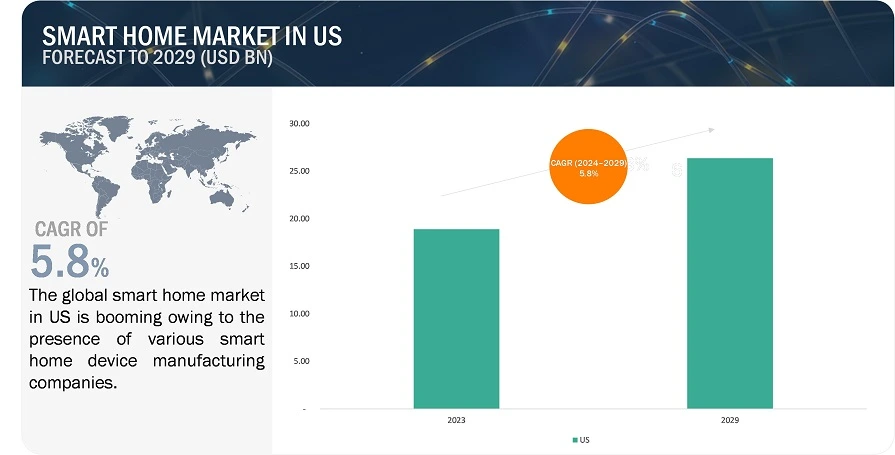
According to MarketsandMarkets, the Global smart home market size in the US is expected to grow from 18.90 billion in 2023 to 26.36 billion in 2029, at a CAGR of 5.8% from 2024 to 2029.
North America Smart Home Market Growth Overview
The North America smart home market is witnessing robust growth, driven by high consumer awareness, early adoption of advanced technologies, and strong penetration of IoT-enabled devices across residential spaces. The United States dominates the regional market, followed by Canada, supported by widespread use of smart speakers, security systems, connected lighting, and energy management solutions. Increasing demand for home safety, convenience, and energy efficiency is accelerating the adoption of smart home technologies across both single-family and multi-family households.
The market continues to benefit from the presence of major technology providers and smart device manufacturers focusing on AI-powered automation, voice-controlled interfaces, and interoperable ecosystems. Advancements in wireless connectivity, cloud platforms, and smart home hubs are shaping key trends, while rising investments in smart buildings and sustainable housing projects are further contributing to regional market expansion.
Key Market Drivers & Trends
-
Strong adoption of smart security systems, including video doorbells and surveillance cameras
-
Growing demand for energy-efficient smart thermostats and lighting solutions
-
High penetration of voice assistants and AI-enabled smart home platforms
-
Increasing integration of IoT devices with mobile and cloud-based applications
-
Expansion of smart home adoption in both new housing projects and home retrofits
Key Highlights
-
North America holds a significant share of the global smart home market
-
The U.S. remains the largest contributor to regional market growth
-
AI, IoT, and cloud technologies are transforming smart home ecosystems
-
Rising focus on energy efficiency and home security continues to drive demand
Rise of Smart Home Technology in United state
The US is at the forefront of the global smart home revolution, driven by a mix of technological innovation, consumer demand, and lifestyle trends. Smart homes are no longer futuristic concepts but a reality that is transforming how people in the US live, work, and interact with their spaces. Smart home technology encompasses a broad range of connected devices designed to enhance convenience, security, energy efficiency, and entertainment. From smart thermostats like Nest and Ecobee to voice-controlled assistants such as Amazon Alexa and Google Assistant, these technologies have become integral to modern living. Recent advancements have focused on interoperability, enabling seamless communication between devices from different manufacturers.
Convenience and Automation
The appeal of controlling home appliances and systems with a smartphone or voice command has driven widespread adoption. Devices such as smart lighting systems, robotic vacuum cleaners, and voice-controlled hubs allow homeowners to automate routine activities, from adjusting the thermostat to turning off lights in unoccupied rooms. This ease of control, often centralized in a smartphone app or through voice commands, empowers users to manage their homes effortlessly, even when they are away.
Energy Efficiency
Energy-conscious consumers are gravitating towards solutions like smart thermostats, energy monitoring systems, and automated blinds. These not only reduce energy bills but also contribute to sustainability efforts. Rising energy costs and growing environmental awareness have led people in the US to seek energy-efficient solutions. Smart thermostats like Nest and Ecobee learn user habits to optimize heating and cooling schedules, while smart plugs and energy monitors help identify and reduce unnecessary energy usage. These technologies not only lower utility bills but also contribute to broader sustainability goals, making them attractive to eco-conscious consumers.
Home Security
Security-focused devices, including smart cameras, video doorbells, and connected alarm systems, are a top priority for homeowners in the US. The ability to monitor properties remotely provides peace of mind. The ability to remotely lock doors or view live camera feeds through mobile devices has added an extra layer of control and reassurance for users.
Impact of AI on U.S Smart Home Market
The integration of Artificial Intelligence (AI) is profoundly transforming smart homes in the US, enhancing their functionality, personalization, and efficiency. AI-powered devices can learn user preferences and behaviors over time, enabling them to automate tasks such as adjusting lighting, temperature, or security settings based on daily routines. Virtual assistants like Amazon Alexa and Google Assistant leverage natural language processing to provide seamless voice control, while AI-driven security systems offer advanced features like facial recognition and anomaly detection for enhanced protection. Additionally, AI enables predictive maintenance, where smart appliances can detect issues before they escalate, minimizing downtime and repair costs.
Challenges for U.S Smart Home Market
Despite its rapid growth, the US smart home market faces several challenges. Interoperability remains a significant issue, as many devices struggle to integrate seamlessly across different platforms, though initiatives like the Matter standard aim to address this. Data privacy and cybersecurity concerns also persist, as smart devices collect vast amounts of user information, prompting demand for robust safeguards against breaches. Additionally, the high upfront costs of smart home devices can deter widespread adoption, particularly among lower-income households, limiting the technology's accessibility and potential market reach.
The United States smart home market is one of the most advanced and fastest-growing in the world, driven by widespread adoption of connected devices, high consumer awareness, and strong technology infrastructure. American households are increasingly integrating smart home solutions such as security cameras, smart speakers, thermostats, lighting controls, and automated appliances into their daily lives. This adoption is supported by high broadband penetration, tech-savvy consumers, and a competitive landscape with major global players like Amazon, Google, Apple, and specialized home automation brands continuously innovating to deliver seamless, user-friendly experiences. As a result, the U.S. market continues to demonstrate robust growth in both residential and multifamily segments, with smart home technology becoming a standard expectation rather than a luxury.
Key drivers of growth in the United States smart home market include advancements in artificial intelligence (AI), voice control integration, and the emergence of unified connectivity standards that enable better interoperability across devices. Smart home safety and security solutions remain among the most popular categories, as homeowners prioritize protection, remote monitoring, and convenience. Additionally, energy management systems that help reduce utility costs and improve sustainability are gaining traction, particularly as consumers become more environmentally conscious. Forecasts suggest that the U.S. smart home market will continue expanding at a healthy pace over the next decade, supported by ongoing innovation, increased affordability of smart devices, and the growing trend of connected living across urban and suburban areas alike.
FAQ
What is driving the growth of the North America smart home market?
The North America smart home market is driven by high consumer awareness, widespread adoption of IoT devices, strong demand for smart security solutions, and increasing focus on energy-efficient and connected living.
Which country leads the smart home market in North America?
The United States leads the North America smart home market due to early technology adoption, strong presence of major smart home companies, and high usage of connected home devices.
What are the most popular smart home solutions in North America?
Popular smart home solutions include smart security systems, video doorbells, smart lighting, smart thermostats, and voice-controlled smart speakers integrated with AI platforms.
How is AI influencing the North America smart home market?
AI is enhancing smart home systems through voice recognition, predictive automation, personalized user experiences, and improved energy management across connected devices.
What are the key trends shaping the future of the North America smart home market?
Key trends include increased device interoperability, cloud-based smart home platforms, integration of AI and IoT technologies, and growing adoption of smart home solutions in both new and existing homes.
Related Report
Smart Home Market Size, Share & Trends by Product (Lighting Controls, Smart Speaker, Entertainment, Smart Kitchen, HVAC Controls, Security & Access Controls), Offering (Behavioral, Proactive), Sales Channel, Installation Type and Region - Global Forecast to 2029
Contact:
Mr. Rohan Salgarkar
MarketsandMarkets™ INC.
1615 South Congress Ave.
Suite 103
Delray Beach, FL 33445
USA : 1-888-600-6441
[email protected]



